Animals are pretty good at defending themselves. Take humans, for
example. Our basic senses (eyes, ears, smell, taste, and touch) have
all evolved, at least in part, to protect us from threats of various
kinds. Back in the days of the cavemen, our ancestors could see and
hear attacking animals approaching and either prepare themselves to
fight or hurriedly get out of the way. In modern times, the same
equipment is just as useful for keeping us safe when we cross the
road. But some threats are simply too subtle for our bodies to
detect. One of the most dangerous is poisoning by carbon monoxide,
a gas produced when things like gas boilers
are not properly ventilated. Evolution hasn't managed to adapt to alert us to
carbon monoxide, but human ingenuity has stepped forward with clever
gadgets that can do the same thing. Let's find out how they work!
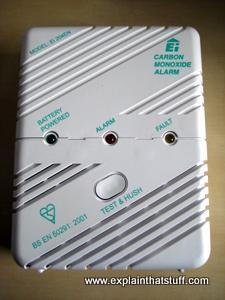
Photo: An inexpensive, electronic carbon monoxide detector. This one
lets you know there's a problem with a red LED indicator light and a
piercing alarm. The detector part is hidden behind the bottom half of the unit; the batteries fill the top half.
Check that the alarm is working correctly by pressing the "Test" button once a week or so. A green indicator light flashes every minute or so to reassure you that the battery is connected and working okay.
If you've been following all the news about global warming, you'll
know that when we burn materials like coal, oil, and gas
(collectively called fossil fuels) in engines or heating systems,
they give off energy, but they also make a colorless, odorless,
generally harmless gas called carbon dioxide. The trouble with
carbon dioxide is that it's building up in the atmosphere and slowly
smothering our planet like a blanket, gradually making it hotter and
changing the climate. However, that's another story.
To make fuels burn properly, you need plenty of oxygen. If there
isn't any oxygen available, things won't burn at all—and that's one
of the secrets fire-fighters use. Devices like fire extinguishers,
fire blankets, and sprinklers all try to remove the oxygen
(or the
heat or fuel) from a fire in order to make it go out more quickly.
But what happens if you have only a small amount of oxygen—enough to
make a fuel burn but not enough for it to burn properly? Instead of
the fuel burning cleanly in oxygen to give energy, water, and carbon
dioxide (CO2), you get the fuel burning
incompletely, and giving off a poisonous gas called carbon
monoxide (CO—because there's not enough oxygen to make CO2).
Artwork: A molecule of carbon dioxide has two oxygen atoms (blue) attached to one carbon atom (red), where a molecule of carbon monoxide has only one.
If you have a camp fire in the open air, there will always be
enough oxygen to make the fuel burn completely, so you never have to
worry about carbon monoxide. But suppose you have a gas central
heating boiler in your home and it gets all its oxygen from the room
in which you're sitting. You're getting all the oxygen you need
from the room as well. Now if there's plenty of ventilation in your
home, there's no problem: you can breathe and so can your fire. But
what if there isn't? As the boiler burns, it
will rapidly suck all the oxygen out from the room. Sooner or later,
there won't be enough oxygen for the fuel to burn efficiently and, instead
of combusting cleanly, it will start to make carbon monoxide. If the
room's sealed up, the carbon monoxide will gradually build up.
That's when things become dangerous.
Carbon monoxide is harmful because it very readily attaches to haemoglobin, the
protein in your red blood cells that ferries oxygen around your body.
In fact, carbon monoxide is over 200 times better at attaching to oxygen.
When you breathe in carbon monoxide, it effectively snatches up the haemoglobin,
so stopping it from carrying oxygen to your brain and the rest of
your body.
[1]
Carbon monoxide is odorless and colorless so you don't notice it
accumulating. It makes you feel drowsy, then it puts you to sleep,
and finally it kills you. It's usually a painless death for the victim,
but an entirely unnecessary one.
Over 400 people die each year in the United States alone from
CO poisoning, 14,000 are hospitalized, and 100,000 need emergency treatment.
[2]
If you have a detector
fitted in your home and your heating system starts to produce carbon monoxide, you'll
hear an alarm sounding the minute the gas levels become dangerous. At
that point, you can switch off your heating, open all the windows,
evacuate your home, and call in a repairman.
It's not just faulty home heating systems that can produce carbon
monoxide. It can be a major hazard in the workplace where people use
engines, furnaces, forges, or any other
equipment that uses oxygen to produce energy through combustion.
Sponsored links
How do carbon monoxide detectors work?
Detectors come in two basic kinds: inexpensive detector strips
(sometimes described as biomimetic detectors, because they supposedly
mimic the way our bodies respond to carbon monoxide) that you stick on
your wall and more expensive electronic
alarms that run off a power
outlet or battery supply. They have some things in common but work in
different ways, so let's tackle them separately.
Chemical "blob" detectors
These simple detectors are pieces of plastic
with a small beige-colored "blob" in the middle. If there's a high-level of carbon
monoxide in the room, the blob changes color from beige to black. How
does that happen? Chemistry! Look closely at the detector blob and
you'll see it's gritty and sand-like. It's actually silica
gel impregnated with a catalyst (something that accelerates a
chemical reaction) made from chemicals that include palladium and
molybdenum salts (such as palladium sulfate, palladium chloride, and ammonium
molybdenate).
[3]
When carbon monoxide touches the detector, it's
oxidized by (steals some oxygen atoms from) the chemical salts on the
strip and turns into carbon dioxide. The chemicals on the strip are
simultaneously reduced (have some oxygen atoms stolen from them) and
change color to black.
The strip also contains a chemical salt made
from a transition metal such as iron,
nickel, or copper. Once the
carbon monoxide's removed, this metal salt steals some oxygen from the
air and changes the catalyst back to its original
chemical form—so the detector spot changes color back to beige
again. In other words, the catalyst regenerates itself in the air.
[4]
Photo: An inexpensive, blob-type carbon monoxide detector. You can find these in hardware and grocery stores, or online, for just a few dollars. They're better than nothing, but electronic detectors give you better protection and work out considerably cheaper in the long run. Blob detectors have a beige spot in the center that goes
black if dangerous levels of carbon monoxide are present. Look closely (right) and you can
see the gritty, catalyst-impregnated blob that does all the work. You'll notice that detectors
like this have a space on top where you're supposed to write the date when you opened them.
That's because they stop working properly after more than a few months' exposure to air.
The advantage of simple detectors like this is that they cost only
a few dollars (pounds) each, so they're a good way to give yourself
basic protection if you can't afford anything more sophisticated. The
disadvantages are multiple. First, these detectors don't sound an
alarm: you have to keep looking at them to notice that the color has
changed. That's fine if you're observant, or if there's only a small,
slow build-up of gas, but it's much less satisfactory if there's a
sudden, major problem with your heating system and the carbon
monoxide is being produced very quickly: you might not notice the
blackening detector blob until it's too late. Another problem is that strip detectors have to
be replaced every 3–6 months or so, which means that, after a few
years, you've spent almost as much as if you'd bought an electronic
alarm in the first place.
How blob detectors work
What makes a blob detector change color when it "sniffs" out carbon monoxide?
Carbon monoxide molecules move toward the blob detector. Carbon is shown as red, oxygen as blue.
Carbon monoxide is very oxygen hungry and readily "steals" oxygen from
the chemical salts on the blob, oxidizing itself (gaining oxygen) to make carbon dioxide and
reducing (removing oxygen from) the blob chemicals at the same time.
This makes the blob chemicals turn black.
Eventually, when the carbon monoxide has cleared and there is plenty of oxygen around, a
transition-metal salt on the blob steals oxygen back again, reverting the blob to its original
chemical form.
But can you really be sure that blob still looks okay? There will always be some doubt in your
mind if you rely on a basic detector like this. Electronic detectors, regularly checked to ensure they're
working, offer a higher level of protection.
Sponsored links
Electronic carbon monoxide alarms
Although electronic carbon monoxide detectors all look very
similar, they work in a variety of different ways. Colorimetric
detectors have a chemical blob inside similar to the ones we've
just described. A light beam shines onto the blob and
an "electronic eye" (also known as a photoelectric cell or
photocell)
measures the light
reflected back. If there's no carbon monoxide around, the strip is
beige and lots of light is reflected. With carbon monoxide present,
the strip turns black, the light shining onto it is absorbed and
little or none is reflected back. The electronic eye detects the lack
of reflected light and sounds a shrill, piercing alarm. (Detectors
like this are called colorimetric because they detect and
measure a color change in the chemical blob.)
Photo: How an electronic, colorimetric carbon monoxide detector works. An LED
shines through a colored chemical detector onto a photocell. When carbon monoxide is present, the detector
changes color, the beam is interrupted, and the photocell no longer picks up light. This triggers the circuit,
which sounds the alarm. I've
shown carbon monoxide in blue here, but it's very important to remember that it's invisible: you cannot see
or smell it!
Other electronic detectors work in different ways. Metal-oxide
detectors have open
chambers containing sensors made of metal (tin or
platinum) oxide.
When there's carbon monoxide around, the metal oxide reacts with it:
the carbon monoxide "steals" oxygen from the metal oxide, converting
itself into carbon dioxide, turning the metal oxide into pure metal,
and producing heat at the same time. An electronic circuit monitors
the temperature inside the chamber and
sounds the alarm if too much heat is produced too quickly.
In some detectors, the circuit measures the resistance
of the sensor element and infers the presence of carbon monoxide from that.
Detectors like this are often battery
operated, but they can also be powered from your main electricity outlet.
[5]
A third type of detector, known as an electrolytic detector,
works
a bit like a battery. It has terminals called electrodes, made from
platinum metal, dipped into a chemical
solution called an electrolyte. When
carbon monoxide is present, the electrolyte conducts electricity more
readily, making a current flow in a detector circuit, and
triggering an alarm. Electrolytic detectors are usually the most
sensitive and accurate—and therefore also the most expensive. They
also need powering from an electricity outlet, instead of batteries,
which means they may
not be suitable if you don't have an outlet nearby.
Photo: Most electronic alarms have warning/indicator lamps (left), a test/reset button, and
a chamber where gas enters. In both these models, the detection chamber is on the right
(behind the holes in the Kidde and behind the louvres in the Fire Angel).
These two alarms sit side-by-side in my kitchen.
Electronic detectors vary considerably in sophistication. The
simplest ones are either "on" or "off": if carbon monoxide is
present in dangerous levels, they trigger an alarm and maybe flash a
warning light at the same time. You don't know there's anything wrong
until the alarm sounds. More sophisticated detectors have a
digital display showing the amount of carbon monoxide present as a
reading in parts per million (PPM). Detectors like this can
alert you
to a gradually worsening problem with carbon monoxide by showing a
progressively increasing PPM reading. Any reading over about 35PPM
(the maximum exposure level permitted in workplaces for any
eight-hour period by National Institute for Occupational Safety and Health, NIOSH) is a cause for concern, but you might want to check out your appliances or your room ventilation if you get any significant PPM
reading at all.
[6]
Have you got enough detectors?
Photo: This battery-powered, wall-mounted carbon monoxide detector
has an LCD display showing the CO concentration in parts per million (PPM).
At the moment, we're completely safe because the display reads "0 PPM".
It's not enough to have only one carbon monoxide detector in a building; you
need one near each appliance, fire, furnace, fuel-burning engine, or other device that could potentially produce
CO gas if it malfunctions. So if you have a gas boiler in one room of your house and separate,
standalone gas fires (or coal fires) in other rooms, more than about 10m (30ft) away from
your detector, or on other floors of the same building, you need one detector next to each of them.
About the author
Chris Woodford is the author and editor of dozens of science and technology books for adults and children, including DK's worldwide bestselling Cool Stuff series and Atoms Under the Floorboards, which won the American Institute of Physics Science Writing award in 2016. You can hire him to write books, articles, scripts, corporate copy, and more via his website chriswoodford.com.
While You Were Sleeping by Deborah Blum, Wired, August 15, 2013. Remember: you could also be at risk from CO poisoning away from your home.
Hazards: Enlisting Hospitals in Fight Against Carbon Monoxide by Eric Nagourney. The New York Times, February 26, 2008. Hospitals don't routinely test for CO poisoning, so people treated for it might be discharged and returned to a dangerous environment.
Carbon monoxide kills many in UK: BBC News, 26 June 2007. Dozens of people die unnecessarily from carbon monoxide poisoning, according to this news report.
Your Home: Detecting Carbon Monoxide by Jay Romano. The New York Times, January 18, 2004. Compares the main different types of carbon monoxide detectors and their advantages and disadvantages.
↑Carbon Monoxide Poisoning: FAQ, US Centers for Disease Control and Prevention (CDC), March 27, 2023
and the earlier (archived) version Carbon Monoxide Poisoning (CO), US Centers for Disease Control and Prevention (CDC), March 17, 2021 [Archived via the Wayback Machine].
↑ The specific detector shown in my picture uses a palladium (II) dichloride dihydrate–copper (II) chloride cocatalyst (two catalysts working together), and chemistry similar
to the Wacker process (also known as Wacker oxidation). When carbon monoxide is present, it reduces the palladium dichloride to palladium metal, producing carbon dioxide, and turning the detector black. With the carbon monoxide removed and oxygen present once more, the copper (II) chloride changes the palladium metal back to palladium chloride, changing into copper (I) chloride in the process. This is then oxidised back to copper (II) chloride by oxygen from the air.
See "A Detector Calls" by Rob Kingston, Chemistry in Britain, April 1999, reprinted in Health, Safety and Risk: Looking After Each Other at School and in the World of Work by Dorothy Warren, Royal Society of Chemistry, 2001, p.46. This explains the chemistry of an EI1200 detector made by EI Electronics of Shannon, Ireland and quotes the exact oxidation-reduction reactions.
↑Carbon monoxide, National Institute for Occupational Safety and Health (NIOSH), reviewed September 28, 2011.
Please do NOT copy our articles onto blogs and other websites
Articles from this website are registered at the US Copyright Office. Copying or otherwise using registered works without permission, removing this or other copyright notices, and/or infringing related rights could make you liable to severe civil or criminal penalties.