Fire is one of humankind's oldest
discoveries; it's also one of our
biggest threats. A fire can destroy in a matter of minutes a home or
business that has taken decades to establish. That's why methods of
putting out fires are so important. Many buildings are
equipped with fire extinguishers, but why are there so many different
kinds? What do they do to a fire? And how exactly do they work?
Photo: The characteristic blast of "frozen snow" from a carbon dioxide (CO2) extinguisher. Note how the firefighter wears protective gloves and avoids touching the black end of the extinguisher horn, which gets very cold.
Photo by Christopher O'Grady courtesy of US Navy.
Photo: Fire fighters, like this one from the US Navy, are always happy to show you how to use fire extinguishers the correct way. Photo by Rachel McMarr courtesy of
US Navy.
Before we start, here's something to note: fire
is extremely dangerous. Never ever play with fires or anything that can trigger
a fire. You could put your life in danger and risk the lives of other
people.
Never play with fire-fighting equipment like fire
extinguishers and hoses. They're designed to save lives in emergencies, not to
set off like toys. If you set off fire alarms as a prank, people are
more likely to ignore them when they go off for real, and someone
might die as a result. What if that person was a friend of yours
or someone in your family?
If you want to try out a fire extinguisher, go visit
your local fire department or arrange for them to come to your school.
They'll often be happy to oblige. Many fire departments have open days
when you can look around, peek inside a fire engine, and even slide
down the fire station poles! Keep an eye out in the local media
for events like this.
What is fire?
Photo: Putting out a fire caused, by a mortar attack, with a carbon dioxide (CO2) extinguisher. The white cloud coming from the horn is formed when liquid carbon dioxide stored
under pressure in the extinguisher turns back to a freezing cold gas. Photo by Sgt. Jeremiah Johnson courtesy of US Army.
Ask most people what a fire is and they'll tell you it's something
frightening and destructive involving flames. But to a scientist, a
fire is something much more precise. A fire is actually a chemical
reaction called combustion. When combustion
happens, substances
like wood, paper, oil, or coal (all of which are made from chemicals,
even if you don't immediately think of them that way) combine with
oxygen in the air to produce water, carbon dioxide, waste gases that make
air pollution—and an
awful lot of heat. Combustion doesn't normally happen all by itself:
things don't burst into flames without help. It usually takes some
activation energy (provided by a spark or a match, the heat of the sun, or an overheating machine) to kick off the
reaction. Once combustion is underway, the fire seems to continue all by itself.
Sponsored links
Breaking the fire triangle
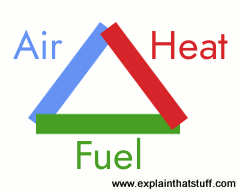
That's not quite true. Fire happens when three things are in the same place at the same time:
A fire can burn when all these things are present; it
will stop when at least one of them is removed. As any fire-fighter
will tell you, putting out a fire involves breaking the
fire triangle—which means removing either the fuel, the heat, or the
oxygen. Suppose a fire breaks out in a pan on top of your cooker, the
first thing you normally do is switch off the heat. If that doesn't
work, you might soak a towel with water and place it very carefully
over the pan (or, better still, use a fire blanket). The towel is designed to block off the supply of oxygen to the fire (the water stops the towel from catching fire and
making things worse). Every fire-fighting technique you can think of
involves removing heat, oxygen, or fuel—sometimes more than one of
those things at the same time. Fire extinguishers work by removing heat,
air, or both.
Artwork: You need to to take away one or more of heat, air (oxygen), or fuel to break the triangle and put the fire.
Although professional firefighters have other, more comprehensive ways of understanding fires
(including a more complex idea called the fire tetrahedron), the fire
triangle is still probably the simplest and most useful rule of thumb for the rest of us.
Types of fire extinguishers
There are four main types of extinguishers and they work in slightly different ways:
Water extinguishers, which are the most common, are
essentially tanks full of water, often with
nitrogen or carbon dioxide as the propellant to make them come out.
Water extinguishers work mainly by removing heat from the fire, though they also
help to cut off a fire's oxygen supply.
Dry powder extinguishers are tanks of dry powder
with compressed nitrogen as the propellant. In extinguishers like this,
it's the composition of the chemical (rather than the mechanical
design of the extinguisher) that really counts
The powder is a specially designed mixture that absorbs heat, melts, and coats the
fuel, stopping it from making flammable vapors and blocking out oxygen, so it's helping to tackle two sides of the
fire triangle at once. The most widely used powder in extinguishers is monoammonium phosphate; other powder ingredients include the metal alkali salts sodium bicarbonate (baking soda) and potassium bicarbonate (similar to sodium bicarbonate), though these are less effective on things like wood and paper fires.
Foam extinguishers are tanks of water and foam
with compressed nitrogen as the propellant. They work by smothering the
fire: when you spread a thin layer of foam over a fire, you cut the
fuel off from the oxygen around it. Foam extinguishers
also help to absorb heat, since the cool foam they release contains a lot of water.
Carbon dioxide (CO2) extinguishers contain a mixture of
liquid and gaseous carbon dioxide (a nonflammable gas). CO2 is normally a gas
at room temperature and pressure. It has to be stored under high pressure to make it a liquid. When you
release the pressure, the gas expands enormously and makes a huge white jet. CO2
attacks the fire triangle in two ways: it smothers the oxygen and, when it
turns from a liquid back to a gas, it "sucks" in a massive amount
of heat from its surroundings (the latent heat of vaporization), which
cools whatever you spray it on by removing heat.
Artwork: The four main types of extinguishers and how they break the fire triangle.
1) Water extinguishers work mainly by cooling (removing heat), but a dense spray of water droplets also helps to cut off oxygen. 2) Dry powder extinguishers soak up heat, melt on the fuel, and cut off oxygen, but they also neutralize the fuel (cutting it off from the fire). 3) Foam extinguishers typically float a thin layer of foam over something like a burning liquid, so cutting off oxygen. They also cool a fire. 4) CO2 extinguishers mostly work by cooling a fire, but they also help to cut off its oxygen.
That classifies extinguishers by what they contain. You'll also find fire extinguishers classified by the types of fires you can use them on. This gives us five different kinds:
A: Green: For wood, cloth, and paper.
B: Red: For combustible and flammable liquids such as oil, gasoline, and paint.
C: Blue: For electrical equipment and tools.
D: Orange:: For flammable metals.
K: Black: For animal or vegetable oils or cooking fats.
It's important always to use the right extinguisher for the fire.
Using the wrong extinguisher can put your life in danger and make the
fire worse. For example, you must never use water extinguishers on
electrical fires because you could electrocute yourself and the people
nearby. If you're in the slightest doubt about tackling a fire, leave
it alone and get yourself to safety. Once you've done that, call
the fire department.
How do fire extinguishers work?
Inside, a fire extinguisher is quite like a giant aerosol can, often
with two different substances inside. One of them is a solid, liquid,
or gas substance for fighting the fire. The other one is called a
propellant and is a pressurized chemical that makes the fire-fighting
substance come out when you press the extinguisher handle. Next time
you see a fire extinguisher, take a good look. Have you noticed that
fire extinguishers are always really strong steel canisters? That
because the propellant is stored inside at a high pressure. Strong
canisters are needed to stop the extinguishers exploding!
Water extinguishers
A water extinguisher is like a giant water pistol, but instead of using pressure from your finger to fire out the water,
it uses pressure from a trapped gas (the propellant). Typically, this is nitrogen or carbon dioxide.
A ring or pin on the handle stops the fire extinguisher from being set off by accident. It also acts as a tamper-proof seal: if the ring is broken or missing, you know the extinguisher needs to be checked.
Inside the sturdy steel case, there's a canister containing high-pressure gas (orange with blue hashing).
Most of the extinguisher is filled with water (blue).
A tube runs right up the inside of the tube to a nozzle outside (gray).
The nozzle often ends in a piece of bendy plastic so you can easily direct it toward the base of a fire.
To operate the extinguisher, you pull the ring and press the handle.
Pressing the handle opens a valve (shown here as a green arrow) that releases the pressurized gas from the canister.
The gas immediately expands and fills the inside of the extinguisher, pushing the water downward
As the water is pushed down, it rises up the tube
A jet of water emerges from the nozzle.
Photo: The frozen white blast from a carbon dioxide extinguisher.
Photo by Scott A. Thornbloom courtesy of US Navy.
Carbon dioxide extinguishers
Artwork: A typical carbon dioxide fire extinguisher. From
US Patent 3,901,322: Fire Extinguisher Discharge Horn by Jack Winston, Brooks Equipment Co., Inc., August 26, 1975, courtesy of US Patent and Trademark Office.
The most noticeable difference between a water extinguisher and one that fires carbon dioxide is the large,
black, cone-shaped horn, which allows the carbon dioxide gas to expand, cool, and turn into a mixture of frozen "snow" and gas.
The horn has to be designed very carefully to stop two major potential problems: it has to allow the
CO2 to exit at high speed, so any snow that forms doesn't block it up,
and it has to mix up the gas in a fairly turbulent way to stop it firing air from the horn at the fire
as well (which would effectively make the fire burn more strongly). This typical design from a patent
by Brooks Equipment in the 1970s solves both problems. I've added the coloring for clarity, but followed the original numbering of the key parts:
10. Tank containing pressurized liquid carbon dioxide.
12. Valve.
14. Trigger.
16. Discharge horn made of plastic that can survive low temperatures without cracking.
18. Reinforcing bands wrap around horn at intervals.
20. Nipple with a screw thread to which the horn attaches.
As the carbon dioxide enters the horn, it swirls around in a turbulent flow (orange arrows) forming
snow (orange blobs) and gas. The swirling turbulence stops dead air zones forming in the horn, which in turn prevents air being swept down the horn toward the fire.
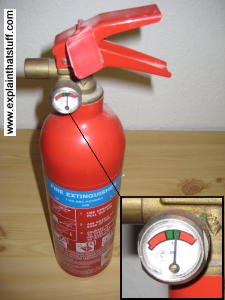
Photo: Some extinguishers have pressure gauges on top so you can check they're correctly pressurized and safe to operate. If the pressure is either too high or too low, the needle moves into the upper or lower red zone.
On this dry-powder extinguisher, the needle is right in the middle: still safely in the green zone,
pressurized to about 14 times atmospheric pressure (the normal pressure of the air around us).
Foam extinguishers
These are similar to water extinguishers but, instead of containing just water and a propellant, they also have a concentrated
foaming solution inside them. Liquid water is almost impossible to compress, so an ordinary water extinguisher can't produce more water for fighting a fire than the volume of the extinguisher itself, which is usually no more than about 6–9 liters.
A foam extinguisher, on the other hand, works a bit more like a carbon dioxide extinguisher when the nozzle is open: the water and foaming solution swirl together in the nozzle, producing a much bigger volume of foam than the volume of the can itself.
Foam extinguishers are often called AFFFs (aqueous film-forming foam), which is simply a technical way of describing how
they tackle a fire: they use water (aqueous) to make a foam that sits like a film over burning fuel, cutting off its air supply.
Historic figure extinguishers
Fire extinguishers didn't always come in bright red metal cans. Here's a common design from the late 19th century: the fire hand grenade. It consisted of a sturdy glass sphere (A) that you tossed into a fire. Inside, there was a pressurized fire extinguishing gas (B) or solution, and solid particles of something like quartz sand (C), which helped the glass break on impact. If the glass didn't smash straight away, energy from the fire soon conducted through the wire wrapped around the outside (D and E), concentrating the heat and making the glass crack open.
Fighting Fire With Electricity by Priti Patel. IEEE Spectrum, April 6, 2011. Military researchers explore using electricity to put out fires by detaching flames from the fuel they're burning.
For deeper technical detail, here are a few examples of fire extinguisher patents. One thing to note is that the design of a fire extinguisher's nozzle is as important as (often more important than) the rest of the mechanism, because how the extinguishing chemicals arrive at the fire is critical. That's why a lot of patents focus on the specifics of the nozzle.
Please do NOT copy our articles onto blogs and other websites
Articles from this website are registered at the US Copyright Office. Copying or otherwise using registered works without permission, removing this or other copyright notices, and/or infringing related rights could make you liable to severe civil or criminal penalties.