A column of platinum the size of a man
is about 25 times heavier (it weighs an amazing 2000kg or 4,400lb)! Platinum is a
dense, expensive, and relatively rare, silvery-white metal—and those
may be the only things you know about it. The name "platinum",
which comes from the Spanish word platina
(meaning "little silver"), relates to when and where the metal was discovered (in
Latin America in the early 18th century). Platinum is a relatively
recent human discovery compared to such age-old metals as iron and
copper, but it's rapidly found important
uses. You probably know that it's the magic ingredient in pollution-busting catalytic converters
that help to keep our streets free of traffic fumes, but it's also
used in dental fillings, scientific equipment, and jewelry.
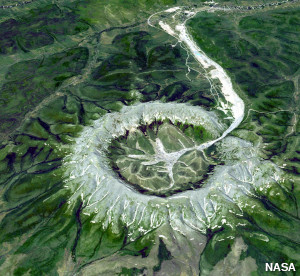
Photo: Rich pickings: The Kondyor Massif in
Eastern Siberia, Russia
is a natural ridge about 10km (6 miles) across packed full of minerals,
including platinum. Photo by courtesy of NASA
Jet Propulsion Laboratory (NASA-JPL).
It's not something you stumble across every day. Platinum is
the 72nd most common chemical element in Earth's crust—and, given
that there are only 94 natural elements anyway, that makes it pretty
rare. That's largely why platinum is so expensive. Currently (2022) it costs
around $30,000–$34,000 or £22,000–25,000 per kilogram (which is about $13,000
or £10,000 per pound)—quite a lot more than it was worth just two years ago, but less than its peak price in 2013. So the adult-sized block we spoke about earlier would set you back a cool $60 million or so.
You can find platinum (atomic number 78) buried deep in the middle
of the periodic table in group VII among elements collectively known
as the transition metals. Its near neighbors include iridium,
osmium, palladium, rhodium, and ruthenium—five metals which, with
platinum, are often called the platinum group metals (PGMs).
They're well known for their catalytic properties: they
help to speed up chemical reactions without themselves changing in the process.
Platinum's catalytic properties have been known since the 1820s, when
they were first discovered by German chemist
Johann Wolfgang Döbereiner (1780–1849).
Although platinum earned its name only in the 18th century, the
platinum metals (and alloys rich in platinum) were known in ancient
times. Platinum is thought to have been described for the first time
in 1557 by Italian chemist Julius Scaliger (1484–1558), though it was found in large quantities only in 1750 when Spaniards mining for
silver in Rio Pinto, Colombia discovered it as an impurity and named
it "little silver" (it's also sometimes called "white gold").
Chart: Which countries produce the world's platinum? Chart shows estimated figures for 2018 (inner ring) to 2021 (outer ring). Source: U.S. Geological Survey, Mineral Commodity Summaries, January 2022 (and earlier years).
Unlike many elements, platinum can be found in its pure metallic
form in nuggets, alloyed with other platinum metals, or as part of a
mineral ore called sperrylite (platinum arsenide). It's
located and mined all over the world, although the biggest producers
(in order) are South Africa (where most platinum comes from), Russia, Canada, and Zimbabwe (see the chart
alongside). The United States is currently the world's fifth leading platinum
producer, with two dedicated platinum mines in south-central Montana
(Stillwater and East Boulder); some platinum is also made as a byproduct of copper refining in mines in Texas and Utah.
According to the US Geological Survey, the United States produces over six times as
much PGMs by recycling new and old scrap (some 110,000kg) as it does from these
mines (16,900kg); roughly half of that comes from old catalytic converters,
the rest from recycled electronic equipment and jewelry.
The world's biggest reserves of platinum (roughly 63 million kg) are in South Africa's
Bushveld Igneous Complex,
notably in three mineral-bearing regions called the
Merensky Reef, the Upper Group 2 Reef (UG2) Reef,
and Platreef. Although figures vary from year to year, some 60–70 percent of the world's PGMs and platinum come from here.
Photo: Mining at Stillwater County, Montana, source of most of the platinum mined
in the United States. Photo by Russell Lee courtesy of
US Library of Congress.
Sponsored links
Extracting platinum
If you take your spade to one of these platinum-rich deposits, you'll find the metal you're looking for mixed up with other valuable elements from the platinum group, other useful metals like gold, copper, and nickel, and less interesting stuff such as iron and sulfur. How, then, do you turn platinum-bearing ore into something you can wrap round your finger or use in a
catalytic converter to clean the pollution from your car? The exact refining process depends on the components of the ore you're digging from the ground, and that obviously varies from place to place. In other words, somewhat different processes are used in different parts of the world.
In South Africa, processing starts with a waste product of nickel and copper mining called nickel-copper matte. PGMs make up just 0.14 percent of the matte—roughly 1.4 kg in a tonne (or 50oz in a ton). The tiny amount of PGM is extracted with a combination of smelting (heat), electrolysis (passing an electric current through chemicals to separate them), and chemical purification (with acids). First, the ground matte is smelted in a blast furnace (similar to the ones used for making steel) to remove copper and sulfur, leaving behind a nickel matte and PGMs. The copper and nickel are turned, separately, into electrodes, which are purified through electrolysis. This turns them into pure copper or
nickel blocks and a residue called anode slime, containing the PGMs. The slime is treated chemically through a complex, multi-stage process that separates it into its six useful PGM components: platinum, palladium, iridium, rhodium, ruthenium and osmium.
Artwork: The platinum group metals (with their periodic table data).
Physical and chemical properties
Physically, platinum is heavy, soft, malleable
(easy to work—only
silver and gold are easier to shape), and ductile
(easy to draw into
wires) and has a fairly high melting point (~1770°C or 3220°F).
Chemically, it's often described as a noble metal
because it is
so unreactive. It doesn't even react with oxygen in air so it doesn't
rust or tarnish. It's also reasonably resistant to attack from acids.
Photo: This low-temperature oxidation catalyst, made from tin oxide and platinum, can turn toxic carbon monoxide into harmless carbon dioxide. In future, devices like
this could protect homeowners from fumes produced by poorly maintained heating appliances. Photo by courtesy of NASA Langley Research Center (NASA-LaRC).
Uses
If you know platinum at all, you probably know it as the "magic
metal" that helps catalytic
converters to strip out pollutants from
car engine exhaust gases, but it's so
expensive that other platinum group
metals such as palladium are often used in its place. The ease with
which platinum can be shaped and its inertness (chemical
unreactivity) makes it particularly suitable for jewelry.
Unreactivity also makes it useful in dental fillings, surgical
tools, and apparatus for scientific laboratories. Apart from that,
platinum finds
important uses in the electrical
industry, in lasers, and in making
photographic materials.
Key data: platinum
Artwork: The periodic table of the elements showing the position of platinum (element 78).
Note that it's in the same group as nickel (Ni) and palladium (Pd) and its near neighbors include rhodium (Rh), ruthenium (Ru), iridium (Ir), and osmium (Os). Gold (Au, element 79) is just to the right of platinum.
Melting point: 1768.3°C (3214.9°F).
Boiling point: 3825°C (6917°F).
Atomic number: 78 (one platinum atom
contains 78 protons, 117
neutrons, and 78 electrons).
Relative atomic mass: 195.
Density: 21.5 g/cc.
Hardness: 4.3 (between fluorite and apatite on the Mohs hardness
scale).
US Geological Survey: Platinum-Group Metals: Useful statistics and summaries about world markets and trends (covers platinum, palladium, rhodium, ruthenium, osmium, and iridium).
News articles
The Superpowers of Super-Thin Materials by Amos Zeeberg, The New York Times, 7 January 2020. A look at the future of flatter materials, including platinum selenide used in newer fuel cells.
Platinum prices 'set to rise 50%': BBC News, 19 May 2008. Why production problems in South Africa have pushed the price of platinum even higher.
Who pays the price of platinum? by Angus Stickler. BBC News, 25 March 2008. A short introduction to the environmental and social impacts of platinum mining in South Africa.
Sci/Tech Gold rush in space? by David Whitehouse. BBC News, 22 July 1999. One reason space scientists are so interested in asteroids is because of the hugely valuable minerals they contain, including gold and platinum.
Mining Platinum in Montana: New York Times, 13 August 1998. This article from the Times archive shows how platinum mining raises the age-old debate about balancing economic and environmental interests.
Platinum four hundred years ago: Platinum Metals Review, 1957, 1, (3). This old article from the archive gives us some of platinum's fascinating backstory.
Extraction and refining of the platinum metals by A. Gouldsmith and B. Wilson. Platinum Metals Review, 1963, 7, (4). Another old article describes the process for extracting platinum in South Africa.
These two volumes are ideal for school libraries and most suitable for middle-school readers:
Platinum by Paula Johanson. Rosen, 2009. A basic 48-page introduction that introduces platinum, describes its properties, looks at platinum found in meteors and craters, and reviews the environmental and other uses.
Platinum by Ian Wood. Benchmark/Marshall Cavendish, 2004. A slightly shorter (32-page) introduction that covers similar ground. Includes a good selection of photos and illustrations.
Chemical elements
These are more general introductions to atoms, chemical elements, and the periodic table.
Atoms and Molecules by Chris Woodford and Martin Clowes. Blackbirch/Gale, 2004. One of my own books, this charts the history of how people came to understand that materials were built up from different kinds of atoms.
Please do NOT copy our articles onto blogs and other websites
Articles from this website are registered at the US Copyright Office. Copying or otherwise using registered works without permission, removing this or other copyright notices, and/or infringing related rights could make you liable to severe civil or criminal penalties.