It's hard to think of many things
powerful enough to disrupt life
across our entire planet. Huge natural disasters—like
earthquakes,
erupting volcanoes, or tsunamis (freak tidal waves)—can affect many
thousands of people, but their impacts are usually confined to just one
region of the world. Terrorist attacks cause worldwide panic and
horror, but their effects are usually quite localized. Catastrophic
nuclear accidents, like the one that happened at the Chernobyl nuclear
plant in the Ukraine in 1986, can spread "fallout" (toxic
radioactive
debris) across an entire continent—but even they do not affect the
whole Earth.
Global warming, which is a gradual rising of Earth's temperature, is
different from all these, representing a scale of threat greater than
anything humans have faced in recent history. That's why some people
now refer to it as "global heating" or the "climate emergency."
Unless we tackle the problem soon, it could transform the planet we live on, making the
climate (Earth's weather patterns) much more erratic, forcing many
species into extinction, and making life much harder—especially for people in
developing countries.
Photo: Is global warming too hot an issue for
politicians to handle? This image shows the
temperature across Earth as measured by NASA's Aqua satellite.
What will the same image look like in 20, 50, or 100 years?
Picture courtesy of AIRS Science Team, NASA/JPL and the
NASA
Earth Observatory.
Imagine you live in a timber shack in Alaska. It's chilly up there,
so you build yourself a huge log fire and pile on all the wood you can
find. To start with, the fire seems a great idea—especially since it's
so cold outside. The shack warms up slowly, but predictably, and it's
soon pretty cosy. Since the shack is much warmer than the atmosphere
and ground that surround it, it loses heat quite quickly. If the fire
supplies heat at the same rate as the shack loses it, the shack stays at roughly the
same temperature. But if you make the fire too big, the shack will get
hotter... and hotter... and hotter. Before long, you'll start feeling
uncomfortable. You might wish you'd never made the fire so big in the
first place. But once it's burning, there's nothing you can do to stop
it. The shack will keep getting hotter long after you stop piling wood
on the fire.
Photo: Getting warmer? A NASA map of global sea surface temperatures produced using
infrared measurements taken by a satellite in space. Red and yellow
areas are hottest, green and blue are coldest. Picture courtesy of NASA on the Commons.
Global warming is working a bit like this. Thanks to a variety of
things that people do, Earth is getting slightly warmer year by year.
It's not really warming up noticeably—at least not in the short term.
In fact, since 1900, the whole planet has warmed up only
by around 1.1 degrees Celsius.
[1]
By the end of the 21st century, however, global warming is likely to cause
an increase in Earth's temperature of around
2–5 degrees Celsius.
There is a 75 percent chance of a 2–3 degree
warming and a 50 percent chance of a 5 degree warming, and
scientists agree that the warming is most likely to be around 3 degrees.
[2]
Now even a 5-degree warming might not sound like
much to worry about, but 5 degrees is roughly how much difference there
is between the world as it is today and as it was
during the last Ice Age.
[3]
In other words, when we came out of the Ice Age,
the planet
warmed by 5 degrees over about 5000 years.
Modern climate change threatens to produce the same amount of a warming
in as little as a century!
Once something as big as a planet starts to warm up, it's very hard to
slow down the process—and almost impossible to stop it completely. Global warming
means Big Trouble.
Artwork: How much has Earth warmed up recently? This image shows how different parts of Earth have warmed up compared to the second half of the 20th century. Blue areas show cooling; white shows little or no change;
orange shows warming of around 2°C; red shows even more warming. For a bigger version and more details,
see 2020 Tied for Warmest Year on Record. Picture courtesy of AIRS Science Team, NASA/JPL and the NASA
Earth Observatory.
What causes global warming?
"The last time global surface temperature was sustained at or above 2.5°C higher than
1850–1900 was over 3 million years ago."
Global warming is caused by a phenomenon known as the greenhouse effect. A greenhouse (or glasshouse) is good for growing things
because it traps heat inside and stays hotter than the atmosphere around it.
The natural greenhouse effect
Earth's atmosphere behaves like a gigantic greenhouse, though it traps
heat a different way. Gases high in the atmosphere, such as carbon dioxide
and methane, behave like a giant piece of
curved glass wrapped right round the planet. The
Sun's rays (mostly visible light and short-wavelength, high-energy
ultraviolet radiation) pass straight through this greenhouse gas and
warm up Earth. The warming planet gives off heat energy (longer
wavelength infrared radiation), which radiates out toward space. Some
of this outgoing radiation does not pass through the atmosphere, but is
reflected back down to Earth, effectively trapping heat and keeping the
planet about 33°C (59°F) hotter than it would otherwise be.
[5]
This is called the natural
greenhouse effect and it's a good thing. Without it, Earth would
be much too cold to support the huge diversity of life that it does.
The enhanced greenhouse effect
The greenhouse effect would be nothing to worry about were it not
for one important thing. Since the Industrial Revolution in the 18th
and 19th centuries (when coal-burning steam engines were first
used on a large scale), humans have been using
energy in far greater
quantities. Car engines, for example,
which were invented in the
mid-19th century, work by burning gasoline (petrol) with oxygen from
the air to make heat in a chemical reaction called combustion.
As a byproduct, combustion gives off (or "emits") invisible carbon
dioxide gas (the gas our bodies breathe out). In a similar way,
power plants use
combustion to make our electricity—by burning fuels like coal, gas, and oil—so they give off carbon dioxide too. Most of the energy people use
is made by burning these so-called fossil fuels—producing
huge
clouds of carbon dioxide, which are known as carbon
dioxide
emissions. The carbon dioxide drifts up into the atmosphere and
makes Earth's greenhouse gas just a little
thicker. This is
called the enhanced greenhouse effect. As a
result, more of the
Sun's heat gets trapped inside the atmosphere and the planet warms up.
To summarize: burning fossil fuels give off carbon dioxide, which
increases the greenhouse effect and heats the planet—the process we
call global warming. This is often described as an
anthropogenic process, which simply means "humans caused it."
Although a small minority of people dispute this, the
overwhelming majority of the world's climate scientists believe that global warming is "very likely" caused by human greenhouse gas emissions.
Artwork: The Enhanced Greenhouse Effect: 1) When the Sun's radiation enters our atmosphere,
it heats our planet. 2) Like all hot objects, Earth gives off some of its heat as radiation of its own.
Some of this radiation passes straight through the atmosphere and disappears off into space. 3) However, some is reflected back
again by the "blanket" of greenhouse gases in the atmosphere. The more greenhouse gases there are,
the more heat is trapped and the hotter Earth becomes.
Sponsored links
Is global warming getting worse?
Photo: Warming Island: These photos taken from the USGS Landsat satellite in 1985, 2002, and 2005 show how a new island has appeared in Greenland following the melting of an arctic glacier. Melting glaciers are one indication that the world is warming up.
Picture courtesy of US Geological Survey (USGS): Landsat.
Thanks to all the fossil fuels we burn, there is now more carbon
dioxide in the atmosphere than at any time in the last 420,000 years.
[6]
However, the actual amount of carbon dioxide in the atmosphere is still
relatively small. Before industrial times, it was
about 280 parts per million (ppm).
Today, it's over 415 ppm.
That means if you had a chunk of atmosphere about as big as your bedroom, all the carbon
dioxide in it would take up 415 millionths of the space—or roughly half
the volume of a shoebox. Doesn't sound much to worry about, does it?
But the important thing is that the amount of carbon dioxide is rising:
in the last 150 years or so, humans have increased the carbon dioxide
in the atmosphere by around a half—and that's a very big change for
something as finely balanced as our planet.
[7]
Most people have no idea how much carbon dioxide they generate each
day. The Carbon
for kids
web page gives you some idea what your personal carbon dioxide emissions
look like.
The United States produces roughly
15 tonnes of
carbon dioxide for each one of its citizens each year
(down from a peak of 22.5 tonnes in 1973). Or to put it
another way, that's enough carbon dioxide to cover the entire land
surface of the United States 24 cm (10 in) deep. Most of this gas winds
up in the atmosphere and contributes to global warming.
The problem is getting worse all the time. Currently,
80
percent of our energy comes from fossil fuels. And the amount of
energy people use is increasing too, not least because developing countries such as China and India are becoming more affluent. According to the US Energy Information
Administration's 2019 forecast, world energy consumption will increase by 50 percent between 2010 and 2050, mostly due
to growth in Asia, and over 75 percent of that energy will still be coming from fossil fuels.
In summary, if things continue as they are, we'll soon be using nearly twice
as much energy and still getting almost as much of it from fossil fuels. Without drastic action, the amount of carbon dioxide in the atmosphere will continue to increase—and Earth will
continue to heat up. In other words, global warming will get worse.
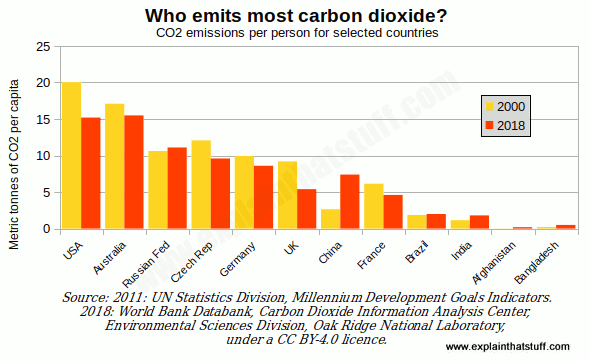
Who emits most carbon dioxide?
This chart shows the per capita (per person) carbon dioxide emissions for a dozen representative countries. The yellow bars show emissions for 2000; the orange bars show the picture in 2018. You can see a clear trend: developed countries are slowly reducing their emissions; developing countries show emissions that are steadily rising (but still much lower per capita overall). At the time this page was last updated (August 2021), these remain the latest available figures.
Climate is the pattern of weather in a particular place: how much
sunlight and rainfall it gets, how windy it is, and so on. The world's
weather is entirely powered by the Sun. Since Earth rotates on a tilted
axis, different
parts of our planet are heated by different amounts at different times
of year, making some regions hotter
than others and causing the seasons. The temperature variations between
one part of the world
and another cause differences in air pressure, producing winds, storms,
and even hurricanes. The Sun's heat also warms the seas unevenly,
driving ocean currents—which, in some ways, are like underwater
winds—from one place to another. Links between the atmosphere and the
oceans can produce complex weather patterns such as El-Niño—a
kind of
abnormal and erratic weather that happens every few years in the
Pacific.
Scientists believe that greater amounts of carbon dioxide in the
atmosphere, and hotter temperatures on Earth, will significantly change
the climate across the whole planet. This climate
change is
already beginning to happen in parts of the world. If you live in a
chilly place like Alaska or Greenland, you might think a bit of global
warming sounds like a great idea. But climate change doesn't
necessarily
mean things will get hotter. Some places will be hotter some of the
time, but most places will simply see more erratic and extreme weather.
That could mean heavier rainfall on occasions, more snow in some
places, longer periods of
drought, more storms and hurricanes, and more frequent heatwaves.
Climate change is nothing new. Earth's climate has been changing
regularly for hundreds of millions of years, sometimes getting colder
and sometimes warmer. Everyone knows about
Ice
Ages—those periods of
history when Earth was far colder than it is now. The climate change
people talk about today seems to be different. Most scientists believe
it is caused by systematic global warming, itself caused by a gradual increase
in fossil fuels. Whereas traditional climate change makes Earth as a
whole either hotter or cooler, modern climate change is going to make
the climate much more erratic—hotter in some places, cooler in others;
drier in some places; wetter elsewhere. In a nutshell, climate change means the type of
weather we experience will change—perhaps
quite dramatically in some places—as the years go by.
Is climate change really happening?
"Warming of the climate system is unequivocal, and since the 1950s, many of the observed
changes are unprecedented over decades to millennia. The atmosphere and ocean have
warmed, the amounts of snow and ice have diminished, and sea level has risen."
Scientists have been debating this question for about 20 years now.
So what's the official position? According to the Intergovernmental Panel on Climate Change (IPCC), which summarizes key scientific
research on the issue carried out by thousands of scientists, greenhouse gases have "increased markedly as a result of human activities since 1750 and now far exceed pre-industrial values" and "most of the observed increase in global average temperatures since the mid-20th century is very likely due to [this]... It is likely that there has been significant anthropogenic [human-caused] warming over the past 50 years averaged over each continent (except Antarctica)." As one of the world's leading climate scientists, Stefan Rahmstorf of
Potsdam Institute for Climate Impact Research, puts it, the current
scientific view of global warming is: "based on decades of research and
thousands of studies. The extraordinary consensus reached is seen in
the statements of many international and national professional bodies
which have extensively and critically assessed the scientific evidence."
[8]
So where do things stand now? The BBC has produced a handy, one-page summary called
Six graphics that explain climate change, which contains charts showing climate
trends over the last few years. Browse those charts and you will see that Earth's
temperature has increased systematically over the last century, sea
levels have risen significantly, and carbon dioxide emissions from
burning fossil fuels have increased almost exponentially. Most climate
scientists believe these things are connected: they consider that the
burning fuels cause the carbon dioxide emissions, which make the
temperature increase, which causes the sea levels to rise.
(If you want to see lots more charts, take a look at the official
IPCC reports website.)
Photo: Drilling out an ice core in Russia.
Photo by Mike Dunn, NC State Museum of Natural Sciences, courtesy
of NOAA Climate Program Office, NABOS 2006 Expedition,
published on Flickr
under a Creative Commons (CC BY 2.0) licence.
Since records of the weather date back only a hundred years or so,
how can scientists confidently make claims that the climate has
been changing over a much longer period? In turns out that Earth keeps
a natural record of its own climate in many surprising ways. For
example, as ice has formed year upon year at the poles, old ice has
been buried underneath with bubbles of air trapped inside it. The
bubbles act as a record of what the air was like on Earth when the ice
formed—and thus what the climate was like in years gone by. Using
drills, scientists can extract
ice cores
(long thin pipes full of ice), study the air bubbles at different depths, and calculate how
much carbon dioxide they contain. If they figure out how old the ice
is, they can use an ice core as a kind of graph of how carbon dioxide
has changed over time. Scientists can also study changes in the climate
using ocean sediments, samples of buried pollen, and other, once-living
matter. Research like this can tell us what the climate was like
hundreds of thousands of years ago.
Although most scientists believe in global warming, it's important
to note that a very small minority do not. Most agree that Earth is warming but not that fossil-fuel burning
and human carbon dioxide emissions are responsible. The "climate-change
skeptics" argue that increases in Earth's temperature
are either not happening at all or may be caused by other things,
including natural variations in the climate that have been happening
for millennia. In recent years, however, fewer and fewer scientists
have dissented from the widely held position that global warming and
climate change are really happening. People could still be wrong about
global warming—but that's becoming increasingly unlikely.
Runaway world?
This chart shows why the world is in trouble.
Over the last few decades, the amount of energy people use (red
line),
their economic activity (yellow),
the electricity they use (dark blue),
the world's population (green),
and their carbon dioxide emissions (light blue line)
have all increased inexorably.
Can the world continue to develop at such a pace without
experiencing an environmental and social catastrophe? On the other
hand, would reducing energy or electricity consumption cause major
economic upheaval and social problems of a different kind? How can
countries balance the need to develop economically with the need to
protect the environment?
How can scientists predict what will happen in future?
If we know what's happened in the past, we can often figure out what
will happen in the future. If you know it's rained every Tuesday for
the last five years, you might hazard a guess that it will rain next
Tuesday too—and you might well be right. Forecasting the weather is
somewhat more complex than this, but it essentially means using data
from the past to figure out the future. Forecasting Earth's climate—the
long-term patterns of weather for the entire planet—is more complex
still.
Photo: The Summit supercomputer at Oak Ridge National Laboratory is used for
modeling climate change—and other super-complex problems!
Picture courtesy of Oak Ridge National Laboratory, US Department of Energy, published on Flickr under a Creative Commons Licence.
Scientists make forecasts of the climate using what is known as a computer
model. This is a large and very complex program running on a
supercomputer (one of the world's most powerful computers). It's
essentially a collection of math equations that describe how different
parts of the climate work. Each equation contains variables (quantities
that change) like temperature, rainfall, amount of carbon dioxide, and
sea-level and shows how
one of these things affects the others. Taken all together, the
equations describe roughly how the climate works. How can the
scientists be sure of that? They go through a process called
"calibrating the model". If they start the model with data from 1900,
say, and ask it to run forward 50 years, it should predict the weather
in 1950. The scientists can compare the model's predictions with the
real data for 1950 and see how the model fares. If it makes accurate
predictions, they can run it forward into the future to see what will
happen in 2050, 2100, or even later. The further into the future the
model runs, the less accurate it is likely to be.
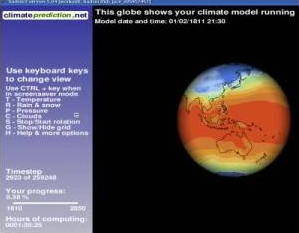
Photo: The model I'm currently running for
Climateprediction.net to help scientists improve their ideas about global warming.
My computer is processing some data for the year 1811 as you read this!
Over 658,000 computers in the world have contributed to the project,
which works just like SETI@home.
[9]
One reason some people are skeptical about global warming is that
they doubt computer models are good enough to model the climate decades
into the future. To produce a computer model, scientists have to make
certain assumptions about how the climate works. Since the climate is
very complex and computers are only so powerful, these assumptions are
usually simplifications. The skeptics are concerned that the computer
models are too crude and simple and they may not reflect how things
work in reality. But as time goes on, climate scientists have more and
more data to work with, and computers become more and more powerful—so
the models get better. How good are their predictions?
A study published in 2019 found that climate models have accurately predicted the last 50 years of global warming.
There's more about how scientists make computer models of the climate in a great BBC news article
Models
'key to climate forecasts' by Dr Vicky Pope of the UK's Hadley
Centre. If you want to go one better, go to
Climateprediction.net
to run your own mini model of the climate.
Using your computer's "down time", you'll be able to help
some of the world's leading scientists produce even better models of our climate.
What will be the impacts of climate change?
As Earth warms up, the oceans warm up too—very slowly but
significantly. Water expands as it warms so, as the oceans are heated,
the water they contain takes up more volume, and this makes the level
of the seas rise. The seas also rise when glaciers and ice sheets melt,
feeding more water into the oceans. Sea-level rise is one of the major
impacts of global warming. That might not worry you if you live in the
center of a country or up on high ground—in Colorado or Montana, USA,
for example, or in Birmingham, England. But if you live near sea level
in Florida or California, in a country like Bangladesh, or on a
low-lying island such
as one of the Maldives in the Indian Ocean, there's a growing (but so
far, still very slim) chance
your home might disappear underwater. Currently, the world's sea levels
are rising at 3.4cm (about 1.3in) per decade.
[10]
In the worst-case scenario they've modeled,
scientists think sea levels could rise on average by anything from 61cm to 1.1m (2–3.3ft) by 2100,
though melting polar ice could add substantially to that.
[11]
Another very obvious consequence of global warming is that the North
and South Poles are warming dramatically. Back in 2004, the
Arctic Climate Impact Assessment (ACIA)
found that sea ice in the Arctic had reduced by about 8 percent over the previous 30 years—which meant an area of ice the size of Norway, Sweden, and Denmark (or Texas and Arizona) combined had
now disappeared. Currently, the extent of the Arctic's summer ice is declining at a rate of 13.1 percent
per decade. A few years ago, scientists were warning that, by 2100, the North Pole may be so warm that its ice
disappears entirely in summer; now
they're warning that could happen imminently.
Antarctica, at the South Pole, contains around 90 percent of the
world's ice. Here, some glaciers are melting rapidly, draining water into the oceans
and causing concerns about large-scale rises in sea-level. But the
exact effect of climate change is complex: it is also
leading to greater snowfall, which is building up glaciers in some
places at the same time as they are being eroded elsewhere.
If all of Antarctica's ice were to melt, it has been estimated
that global sea levels would rise by 60m (195ft)!
[12]
Fortunately, that's not likely to happen. Melting Antarctic ice is contributing only about
20–25 percent of the rise in sea level that is currently underway.
[13]
Why do these things matter?
The ecosystems in different regions of
our planet are finely balanced. In the polar regions, for example,
plants and animals are adapted to living in extreme cold, with little
sunlight, and hardly any rainfall. In the tropics, plants and animals
are used to a much warmer and wetter climate. As global warming gathers
pace, many parts of Earth will see their climate change significantly.
The poles may become too warm for many of the creatures that live
there. If the climate change happened slowly, things would have time to
adapt: plants that like the cool could gradually shift northwards and
grow at higher latitudes. But
with a relatively rapid climate change, plants and animals may not be
able to adapt quickly enough—and many will become extinct.
Photo: The future looks uncertain for polar bears.
Picture by Erich Regehr courtesy of US Fish & Wildlife Service.
Consider the Arctic, where average temperatures have risen twice as
fast in recent years as for the rest of the world. Polar bears depend
on sea ice for hunting and moving from one place to another. If all the
summer sea ice disappears, as predicted, polar bears may be unable to
survive. Hundreds of millions of migratory birds fly to the Arctic every summer
to breed and nest. But global warming will alter the plants that can
thrive in the Arctic. Almost a quarter of mammal, bird, and amphibian
habitats could disappear by 2100, threatening the species that depend on them.
[14]
Caribou (reindeer) and other Arctic species are
already in decline in many places because their tundra habitats are starting to disappear.
Photo: Are caribou really heading for
extinction? Picture by Karen Laubenstein courtesy of US Fish & Wildlife Service.
And it's not just the Arctic that will be affected: climate change will make life difficult for
plants and animals all over the world. In the tropics, for example,
warming oceans are expected to kill off parts of coral reefs, with
disastrous effects on the complex, colorful ecosystems that depend on
them. Some predictions say climate change could make up to half
of all plant and animal species extinct in the world's most
"biodiverse" (species-rich) areas.
What impact will climate change have on people?
Humans, of course, are animals too—and, although we often forget it,
we are also part of the complex global ecosystem. What's happening at
the North Pole might seem remote and unimportant, but we are likely to
feel the effects of climate change much closer to home. More erratic
weather patterns could mean much greater storm damage and the loss of
coastal areas to rising seas; the insurance industry has been worried
about the effects of climate change for many years.
Episodes of El-Niño are more intense and longer-lasting and already happening around three
times more often than a century ago and are
expected to double in future.
Floods are likely to plague some countries, droughts others. On
some predictions, climate change
flooding could make around 100–200 million people permanently homeless
by 2100. Ironically, even in a world of rising sea levels and often
more severe rainfall, many more people are expected to suffer severe water shortages.
Photo: What will happen to low-lying coastal areas as sea levels rise? Many of the world's biggest and most-populated cities grew up around the shipping trade, so they were built at
today's sea level.
Cities at risk include London, New York, Sydney, Mumbai, and Tokyo.
There will be other impacts too. Changes in climate will make it
easier to grow food in some places, but much harder in others. There
may be gains in production in parts of the United States, but countries
such as those in Africa are predicted to lose out.
[15]
Overall, the world's poorest
people are expected to be hit hardest. Pests and diseases are predicted
to spread much further to take advantage of global warming. Mosquitoes,
for example, breed faster in warmer climates, spreading diseases to
more people. In a warming world, some scientists believe that
malaria will spread much more widely;
according to some estimates, two-thirds of the world's people could be at risk—compared to just 45 percent at risk today.
(But the science is
complex, since many other factors are involved.)
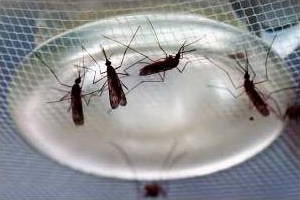
Photo: Mosquitoes are expected to extend their range
north, putting more people at risk from malaria.
Picture by National Institute of Allergy and Infectious Diseases (NIAID) courtesy of
National Institutes of Health Image Gallery.
What can we do to stop global warming?
The short answer is a simple one: to reduce the impact of climate
change, we need to reduce global warming. That means producing fewer
carbon dioxide emissions and it might mean using less energy or using
it more efficiently (doing the same things with less energy or better
technology). In practice, reducing emissions is both very simple and
very hard.
It's very simple for any one of us to reduce our personal carbon
dioxide emissions. You can replace the incandescent lamps in your home (ones that make light by getting hot) and use
energy-saving fluorescent
lamps instead.
You can switch your utility company so more of your electricity
is made from renewable energy.
Or you could bicycle, walk, or take the bus
from time to time instead of using your car. You could put on a sweater
instead of turning on the heating, open your windows instead of
using the air-con,
and drive with better fuel economy in mind.
These things are all very easy to do and will make
an immediate difference. But are they enough?
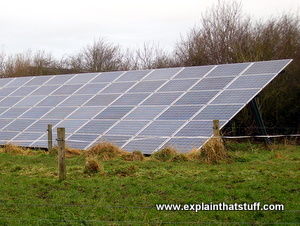
Photo: Solar panels like these could
help us to tackle global warming by producing energy without emitting carbon dioxide.
The real problem is that the global trends are working against us.
Developing countries like India and China are becoming more affluent as
people there escape from poverty. More people are buying cars and
aspiring to the same kind of lifestyle that people enjoy in the United
States and Europe. With global energy and fossil-fuel use still
increasing, major climate change seems almost unavoidable. That doesn't
mean we should give up trying to stop it. With a dramatic international
effort, we might be able to halt the growth in carbon dioxide emissions
by 2100. If we can keep carbon dioxide levels in the atmosphere to
below 550 ppm (roughly twice what they were before the Industrial
Revolution and about a third higher than they are today), flooding
caused by climate change in low-lying countries like Bangladesh will be
reduced by as much as 80–90 percent.
[16]
While it's easy for individuals to make a difference to global
warming, governments are finding it much harder. One concern is that
measures to reduce carbon dioxide emissions may mean using less energy
and could harm economic growth. So if one country voluntarily tries to
clean up its act, the fear is that it may find itself at an economic
disadvantage to other nations. This is why the United States refused to
support an international climate-change treaty called the Kyoto
Protocol. The treaty excluded developing nations such as
China—and
the US government believed all countries should take part.
How do things stand now?
All the time the world's governments continue to debate and
disagree, global warming is getting steadily worse. The longer it takes
to reach agreements, the worse things will get. In October 2006, the
British government published a report by a distinguished economist
called Sir Nicholas Stern. The
Stern Review argued that it makes sense to invest money and tackle climate change now, because the
cost of putting off action will be greater tomorrow. (It's rather like
going to the dentist for a filling now to stop your teeth falling out
later.) Stern claims global economic activity (measured by something
called gross domestic product, or GDP) could fall by up to 20 percent
if the effects of climate change are really severe. By contrast,
investing in measures to stop climate change now would cost only one
percent of GDP—20 times less. With the publication of the Stern report, scientists, economists,
and politicians finally appeared to be talking the same language.
Interestingly, some noted climate change skeptics have now reversed their position. Several years ago, Professor Richard Muller of the University of California at Berkeley was distinctly dubious about global warming,
so he set up the Berkeley Earth Surface Temperature
project to test the evidence fairly and with an open mind—just as you would expect a good scientist to do. By July 2012, he had announced in the New York Times a much stronger belief in human-caused climate change than even the official IPCC verdict: "Global warming [is] real... and humans are almost entirely the cause."
Even so, governments have continued to dither and put off firm action. In December 2015,
at an international summit in Paris, France (COP21),
195 nations finally agreed a deal to try to limit global temperature
rises to less than 2°C. While the negotiators congratulated themselves on a momentous achievement,
critics were quick to point out that little is changing: the world is still on course for a much higher temperature rise and potentially devastating climate change. One of the world's most influential climate scientists, James Hansen, described the Paris agreement as "a fraud... a fake... worthless words. There is no action, just promises. As long as fossil fuels appear to be the cheapest fuels out there, they will be continued to be burned."
And temperatures will keep on rising.
Each January since 2013, journalists have found themselves writing the same headline: measured one way
or another, last year was, more or less, "the hottest ever."
According to NASA, summarizing the position in January 2023, "the last 9 consecutive years have been the warmest 9 on record."
Global warming means many more headlines like this in the future.
At the end of 2018, the Intergovernmental Panel on Climate Change (IPCC)
warned that we now
have just 12 years to limit global warming to 1.5 degrees, which would
"require rapid, far-reaching and unprecedented changes in all aspects of society."
In its latest, August 2021 report, the IPCC noted that climate change is now "widespread, rapid, and intensifying,"
with "many of the changes observed in the climate... unprecedented in thousands, if not hundreds of thousands of years... some of the changes already set in motion—such as continued sea level rise—are
irreversible over hundreds to thousands of years."
[17]
The clock is ticking.
Even with all these warnings, there remains a distinct lack of urgency in tackling climate change. What will it take to make us wake up to global warming? And when we finally do, will it already be too late?
Sponsored links
Find out more
On this website
You might like these other articles on our site covering related topics:
NASA Temperature Data: 1880–2015: This is a quick, 30-second animation from NASA showing how global temperatures have changed since the Industrial Revolution.
The Thinking Person's Guide to Climate Change
by Robert Henson. American Meterological Society, 2019.
(Also published in the UK and other countries as The Rough Guide to Climate Change, Rough Guides, 2011.) The best single-volume introduction to climate change I've seen. A very accessible book for adults and older teens.
Global Warming: The Complete
Briefing (Fifth Edition) by John Houghton. Cambridge University Press, 2015. A good, no-nonsense introduction to the science. It's less accessible than Henson's book, but still an easy read.
Climate Change: Turning up the Heat by A. Barrie Pittock. Routledge, 2017. Another excellent choice if you're looking for a one-volume introduction to the topic.
The Carbon War by Jeremy Leggett. Routledge, 2001. The monumental challenge we face in overcoming a carbon-based economy.
For younger readers (ages 8–12)
Eyewitness: Climate Change by John Woodward. Dorling Kindersley, 2008: A clear and straightforward guide presented in easily-digestible, picture-story format.
Earth Matters by Lynn Dicks et al. Dorling Kindersley, 2008: A colorful guide to the many challenges Earth faces in the coming years and decades, with a particular emphasis on climate change. I wrote the polar section of this book.
Websites
Climate change fact sheet: A handy summary of key facts and data collected together by leading climate scientist Prof. Stefan Rahmstorf of Potsdam Institute for Climate Impact Research.
IPCC: Climate Change 2014: Synthesis Report: At the time of writing, in early 2018, this remains the most comprehensive single-volume summary of the global scientific consensus about climate change.
You can download the original 151-page report as a
PDF (14 MB) or browse a user-friendly summary.
UK Met Office: Climate Guide: A good collection of introductory guides and more detailed reports from the leading UK climate organization.
The Guardian: Ultimate Climate Change FAQ: A huge collection of facts, resources, and news articles about climate change. It doesn't appear to be updated anymore, but it's good as far as it goes.
↑ [PDF] Climate Change—State of the Science by Stefan Rahmstorf, Potsdam Institute for Climate Impact Research, 2010. Although the numbers are now out-of-date, this remains a very useful little briefing.
Please do NOT copy our articles onto blogs and other websites
Articles from this website are registered at the US Copyright Office. Copying or otherwise using registered works without permission, removing this or other copyright notices, and/or infringing related rights could make you liable to severe civil or criminal penalties.