Now here's a bright idea—a lamp that
saves you money and helps the environment! It lasts 10 times longer than an old-fashioned
incandescent lamp and uses 80 percent less
energy.
[1]
If you care about tackling global warming, lamps like this
are a great place to start. During its lifetime, a typical energy-saving lamp will stop about a tonne of
carbon dioxide from entering the atmosphere and pay for itself many times over.
[2]
So it's good for your pocket and kind to the Earth as well. There are two quite different kinds: CFLs (compact fluorescent lamps) and
LED (light-emitting-diode) lamps. What's the difference between them, how do they work, and which is best?
Let's take a closer look!
Photo: A typical dimmable LED lamp. Light comes from a ring of tiny LEDs inside a transparent plastic globe. Unlike CFLs and other LEDs, this one is specifically designed for use with a dimmer switch.
To understand what's so good about energy-saving lamps, we first
need to understand what's so bad about ordinary ones.
Traditionally, most lamps were incandescent. This means they give off light
because they are hot. A typical electric light bulb comprised a glass globe
with a very thin piece of wire inside it. The thin wire, called a
filament, gets extremely hot when electricity flows through it. Now,
hot things often give off light. Fires, for example, look red,
orange, yellow, or white because they are hot. Put an iron bar in a
fire and it will glow red when the temperature reaches about 800°C
(1400°F); this is what we mean by "red hot." If the temperature
rises to about 1000°C (1800°F), the bar glows orange,
and turns yellow at 1250°C (2300°F). If it
gets hotter still, say about 1300°C (2400°F) it will glow with a
bright, white light. The filament in a lightbulb looks white because
it is glowing white hot.
[3]
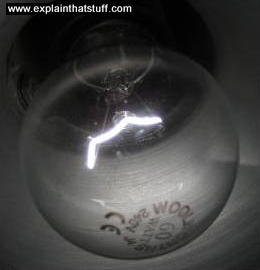
Photo: An incandescent lamp makes light when the filament gets white hot. It's hard to see this normally since you can't look at a lamp for very long without it hurting (or even damaging) your eyes. But this short exposure photo makes it clear exactly what's happening.
Hot iron looks red, yellow, or white because it is giving off
light—but why should it give off light at all? When you heat iron,
the atoms inside it absorb the heat energy you supply. The electrons inside the atoms push out farther from the nucleus to soak up this
extra energy. But this makes them unstable, so they quickly return to
their original or "ground" state. When they do so, they have to
get rid of some energy and do so by giving off a tiny packet
of light called a photon. Depending on how much energy they get
rid of, the photon appears as light of a particular color.
See our article on light for a fuller explanation of how atoms make light.
Sponsored links
You might think heating up a bit of wire is a pretty inefficient
way to make light—and you'd be right. A fire, a hot iron bar, and
the wire filament in a lamp all give off light, but they also give
off heat. If making light is our only objective, any heat we make is
wasted energy. If you've ever put your hand near a typical
incandescent lamp, you'll know it gets incredibly hot—far too hot
to touch, so don't try it! In fact, an incandescent bulb wastes over
90 percent of the electricity it uses by getting hot.
[4]
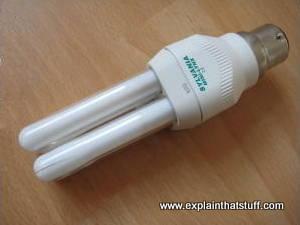
Photo: A typical energy-saving compact fluorescent lamp (CFL). Light comes from the twin fluorescent tubes on the left. The cube-shaped base of the lamp contains a transformer and other electronics, as explained below.
Traditionally, energy-saving lights save energy by making light without the
heat using a completely different process called fluorescence. This is a trick similar to the one used by creatures like fireflies and glow-worms, whose bodies contain chemicals that make
"cool light" without any heat. The general name for light made this way
is luminescence.
You've probably had long, fluorescent strip lamps in your home or office for years.
Modern compact fluorescents work in exactly the same way only they've been squeezed
down to fit inside roughly the same volume as a traditional light bulb.
From the outside, a compact fluorescent lamp looks simple enough, with two main
parts: a squarish base out of which two or more white glass tubes
emerge. Plug in the base and the tubes light up. What could be simpler? Inside, things are a bit more complex!
Here's how it all works:
You plug the base into the power outlet.
Just inside the base, where the case widens out, there's a small electronic
circuit, containing a transformer, that boosts the
voltage of the incoming electricity. (You can see a photo of the circuit below.) This means the lamp can produce more light than it would otherwise do and also helps to reduce flicker.
The circuit is connected to a couple of electrical contacts called electrodes.
When electricity flows into the electrodes, electrons (shown here as red
dots) boil" from their surface and shoot off down the thin white tubes, which contain
mercury gas, shown here as bigger blue dots.
As the electrons hurtle down the tubes, they collide with atoms of the mercury.
The collisions give the mercury atoms energy so their electrons jump to higher energy levels. But this
makes the mercury atoms unstable, so the electrons quickly return to
their ground states. When they do so, they give off photons of
invisible ultraviolet light (slightly higher frequency than the blue
light we can see), shown here as a purple wiggly line.
If fluorescent lights make invisible light, how come they glow
white? Here's the clever part. The thin glass tubes of a fluorescent
light are covered in white-colored chemicals called phosphors. When
the ultraviolet light strikes atom of the phosphors (shown here as white dots), it excites
their electrons in just the same way that the mercury atoms were
excited. This makes the phosphor atoms unstable, so they give off
their excess energy as photons—which, this time, happen to be visible,
white light (indicated here with yellow wiggly lines).
Photo: The electronic circuit inside an energy-saving lamp.
The transformer is the big orange/gold thing in the center. The black cylinder
on the left is a capacitor; so are the four gray blocks.
The four silver colored contacts on the extreme right are where the electrodes attach.
The blue ring at the front wrapped in copper wire is an inductor.
Summary
So, in short, fluorescent lights make their energy in a three-step process:
Electrodes take electrical energy from the power supply and generate moving electrons.
The moving electrons collide with mercury atoms in the tubes to make ultraviolet light.
The white phosphor coating of the tubes converts the ultraviolet light into visible light (that we can see).
What's inside a compact fluorescent lamp?
In case you're wondering, here's what a compact fluorescent light actually looks like inside.
(Don't break one apart yourself; there is some safety risk from the mercury inside if you smash those white glass tubes.)
Photo: Inside a compact fluorescent lamp. The numbers on this photo correspond to the numbers in the artwork up above: 1) Connection to power socket; 2) Transformer circuit; 3) Electrodes; 4-6) Glass tubes with white phosphor coating inside.
Sponsored links
Drawbacks of CFLs
Energy-saving fluorescent lamps are far better than incandescent ones, but they still have their drawbacks. As you can see from the photo up above, there's lots of electronic circuitry inside them and that's hard to recycle at the end of their life, so most lamps like this end up in landfills. The mercury inside them is toxic, so if you break a bulb inside your home, there's a small risk to your health (and the mercury pollutes the landfill as well).
Photo: CFLs are difficult to recycle, but don't just toss them in the trash: they contain toxic materials like mercury. Collect them up, store them safely, and periodically take them to your local recycling centre for proper disposal.
Just as incandescent lamps have gone the way of the dinosaurs, CFLs are destined to follow: in February 2016, leading maker General Electric announced that it would stop making and selling CFLs in the United States in favor of
LED lamps. It's now possible to buy LED equivalents of most incandescent and CFL bulbs, including small strip lights,
so, if you have a choice, there's no real reason not to opt for LEDs straight away.
The market certainly seems to be heading this way: in the United States, LEDs represented about two thirds of all
bulb shipments by the end of 2018, according to the
US Energy Information Administration.
In 2012, 41 percent of all commercial buildings were using CFLs
and 84 percent used standard fluorescent tubes; by 2018, according to the
EIA, those figures had fallen to just 19 percent (CFLs) and 68 percent (standard tubes). Over the same time period, LED uptake increased from 9 percent in 2012 to 44 percent in 2018.
By 2022, nearly half of all US homes were using LEDs for all or most of their lighting,
compared to just 4 percent in 2015, according to the
EIA.
Some countries are now introducing complete bans on fluorescent lamps, including CFLs, partly because of their inefficiency
(compared to LEDs) and partly because of their toxic mercury content. In the United States,
California, Hawaii, and Minnesota have had bans in place since January 2025; other states
have plans to introduce bans over the next few years. Canada introduces a ban in January 2026.
Europe and the UK have had bans in place since 2023.
[5]
LED lamps
Photo: A typical LED lamp (left) looks much more like an old incandescent lamp than
its older CFL rival (right).
Since compact fluorescent lamps started to become popular in the mid-1990s, better alternatives have
emerged: LED lamps. They're even more energy efficient, last quite a bit longer, contain far fewer electronic components, and don't contain toxic mercury, though, for the moment at least, they can be more expensive to buy. Another big advantage is that they reach maximum brightness instantly, unlike CFLs, which take several minutes to "warm up." LED lamps contain a dozen or so low-power, low-voltage light-emitting diodes and some circuitry to make them work off the higher voltage of the domestic supply. Many have a frosted outer plastic case or "diffuser" to spread the bright, highly directional flashlight glare of their little LEDs into a warmer, fuzzier glow more suitable for home lighting.
How LED lamps work
One LED would normally run off something like a 1.5-volt DC (direct current) battery: a lot of modern flashlights work exactly this way, with a handful of LEDs powered by a couple of small batteries. A household lamp has some extra complications: the voltage is much higher (110–250 volts) and it's AC (alternating current) instead of DC. So, just as in a CFL, we need some circuitry to make our LEDs work properly.
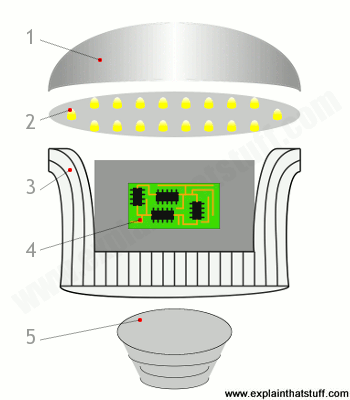
Here are the five main parts of a typical LED lamp:
Diffuser: Individual LEDs have lenses built into them at the top so they fire their light in one direction. Put 9–20 of them together and you get quite a glaring beam—like an oversized flashlight. That's why most LED lamps have diffusers in them, which are typically frosted plastic domes that spread the LED beams into a fuzzier, more even glow, sending equal light in all directions.
LED array: There are nine or more LEDs in a typical bulb.
Heat sink: Although LEDs are energy efficient, they (and the circuit underneath them) still generate quite a bit of heat. Because the lamp is a completely sealed unit, all that heat would soon build up and damage or destroy the components inside. That's why LED lamps typically have ridged "heat sinks" (like the vanes of a radiator) to cool them down.
Circuit: A transformer and a few other components convert high-voltage domestic AC to DC power for the LED array.
Base: Usually either a screw-in (Edison screw, ES) or bayonet fitting.
Here's what a typical LED lamp looks like inside its plastic diffuser: a simple circuit board with nine LEDs, a capacitor, and a couple of small chips. In some lamps, the rest of the components are underneath the board. In this one, what you see is what you get: all the electronics are on the board and there's nothing else underneath it.
Here's the same lamp taken apart completely:
The components you can see here are: 1) Plastic diffuser; 2) Connections to power supply;
3) Nine LEDs and other components on circuit board; 4) Aluminum heat sink; 5) Plastic insulating
outer layer; 6) Bayonet fitting.
How can you compare the efficiency of different kinds of lamps?
It's easy to pick up lamps in a store and fall for simple arguments on the box like "Uses 90% less energy" (less than what?"),
"lasts 15 years" (no matter how much you use it?), or whatever it might be, but when it comes to efficiency, we need to compare like for like. An incandescent bulb might be brighter than a CFL, for example, so is a straight comparison of energy use really that fair? One way to compare lamps is by looking at how much energy they need (measured in watts) to produce the same amount of brightness (measured in lumens). Dividing these two numbers, we get the number of lumens each lamp can produce for a single watt of energy. Looking at the chart here, you can see that LEDs are considerably better than CFLs on this measure, which are in turn much better than incandescent lamps.
Chart: Lumens per watt: LED lamps are almost twice as efficient as CFLs when you factor in brightness. On the same measurement, CFLs don't look quite as good compared to incandescents (only 5 times better). LEDs are 10 times better than incandescents.
What about the color?
You'll sometimes hear it said that modern CFLs are harsher and whiter than old-fashioned incandescent lamps, though that's
not necessarily the case. If you buy your CFLs from a grocery store or supermarket, there's not much choice beyond
the screw type and watt rating; you probably just pick up whatever's there without thinking about the color
of the light. But if you go to a specialist lamp retailer (in person or online), you'll find you can
buy CFLs and LEDs in different "color temperatures."
Changing the color temperature of your lamps will make a big difference to the ambience of your room.
With CFLs, the color is often (depending on the manufacturer) indicated by a three-digit code on the box. So, for example, you can buy a Philips 10-watt CFL with a color temperature of 827 (extra warm white—quite a reddish, cosy light, good for ambient light in a home, bar, or hotel), 830 (warm white—a yellower light), 840 (ordinary white—a general-purpose white light, more suitable for reading at home), or 940 (cool white, perhaps more suitable for an office).
With LEDs, the color is more often indicated as a "Kelvin temperature" value ranging from 2700 (warm white, for cosy homes) to over 5000K (cold white, for places like offices, home workshops, and factories).
Photo: Color temperatures: This is one of my table lamps with two different color-temperature CFL bulbs photographed under identical conditions. The photo doesn't really do justice to how much difference there is between a warm white (827) and a much cooler white (840).
How much do energy-saving lamps actually save?
You often hear people say that lamps like this pay for themselves quite quickly, but is that really true?
Let's crunch the numbers and find out!
Suppose you buy an incandescent lamp rated at 100 watts and it lasts for 1000 hours. In its lifetime, it will use 0.1 kilowatts (100 watts) × 1000 hours = 100 kilowatt hours, which is equivalent to 100 units of electricity or 360 megajoules. If you're in the USA, electricity might cost you 15–20 cents per kilowatt hour, making the total lifetime electricity cost around $15–20. (If you're in the UK, electricity would cost you probably 15–20p per unit, making the total lifetime cost of electricity £15–20.) A quick look around online
reveals that you could buy a packet of 10 energy-saving lamps for that price. So it would take only 100 hours' worth
of electricity to buy one equivalent, energy-saving lamp. For the sake of easy math, let's say an energy-saving lamp equivalent to an old-style 100 watt lamp uses 20 watts and lasts for 10,000 hours (so it will use five times less electricity and cost only a fifth as much to run). For every 1000 hours that it runs, it will save you 80 units of electricity. Ten lamps running for 1000 hours will save you 800 units of electricity or roughly $120–160.
In other words, switching to low-energy lamps is definitely a no-brainer: they easily pay for themselves.
Should you wait till your incandescent lamps stop working before changing over? No, change them straight away: there
is no benefit at all to keeping them—you're throwing good money after bad in the energy you waste.
What about switching from CFLs to LEDs? That's a slightly different case. Although
LEDs are more efficient than CFLs, the difference is smaller. Even so, there's a compelling argument for replacing your CFLs immediately. Since they contain hazardous mercury, be sure to recycle them properly and don't just toss them in the trash.
About the author
Chris Woodford is the author and editor of dozens of science and technology books for adults and children, including DK's worldwide bestselling Cool Stuff series and Atoms Under the Floorboards, which won the American Institute of Physics Science Writing award in 2016. You can hire him to write books, articles, scripts, corporate copy, and more via his website chriswoodford.com.
Light by David MacKay. This short chapter from David's excellent book Sustainable Energy Without the Hot Air explains the science behind home lighting, concluding that you should switch over immediately because "continuing to use an old lightbulb is throwing good money after bad."
America's Light Bulb Revolution by Nadja Popovich, The New York Times, March 8, 2019. Examining changing patterns of lamp use in the United States.
Regional variations in household lighting consumption driven by bulb choice and bulb count: Today in Energy, US Energy Information Administration, 25 February 2019. By the third quarter of 2018, LED bulbs accounted for almost two thirds of bulb sales, with CFLs down to just 7 percent. LEDs are the only types of bulbs growing in market share, with incandescent bulbs now obsolete and CFL and halogen both dwindling in importance.
How it Works: Fluorescent Lamp by Merle Henkenius, Popular Science, October 1991. Explains the workings of a fluorescent strip lamp.
All About Fluorescent Lighting by Evan Powell, Popular Science, August 1975. An old but nonetheless interesting article about the general principles of fluorescent lamps.
↑ Exactly how long energy-saving lamps last is a matter
of debate—and obviously depends on how (and how much) you use them. In particular, turning CFLs (or other fluorescents)
on and off very frequently can dramatically shorten their life. Opinions vary on whether you should switch off
CFLs when you leave a room, however. The US Department of Energy suggests you switch off if you'll be gone
over 15 minutes, but experts from Lawrence Berkeley National Laboratory argue that it's best to switch off
whenever you're not using them (because the cost of electricity is a much bigger factor than the cost of the bulb).
With LEDs, switching on and off has little or no effect on the lifetime of the lamp so always switch off when
you leave the room.
The energy savings quoted for CFLs and LEDs are usually compared to old-fashioned incandescent lamps, which
aren't completely comparable for all sorts of reasons. For example, if you used several old-fashioned 100-watt lamps
in the same room in wintertime, they would have provided a modest contribution to warming your home: the byproduct heat
they made wasn't remotely wasted, as we always assume; on the other hand, in summertime, incandescent lamps make
your home hotter and increase the need for cooling.
↑ "About a tonne" is a ballpark average.
For CFLs (of unspecified wattage!), the often-quoted figure is about half a tonne, which comes from the
International Energy Agency and is quoted in [PDF] Technology Fact Sheet: Energy-saving compact fluorescent lamps.
A 7W LED saves about 2 tonnes (4500 lb) of CO2 over its lifetime, according to
EAG-LED.
"Pays for itself" is, again, based on a comparison with incandescent lamps. If you're not
comparing lamps this way, they don't "pay for themselves" at all: they cost you money, just
like anything else that uses energy.
Please do NOT copy our articles onto blogs and other websites
Articles from this website are registered at the US Copyright Office. Copying or otherwise using registered works without permission, removing this or other copyright notices, and/or infringing related rights could make you liable to severe civil or criminal penalties.