Now you see it, now you don't. Glass is
a bit of a riddle. It's hard enough to protect us, but it shatters with
incredible ease. It's made from opaque sand, yet it's completely
transparent. And, perhaps most surprisingly of all, it behaves like a
solid material... but it's also a sort of weird liquid in disguise!
You can find glass wherever you look: most rooms in your home will
have a glass window and, if not that, perhaps a glass mirror... or a
glass lightbulb. Glass is one of the world's oldest and most
versatile human-created materials. Let's find out some more about it.
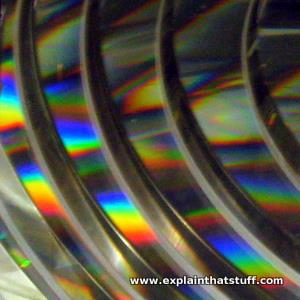
Photo: Glass riddle: How does something transparent to light appear colored? The colors in this glass aren't really there! Glass lenses refract (bend) light rays of different wavelengths by different amounts, causing spectral colors to appear. This is a closeup of a Fresnel lens from a lighthouse.
Believe it or not, glass is made from liquid sand. You can
make glass by heating ordinary sand (which is mostly made of silicon
dioxide) until it melts and turns into a liquid. You won't find that
happening on your local beach: sand melts at the incredibly high
temperature of 1700°C (3090°F).
When molten sand cools, it doesn't turn back into
the gritty yellow stuff you started out with: it undergoes a complete
transformation and gains an entirely different inner structure. But it
doesn't matter how much you cool the sand, it never quite sets into a
solid. Instead, it becomes a kind of frozen liquid or what materials
scientists refer to as an amorphous solid.
It's like a cross
between a solid and a liquid with some of the crystalline order of a
solid and some of the molecular randomness of a liquid.
Glass is such a popular material in our homes
because it has all kinds of really useful properties. Apart from
being transparent, it's inexpensive to make, easy to shape when it's
molten, reasonably resistant to heat when it's set, chemically inert
(so a glass jar doesn't react with the things you put inside it), and
it can be recycled any number of times.
Photo: Stained glass is made by adding salts of metals such as iron, manganese,
chromium, and tin to the ingredients of molten glass to give it a variety of attractive colors.
This stained glass window, designed by artist
Edward Burne-Jones, is in St Philip's Cathedral, Birmingham, England.
Sponsored links
How is glass made?
When US scientists tested a
prototype of the
atomic bomb in the New Mexico desert in 1945, the explosion turned
the sand in the immediate area of the impact into glass. Fortunately,
there are easier and less extreme ways of making glass—but all of
them need immense amounts of heat.
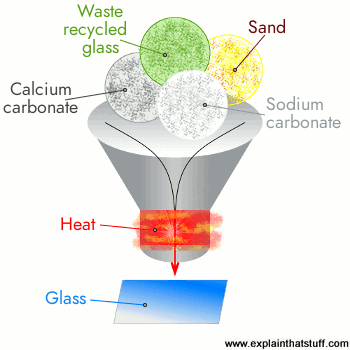
In a commercial glass plant, sand
is mixed with waste glass (from recycling collections), soda ash
(sodium carbonate), and limestone (calcium carbonate) and heated in a
furnace. The soda reduces the sand's melting point, which helps to
save energy during manufacture, but it has an unfortunate drawback:
it produces a kind of glass that would dissolve in water! The
limestone is added to stop that happening. The end-product is called soda-lime-silica glass. It's the ordinary glass we
can see all around us.
Artwork: Glassmaking simplified: mix and heat sand and recycled glass with calcium carbonate and
sodium carbonate.
Once the sand is melted, it is either poured into
molds to make bottles, glasses, and other containers, or "floated"
(poured on top of a big vat of molten tin metal) to make perfectly flat
sheets of glass for windows.
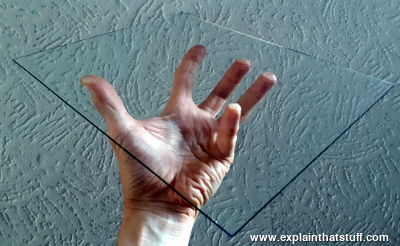
Photo: Perfectly flat panes of glass of uniform thickness are made by floating molten
glass on giant tanks filled with molten tin. After cooling and solidifying, the glass is cut to whatever size is needed.
Unusual glass containers are still sometimes made
by "blowing" them. A "gob" (lump) of molten glass is wrapped
around an open pipe, which is slowly rotated. Air is blown through
the pipe's open end, causing the glass to blow up like a balloon.
With skillful blowing and turning, all kinds of amazing shapes can be
made.
Photo: Making a piece of glass artwork by blowing and spinning. The glass (right) has been blown into a sphere on the long metal pipe you can see on the top right. It's now being turned on the same pipe to shape it further. Note how two hot blow torches are being applied from the left to keep the glass molten and flexible so it can be worked into shape. Photo by James Bunn courtesy of US Army and
DVIDS.
Glass makers use a slightly different process
depending on the type of glass they want to make. Usually, other
chemicals are added to change the appearance or properties of the
finished glass. For example, iron and chromium-based chemicals are
added to the molten sand to make green-tinted glass. Oven-proof borosilicate glass (widely sold under the
trademark PYREX®) is
made by adding boron oxide to the molten mixture. Adding lead oxide
makes a fine crystal glass that can be cut more easily; highly prized
cut lead crystal sparkles with color as it refracts (bends) the light
passing through it. Some special types of glass are made by a
different manufacturing process. Bulletproof
glass is made from a sandwich or laminate of multiple layers of glass and plastic bonded
together. Toughened glass used in car windshields is made by cooling molten
glass very quickly to make it much harder.
Stained (colored) glass is made by adding metallic compounds to glass while it is molten; different
metals give the separate segments of glass their different colors.
Photo: Borosilicate glass, such as this PYREX® jug (back), can withstand extreme changes of temperature, unlike normal glass (front), which shatters. The ordinary glass jar at the front is quite a bit thinner and considerably lighter. You can also see,
very clearly that the borosilicate glass is a slightly blueish color (as is the boron oxide from which it's made).
Sponsored links
Is glass a solid... or a liquid?
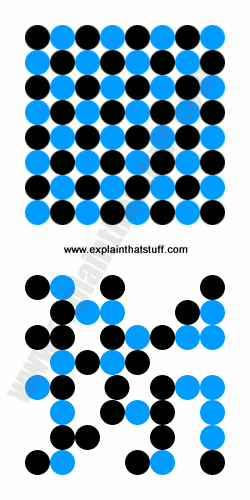
Artwork: Top: In a regular crystalline solid, the atoms are arranged in
a neat and predictable way. Bottom: In an amorphous solid, such as glass, the arrangement is much more random.
It's a very interesting question.
The answer is both—and neither! There are widely differing opinions
on how to refer to materials such as glass that seem to be a bit like
liquids in some ways and a bit like solids in others.
In schools and in books, we tend to learn that solids all have a
fixed structure of atoms.
In fact, there are different kinds of solids that have very
different structures and not everything we describe as "solid" behaves
in exactly the same way. Think of a lump of iron
and a lump of rubber. Quite clearly they are
both solids, and yet the rubber is very different from the iron.
Inside, rubber and iron have their atoms (in
the case of iron) and molecules (in the case of rubber) arranged in
totally different ways. Iron has a regular or crystalline structure
(like a climbing frame with atoms at the corners), while rubber is a polymer (made from long chains of molecules
loosely connected together). Or think of water.
As you may have discovered, water is an almost unique solid because it
expands to begin with when it freezes. In short, not everything fits
neatly into our ideas of solid, liquid, and gas and not all solids,
liquids, and gases behave in a nice, neat, easy-to-explain way. The
exceptions are the things that make science really interesting!
Amorphous solids
Let's return to glass. Peer through a microscope
inside some glass and you'll find the molecules from which it's made
are arranged in an irregular pattern. That's why glass is sometimes
referred to as an amorphous solid (a solid without the regular
crystalline structure that something like a metal would have). You may
also see glass described as a "frozen supercooled liquid". This is
another way of saying "glass is a liquid that has never set", which is
the puzzling statement you'll sometimes find in science books. We could
say glass is a bit like a liquid and a bit like a solid. It has an
internal structure that is somewhere between the structure of a liquid
and a solid, with some of the order of a solid and some of the
randomness of a liquid.
Glass is by no means the only amorphous solid. It's possible to make
a type of water called amorphous ice that could be described as
in-between solid (water) and liquid (ice). You do this by cooling water
very quickly. The ice forms so fast that it doesn't have time to build
up its normal, crystalline structure. So what you get looks like ice
but behaves in some ways like liquid water. Other substances can be
made into amorphous solids too. Solar cells are often made from
something called amorphous silicon.
Photo: Glass can be used to recycle other
materials. Uranium glass has an unusual yellow-green color and glows in
ultraviolet light.
These glass pieces were made using waste uranium from the cleanup of
the Fernald uranium processing plant near Cincinnati, Ohio, USA.
Vitrification (turning a material into glass) is one way to dispose of
nuclear waste safely.
Picture by courtesy of US Department of Energy.
Glass starts your day with a sparkle: a glance at your watch, a gaze through the glaze
at the sun or the rain, a frown in the mirror, a song from the
shower, as you wash with water trickling down warm from the
solar panels
on the roof. Glasses pack the breakfast table, which might, itself,
be made from smoked glass, and there are bottles and jars of all
shapes and colors. Making breakfast in your kitchen, you might be
using a glass-ceramic cooktop or a
microwave with a metal-lined
window to keep the waves inside. Maybe you're watching croissants warm
through the Pyrex oven door? (And is that a glass teapot?)
When you check your email over breakfast (bad habit), speed-of-light Internet data zips
to your home through optical fibers, just as sunlight streams
through the heat-reflective windows that keep you cool. You read the
words through the glass LCD panel of your laptop or the toughened
gorilla glass of your smartphone, both charged by solar energy
from photovoltaic panels on the roof. Talking heads are
muttering at you through the TV screen in the corner.
Then you set off for work or school, in a glass-wrapped car, bus, train (perhaps even
helicopter), hunched under low-energy lamps covered by glass to make them last. If you're driving, the highway you're
roaring down could be made from aggregates and asphalt including
recycled glass; even the white stripes down the middle use tiny glass
beads to make them shine in your headlights. Maybe you drop in the
bank or the post office on your way, smiling at the cashier behind
her bulletproof window, as you make a quick copy of
your driving licence (which you carelessly leave behind on the glass plate
of the photocopier).
Photo: Glass brings the outside in! This is the wonderful Wayfarers Chapel in Rancho Palos Verdes, California, designed by Lloyd Wright (son of Frank Lloyd Wright). Picture from The Jon B. Lovelace Collection of California Photographs in Carol M. Highsmith's America Project, Library of Congress, Prints and Photographs Division.
If it's a modern building, your office or school might be a mini glass cathedral; we
think of glass as brittle and fragile, but toughen it the right way
and you can make walls, floors, roofs, and staircases from it; shops
show their wares through huge, laminated panels, polished to
perfection.
And that's only a tiny selection of the things glass does for us. There are
loads more places you'll find it hiding, from the bulbs in
thermometers
and the cermet fillings in teeth to the fiberglass hulls of boats,
the "sandpaper" we use for decorating (which is often glasspaper), and
even the strain gauges that warn us when buildings are cracking. Clear,
clean, attractive, unreactive, cheap, strong, and effective. What
more could you want? Glass is one of those magic materials we absolutely take for granted;
everywhere and nowhere—"invisibly transparent," so
we don't even notice that it's there!
About the author
Chris Woodford is the author and editor of dozens of science and technology books for adults and children, including DK's worldwide bestselling Cool Stuff series and Atoms Under the Floorboards, which won the American Institute of Physics Science Writing award in 2016. You can hire him to write books, articles, scripts, corporate copy, and more via his website chriswoodford.com.
The Glass Bathyscaphe: How Glass Changed the World
by Alan MacFarlane and Gerry Martin by Alan Macfarlane and Gerry Martin. Profile, 2002. Explores the history of glass from ancient to modern times. I believe this is the same book (differently packaged) as Glass: A World History by Alan Macfarlane and Gerry Martin. University of Chicago Press, 2002.
Introduction to Glass Science and Technology by J.E. Shelby. Royal Society of Chemistry, 2020. An undergraduate text covering the chemical and materials-science aspects of glass. Covers the various different types of glass and their mechanical, optical, and other properties.
Glass: Mechanics and Technology by Eric Le Bourhis. Wiley-VCH, 2014. Covers the history, structure, properties, and applications of glass.
Glass Science by Robert Doremus. Wiley, 1994. A classic single-volume guide to the science of amorphous, glassy solids.
Atoms Under the Floorboards by Chris Woodford. Bloomsbury, 2015. If you're looking for a more light-hearted approach, my recent book explores the wonders of glass in "Chapter 8: Amazing Glazing." You might be able to read some it online on Google Books by following this link.
Articles
For the Sake of Art: Risk and Reward at 2,000 Degrees by Gloria Dawson. The New York Times, September 1, 2016. This slideshow goes behind the scenes at UrbanGlass, an experimental glass workshop in New York City.
The Glass Whisperer by Andrea Truppin. The New York Times, January 27, 2005. The world of Michael Davis, a specialist in restoring antique glass.
Glass Blowing Becomes an Art Form by Katherine Pearson. The New York Times, January 7, 1979. From the Times archive, a short introduction to the wonders of blown glass.
US Patent 1,304,623: Glass by Eugene C. Sullivan and William C. Taylor, Corning, May 27, 1919. One of Corning's original Pyrex (borosilicate glass) patents, which describes its chemical composition and physical properties.
Please do NOT copy our articles onto blogs and other websites
Articles from this website are registered at the US Copyright Office. Copying or otherwise using registered works without permission, removing this or other copyright notices, and/or infringing related rights could make you liable to severe civil or criminal penalties.