During your lifetime, you'll produce
over 600 times your own weight in
trash—enough to fill a good few trucks. [1]
That staggering statistic might not be
such a problem if we didn't have to live on a relatively small,
overcrowded planet. Pretty much all the resources we have on
Earth—all the raw materials and an awful lot of the energy—are
limited: once we've used them up, we won't get any more. So it makes
sense to use things as wisely as we can.
The best way to use Earth's resources more sensibly is to reduce the amount of things that we use
(for example, less packaging on food in shops) and to reuse things
instead of throwing them away (reusing carrier bags at the grocery
store makes a lot of sense). If we can't reduce or reuse, and we have
to throw things away, recycling them is far better than simply
tossing them out in the trash. Let's take a closer look at recycling
and how it works!
Photo: Separating waste is the key to recycling.
In this park in Bath, England, there are separate dumpsters
for bottles, cans and plastic, paper/card (shown here), and general waste.
When you throw stuff away, you might be very glad to get rid of it:
into
the trash it goes, never to be seen again! Unfortunately, that's not
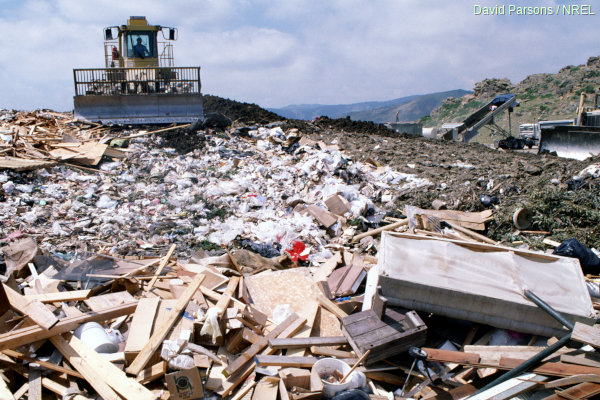
the end of the story. The things we throw away have to go
somewhere—usually they go off to be
bulldozed
underground in
a landfill or burnt in an incinerator. Landfills can be horribly
polluting. They look awful, they stink, they take up space that could
be used for better things, and they sometimes create toxic soil and
water pollution
that can kill fish in our rivers and seas.
One
of the worst things about landfills is that they're wasting a huge
amount of potentially useful material. It takes a lot of energy and
a lot of resources to make things and when we throw those things in a
landfill, at the end of their lives, we're also saying goodbye to all
the
energy and resources they contain. Some authorities like to burn
their trash in giant incinerators instead of burying it in landfills.
That certainly has advantages: it reduces the amount of waste that
has to be buried and it can generate useful energy. But it can also
produce toxic air
pollution and burning almost anything (except plants that have grown very recently)
adds to the problem of global warming and climate
change.
The trouble is, we're all in the habit of throwing stuff away.
"Recycling" might sound like a modern fad that flies in the face of
our tendency to waste, but only the name is a recent
thing: since ancient times, people have generally used things sensibly and frugally, often
through necessity.
[7]
In the early part of the 20th century, for example, people used materials much
more wisely—especially in World War II (1939–1945), when many
raw materials were in short supply.
[2]
But in recent decades we've become a
very disposable society. We tend to buy new things instead of getting
old ones repaired. A lot of men use disposable razors, for example,
instead of buying reusable ones, while a lot of women wear disposable
nylon stockings. Partly this is to do with the sheer convenience of
throwaway items. It's also because they're cheap: artificial
plastics, made from petroleum-based
materials, became
extremely inexpensive and widely available after the end of World War
II. But that wasteful period in our history is coming to an end.
We're finally starting to realize that our live-now, pay-later
lifestyle is
storing up problems for future generations. Earth is soon going to be
running on empty if we carry on as we are. Americans live in much
greater affluence than virtually anyone else on Earth. What happens
when people in developing countries such as India and China decide
they want to live the same way as us? According to the
environmentalists
Paul Hawken, Amory Lovins, and Hunter Lovins, we'd need two Earths to
satisfy all their needs. If everyone on Earth doubles their standard
of living in the next 40 years, we'll need 12 Earths to satisfy them!
[3]
Sponsored links
Why should you recycle?
If everyone reduced, reused, and recycled, we could make Earth's
resources go an
awful lot further. Recycling saves materials, reduces the need to
landfill and incinerate, cuts down pollution, and helps to make the
environment more attractive. It also creates jobs, because recycling
things takes a bit more effort than making new
things. Recycling doesn't just save materials: it saves energy too.
Manufacturing things uses a lot of energy from power plants—and
hungry power plants generally make global warming worse. We can save
a surprising amount of energy by recycling. If you recycle a single
aluminum can you save about 95 percent of the energy it would take to
make a brand new one. [4] That's enough energy saved to power your television for
about 3 hours! [5]
You'll often hear people say that over half the trash we throw away can be recycled.
Looking at the chart below, you can see that we currently recycle somewhere between 30–100 percent of the various different materials we use.
Just imagine if everyone were recycling most of their garbage: together, we'd be making
a tremendous reduction in the
amount of raw materials and energy we use—and doing a lot of
good for the planet.
Throwing things away is a bad habit; recycling them is a good habit.
Recycling isn't all that difficult: it's simply a matter of changing your habit.
Practically speaking, recycling happens in one of two ways. Either
your local government authority arranges a door-to-door collection
(this is sometimes called curbside recycling) or you take your
recycled items along to a local recycling center and place them in
separate containers.
Photo: A curbside recycling service in England. Householders fill a large plastic box with mixed material for recycling, without sorting it out, and leave it outside their home. Items are sorted out at the curb into separate bins inside the truck, which has completely open sides for ease of loading and unloading.
The essential difference between a bag of trash and a bag of
valuable,
recyclable waste is that the trash is all mixed up together and the
recyclable waste is sorted out and separated. If you have a curbside
recycling scheme, you may be given a recycling box into which you can
place certain types of waste (perhaps metal cans, glass bottles,
plastics, and newspapers) but not others. When the box is collected,
it might be sorted out at the curb. People on the truck will take
time to sort through your box and put different items into different
large boxes inside the truck. So, when the truck arrives at the
recycling station, the waste will already be sorted.
Alternatively, you may see your whole box being tipped into the truck without any
kind of sorting. The truck then takes your waste to a different kind
of recycling station called a MURF,
which stands for Materials Recycling Facility (MRF),
where it is sorted partly by hand and partly by machine
(this type of recycling is also called single-stream or comingled). If you don't
have curbside recycling, it helps to sort out your waste and store it
in separate bags or boxes before you take it to the recycling center.
(For example, you could wash out food tins and glass bottles and keep
them in separate plastic bags.)
Photo: A man sorts aluminum cans onto a conveyor at a MURF. Photo by Quay Drawdy courtesy of US Air Force and DVIDS.
Which materials can be recycled?
Most things that you throw away can be recycled
and turned into new products—although some are easier to
recycle than others.
Kitchen and garden waste
Photo: Nature is a great recycler: find and use your local compost
heap—or make one yourself.
You can recycle up to half your kitchen and garden waste by making
your own compost—a rich, crumbly,
earthlike material that forms when
organic (carbon-based) materials biodegrade (are broken
down by
worms and bacteria). Compost is great for using on your garden: it
returns nutrients to the soil that help your plants to grow. Making
your own is much cheaper than buying compost at a garden center; it's
also better for the environment than using peat, which is a
threatened habitat. To make compost, you will need a compost heap or
a large container of some kind in your garden or yard. Composting is
obviously much easier if you have a garden than if you have an
apartment on the 23rd floor of a skyscraper! But even in
cities, some authorities arrange collections of biodegradable waste
and make compost at a central location. It can take anything from a
few months to a year or more for waste to rot down and turn into
compost. Generally, you need to add an equal mixture of
"greens" (vegetable scraps, dead flowers, grass cuttings, and so on)
and
"browns" (torn up cardboard, small twigs, shredded
paper, and that kind of thing).
Paper and cardboard
Photo: A truck delivers paper collected for recycling.
Photo by Quay Drawdy courtesy of US Air Force and DVIDS.
In the early 1970s, photocopier
manufacturers got scared that we would stop
using paper and turn into a "paperless society." Not
much chance of that! Over four decades later, the bad news is that we're producing
more paper than ever before. But the good news is that we're
recycling more as well. Unlike some materials,
paper can be recycled only so many times. That's because it's made
from plant fibers that become shorter during paper-making. When
they're too short, they no longer make decent paper. In
practice, this means some new paper always has to be added during the
papermaking process.
One problem with recycling paper is that not all paper is the same.
White office printer paper is made of much higher quality raw material than the
paper towels you'll find in a factory washroom. The higher the
quality of paper waste, the better the quality of recycled products
it can be used to make. So high-grade white paper collected from
offices can be used to make more high-grade white recycled paper. But
a mixture of old newspapers, office paper, junk mail, and cardboard
can generally be used only to make lower-grade paper products such as
"newsprint" (the low-grade paper on which newspapers
are printed). Corrugated cardboard (which is held together with glue) is
harder to recycle than the thin cardboard used to package groceries.
Waste documents are usually covered in ink, which has to be removed
before paper can be recycled. Using bleach to de-ink papers can be an
environmentally harmful process and it produces toxic ink wastes that
have to be disposed of somehow. So, although recycling paper has many
benefits, it comes with environmental costs as
well.
Metal
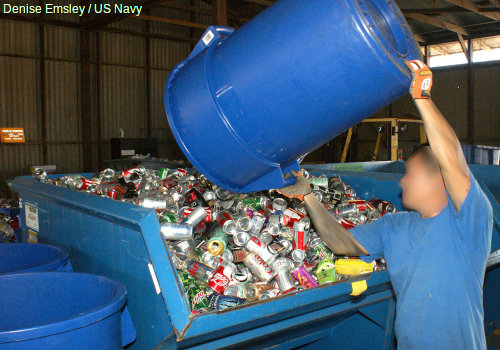
Photo: Collecting aluminum cans for recycling.
The next stage is squashing them into bales so that they take up less
room. Photo by Denise Emsley courtesy of US Army and Internet Archive.
Most of the metal we throw away at home comes from food and drink
cans and aerosols. Typically food cans are made from steel, which can be
melted down and turned into new food cans. Drinks cans are generally
thinner and lighter and made from aluminum, which can also be
recycled very easily. Mining aluminum is a very energy-intensive and
environmentally harmful process. That's why waste aluminum cans have
a relatively high value and why recycling them is such a good thing
to do.
Wood
Photo: Wooden palettes and crates can easily be turned into useful new objects or fed through a chipper to make landscaping pellets or mulch. Photo by Ashley Bradford courtesy of US Army Reserve Command and DVIDS.
People have been reusing this traditional, sustainable material for
as long as
human history. Waste wood is often turned into new wooden
products—such as recycled wooden flooring or garden decking.
Old wooden railroad sleepers (now widely replaced by concrete) are
sometimes used as building timbers in homes and gardens. Waste wood can also be
shredded and stuck together with adhesives to make composite woods
such as laminates. It can also be composted or burned as a fuel.
Glass
Photo: Glass is loaded into a crusher to
compact it ready for recycling. Photo by A. Sanchez, courtesy of US Navy and
US National Archives.
Glass is very easy to recycle; waste
bottles and jars can be melted down
and used again and again. You simply toss old glass into the furnace
with the ingredients you're using to make brand-new glass. Bottle
banks (large containers where waste glass is collected) were the
original examples of community recycling in many countries.
Oil
Waste oil from truck and car engines
causes huge environmental problems if you
tip it down the drain. It pollutes our rivers and seas, the wildlife
that depend on them, and even the water we drink. If you take your
waste oil along to a recycling center, it not only keeps our waterways
clean—it can also be reprocessed into new products such as
heating
oil. Waste vegetable oils (made by frying food, for example) can be
turned into a useful kind of vehicle fuel called biodiesel.
Plastics
Photo: Disposable bottles and other containers are typically collected together,
but they have to be carefully sorted into different kinds of plastic before they can be recycled.
Photo by John Gordinier courtesy of US Air Force.
Of all the different materials we toss in the trash, plastics cause by far the
biggest problem. They last a long time in the environment without
breaking down—sometimes as much as 500 years. They're very
light and they float, so plastic litter drifts across the oceans and
washes
up on our beaches, killing wildlife and scarring the shoreline. The
only trouble is, plastics are relatively hard to recycle. There are
many different kinds of plastic and they all have to be recycled in a
different way. There's so much plastic about that waste plastic
material doesn't have much value, so it's not always economic to
collect. Plastic containers also tend to be large and, unless people
squash them, quickly fill up recycling bins.
All told, plastics are a bit of an environmental nightmare—but
that's all
the more reason we should make an effort to recycle them! Different
plastics can be recycled in different ways. Plastic drinks bottles
are usually made from a type of clear plastic called PET (polyethylene
terephthalate) and can be turned into such things as textile
insulation (for thermal jackets and sleeping bags). Milk bottles tend
to be made from a thicker, opaque plastic called HDPE (high-density
polyethylene) and can be recycled into more durable products like
flower pots and plastic pipes.
Another solution to the problem could be to use bioplastics, which claim to be more environmentally friendly.
Photo: My recycled rubber mouse mat made from an old car tire.
Rubber
Huge amounts of waste rubber are produced each year, much of it from old vehicle tires
(quite a lot of shredded rubber also ends up on roads and reappears in the form of air and water pollution).
Given how big and bulky tires are and how many of them we get through, it's perhaps surprising that only 3.4 percent
of all municipal waste in the United States is classed as rubber and leather. That might not sound a lot, but it's
about 9 million tons a year (the same weight as 2 million elephants). [6]
Old tires can often be turned into new ones ("retreads") or shredded to make soft, bouncy landscaping materials
for cushioning children's playgrounds.
Sponsored links
Is recycling effective?
Some people hate recycling; the very mention
of it sets their blood boiling! They claim it's a waste of time, money,
effort, and energy—with supposedly recycled material often simply
thrown away or shipped around the world to developing countries.
According to this point of view, recycling is an example of "feel-good"
environmentalism:
something people do mainly to make themselves feel better, and which may
have a dubious or even negative effect on the planet.
In 1996, journalist >John Tierney summed up many people's doubts—and ruffled an awful lot of eco feathers— when he wrote,
in the New York Times, that "Recycling may be the most wasteful activity in modern America: a waste of time
and money, a waste of human and natural resources."
[1]
Just as you'd expect, environmentalists and recycling champions vigorously refute this.
It's very easy to find statistics from different countries about the benefits of
recycling. For example, the US EPA has summarized the positive side of recycling in a single sentence: "In 2006, Americans recycled 32.5 percent of municipal solid waste, which prevented the release of 52 million metric tons of carbon equivalent—the same as taking 41.2 million cars off the road."
[2] But it's often uncertain whether statistics like this take account of the energy
consumed (and carbon emissions produced) during recycling collection and processing. What if the recycling
process produces more carbon emissions than it saves? What if it costs more to collect materials
than you get back from recycling them? It's obviously vitally important to consider these things.
?
Studies of recycling
A few studies of the effectiveness of recycling have been done. In 2010, the UK government's
waste and packaging advisory agency, Wrap, carried out a detailed analysis
of the effectiveness of recycling. It compared seven types of disposal (recycling,
landfill, incineration, and so on) for seven different types of material
commonly recycled (paper, glass, plastics, and so on). In almost every case,
reusing or recycling was the best option, although it's a much more effective solution
for some materials than others; in a small number of cases, for example, low-grade waste paper, the report suggested
that incineration with energy recovery might be a better option.
[3]
But doesn't recycling consume energy? What about all
the fuel needed to drive those recycling trucks around carrying old newspapers from
place to place? Even taking this into account, there is a net benefit from recycling
compared to landfill or incineration. According to the UK government's 2007 Waste
Strategy: "Current UK recycling of paper, glass, plastics, aluminum and steel is estimated to save more than 18 million tonnes of carbon dioxide a year through avoided primary material production."
[4]
Economics—commodity market conditions—also plays a vital part in evaluating recycling. When markets are buoyant and people
are willing to pay more for scrap metal or waste glass, recycling is obviously more cost-effective
than when prices are low. And if you think recycling is just a cost to society, don't forget
the benefits. According to the US EPA, the recycling industry provides 757,000 jobs, $36.6 billion in wages, and
$6.7 billion in tax revenues.
[5]
Ultimately, the bottom line is that it's rarely better to throw something away than to reuse it or recycle it.
Further reading
How Useful Is Recycling, Really? by E. A. Crunden. The Atlantic, January 2021. Recycling is well worth doing, but don't expect it to make much difference to problems like climate change.
↑Recycling is Garbage by John Tierney. The New York Times, June 30, 1996. Almost 20 years on, Tierney updated his figures but essentially made the same argument again in The Reign of Recycling, The New York Times, October 3, 2015. Readers responded the following week in
Where Our Trash Goes, The New York Times, October 10, 2015.
↑US EPA: Recycling: Basic information: The main EPA website about how to recycle things, including what happens to recycled materials and other ways of reusing things (such as donating used electronic equipment to good causes).
The specific quote comes from
US EPA Archive: Wastes: Basic Information, February 21, 2016.
↑ Does recycling reduce carbon emissions? by Local Government Improvement and Development, 20 July 2010.
In England, just under half of household waste (45 percent) was being recycled in 2020, with
a target of 65 percent for 2035, according to UK Government
Progress report on recycling and recovery targets for England 2020.
↑Recycling Economic Information: US EPA, 2016. The economic value of recycling explored and explained. No more recent figures were available the last time I checked the EPA's page in June 2023.
How can we get people to recycle more?
Generally, it's better to recycle things than to trash them—but
that's not
always true. What we really need to do is think harder about how we
produce waste and how we dispose of it. It will always be better not
to produce waste in the first place than to recycle it, so reducing
the need for things is always the best option. That means
pressurizing manufacturers to use less packaging, for example.
Reusing things is also generally better than recycling them, because
recycling takes energy. (It takes energy to power the truck that
collects your recycled material and energy is also used at the plant
where things are recycled.) So it's better to keep a plastic
ice-cream container and reuse it as a storage box than to send it off
to be recycled. You're saving the material you'd use if you bought a
new box, but you're also saving the energy that would be needed to
recycle the old one.
Photo: 100% recycled: look out for this symbol. By buying recycled products, you're
helping to create a market that encourages even more recycling.
Buying recycled products is another important part of recycling. If
no-one's prepared to buy recycled, it doesn't pay people to recycle things in
the first place. Why do recycled things cost more if they're made of old trash?
Recycled things are often more expensive than non-recycled ones, because they're made in smaller quantities and it
often takes more effort to make them and get them to the shops. But
remember this: although they have a higher cost, they usually have a
lower environmental cost: they are doing
less damage to the planet.
That's not always true. Some cynical manufacturers have
seized on the public's enthusiasm for recycled goods. They produce
costly, pointless recycled gimmicks that make little if any
difference to the planet. Sometimes recycled products are made in
energy-hungry factories and shipped or (worse still) air-freighted
halfway round the world. Then it's possible they are actually doing more damage to the planet than the cheap, disposable products
they're pretending to replace. If you're not sure whether a recycled
product is all it seems, contact the manufacturer and ask them to
explain exactly how and where it is made. Ask them to explain exactly
how it's helping the environment. A genuine manufacturer, truly motivated
by environmental concern, will always be pleased and proud to do this.
In short...
Think carefully about what you use, where it comes
from, and where it goes. Try to reduce, reuse, and recycle if you possibly can—and in that order!
Be a thoughtful consumer, not a reckless one, and you'll be doing your bit to save the
environment.
The Indian men who make money selling trash by Aparna Alluri. BBC News, January 2, 2019. How Delhi's scrap merchants (kabadiwalas or raddiwalas)
make good money by recycling other people's trash.
South Korea's enthusiasm for recycling by Lucy Williamson, BBC News, 9 June 2011. An English journalist is baffled but impressed by the diligent recycling in Seoul.
The truth about recycling by Leo Hickman. The Guardian, February 26, 2009. Recycling (and using recycled materials) needs to be a much more fundamental part of everyday life.
Recycling around the world: BBC News, 25 June 2005. How good are people at recycling in different European countries?
Useful briefings
Plastic waste: UK House of Commons Library Briefing Paper, March 9, 2022.
Waste Management Single-Stream Recycling: How mixed (comingled) recycling works—why it's easier for residents and how the waste is sorted at the MRF recycling plant.
Books
For older readers
Understanding Environmental Pollution by Marquita K. Hill. Cambridge University Press, 2020. A wide-ranging introduction that includes chapters on recycling and waste.
Reduce, Reuse, Recycle: An Easy Household Guide by Nicky Scott. Green Books, 2009. A practical guide designed to help determined recyclers find a home for things they're determined not to trash. However, recycling information varies widely from place to place and changes quite often so much of the guidance may not apply to you.
What A Waste: Rubbish, Recycling, and Protecting our Planet by Jess French. DK, 2019. Includes experiments and activities. A wide-ranging look at the interlinked problems of waste, pollution, dwindling resources, and energy use. 72 pages for ages 6–9.
Recycling by Charlotte Wilcox. Lerner Publishing, 2008. Lots of impressive facts and statistics mixed in with clear text. The photos are mostly of dull and dirty old recycling plants, but never mind! Good for ages 9–12.
Recycling by Eleanor J. Hall. Kidhaven, 2004. An alternative for ages 9–12.
Organizations
US EPA: Wastes: A huge collection of information from the US Environmental Protection Agency covering all the different types of waste disposal and recycling.
↑ Americans produce about 2.2kg of
solid waste per person per day, which works out at 800kg per year or roughly 9 times average body weight.
Assuming a lifetime of about 70 years, that gives at least 600 times your body weight in trash.
Waste statistics come from
Municipal Solid Waste, US Environmental Protection Agency, July 14, 2021, and an earlier version,
Municipal Solid Waste, US Environmental Protection Agency, March 29, 2016.
↑ The figure of 95 percent energy saved by recycling a can has been quoted widely since the 1970s (see for example this search on Google Books). The earliest reference here appears to be a Newsweek article from 1976.
↑ Appropriately enough, the figure of three hours of TV power has, itself, been "recycled" widely. The first reference I found is a 1991 Forbes article (Volume 148, Issues 11–14, p195), though an earlier Illinois Information Service article (from 1988) quotes a figure of 24 hours. One problem with this statistic is that today's LCD TVs are much less energy-hungry than
the old cathode-ray TVs that would have been commonplace in 1991.
Please do NOT copy our articles onto blogs and other websites
Articles from this website are registered at the US Copyright Office. Copying or otherwise using registered works without permission, removing this or other copyright notices, and/or infringing related rights could make you liable to severe civil or criminal penalties.