Heat insulation
by Chris Woodford. Last updated: March 5, 2025.
If you're out and about in winter and you're feeling cold, chances are you'll put on a hat or another layer of clothing. If you're sitting at home watching television and the same thought strikes you, you're more likely to turn on your heating. Now what if we switched the logic around? What if you ate more food whenever you felt cold and stuck a woolly hat on top of your house each winter? The first wouldn't make much difference: food supplies the energy your body needs, but it doesn't necessarily make you any warmer right there and then. But putting "clothes" on your house—by insulating it—is actually a very good idea: the more heat insulation you have, the less energy escapes, the lower your fuel bills, and the more you help the planet in the fight against global warming. Let's take a closer look!
Photo: Aerogel is one of the world's most exciting insulating materials. Put a slab of aerogel between a gas flame and some wax crayons and the crayons won't melt: the aerogel stops virtually any heat flowing through. One day, we could make all our windows out of aerogel—but scientists have to figure out how to make it transparent first! Photo by courtesy of NASA Jet Propulsion Laboratory (JPL).
Sponsored links

Contents
Why do we need insulation?
Put simply: we need insulation because fuel is expensive and fuels that burn damage the environment, one way or another. Some fuels are more expensive than others; some are more harmful than others; some are more efficient than others. But even efficient fuels cost money—so the less of them you burn, the better.
Compared to using age-old technology such as an open-coal fire, most modern heating appliances are actually pretty efficient; look at the red bars in the chart below and you'll see that, for every joule (the standard modern unit of measuring energy) of fuel you feed into them, you typically get about 70 percent back again as heat (in practical terms, that's what the fuel efficiency percentage means).
How efficiently you can heat your home (and how much it will cost) depends to a large extent on the fuel you use—which is not always something you can change easily.
As this chart shows, home heating fuels vary dramatically in cost (with electricity the most expensive and coal and natural gas the cheapest), though most are about 70 percent efficient or better. Wood is the least efficient fuel, but given its low cost, availability, and sustainability, that doesn't always bother people. Even though coal is one of the cheapest fuels, it's dirtiness and other environmental drawbacks have made it much less popular in recent decades. Natural gas owes its popularity to its low cost and high efficiency.

Chart: Comparing the cost and efficiency of different fuels. The blue bars in this chart show the cost in dollars per million btu of nine common residential fuels (read the vertical axis on the left). The red bars alongside show the efficiency of each fuel as a percentage (read the vertical axis on the right). Drawn using 2022 data from various different market sources, including the US Energy Administration. The efficiency data doesn't really change from year to year.)
"In 2020, 34 million U.S. households (27% of all U.S. households) reported difficulty paying energy bills or reported that they had kept their home at an unsafe temperature because of energy cost concerns."
US Energy Information Administration, April 11, 2022
Over the last few decades, there's been a major shift in energy use: modern homeowners spend a much higher percentage of their utility bills powering appliances and air conditioning than they did back in the late 20th century. Take a look at the donut chart below. In 1978 (inner ring), about 80 percent of home energy use went to heating homes (66 percent) and hot water (14 percent). Today, those figures have changed quite a bit and much less of our energy (62 percent) is now used this way (heating comes in at 43 percent and hot water at 19 percent). That's still almost two thirds of your bills, however—and a powerful incentive to insulate and improve efficiency!
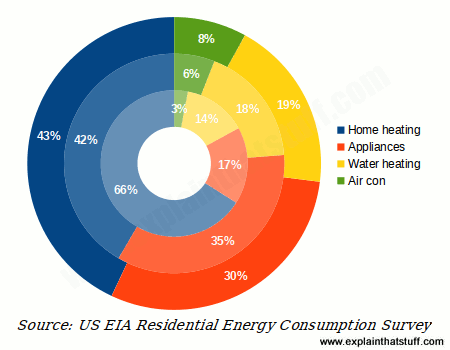
Charts: US home energy use from 1978 (inner ring), 2009 (middle ring), and 2015 (outer ring). Blue = home heating, Orange = appliances and electronics, Yellow = water heating, Green = air conditioning. Data from Residential Energy Consumption Surveys (RECS), US Energy Information Administration (EIA).
Holding onto your heat
The real problem with home heating is retaining the heat you produce: in winter, the air surrounding your home and the soil or rock on which it stands are always at a much lower temperature than the building so, no matter how efficient your heating is, your home will still lose heat sooner or later. The answer is, of course, to create a kind of buffer zone in between your warm house and the cold outdoors. This is the basic idea behind heat insulation, which is something most of us think about far too little. According to the US Department of Energy, less than a third of homes built before 1980 are properly insulated; as you can see from the chart below, most of us believe our properties are better insulated than they actually are. (The good news is that standards are rising. Over a quarter of new homes now meet ENERGY STAR® specifications, according to the US Energy Information Administration, which means they use 15 percent less energy than those built to 2009 building codes.)

Chart: Over 95 percent of homes built in the 1990s and after are either well- or adequately insulated, according to the perceptions of their owners, compared to just 68 percent built before 1950. (In reality, many homes are much more poorly insulated than their owners believe.) Drawn using data from [PDF] Householder's Perceptions of Insulation Adequacy and Drafts in the Home in 2001 by Behjat Hojjati, US Energy Information Administration, 2004.
How does heat escape from your home?
- Your house is standing on cold soil or rock, so heat flows down directly into the Earth by conduction.
- Heat travels by conduction through the solid walls and roof of your home. On the outside, the outer walls and the roof tiles are hotter than the atmosphere around them, so the cold air near to them heats up and flows away by convection.
- Your house may seem like a big complex space with lots going on inside in but, from the point of view of physics, it's exactly the same as a camp fire in the middle of vast, cold surroundings: it constantly radiates heat into the atmosphere.
The more heat escapes from your home, the colder it gets inside, so the more you have to use your heating and the more it costs you. The more you use your heating, the more fuel has to be burned somewhere (either in your own home or in a power plant up-state), the more carbon dioxide gas is produced, and the worse global warming becomes. It's far better to insulate your home and reduce the heat losses. That way, you'll need to use your heating much less. The great thing about home insulation is that it usually pays for itself quite quickly in lower fuel bills. Before long, it's even making you money! And it's helping the planet too.
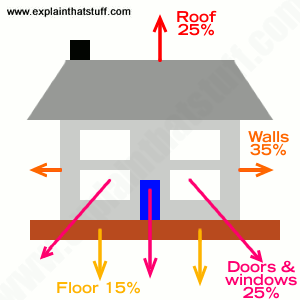
Artwork: Where does the heat escape in a typical home? It varies from building to building, but these are some rough, typical estimates. The walls give the biggest heat loss, followed by the doors and windows, the roof, and the floor.
Why does heat escape from your home in the first place? To understand that, it helps to know a little bit about the science of heat. As you probably know, heat travels in three different ways by processes called conduction, convection, and radiation. (If you're not sure of the difference, take a look at our main article on heat for a quick recap.) Knowing about these three types of heat flow, it's easy to see lots of ways in which your cozy warm home is leaking heat to the freezing cold world all around it:
Well-insulated homes that hold onto their heat in winter tend to be better at keeping the heat out in summer, so any improvements you make to your insulation should also help to keep your air conditioning bills down. That matters because "air con" is now the fastest growing use of energy in buildings (both homes and commercial buildings), according to the US Energy Information Administration.
How heat insulation works
Suppose you've just poured yourself a hot cup of coffee. A fundamental rule of physics called the second law of thermodynamics says it's never going to stay that way: pretty soon, it's going to be a cold cup of coffee instead. What can you do to postpone the inevitable? Somehow you need to stop heat escaping by conduction, convection, and radiation.
The first thing you could do is put a lid on. By stopping hot air rising and falling above the cup, you'll be cutting down heat losses by convection. Some heat is also going to be disappearing through the bottom of the hot cup into the cold table it's standing on. What if you could surround the cup with a layer of air? Then very little conduction could take place. So maybe have a second cup outside the first one with an air gap (or, better still, a vacuum) in between.
That's convection and conduction just about licked, but what about radiation? If you were to wrap aluminum foil round the outer cup, most of the infrared radiation the hot coffee gives off will be reflected back inside it, so that should solve that problem too. Apply all three of those solutions—a lid, an air gap, and a metallic coating—and what you have is effectively a vacuum flask: a really effective way of keeping hot drinks hot. (It's also good at keeping cold drinks cold, because it stops heat flowing in just as effectively as it stops heat flowing out.) It's worth noting, just in passing, that most takeaway stores give you hot drinks in nasty-tasting polystyrene containers. Ever wondered why? The answer is simply that polystyrene (and especially expanded polystyrene, filled with air—the crumbly kind you get in packaging materials) is a superb heat insulator (check out the table below and you'll see it rates better than double- and triple-glazing).

Photo: Above: Vacuums coated with metal are among the best insulators, but they're not always suitable for everyday uses. In the late 1980s, two scientists working at the National Renewable Energy Laboratory, David Benson and Thomas Potter, developed a more practical way to use this technology called compact vacuum insulation (CVI). The outer metal plates, held apart by ceramic spacers, seal an insulating vacuum inside. Photo by Warren Gretz courtesy of US Department of Energy/National Renewable Energy Laboratory (DOE/NREL).
Photo: Below: A similar idea is at work in products like Superfoil, an affordable insulating material that (if you peel it apart) is much like bubble-wrap, only it's sandwiched between thin layers of aluminum foil instead of paper. According to the manufacturers, the basic version has an R-value of around 0.97–2.33 (depending on where you use it), though the thicker versions manage somewhat better.

The best way to insulate your home
Now, unfortunately, we can't build our houses exactly like a vacuum flask. We have to have air to breathe, so a vacuum's out of the question. Most people like windows too, so living in a sealed box lined with metallic foil isn't that practical either. But the basic principle of cutting down heat losses from conduction, convection, and radiation still applies nevertheless.
If you want to improve your insulation, you need to take a very systematic approach, considering every possible way in which cold air can enter your home and heat can escape. You need to work your way around the entire building looking at every door, wall, window, roof, and other potential source of heat loss in turn. How much loft (attic) insulation do you have and could you do with some more? Is your home suitable for cavity-wall insulation and have you worked out the likely savings and payback period? How much energy are you losing through those drafty old sash windows? Have you thought about investing in caulking, secondary glazing, heavy curtains, magnetically attached plastic sheets, or some other means of keeping out the cold?
Walls

Photo: Reduce the energy losses from your home by filling the walls full of foam insulation. This eco-home is being insulated with Icynene, a plastic insulation material similar to that used in pillows and mattresses. Photo by Paul Norton courtesy of US Department of Energy/National Renewable Energy Laboratory (DOE/NREL).
Many homes have what are called cavity walls with two layers of brick or blocks between the inner rooms and the world outside and an air gap between the walls. The air gap reduces heat losses from the walls by both conduction and convection: conduction, because heat can't conduct through gases; convection, because there's relatively little air between the walls and it's sealed in, so convection currents can't really circulate.
By itself, air isn't the best insulating material to have between your walls. It's actually far more effective to have the cavities in your walls filled with expanding foam or another really good insulating material that stops heat escaping. Cavity-wall insulation, as this is known, takes only hours to install and costs relatively little. Cavity walls are often filled with loosely packed, air-filled materials such as vermiculite, shredded recycled paper, or glass fibers (specially treated to make them fireproof). These materials work in exactly the same way that your clothes work: extra layers of clothing make you warmer by trapping air—and it's the air, as much as (or more than) the clothes themselves, that stops heat escaping.