Sound is wonderful—think of Beethoven or birdsong. But sound we
don't want to hear, in the wrong place, at the wrong time, is simply
noise: a nuisance that can make life stressful and work, study, or
sleep impossible. If you're plagued by a noise problem, the simplest
approach is to kill the sound at its source, but sometimes
that's just not an option. If you live near a construction
site, a noisy bar or nightclub, or you have an elderly, forgetful
neighbor who plays the TV through your wall at full blast, getting
the volume turned down may be very hard work. Maybe you have the
reverse problem: perhaps you have a noisy occupation or hobby—you
might be a practicing musician or a DJ—and you want to spare the
people around you from suffering the sounds you make. Either way,
your thoughts have probably turned to soundproofing. Just what is it
and how does it work? Let's take a closer look!
Photo: If you're serious about soundproofing, measuring the noise nuisance you're suffering is a useful first step. That way, you can compare different sound-reduction measures to find out what works best. Photo by Ryan Brooks courtesy of US Air Force and
DVIDS.
There are times when it really helps to think like a scientist,
and tackling problems with noise is definitely one of them.
Understanding the science of sound is the best way to set about
reducing it.
Sound is a kind of energy that's produced when
things vibrate. The energy has to go somewhere, so it travels
outward, away from the sound source, making objects and the air all
around us vibrate in sympathy until what's left of the energy reaches
our ears. Inside our ears, the air vibrates too, banging on our ear drums,
stimulating tiny hair cells deep inside our heads, and registering
the sounds in our brains. In short, sound starts life at a source,
travels through one or more media, enters our ears, and lights up our
brains—and if you want to stop it in its tracks you have to interrupt
that chain of events somewhere along the route.
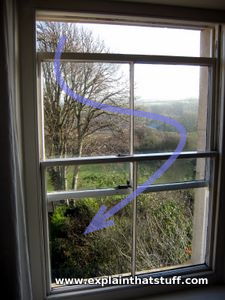
Photo: Sound energy needs a medium such as air to carry it along. An open window lets in air, but it lets in sound too—because the air carries sound waves. Closing the window doesn't keep out all the noise because sound also travels through the solid glass and the wooden window frame. Nevertheless, "airproofing" is a good first step toward soundproofing.
Understanding how sound waves travel through air and solid
materials is the key to stopping it, but that's easier
said than done. One reason we struggle with soundproofing is that we
confuse sound with light. Although both are kinds of energy that
travel in wave form, light waves have much shorter wavelengths than
sounds and are far easier to block out: it's much simpler to make
your house pitch black than completely quiet. Unlike nanoscopic light
waves, long-wavelength sounds can bend (diffract) round corners and
wriggle through the tiniest cracks and openings. More importantly,
while light waves pass through only a handful of solid materials
(such as transparent plastic and
glass), sound energy will happily
storm through most solids and emerge almost as loud the other side.
For example, sound travels through (solid) steel about 15 times faster than through (gaseous) air.
It's often said that when engineers work in tunnels, they bang on metal pipes to communicate with colleagues because that's the quickest, most efficient way
of transmitting sound.
Prisoners reputedly signal to one another by banging on
the pipes in a jail for the same reason. Whether those things really happen or not, or are just fun
stories, I don't know, but the science is sound (no pun intended) at least.
It's probably also worth remembering that if you're ever trapped somewhere and
need rescuing, banging may be a better strategy than shouting for the same reason.
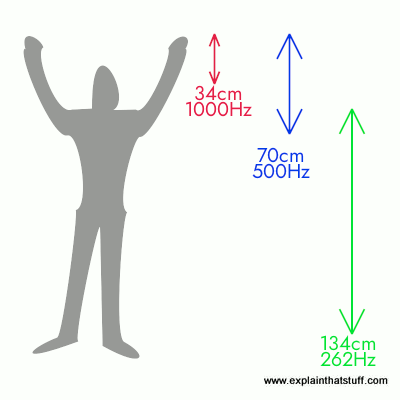
Artwork: Sound diffracts (bends and spreads) around obstacles because its waves are relatively large—the same sort of size as things like open doorways and windows. A 262Hz tone (middle C) has a wavelength of about 1.3m (4ft 3in), roughly the distance from my shoulder to my ankle. A 500Hz tone has waves about 70cm (28in) long (the length of my arm and about the width of a small open doorway). A 1000Hz tone has a wavelength of about 34cm (13in), which is about the length of my forearm.
The three easiest ways to stop sound are to turn off the source,
increase your distance from it (walk out of that noisy bar), or stop
the sound waves from entering your ears (cover your ears or wear
earplugs at the rock concert). As we've already seen, the first of
these is often impossible: if you're living near an airport, the
airplanes aren't going to stop flying just for you! Earplugs (widely
available from drug stores or online for just a few dollars) and
noise-canceling headphones are probably the most effective option if
your objective is quiet work or study or traveling in peace on an airplane or train—but they're not always
suitable ways of reducing sound at home. If you're a musician and you want to
keep traffic noise out of your room while you record an LP, you need to
block incoming sounds in more drastic ways.
Soundproofing your head
Photo: Why go to the bother of soundproofing your room if soundproofing your head will do the job just as well?
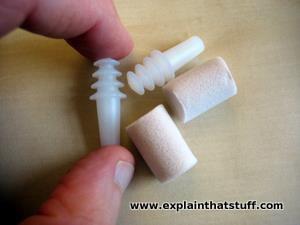
Ear plugs are the cheapest, simplest way of getting peace and quiet. Here we have two of the more common kinds. On the right, there's a pair of cheap, comfortable, disposable foam earplugs (suitable for working or sleeping). They're generally viscoelastic, which means if you scrunch them up, they take quite some time to return to shape, so hold them in place in your ear with a fingertip for 30 seconds or so to ensure a good seal. On the left, I'm touching a heavy-duty, washable and reusable airplane-style plug with flanges that bunch up inside your ears to make an effective suction seal. These are great for day-time use, but very uncomfortable for sleeping (if you put your ear against the pillow). If you need "ear defenders" for industrial-strength ear protection over a long period of time, check the packaging to make sure you're getting the right ones: long exposure to high levels of noise can and will damage your hearing.
Sponsored links
Stopping sound in its tracks
Suppose you're sitting comfortably in a room in your house, hoping
to record some music, but wondering how to block out traffic noise
from outdoors. Think about the sound waves coming into your room:
they travel through the outside air, hit the walls and windows of
your home, and make those solid materials vibrate. The energy is
transmitted right through the solid glass, wood, concrete, or stone
and makes the air vibrate again on the other side. That's how sounds
from outside get inside. You can probably see that you have several
different ways to solve the problem, but they're not really
alternatives—they're solutions you can combine: you can reduce
incoming noise by blocking any direct air pathways that allow sound
to travel from the outside to the inside; you can absorb or dampen
sound energy coming through the walls; or you can physically
"decouple" the inside of the room from the outside world.
Artwork: Noise can be more than just a nuisance; it can seriously damage your hearing.
According to the National Institute of Deafness and Other Communication Disorders, almost a quarter of US adults have hearing loss caused by noise ("noise-induced hearing loss") that's too loud or lasts too long.
Noise reduction
The first and simplest step is to reduce noise by blocking off the
paths sound is likely to take into your room. Obvious things like
extra layers of glazing help, but only if they're tightly sealed
around the edges. Double-glazed windows with a tiny air gap aren't
going to help much at all if they're made of wood and the opening
part of the window doesn't seal properly into the frame. If air can
get in, sound can get in too so installing good seals, gaskets, and
caulks around doors and windows is extremely important. Even things
like ducts and channels for cables or electrical
outlets provide access points for sound. Sorting out drafts and leaks in your home
to improve heat insulation is a different thing from soundproofing.
The benefits of doing one will also improve the other, but the
objectives are different; heat insulation materials generally improve
soundproofing, but don't always work as well as materials designed
specifically for sound insulation.
Absorbing and dampening
Photo: Mass-loaded vinyl is a simple plastic (such as PVC) with ceramic material added to give it extra weight and improved soundproofing properties. Typically, it weighs a hefty 5–10 kg per square meter (1–2 lbs per square foot). You can buy it on rolls from DIY stores and specialist soundproofing companies.
There are two slightly different techniques at work
here, but they typically go hand in hand. Absorbing means using rubbery materials that
soak up incoming sound energy so there's less to transmit onwards into a room, whereas dampening
means using a solid, acoustically "dead" wall that doesn't
readily vibrate. In practice, dampening and
absorbing might mean fitting solid, extra-thick doors (rather than
hollow ones), or heavy double doors separated by an air gap. Or
it might mean constructing a building with massive walls (made of dense, heavy
materials such as lead or concrete) with large air gaps in between. Absorbing by
itself could mean adding materials between walls that soak up
vibrations with such things as fiberglass, neoprene rubber,
viscoelastic foam, or MLV (Mass-Loaded Vinyl).
Artwork: If you want to keep sound out of a building, heavy concrete walls separated with an air gap are one approach you might take. Suppose the noise is outside (1) and you're on the inside (2). The concrete walls and air gap (3) will dramatically reduce any direct transmission of noise. But sound will still travel through the floor (4) and the ceiling (5), reducing the gains you make. For really effective soundproofing, you need to consider all the paths by which sound might travel from source to listener.
Decoupling
In theory, the perfect way to soundproof a room is to build a
smaller room inside it and stop sounds traveling from one to the
other. This is sometimes called a "room within a room" or
acoustic decoupling. Each room is made from heavy, solid materials
but the two rooms cannot be touching one another directly or sound
will pass through. Instead, the inner room is typically supported by small
metal and rubber clips (such as RSIC™ Resilient Sound Isolation Clips or WhisperClips).
You can read about the basic principles of how these work in
a recent patent titled Sound isolation assembly filed by RSIC inventor Michael Gernhart and colleagues.
Measuring sound insulation
How can you compare the amount of sound insulation you get from different materials? There
are several different measurements you'll come across.
Sound Transmission Class (STC)
In the United States, a common way of comparing sound insulation in buildings is using a measurement called STC (Sound Transmission Class), which describes how well or badly sound waves (broadly in the range of normal human voices, 125–4000 Hz) travel through ceilings and walls.
A very bad partition wall through which you could hear more or less everything would score about 20–25, while a luxury
hotel wall that blocks out virtually everything would notch up about 60. Most domestic walls rate somewhere in the middle
from about 30–45. You can improve the STC of a partition wall by building it from a more dense material (sound insulation improves by about 5 decibels for every doubling of mass), by adding an air gap, or by adding sound absorbing material.
In countries outside the USA, SRI (Sound Reduction Index) is a more common measurement. Typically, companies offering soundproofing products will suggest they can achieve an improvement of so many decibels (dB) sound reduction or SRI.
Everyday materials have widely differing SRIs. A thin plane of glass would achieve about 20–25 dB, light concrete slabs would be about 40 dB, while two brick walls separated by a large air cavity would cut noise by 60–75 dB. Like STC, SRI measurements are highly dependent on sound frequencies: a material that gives a considerable improvement in sound insulation for human speech
(cutting out conversation from your neighbors upstairs) is likely to be much less effective at cutting lower sound frequencies (so
you may still hear the deep bass of their stereo).
Noise Reduction Coefficient (NRC)
While STC and SRC indicate how well noise passes through different materials, NRC (Noise Reduction Coefficient) measures how well materials stop sound from reflecting (how much sound they can absorb). The NRC is the percentage of sound that a surface absorbs (in other words, hits a surface and doesn't reflect back again into the room). So a carpet on rubber underlay could easily have an NRC of about 0.4 (it absorbs 40 percent of the sound hitting it and 60 percent bounces back), while a glass window might score only about 0.05 (it reflects 95 percent of the sound hitting it straight back again).
The NRC is an average of measurements made at several different frequencies between 250Hz and 2000Hz (broadly, the range of the human voice) and may be misleading as an indicator of a material's performance at one specific frequency or a frequency outside this range.
Chart: Typical values of NRC (noise reduction coefficient) for some common materials.
Green (top) indicates most absorbent; red (bottom) most reflective. Note that NRC values do vary substantially according to whether materials are, for example, painted or coated with other materials. Even so, this chart shows exactly what we'd expect: harder materials reflect sound more (and reduce it less) than softer materials. It's worth noting that people absorb sound very well. This is a major factor in the design of concert halls and their seats, which are usually designed to sound as similar as possible whether they're occupied or empty. Source: Table: "Sound Absorption Data for Common Building Materials and Furnishings" in Architectural Acoustics by David M. Egan, McGraw-Hill, 1988, pp.52–53.
Sponsored links
Simple tips for soundproofing a room
Photo: Acoustic instruments are tested in soundproof rooms called anechoic chambers, lined
with sound-absorbent materials such as these triangles of foam. In this photo, an airplane engine's inlet fan is being tested for noise emissions in an anechoic chamber at NASA. Photo by courtesy of NASA Langley Research Center (NASA-LaRC).
If you just want to make your home a little quieter, you won't
want to go to extreme lengths like building yourself an anechoic chamber or a room within a
room; if all you're doing is the crossword or the knitting, you
probably don't need a padded cell! Making an ordinary room quieter
involves a two-pronged attack on noise through a combination of noise
reduction and noise absorption.
Noise reduction
The first, obvious step is to tackle the routes by which noise enters your room.
Doors and windows are likely your biggest
problem, so check those out first: make sure they're shut tight and
locked, check the seals, install draftproofing or caulking, and use
draft excluders. Double or triple glazing can be a big help if your
problem is something like airport or highway noise, but make sure
there's a big air gap and proper seals. Do you have an open chimney
you're not using? If it's safe to do so, block it up. If
soundproofing is your mission, you really need to go around your room
(or rooms) systematically, identifying every possible access point
where sound can get in and doing whatever you can to block that path.
But in your quest to block out sound, don't forget that blocking
your ears (with earplugs) may be far more effective—especially
if the noise is only a temporary nuisance.
Photo: Some people go to extreme lengths to soundproof rooms, but that doesn't mean you have to! Here's the world's biggest anechoic chamber at Edwards Air Force Base, California. The blue triangles you can see are energy-absorbing foam wedges. Photo by Thomas Powell courtesy of US Air Force.
Noise absorption
Once you've reduced incoming sound as much as you can, you could try
altering the interior of your room so sound waves are absorbed rather
than reflected by materials inside. Carpets work better than wooden
floors, but rugs can work a treat too. Soft furnishings such as wall
hangings (tapestries or blankets), sofas and cushions soak up sound
very effectively (that's why rooms sound so different when you've
emptied them to decorate or move house). Curtains are good at absorbing sounds from either inside or
outside, but make sure they're dense and heavy, reach right down to
the floor, and seal well all round. Thermal curtains linings and blackout
curtains (designed to stop heat loss and make rooms darker at night) can
significantly improve sound insulation for problems like traffic and street noise.
Step by step
Most of us live in busy urban places and it's unrealistic to expect perfect quiet. Even where I live,
in the deep countryside, it can still get pretty noisy from time to time. Indeed, the very quietness of some
places makes sudden sound an ironic nuisance: when you live in the city, you're sometimes better able to
"tune out" noise because it's so commonplace. Just as you can't expect total quiet, so you shouldn't
expect instant answers when it comes to soundproofing. One good approach is to work incrementally.
Try some low-value solutions first and see what difference they make; if they're insufficient, gradually
move on to more elaborate and expensive solutions if you really need to.
Photo: Edgey wedges: A close-up of the sound-absorbing wedges in an anechoic chamber. Usually they're made of foam, fiber glass, or some other inexpensive absorbent material.
Photo by Christine Saunders courtesy of US Air Force.
About the author
Chris Woodford is the author and editor of dozens of science and technology books for adults and children, including DK's worldwide bestselling Cool Stuff series and Atoms Under the Floorboards, which won the American Institute of Physics Science Writing award in 2016. You can hire him to write books, articles, scripts, corporate copy, and more via his website chriswoodford.com.
Room Acoustics by Heinrich Kuttruff. Taylor & Francis, 2016. A broad introduction to acoustics (aimed at sound engineers and people designing auditoria), with some coverage of noise reduction.
Master Handbook of Acoustics by F. Alton Everest and Ken Pohlmann. McGraw-Hill Education, 2015. A solid textbook for undergraduate students and acoustics professionals.
Soundproofing for New York Noise by Roy Furchgott. The New York Times. December 11, 2015. How professional sound engineers methodically analyze noisy buildings to convert them into silent spaces.
Build a soundproof wall: Natalina on Instructables gives us a good, simple introduction to the theory—followed by a practical wall-building project.
How to soundproof your car: Popular Mechanics, May 1983. An old but still interesting article explains how to reduce the nuisance of a noisy car.
New ideas for noise control at home by Al Lees: Popular Science, September 1970. Another old article, but also a good guide to sound transmission class and how to improve soundproofing with various different types of wall construction.
Please do NOT copy our articles onto blogs and other websites
Articles from this website are registered at the US Copyright Office. Copying or otherwise using registered works without permission, removing this or other copyright notices, and/or infringing related rights could make you liable to severe civil or criminal penalties.