We take for it granted that we can fly from one side of the world
to the other in a matter of hours, but a century ago this amazing
ability to race through the air had only just been discovered. What
would the Wright brothers—the pioneers of powered flight—make of an
age in which something like 100,000 planes take to the sky each day
in the United States alone? They'd be amazed, of course, and
delighted too. Thanks to their successful experiments with
powered flight, the airplane is rightfully recognized as one of the greatest
inventions of all time. Let's take a closer look at how it works!
Photo: You need big wings to lift a big plane like this US Air Force C-17 Globemaster. The wings are 51.75m (169ft) wide—that's just slightly less than the plane's body length of 53m (174ft).
The maximum takeoff weight is 265,352kg (585,000lb), about as much as 40 adult elephants! Photo by Michael Battles courtesy of
US Air Force.
If you've ever watched a jet plane taking off or coming in to
land, the first thing you'll have noticed is the noise of the
engines. Jet engines, which are long metal tubes burning a continuous
rush of fuel and air, are far noisier (and far more powerful) than
traditional propeller engines. You might think engines are the key to
making a plane fly, but you'd be wrong. Things can fly quite happily
without engines, as gliders (planes with no engines), paper planes,
and indeed gliding birds readily show us.
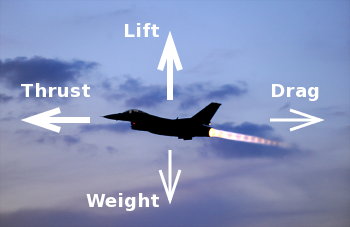
Photo: Four forces act on a plane in flight. When the plane flies horizontally at a steady speed, lift from the wings exactly balances the plane's weight and the thrust exactly balances the drag. However, during takeoff, or when the plane is attempting to climb in the sky (as shown here), the thrust from the engines pushing the plane forward exceeds the drag (air resistance) pulling it back. This creates a lift force, greater than the plane's weight, which powers the plane higher into the sky. Photo by Nathanael Callon courtesy of US Air Force.
If you're trying to understand how planes fly, you need to be
clear about the difference between the engines and the wings and the
different jobs they do. A plane's engines are designed to move it
forward at high speed. That makes air flow rapidly over the wings,
which throw the air down toward the ground, generating an upward force called lift that overcomes the plane's
weight and holds it in the sky. So it's the engines that move a plane forward,
while the wings move it upward.
Photo: Newton's third law of motion—action and reaction—explains how the engines and wings work together to make a plane move through the sky. The force of the hot exhaust gas shooting backward from the jet engine pushes the plane forward. That creates a moving current of air over the wings. The wings force the air downward and that pushes the plane upward. Photo by Samuel Rogers (with added annotations by explainthatstuff.com) courtesy of US Air Force. Read more about how engines work in our detailed article on jet engines.
How do wings make lift?
In one sentence, wings make lift by changing the direction and pressure of the air that crashes into them as the engines shoot them through the sky.
Pressure differences
Okay, so the wings are the key to making something fly—but how do they work?
Most airplane wings have a curved upper surface and a flatter lower surface, making a
cross-sectional shape called an airfoil (or aerofoil, if you're British):
Photo: An airfoil wing typically has a curved upper surface and a flat lower surface. This is
the wing on NASA's solar-powered Centurion plane. Photo by Tom Tschida courtesy of NASA Armstrong Flight Research Center.
In a lot of science books and web pages, you'll read an incorrect explanation of how an airfoil like this generates lift. It goes like this: When air rushes over the curved upper wing surface, it has to travel further than the air that passes underneath, so it has to go faster (to cover more distance in the same time). According to a principle of aerodynamics called Bernoulli's
law, fast-moving air is at lower pressure than slow-moving air, so the pressure above the wing is lower than the pressure below, and this creates the lift that powers the plane upward.
Although this explanation of how wings work is widely repeated, it's wrong: it gives the right answer, but for completely the wrong reasons! Think about it for a moment and you'll see that if it were true, acrobatic planes couldn't fly upside down. Flipping a plane over would produce "downlift" and send it crashing to the ground. Not only that, but it's perfectly possible to design planes with airfoils that are symmetrical (looking straight down the wing) and they still produce lift. For example, paper airplanes (and ones made from thin balsa wood) generate lift even though they have flat wings.
"The popular explanation of lift is common, quick, sounds logical and gives
the correct answer, yet also introduces misconceptions, uses a nonsensical
physical argument and misleadingly invokes Bernoulli's equation."
Professor Holger Babinsky, Cambridge University
But the standard explanation of lift is problematic for another important reason as well: the air shooting over the wing doesn't have to stay in step with the air going underneath it, and nothing says it has to travel a bigger distance in the same time. Imagine two air molecules arriving at the front of the wing and separating, so one shoots up over the top and the other whistles straight under the bottom. There's no reason why those two molecules have to arrive at exactly the same time at the back end of the wing: they could meet up with other air molecules instead. This flaw in the standard explanation of an airfoil goes by the technical name of the "equal transit theory." That's just a fancy name for the (incorrect) idea that the air stream splits apart at the front of the airfoil and meets up neatly again at the back.
So what's the real explanation? As a curved airfoil wing flies through the sky, it deflects air and alters the air pressure above and below it. That's intuitively obvious. Think how it feels when you slowly walk through a swimming pool and feel the force of the water pushing against your body: your body is diverting
the flow of water as it pushes through it, and an airfoil wing does the same thing (much more dramatically—because that's what it's designed to do). As a plane flies forward, the curved upper part of the wing lowers the air pressure directly above it, so it moves upward.
How airfoil wings generate lift#1: An airfoil splits apart the incoming air, lowers the pressure of the upper air stream, and accelerates both air streams downward. As the air accelerates downward, the wing (and the plane) move upward. The more an airfoil diverts the path of the oncoming air, the more lift it generates.
Why does this happen? As air flows over the curved upper surface, its natural inclination is to move in a straight line, but the curve of the wing pulls it around and back down. For this reason, the air is effectively stretched out into a bigger volume—the same number of air molecules forced to occupy more space—and this is what lowers its pressure. For exactly the opposite reason, the pressure of the air under the wing increases: the advancing wing squashes the air molecules in front of it into a smaller space. The difference in air pressure between the upper and lower surfaces causes a big difference in air speed (not the other way around, as in the traditional theory of a wing). The difference in speed (observed in actual wind tunnel experiments) is much bigger than you'd predict from the simple (equal transit) theory. So if our two air molecules separate at the front, the one going over the top arrives at the tail end of the wing much faster than the one going under the bottom. No matter when they arrive, both of those molecules will be speeding downward—and this helps to produce lift in a second important way.
Sponsored links
Downwash
If you've ever stood near a helicopter, you'll know exactly how it stays in the sky: it creates a huge "downwash" (downward moving draft) of air that balances its weight. Helicopter rotors are very similar to airplane airfoils, but spin around in a circle instead of moving forward in a straight line, like the ones on a plane. Even so, airplanes create downwash in exactly the same way as helicopters—it's just that we don't notice. The downwash isn't so obvious, but it's just as important as it is with a chopper.
This second aspect of making lift is a lot easier to understand than pressure differences,
at least for a physicist: according to Isaac Newton's third law of motion,
if air gives an upward force to a plane, the plane must give an (equal and opposite) downward
force to the air.
[1]
So a plane also generates lift by using its wings to push air downward behind it.
That happens because the wings aren't perfectly horizontal, as you might suppose, but tilted back very slightly
so they hit the air at an angle of attack. The angled wings push down both the accelerated airflow (from up above them) and the slower moving airflow (from beneath them), and this produces lift. Since the curved top of the airfoil deflects (pushes down) more air than the straighter bottom (in other words, alters the path of the incoming air much more dramatically), it produces significantly more lift.
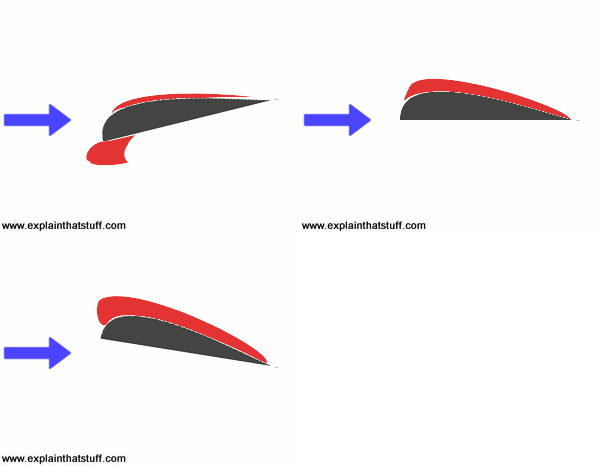
How airfoil wings generate lift#2: The curved shape of a wing creates an area of low pressure up above it (red), which generates lift. The low pressure makes air accelerate over the wing, and the curved shape of the wing (and the higher air pressure well above the altered air stream) forces that air into a powerful downwash, also pushing the plane up. This animation shows how different angles of attack (the angle between the wing and the incoming air) change the low pressure region above a wing and the lift it makes. When a wing is flat, its curved upper surface creates a modest region of low pressure and a modest amount of lift (red). As the angle of attack increases, the lift increases dramatically too—up to a point, when increasing drag makes the plane stall (see below). If we tilt the wing downward, we produce lower pressure underneath it, making the plane fall. Based on Aerodynamics, a public domain War Department training film from 1941.
You might be wondering why the air flows down behind a wing at all. Why, for example, doesn't it hit the front of the wing, curve over the top, and then carry on horizontally? Why is there a downwash rather than simply a horizontal "backwash"? Think back to our previous discussion of pressure: a wing lowers the air pressure immediately above it. Higher up, well above the plane, the air is still at its normal pressure, which is higher than the air immediately above the wing. So the normal-pressure air well above the wing pushes down on the lower-pressure air immediately above it, effectively "squirting" air down and behind the wing in a backwash. In other words, the pressure difference that a wing creates and the downwash of air behind it aren't two separate things but all part and parcel of the same effect: an angled airfoil wing creates a pressure difference that makes a downwash, and this produces lift.
Now we can see that wings are devices designed to push air downward, it's easy to understand why planes with flat or symmetrical wings (or upside-down stunt planes) can still safely fly. As long as the wings are creating a downward flow of air, the plane will experience an equal and opposite force—lift—that will keep it in the air. In other words, the upside-down pilot creates a particular angle of attack that generates just enough low pressure above the wing to keep the plane in the air.
How much lift can you make?
Generally, the air flowing over the top and bottom of a wing follows the curve of the wing surfaces very closely—just as you might follow it if you were tracing its outline with a pen. But as the angle of attack increases, the smooth airflow behind the wing starts to break down and become more turbulent and that reduces the lift. At a certain angle (generally round about 15°, though it varies), the air no longer flows smoothly around the wing. There's a big increase in drag, a big reduction in lift, and the plane is said to have stalled. That's a slightly confusing term because the engines keep running and the plane keeps flying; stall simply means a loss of lift.
Photo: How a plane stalls: Here's an airfoil wing in a wind tunnel facing the oncoming air at a steep angle of attack. You can see lines of smoke-filled air approaching from the right and deviating around the wing as they move to the left. Normally, the airflow lines would follow the shape (profile) of the wing very closely. Here, because of the steep angle of attack, the air flow has separated out behind the wing and turbulence and drag have increased significantly. A plane flying like this would experience a sudden loss of lift, which we call "stall." Photo by James Schultz, NASA Langley Research Center
and Internet Archive.
Planes can fly without airfoil-shaped wings; you'll know that if you've ever made a paper airplane—and it was proved on December 17, 1903 by the Wright brothers. In their original "Flying Machine" patent (US patent #821393), it's clear that slightly tilted wings (which they referred to as "aeroplanes") are the key parts of their invention. Their "aeroplanes" were simply pieces of cloth stretched over a wooden framework; they didn't have
an airfoil (aerofoil) profile. The Wrights realized that the angle of attack is crucial: "In flying machines of the character to which this invention relates the apparatus is supported in the air by reason of the contact between the air and the under surface of one or more aeroplanes, the contact-surface being presented at a small angle of incidence to the air." [Emphasis added]. Although the Wrights were brilliant experimental scientists, it's important to remember that they lacked our modern knowledge of aerodynamics and a full understanding of exactly how wings work.
Photo: As you can see from this modern reconstruction, the Wright Flyer didn't have airfoil wings.
By courtesy of NASA on the Commons.
Not surprisingly, the bigger the wings, the more lift they create: doubling the area of a wing (that's the flat area you see looking down from above) doubles both the lift and drag it makes. That's why gigantic planes (like the C-17 Globemaster in our
top photo) have gigantic wings. But small wings can also produce a great deal of lift if they move fast enough. To produce extra lift at takeoff, planes have flaps on their wings they can extend to push more air down. Lift and drag vary with the square of your speed, so if a plane goes twice as fast, relative to the oncoming air, its wings produce four times as much lift (and drag). Helicopters produce a huge amount of lift by spinning their rotor blades (essentially thin wings that spin in a circle) very quickly.
Wing vortices
Now a plane doesn't throw air down behind it in a completely clean way. (You could imagine, for example, someone pushing a big crate of air out of the back door of a military transporter so it falls straight down. But it doesn't work quite like that!) Each wing actually sends air down by making a spinning vortex (a kind of mini tornado) immediately behind it. It's a bit like when you're standing on a platform at a railroad station and a high-speed train rushes past without stopping, leaving what feels like a huge sucking vacuum in its wake. With a plane, the vortex is quite a complex shape and most of it is moving downward—but not all. There's a huge draft of air moving down in the center, but some air actually swirls upward either side of the wingtips, reducing lift.
Photo: Newton's laws make airplanes fly: A plane generates an upward force (lift) by pushing air down toward the ground. As these photos show, the air moves down not in a neat and tidy stream but in a vortex.
Among other things, the vortex affects how closely one plane can fly behind another and it's particularly important near airports where there are lots of planes moving all the time, making complex patterns of turbulence in the air.
Above: Colored smoke shows the wing vortices produced by a real plane. The smoke in the center is moving downward, but it's moving upward beyond the wingtips.
Below: How the vortex appears from below.
White smoke shows the same effect on a smaller scale in a wind tunnel test. Both photos courtesy of NASA Langley Research Center.
(Originals courtesy of Internet Archive can be found
here and
here.)
How do planes steer?
What is steering?
Steering anything—from a skateboard or a bicycle to a car
or a jumbo jet—means you change the direction in which it's traveling. In scientific terms, changing something's
direction of travel means you change its velocity, which is the speed it has in a particular direction. Even
if it goes at the same speed, if you change the direction of travel, you change the velocity. Changing something's
velocity (including its direction of travel) means you accelerate it. Again, it doesn't matter if the speed stays
the same: a change in direction always means a change in velocity and an acceleration. Newton's laws of motion tell us that
you can only accelerate something (change its speed or direction of travel) by using a force—in other words, by
pushing or pulling it somehow. To cut a long story short, if you want to steer something you need to apply a force to
it.
Photo: Steering a C-17 plane by banking at a steep angle.
Photo by Russell E. Cooley IV courtesy of US Air Force.
Another way of looking at steering is to think of it as making something stop going in a straight line and start going
in a circle. That means you have to give it what's called a
centripetal force. Things that are moving in a circle
(or steering in a curve, which is part of a circle) always have something acting on them to give them centripetal force.
If you're driving a car round a bend, the centripetal force comes from friction between the four tires and the road.
If you're cycling around a curve at speed, some of your centripetal force comes from the tires and some comes from
leaning into the bend. If you're on a skateboard, you can tilt the deck and lean over so your weight helps to provide
centripetal force. In each case, you steer in a circle because something provides the centripetal force that pulls your
path away from a straight line and round into a curve.
Steering in theory
If you're in a plane, you're obviously not in contact with the ground, so where does the centripetal force come from
to help you steer around a circle? Just like a cyclist leaning into a bend, a plane "leans" into a curve. Steering
involves banking, where the plane tilts to one side and one wing dips lower than the other. The plane's
overall lift is tilted at an angle and, although most of the lift still acts upward, some now acts sideways. This sideways
part of the lift provides the centripetal force that makes the plane go round in a circle. Since there's less lift
acting upward, there's less to balance the plane's weight. That's why turning a plane in a circle will make
it lose lift and altitude (height) unless the pilot does something else to compensate, such as using the elevators (the flight control surfaces at the back of the plane) to increase the angle of attack and therefore raise the lift again.
Artwork: When a plane banks, the lift generated by its wings tilts at an angle. Most of the lift still acts upward, but some tilts to one side, providing centripetal force that makes the plane steer round in a circle. The steeper the angle of the bank, the more the lift is tilted to the side, the less upward force there is to balance the weight, and the greater the loss of altitude (unless the pilot compensates).
Steering in practice
There's a steering control in the cockpit, but that's the only thing a plane has in common with a car. How do you steer something that's flying through the air at high speed? Simple! You make the air flow in a different way past the wings on each side.
Planes are moved up and down, steered from side to side, and brought to a halt by a complex
collection of moving flaps called control surfaces on the leading and trailing edges of the wings and tail. These are called ailerons, elevators, rudders, spoilers, and air brakes.
Photo: There are over 20 control surfaces on a C-17 Globemaster.
Seen here from above, they include: four elevators (inboard and outboard), two rudders (upper and lower),
and two stabilizers on the tail; plus eight spoilers, four flaps, and two ailerons on the wings.
Photo by Tiffany A. Emery courtesy of US Air Force with annotation by explainthatstuff.com.
Now flying a plane is very complex and I'm not writing a pilot's manual here: this is just a very basic introduction to the science of forces and motion as they apply to airplanes. For a simple overview of all the different plane controls
and how they work, take a look at Wikipedia's article on control surfaces. NASA's basic introduction to flight has a good drawing of
airplane cockpit controls and how you use them to steer a plane. You'll find much more detail in the official FAA
Pilot's Handbook of Aeronautical Knowledge (Chapter 6 covers the flight controls).
One way to understand control surfaces is to build yourself a paper plane and experiment. First,
build yourself a basic paper plane and make sure it flies in a straight line. Then cut or rip the back of the wings to make some
ailerons. Tilt them up and down and see what effect
they have in different positions. Tilt one up and one down and see what difference that makes. Then try making a new plane with one wing bigger than the other (or heavier, by adding paperclips). The way to make a paper plane steer is to get one wing to generate more lift than the other—and you can do this in all kinds of different ways!
Photo: The Wright brothers took a very scientific approach to flight,
meticulously testing every feature of their planes. Here they are pictured during one of their first powered flights on December 17, 1903. Courtesy of NASA/Internet Archive.
More parts of a plane
Here are some other key parts of planes:
Fuel tanks: You need fuel to power a plane—lots of it. An
Airbus A380 holds over 310,000 liters (82,000 US gallons) of fuel,
which is about 7,000 times as much as a typical car! The fuel's
safely packed inside the plane's huge wings.
Landing gear: Planes take off and land on sturdy wheels and
tires, which are rapidly retracted into the undercarriage (the plane's
underbody) by hydraulic rams to reduce drag (air resistance) when
they're in the sky.
Radio and radar: The Wright brothers had to fly their
pioneering Kitty Hawk plane entirely by sight. That didn't matter
because it flew near the ground, stayed in the air for only 12 seconds, and there were no
other planes to worry about! These days, the skies are packed with
planes that fly by day, by night, and in all kinds of weather.
Radio, radar, and satellite systems are essential for navigation.
Pressurized cabins: Air pressure falls with height
above Earth's surface—that's why mountaineers need to use oxygen
cylinders to reach extreme heights. The summit of Mount Everest is
just under 9km (5.5 miles) above sea level, but jet planes routinely
fly at greater altitudes than this and military planes have flown
almost three times higher! That's why passenger planes have
pressurized cabins: ones into which heated air is steadily pumped
so people can breathe properly. Military pilots avoid the problem by
wearing face masks and pressurized body suits.
Acknowledgements
I'm very grateful to Steve Noskowicz for invaluable help in refining and improving my explanation
of how wings generate lift.
The Beginner's Guide to Aeronautics: A great introduction to the science of flight (particularly aimed at students) from the NASA Glenn Research Center. Covers how planes and engines work, wind tunnels, hypersonics, aerodynamics, kites, and model rockets.
Flying Machine: The original Wright brothers patent (filed March 22, 1903 and granted May 22, 1906) is well worth a read, because it gives an insight into flight in the inventors own words. Since this patent describes an unpowered machine, it's easy to understand the crucial importance of the wings in a "flying machine"—something we tend to overlook in the age of the jet engine!
Pilot's Handbook of Aeronautical Knowledge: US Department of Transport/FAA, 2016. Unfortunately, even this official manual quotes the incorrect Bernoulli/equal-transit explanation of lift.
Books
For older readers
How to Land a Plane by Mark Vanhoenacker. Quercus/The Experiment, 2017/2019. A short but very imaginative guide to what you'd need to do if you ever found yourself in the pilot's seat.
Fundamentals of Aerodynamics by John David Anderson. McGraw Hill, 2016. A readable explanation of the science that keeps planes in the air.
The Airplane, a History of its Technology by John David Anderson. American Institute of Aeronautics and Astronautics, 2002. A book celebrating the first century of powered flight.
Eyewitness: Flight by Andrew Nahum. Dorling Kindersley, 2011. A visual guide to the history and technology behind planes and other flying machines.
Air and Space Travel by Chris Woodford. Facts on File, 2004. One of my own books, this one charts the history of flight through balloons, planes, and space rockets. Suitable for ages from about 10 to adult.
Articles
[PDF] How do wings work? by Professor Holger Babinsky. Physics Education, Volume 38, Number 6, 2003. A more detailed explanation of why the traditional Bernoulli explanation of lift is wrong, and an alternative account of how wings really work.
Videos
Airflow across a wing and
How wings work: These short scientific films by Holger Babinsky show the air movements across an airfoil (aerofoil) as the angle of attack changes and prove that the classic, simple Bernoulli explanation, based on equal transit time, is wrong.
How do wings really work?: A quick summary from the Bloodhound SSC project covers much the same ground as my article but in just a minute and a half!
How airplanes fly: A long (18.5 minute) 1968 video from the Federal Aviation Administration that explains the basics of flight to pilots.
Aerodynamics: This old and crackly US War Department training film from 1941 explains the theory of airfoils and how they produce different amounts of lift as the angle of attack varies.
↑ Newton's third law is sometimes written as "action and reaction are equal and opposite." That can be confusing, because it makes you wonder why anything goes anywhere at all: why don't the action and the reaction just cancel out? The answer is that the action and reaction work on different things. The action works on one thing; the reaction works on something else. So if the action is a whoosh of hot gas firing back from a jet engine, the reaction is the plane moving forward; if the action is a wing going upward, the reaction is the air going downward. The forces are indeed equal and opposite, but they don't cancel out because they act on different things.
Please do NOT copy our articles onto blogs and other websites
Articles from this website are registered at the US Copyright Office. Copying or otherwise using registered works without permission, removing this or other copyright notices, and/or infringing related rights could make you liable to severe civil or criminal penalties.