What's the connection between a water
pistol and this gigantic crane? On the face of it, no connection at all. But
think about the science behind them and you'll reach a surprising
conclusion: water pistols and cranes use the power of moving liquids
in a very similar way. This technology is called hydraulics and it's
used to power everything from car brakes and garbage trucks to
motorboat steering and garage jacks. Let's take a closer look at how it works!
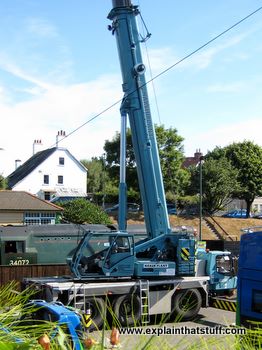
Photo: This crane raises its giant boom into the air using a hydraulic ram. Can you spot the ram here? The main one is shining silver in the sunlight in the center of the picture.
There are also rams supporting the stabilizers ("outriggers"): feet that extend out near the wheels to support the crane at the base when the boom is extended (they're highlighted with yellow and black warning stripes).
Gases are easy to squash: everyone knows how easy
it is to squeeze a balloon. Solids are just the opposite.
If you've ever tried squeezing a block of metal or a lump of
wood, with nothing but your fingers,
you'll know it's pretty much impossible. But what about liquids?
Where do they fit in?
You probably know that liquids are an
in-between state, a bit like solids in some ways and a bit like gases
in others. Now, since liquids easily flow from place to place, you
might think they'd behave like gases when you tried to squeeze them.
In fact, liquids are virtually incompressible—much like solids.
This is the reason a belly flop hurts if you mess up your dive into a
swimming pool. When your body smacks into the pool, it's because
the water can't squeeze downwards (like a mattress or a trampoline
would) or move out of the way quickly enough. That's also why jumping off bridges
into rivers can be very dangerous. Unless you dive correctly, jumping
off a bridge into water is almost like jumping onto concrete.
(Find out more about solids, liquids, and gases.)
Photo: Why does water squirt so fast from a syringe? You can't really compress a liquid at all, so if you force the water up through the wide part of the syringe by pushing hard on the plunger at the bottom, where's that water going to go? It has to escape through the top. Since the top is much narrower than the bottom, the water emerges in a high-speed jet. Hydraulics runs this process in reverse to produce lower speed but more force, which is used to power heavy-duty machines. It's exactly the same in a water pistol (below), which is effectively just a syringe shaped like a gun.
Sponsored links
The fact that liquids don't compress easily is
incredibly useful. If you've ever fired a water pistol (or a squeezy
washing-up liquid bottle filled with water), you've used this idea
already. You've probably noticed that it takes some effort to press
the trigger of a water pistol (or to squeeze water from a washing-up
bottle). When you press the trigger (or squeeze the bottle), you're
having to work quite hard to force the water out through a narrow
nozzle. You're actually putting pressure on the water—and
that's why it squirts out at a much higher speed than you move the
trigger. If water weren't incompressible, water pistols wouldn't work
properly. You'd squeeze the trigger and the water inside would simply
squash up into a smaller space—it wouldn't shoot out of the nozzle as
you'd expect.
If water pistols (and squeezy bottles) can change force and speed, that means (in strict scientific terms) they work just like tools and machines. In fact, the science of water pistols powers some of the world's biggest machines—cranes, tipper trucks, and diggers.
Hydraulics in theory
Turn a water pistol on its end and this is
(crudely simplified) what's going on inside:
Photo: A simplified view of a hydraulic water
pistol.
When you press on the trigger (shown in red), you apply a relatively
large force that moves the trigger a short distance. Because the water won't
squeeze into a smaller space, it gets forced through the body of the
pistol to the narrow nozzle and squirts out with less force but more
speed.
Now suppose we could make a water pistol work in reverse. If
we could shoot liquid into the nozzle at high speed, the water would
flow the opposite way and we'd generate a
large upward force on the trigger. If we scaled our water pistol up
many times, we
could generate a big enough force to lift things. This is exactly how a
hydraulic ram or jack works. If you squirt fluid through a narrow
tube at one end, you can make a plunger rise slowly, but with a lot
of force, at the other end:
Photo: How to magnify force with a water pistol
working in reverse.
The science behind hydraulics is called Pascal's
principle. Essentially, because the liquid in the pipe is
incompressible, the pressure must stay constant all the way through it,
even when you're pushing it hard at one end or the other. Now pressure
is defined as the force acting per unit of area. So if we press down
with a small force on a small area, at the narrow end of the tube on
the left, there must be a large force acting upward on the larger
area piston on the right to keep the pressure equal. That's how the
force becomes magnified.
What about energy?
Another way to understand hydraulics is by thinking about energy.
We've already seen that hydraulic rams can give us more force or speed, but they
can't do both at the same time—and that's because of energy. Look again at the water pistol graphic up above.
If you press down quickly on the narrow pipe (with a little bit of force), the plunger on the wide pipe
rises slowly (with a lot of force). Why would that be? A basic law of physics called
the law of conservation of energy says we
can't make energy out of thin air. The amount of energy you use to move the plunger
is equal to the force you use times the distance you move it. If our water pistol
produces twice as much force at the wide end as we supply at the narrow end, it can only
move half as far. That's because the energy we supply by pushing down is carried
right around the pipe to the other end. If the same amount of energy now has to move twice the force,
it can only move it half the distance in the same time. That's why the wider end moves more slowly
than the narrow end.
Hydraulics in practice
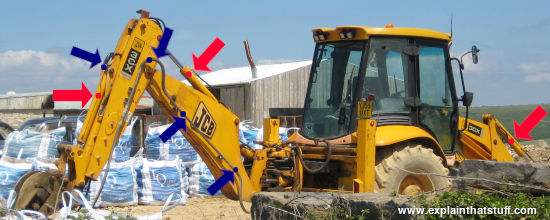
You can see hydraulics at work in this digger.
When the driver pulls a handle, the digger's engine pumps fluid into
the narrow pipes and cables (shown in blue), forcing the hydraulic rams (shown
in red) to extend. The rams look a bit like bicycle pumps working in
reverse. If you put several rams together, you can make a digger's
arm extend and move much like a person's—only with far greater
force. The hydraulic rams are effectively the digger's muscles:
Photo: There are several different hydraulic rams at work in this digger. The rams are shown by red arrows
and the narrow, flexible hydraulic pipes and cables that feed them in blue.
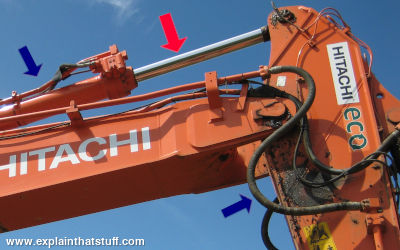
Each ram is working like a diesel-powered water pistol in reverse:
Photo: Close-up of a digger's hydraulic rams.
The engine is pumping hydraulic fluid through one of the thin pipes to move the thicker ram out with much greater force, like this:
Photo: How a hydraulic ram multiplies force.
You might be wondering how a hydraulic ram can move both inward and outward if the hydraulic fluid is always pushing it from one direction.
The answer is that the fluid doesn't always push the same way. Each ram is fed from opposite sides by two separate pipes.
Depending on which way the fluid moves, the ram pushes either inward or outward, very slowly and smoothly, as this little animation makes clear:
Photo: A hydraulic ram moves either inward or outward depending on which direction the hydraulic fluid is flowing.
Next time you're out and about, see how many hydraulic machines you can spot. You might be surprised just how many
trucks, cranes, diggers, dumpers, excavators, and bulldozers use them.
Here's another example: a hydraulic hedge-cutter on the back of a tractor. The cutting head needs to be sturdy and heavy to slash through hedges and trees and there's no way the driver could lift or position it by hand. Fortunately, the hydraulic controls do all that automatically: with several hydraulic joints, a bit like a shoulder, elbow, and wrist, the cutter moves with as much flexibility as a human arm:
Photo: A typical hydraulic hedge-cutter. Red arrows indicate the hydraulic rams.
Hidden hydraulics
Not all hydraulic machines are so obvious, however; sometimes their hydraulic rams are hidden out of sight.
Elevators ("lifts") keep their workings well hidden, so it's not always apparent whether they're working in the traditional way (pulled up and down by a cable attached to a motor) or using hydraulics instead. Smaller elevators often use simple hydraulic rams mounted directly underneath or alongside the lift shaft. They're simpler and cheaper than traditional elevators, but can use quite a bit more power.
Motors are another example where hydraulics can be hidden from view. Traditional
electric motors use electromagnetism: when an electric current flows through coils inside them, it creates a temporary magnetic force that pushes against a ring of permanent magnets, making the motor shaft rotate.
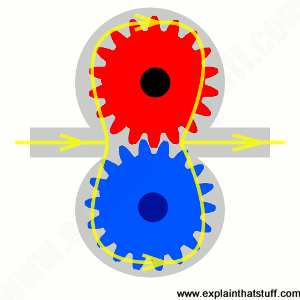
Hydraulic motors are more like pumps working in reverse. In one example, called a hydraulic gear motor, the fluid flows into the motor through a pipe, making a pair of closely meshing gears rotate, before flowing back out through another pipe. One of the gears is connected to the motor shaft that drives whatever the motor is powering, while the other ("the idler") simply turns freely to make the mechanism complete. Where a traditional hydraulic ram uses the power of a pumped fluid to push the ram back and forth a limited distance, a hydraulic motor uses continuously flowing fluid to turn the shaft for as long as necessary. If you want to make the motor turn in the opposite direction,
you simply reverse the fluid flow. If you want to make it turn faster or slower, you increase or decrease the fluid flow.
Artwork: A simplified hydraulic gear motor. The fluid (yellow) flows in from the left, spins the two gears, and flows out to the right. One of the gears (red) powers the output shaft (black) and the machine to which the motor is connected. The other gear (blue) is an idler.
Why would you use a hydraulic motor instead of an electric one? Where a powerful electric motor generally needs to be really big, a hydraulic motor just as powerful can be smaller and more compact, because it's getting its power from a pump some distance away. You can also use hydraulic motors in places where electricity might not be viable or safe—for example, underwater, or where there's a risk of electric sparks creating a fire or explosion. (Another option, in that case, is to use pneumatics—the power of compressed air.)
Machines and Motors by Jon Richards and Ed Simpkins. Gareth Stevens/Wayland, 2016. A clearly written, illustrated guide to all kinds of powered machines. A good overview that will help children understand how simple machines power the bigger, real-world machines they see around them.
The Way Things Work Now by David Macaulay. DK, 2016. Lots of hydraulic machines are taken apart and explained in this classic how-it-works tome.
Can You Feel the Force? by Richard Hammond. Dorling Kindersley, 2007/2015. A fun-filled introduction to basic physics. (I was one of the consultants on this book.)
Force and Motion by Peter Lafferty. Dorling Kindersley, 2000. Although this is quite old now and doesn't seem to have been updated, it's still easy to find in secondhand stores. One of the classic DK Eyewitness books, it has lots of fascinating history as well as modern science.
How Things Work: The Power of Pressure by Andrew Dunn. Thomson Learning, 1993. A slightly dated but still very relevant children's book that connects the basic science of fluids and water pressure to such everyday machines as hovercraft, vacuum cleaners, jackhammers, car brakes, and elevators.
For older readers
Hydraulic Machines and Energy by Giorgio Cornetti. Springer, 2022. A comprehensive general guide to hydraulic power.
Understanding hydraulics by Leslie Hamill. Palgrave Macmillan, 2011. A huge and very popular introduction to hydraulics for college-level engineering students.
Hydraulics and Pneumatics: A Technician's and Engineer's Guide by Andrew Parr. Butterworth-Heinemann, 1998 (reprinted 2013). A shorter book than Hamill's and one that compares the advantages of hydraulic and pneumatic power. Also for college-level.
Videos
Informational
Hydraulic Actuators by Vickers Hydraulics. A dated but quite clear video that explains basic hydraulic actuators, including single- and double-acting rams and hydraulic motors.
Fun projects
Make a Hydraulic Arm by Mist8K. A syringe-powered hydraulic arm with an electromagnetic pick up.
How a hydraulic scissor lift works by by DRHydraulics. This is quite a clear animation showing how a hydraulic pump makes a lift go up and down. It would be better if we could see a cutaway of the cylinder and how the fluid is flowing, but you get the idea.
Articles
Watch the HyQReal Robot Pull an Airplane by Evan Ackerman. IEEE Spectrum, May 23, 2019. You might robots are mostly electromechanical, but hydraulic components are becoming increasingly popular.
Pressure on hydraulics: The Engineer, February 24, 2003. Why is hydraulics still such a popular way of powering machines when electric power is, on the face of it, simpler and easier to implement?
Please do NOT copy our articles onto blogs and other websites
Articles from this website are registered at the US Copyright Office. Copying or otherwise using registered works without permission, removing this or other copyright notices, and/or infringing related rights could make you liable to severe civil or criminal penalties.