It's built to last you a lifetime—quite
literally. But though the human body is the most amazing tool at your disposal, it often needs a
helping hand. Tools made from metal,
wood, and plastic work like
extensions of your body, making you feel stronger and helping you work
faster and more efficiently. In science, tools like this are called
simple machines. And although you might think there's a big difference
between a tiny little wrench and a huge great earthmover, exactly the
same physics is at work in both. Let's take a closer look at tools and
machines and how they work!
Photo: This hydraulic digger uses a collection of simple machines (wheels, axles, and levers) to magnify the force its driver can exert. How many different machines you can spot at work inside the digger? Here are a few to start you off: the levers the driver pulls to make it do things, the wheels, the lever arm with the bucket on the end... and there are plenty more!
To do anything at all—to lift a box, to push a car, to get out of
bed, to jump in the air, to brush your teeth—you need to use a pushing
or pulling action called a force. If you go around telling
people you're strong, what you really mean is that your body can apply a lot of force. You
may have watched incredibly strong people on TV pulling trucks or
trains with their bare hands, but there's a limit to what even the most
muscle-bound human body can do. Simple machines let us go beyond that
limit. Simple machines can make us all strong!
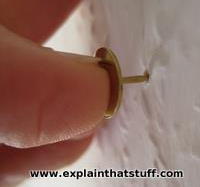
Photo: Thumbtacks (sometimes called drawing pins) are a bit like nails with built-in hammers. When you push on the large, flattened head, the force you apply (to the large flattened end) is effectively magnified because it's
concentrated into a much smaller area at the tiny pin head. According to science, even thumbtacks are simple machines.
When you hear the word "machine", you probably think of something
like a bulldozer or a steam locomotive.
But in science, a machine is
anything that makes a force bigger. So a hammer is a machine. A knife
and fork are a pair of machines. And even an egg whisk is a machine.
All these machines have one thing in common: when you apply a force to
them, they increase its size and apply a greater force somewhere else.
You can't cut meat with your hand alone, but if you push down on a
knife, the long handle and the sharpened blade magnify the force you
apply with your hand—and the meat slices effortlessly.
When you pound a nail with a hammer, the handle increases the force you
apply. And because the head of the hammer is bigger than the head of the nail,
the force you apply is exerted over a smaller area with much greater
pressure—and the nail easily enters the wood. Try pushing in a nail with your finger and
you'll appreciate the advantage a hammer gives you.
There are five main types of simple machine: levers, wheels and axles (which count as one),
pulleys, ramps and wedges (which also count as one), and screws. Let's look at them more closely.
Levers
A lever is the simplest machine of all: it's just a long bar that
helps you exert a bigger force when you turn it. When you sit on a
see-saw, you've
probably figured out that you need to sit further from the balance
point (known as the pivot point or fulcrum)
if the person at the opposite end
is heavier than you. The further away from the fulcrum you sit, the
more you can multiply the force of your weight. If you sit a long way
from the fulcrum, you can even lift a much heavier person sitting at
the
other end—providing they sit very close to the fulcrum on their side.
The force you apply with your weight is called the
effort.
Thanks to the fulcrum, it produces a bigger force to lift the
load (the weight of
the other person). The words "effort" and "load" can be very confusing,
so we've avoided using them in this article.
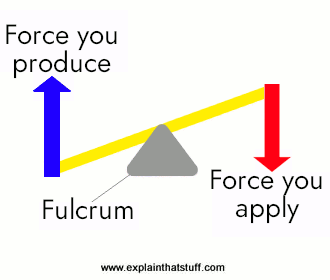
The important thing to remember about levers is that the force you
produce is bigger than
the force you apply:
With a long lever, you can exert a lot of leverage.
When you
use an axe or a wrench, the long handle helps to magnify the force you
can apply. The longer the handle, the more leverage you get. So a
long-handled wrench is always easier to use than a short-handled one.
And if you can't budge a nut or bolt with a short wrench, try one with
a longer handle.
Photo: Two tools that are levers. Left: A garden fulcrum weeder (green, top) and a pipe wrench (red, bottom). The weeder is a class-1 lever, while the wrench is a class-2 lever (these terms are explained immediately below). Right: Here's the weeder in action. The built-in fulcrum makes it easy to lift weeds with a long, strong tap root.
Types of lever
Levers are all around us. Hammers, axes, tongs, knives,
screwdrivers, wrenches, scissors—all these things contain levers. All
of them give leverage, but not all
of them work the same way. There are actually three different kinds of
levers (sometimes known as classes).
Class-1 levers
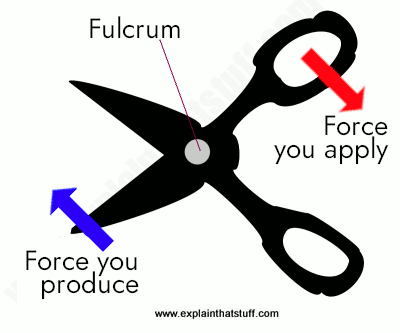
In a class-1 lever, the force you apply is
on the opposite side of the fulcrum to the
force you produce. A see-saw is an example
of a class-1 lever. So is a pair of scissors:
Class-2 levers
A class-2 lever is arranged a slightly
different way, with
the fulcrum at one end. You apply force at the other end and
the force you produce is in the middle. Nutcrackers, garlic presses,
and wheelbarrows
are all examples of class-2 levers:
Class-3 levers
A class-3 lever is different again. Like
a class-2 lever, it
has the fulcrum at one end. But the two forces switch around.
Now you apply the force in the middle and the force you produce is at
the opposite
end. Class-3 levers are unlike other machines in that they reduce the
force you apply, giving you much greater control. Tweezers and tongs
are an example of class-3 levers:
Pens are class-3 levers too: by pivoting them on our hands and
holding them in the middle, we get much more control over the nib or
ballpoint.
Sponsored links
Wheels and axles
The invention of the wheel and axle (the rod around which a wheel turns), around 5500 years ago in the Middle East, revolutionized transportation and gradually brought huge changes to society, but what made it so special?
It's easier to push a cart loaded with a heavy box than to push the same box along the ground because the cart's wheels and axles reduce friction and provide leverage. You can find out how in our main article
on how wheels work.
Big wheels are used to multiply force in other ways too.
Pipes, for example, have wheels called stopcocks (or stop valves) fitted to them. When you
turn the outer rim of a stopcock, the inner axle turns with much
greater force—so the pipe is easier to close. Steering wheels work this
way too. A truck or a bus often has a bigger steering wheel than a car,
because it takes more force to turn its wheels. The bigger wheel gives
the driver more leverage.
Wheels can multiply distance and speed as well as force. Bicycles have large wheels so they
go faster. When you pedal, you power the inside of the wheel. But the
wheel's outer rim turns around faster and covers more ground, so your
pedaling has a much greater effect. Car wheels work the same way.
Artwork: A wheel can work as either a force multiplier or a speed multiplier (but not both at the same time).
If you turn the outside (rim) of a wheel, the axle at the center turns with less speed but more force, so the wheel works as a
force multiplier. If you turn the axle instead (as a car does), the wheel becomes a speed multiplier.
The axle turns only a short distance (blue arrow), but the leverage of the wheel means
the outer rim turns much further (red arrow) in the same time. That's how a wheel helps you go faster.
Wheelbarrows combine wheels and levers to brilliant effect. A
wheelbarrow makes it really easy to transport a load from one place to
another—for two reasons. First, its long frame acts like a lever, so
the load is much easier to lift. Second, it's easier to push the load using
a wheelbarrow because the only friction is between the wheel and the axle.
If you pushed the load across the rough surface of the ground without using a
wheelbarrow, the friction would be much greater.
Gears
Photo: A gear is made from two or more wheels of different sizes with teeth cut into their edges to ensure they "mesh" (turn together without slipping).
Gears are wheels with teeth that can either increase the speed of a machine or its force,
but not both at the same time. Bicycles use gears in both ways. If you want to pedal up a hill,
you use gears to increase your force so you don't have to work quite so hard, although the
catch is that they reduce your speed at the same time. If you're racing along a straight road, you can use gears to increase your speed, but this time the catch is that they'll reduce your force. Although it's not obvious just by looking
at them, gears work in exactly the same way as levers (just as wheels do).
That takes quite a bit of explaining so we won't go into more details here.
Instead, you can read all about it in our gears article.
Pulleys
Put two or more wheels together and loop a rope around them several
times and you create a powerful lifting machine called a pulley. Each
time the rope wraps around the wheels, you create more lifting power or
mechanical advantage. If there are four wheels and the rope wraps around
them, the pulley works as though four ropes are supporting the load.
So you can lift four times as much, although the catch is that you have to pull the rope four times further.
Read more in our pulleys article.
Ramps and wedges
If you've ever helped pull a boat out of the sea, you'll know it's
easier to do it if there's a ramp on the shore. Instead of lifting the boat vertically,
straight up, you can get it out of the sea with much less force if you
go up the ramp. You use less force, but you need to pull the boat a longer
distance—so you use the same amount of energy
in each case. Hillwalkers
sometimes use the idea of a ramp to get to the top of a steep climb. By
zig-zagging from side to side across their climb, they effectively
create their own ramp. The hill becomes less steep, but they have to
walk quite a bit further to get to the top.
Ramps are sometimes known as inclined planes
or wedges. The head of an axe is a wedge working in a
different way. An axe forces wood apart in two ways. The handle works
like a lever, magnifying the force you apply. The wedge-shaped blade
concentrates the force over a smaller area, increasing the pressure on
the wood and splitting it apart. The blade of a knife works the same
way.
Artwork: The head of an axe works like a ramp. When it powers into wood, the wood splits apart along the diagonal. That means you can cut the wood by applying a smaller force over a larger distance. If you wanted to pull a log apart with your bare hands, you'd need to apply a much bigger force (though over a much shorter distance).
Screws
Photo: The spiral thread on a screw means it takes longer to drive
it into wood but—theoretically at least—you need less effort. The grooves also
help the screw to remain in place.
A screw bites into wood when you turn it around. You often read
science books that say a screw is "like
a ramp wrapped around in a circle", which is pretty confusing and hard
to understand. But imagine you're an ant and you want
to climb from the bottom of a screw to the top. If you climb vertically
up the outside, you go a relatively short distance but it takes an
awful lot
of climbing force. If you walk up the screw thread, winding around
and around, you're really walking up a kind of spiral staircase—a ramp
wrapped around in a circle. Yes, you walk much further, but it's a whole
lot easier. There's another good thing about a screw too: because
the head is bigger than the shaft beneath it, a screw works
like a wheel (or lever): each time you turn the head, the sharpened
point beneath bites into the wood with greater force. The tapering
(cone-shaped) design makes it easier to drive in the screw.
Machines are all around us!
That's pretty much all there is to the science of simple machines.
Once you understand how machines work, you start seeing them
everywhere. Even your body is packed with machines. Your skeleton, for
example, is a collection of levers! Take a look around your home and
see how many more "simple machines" you can spot. You'll be amazed how many there are!
Photo: Lots of everyday tools contain several simple machines. I can count at least five on this corkscrew and bottle opener. The bottle opener on the right is a wedge. Once you've jammed it under a bottle-top, you use the rest of the (folded-up) corkscrew as a lever to jack the bottle open. The corkscrew contains another three simple machines. To open a wine bottle, you push the screw down into the cork. Then you use the levers to force the cork up and out of the bottle. The screw is linked to the levers by a kind of worm gear.
Is there a catch?
Lifting, cutting, chopping, moving, bending—machines like the ones we've explored up above make it easier to do all kinds of things
by making forces bigger than you can normally create with your own body. At first sight,
that sounds like it might open up the way to designing a machine that can give us something for nothing—maybe one
that can make energy out of thin air, or a perpetual motion machine that runs forever.
In practice, the laws of physics are strict and if you make life easier for yourself in one way,
you always make it harder in another to compensate. That's the scientist's way of saying "there's no such thing as a
free lunch," and, in physics, it goes by the name of the law of conservation of energy
(simply put: we can't make energy appear magically out of nowhere).
So whenever you have a machine that gives you more force, it doesn't give you extra energy you didn't have before.
With a pulley, for example, ropes and wheels give you much more lifting force, but you have to heave them much further,
so you use exactly the same amount of energy as you would have done before. You just use it more slowly, with less effort,
so the lifting feels easier. In the same way, you can use a see-saw to lift a much heavier friend by sitting further
from the balancing point than they are, but you have to move your legs much further to compensate. You get extra force, but
no extra energy—and that's the catch.
Artwork: A seesaw lets you create extra lifting force. The little red person
can lift the big blue person by sitting further from the pivot point. That means they can lift a bigger force, but
the catch is that they have to move their own body over a much bigger distance.
This machine makes more force, but no more energy.
These are broadly particularly suitable for ages 7–12:
Simple machines
Making Machines with Levers by Chris Oxlade. Raintree, 2016. This is one of a series of six activity-driven books covering levers, wheels and axles, pulleys, ramps, screws, and springs. Ages 7–9.
Can You Feel the Force by Richard Hammond. DK, 2007/2015. A sparky, humorous look at the physics of forces. (I was one of the consultants and contributors to this book.)
Force and Motion by Peter Lafferty. DK, 2000. One of the series of excellent Eyewitness volumes from Dorling Kindersley covering the history, science, and technology of forces in our world.
Please do NOT copy our articles onto blogs and other websites
Articles from this website are registered at the US Copyright Office. Copying or otherwise using registered works without permission, removing this or other copyright notices, and/or infringing related rights could make you liable to severe civil or criminal penalties.
Woodford, Chris. (2007/2022) Tools and simple machines. Retrieved from https://www.explainthatstuff.com/toolsmachines.html. [Accessed (Insert date here)]