What's the world's favorite form of transportation? The car? The
bicycle? The jet airplane? If I had to hazard a guess, I'd pick none
of these things. Instead, I'd opt for the humble pipeline. You might
not notice pipes, but they're transporting vast amounts of fluid
(liquid and gas) around the world quietly and efficiently, day in and
day out. To work efficiently, pipes need a way of regulating how much
fluid can pass through them; they also need a way of switching the
flow off completely. That's the job that valves do: valves are like
mechanical switches that can turn pipes on and off or raise or lower
the amount of fluid flowing through them. Let's take a closer look at
how they work!
Photo: This stop valve is manually operated: you open and close it by turning the wheel.
A wheel like this makes a valve easier to open because it multiplies the force you apply at the rim to
produce a bigger and more useful force at the center. If you're not sure why,
take a look at our article on tools and machines. Photo by Brian Sloan courtesy of US Navy and DVIDS.
A valve is a mechanical device that blocks a pipe either partially
or completely to change the amount of fluid that passes through it.
When you turn on a faucet (tap) to brush your teeth, you're opening a
valve that allows pressurized water to escape from a pipe. Similarly,
when you flush the toilet, you open two valves: one (the siphon) that allows water
to escape to empty the pan and another (called a ball valve or
ballcock) that admits more water into the tank ready for the next
flush.
Photo: Valves come in all sizes. Some are tiny, like this poppet valve, which slides up and down on top of a drinks bottle to let the water in and out when you pull or push it with your teeth.
Valves regulate gases as well as liquids. If you have a gas cooktop (hob) on
your stove, the controls that turn the gas up or down are valves.
When you turn up the heat, you're opening a valve that allows more
gas to flow in through the pipe. More gas burns with a bigger flame
so you get more heat.
Valves are pretty much guaranteed to be in any machine that use
liquids or gases. There's a valve in your clothes washer that turns
the water supply on or off each time the drum rinses out. There are
also valves in the cylinders of your car engine, opening and closing
several times a second to admit air and fuel and to allow burned
exhaust gases to escape.
It's not just machines that use valves. Your body has some pretty
important valves inside your heart that allow it to pump blood to
your lungs (where it picks up oxygen) and then around your body.
Photo: Valves big and small. 1) This 7.3-m (24-ft) diameter butterfly valve from a wind tunnel dwarfs the man standing next to it! Photo by courtesy NASA on the Commons 2) This much smaller butterfly valve works the same way, swiveling open in the center to let air through a pipe. Photo by courtesy of NASA Glenn Research Center (NASA-GRC) and Internet Archive.
Sponsored links
How are valves made?
Valves are usually made of metal or plastic and they have several
different parts. The outer part is called the seat and it often has a
solid metal outer casing and a soft inner rubber or plastic seal so
the valve makes a closure that's absolutely tight. The inner part of
the valve, which opens and closes, is called the body and fits into
the seat when the valve is closed. There's also some form of
mechanism for opening and closing the valve—either a manual lever or
wheel (as in a faucet or a stop cock) or an automated mechanism (as
in a car engine or steam engine).
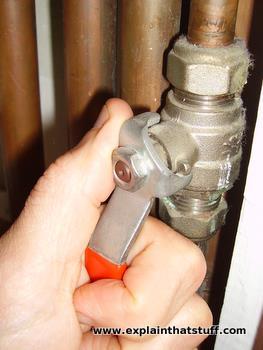
Photo: Shutting off the water with a sturdy brass isolation valve. Turning this lever through ninety degrees closes a ball valve in the middle of the pipe, cutting off the water flowing through. Most homes have valves like this on the incoming cold water "feed" and the pipes leading into and out from the water tanks. Isolation valves are very useful during an emergency (such as a burst water pipe) or for carrying out routine maintenance. Once the valve is closed, you can safely carry out repairs without the fluid all flooding out.
It's often critically important for valves that are switched off to allow absolutely no escape of
liquid or gas through a pipe to avoid accidents, explosions, pollution, or the loss of valuable chemicals
(even a dripping faucet can be expensive if your water is metered). That's why the seal on a valve needs to be perfectly secure and a valve that's turned off must be tightly closed. Turning off a high-pressure flow of liquid or gas by obstructing it
with a valve is physically hard work: in other words, you need to use a lot of force to
do it. That's why some valves are operated by levers (like the one photographed here, but
some can be much longer to give you more turning force) or large wheels (as in the top photo in this article).
If really big valves require too much force for a human to supply, they're operated by hydraulic rams.
Choosing the right material
Not all valves are big, mighty, industrial-strength things made of metal. Look carefully at food containers in your kitchen and you'll find
quite a few have valves in them. Water bottles (like the one I pictured above) often have poppet valves instead of
screw caps. The food jar top I've photographed below is another really ingenious example of a valve, made from
a springy elastomer (in practice, an elastic, synthetic, silicone rubber). It seals a food dispensing jar that normally sits upside down, so, in theory, the food could just dribble out onto the table beneath! This ingenious valve is what stops it. The rubbery material has four slits in it to let the food through, but it's also quite firm, so it opens only when you squeeze the jar. The pressure you supply when you squeeze forces the food through the four slits, which pop open. When you release the pressure,
the elasticity of the valve makes the slits pop back down and the seal the jar up again. It's so simple and mundane
that you've probably never even noticed it, yet it's an ingenious bit of engineering that relies on very careful
selection of exactly the right material.
Photo: An elastomeric food-sealing valve. Left: Looking from below at the sealed valve. Middle: Looking from above at the same sealed valve. Right: Looking from above with my finger pushing up to reveal how the self-sealing slit mechanism works.
(If you're interested, I believe this is a SimpliSqueeze® slit valve made by Aptar,
and you can read all the technical details of how it works in their
US10287066B2: Dispensing valve.)
And choosing materials for valves isn't just a matter of thinking how they'll function during their lifetime, but
what happens to them after that. With food packaging, for example, recycling is an increasingly important consideration. Take the little valves you find on coffee bags. After coffee is roasted and stuffed into bags, it might have to sit on a store shelf for anything up to a year, during which time it continues to give off carbon dioxide gas. Without a valve on the bag, it would puff up and potentially burst in the shop (or your kitchen), hurling coffee all over the place. So coffee bags have these ingenious one-way "degassing" valves on them made of membranes that open when the pressure builds up inside. That's why you can "wake up and smell the coffee" without actually opening the bag. When air tries to push in from outside, it flattens the membrane and seals the bag tight. So far so good, but what about recycling? If you start putting complicated plastic valves on bags, it makes the
bags far harder to recycle. What's the answer? Manufacturers are now making coffee bags and valves entirely from
compostable bioplastics to eliminate the waste disposal problem.
Photo: How coffee valves work. Top row: Left: A typical valve on the inside of a bag of coffee. Middle: This compostable bioplastic valve (made by the Swiss Wipf company) has a fixed outer seat (black) and an inner body (red) with a gas vent. Right: Take it apart and you'll find it also has a plastic membrane inside
(blue). The illustration below shows how these three parts work together. The membrane flexes up to let
CO2 escape, then flattens back down to stop air and water vapor getting in.
Types of valves
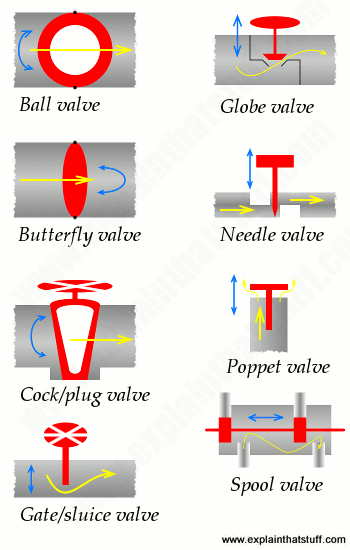
Artwork: Eight common types of valves, greatly simplified. Color key: the grey part is the pipe through which fluid flows; the red part is the valve and its handle or control; the blue arrows show how the valve moves or swivels; and the yellow line shows which way the fluid moves when the valve is open.
The many different types of valves all have different names. The
most common ones are the butterfly, cock or plug, gate, globe,
needle, poppet, and spool:
Ball: In a ball valve, a hollowed-out sphere (the ball) sits tightly
inside a pipe, completely blocking the fluid flow. When you turn the handle, it
makes the ball swivel through ninety degrees, allowing the fluid to flow through the middle of it.
Butterfly: A butterfly valve is a disk that sits in
the middle of a pipe and swivels sideways (to admit fluid) or
upright (to block the flow completely).
Cock or plug: In a cock or plug valve, the flow is
blocked by a cone-shaped plug that moves aside when you turn a wheel or
handle.
Gate or sluice: Gate valves open and close pipes by
lowering metal gates across them. Most valves of this kind are
designed to be either fully open or fully closed and may not
function properly when they are only part-way open. Water supply pipes use valves like this.
Globe: Water faucets (taps) are examples of globe
valves. When you turn the handle, you screw a valve up or down and this
allows pressurized water to flow up through a pipe and out through the spout
below. Unlike a gate or sluice, a valve like this can be set to allow more or less fluid through it.
Needle: A needle valve uses a long, sliding needle to
regulate fluid flow precisely in machines like car engine carburetors and
central-heating systems.
Poppet: The valves in car engine cylinders are poppets. This
type of valve is like a lid sitting on top of a pipe. Every so often, the lid
lifts up to release or admit liquid or gas.
Spool: Spool valves regulate the flow of fluid in
hydraulic systems. Valves like this slide back and forward to make
fluid flow in either one direction or another around a circuit of
pipes.
How do safety valves work?
Valves are often used to contain dangerous liquids or gases—maybe toxic chemicals, flammable petroleum, high-pressure steam,
or compressed air—that mustn't be allowed to escape under any circumstances. In theory, a valve
must be perfectly secure and, once closed, must never allow liquid or gas to get past it. In practice, that's not always true.
Sometimes it's better for a valve to fail, intentionally, to protect some other part of a system or machine.
For example, if you have a steam engine powered by a water boiler in which steam is building up, but the pressure suddenly gets too high, you need a valve to blow open, let the steam escape, and release the pressure safely before the entire boiler explodes catastrophically.
Valves that work in this way are called safety valves. Normally they're held closed by very sturdy springs. They're designed to open automatically when the liquid or gas they contain reaches a certain pressure (though many systems and machines have safety valves that can be opened manually for the same purpose).
Photo: The spring-loaded safety valves on a steam locomotive are positioned on the roof, above the boiler. All steam engines have at least two safety valves; some have three or even four.
Animation: How a steam engine safety valve works. The valve (blue) is normally held shut by a sturdy spring (red) above it. When the steam (orange) builds up to too high a pressure, it pushes the valve up and escapes through the vent (along the yellow arrowed path).
Here's an example of a safety valve fitted into an ordinary hot-water faucet (tap):
In a conventional faucet, you turn the orange handle at the top clockwise or counterclockwise to make the valve screw up or down. That allows water to flow from left to right through the horizontal pipe, around the bend (through the gap where the valve was), and out through the vertical pipe on the right.
You can turn the handle by different amounts to screw the valve open to a different height, letting different amounts of water through.
In this design by Paul Wesson, patented in 1923, there's an extra, safety valve at the bottom, colored green. It has a conical shape and is normally held tightly in place by the yellow spring coiled around it. However, if the water pressure builds up too much, it pushes against the cone, opens the valve, and the water escapes downward, releasing the pressure.
Valve Handbook by Philip L. Skousen. McGraw-Hill Education, 2011. A comprehensive guide to the different types of valves, how to choose them, how to size them, and the sorts of problems you can have with them.
Handbook of Valves and Actuators by Brian Nesbitt. Butterworth-Heinemann, 2007/2011. A practical guide to choosing and using valves, including a buyer's guide.
Valves, Piping, and Pipelines Handbook by T. Christopher Dickenson. Elsevier, 1999. A detailed technical reference. Lots of information about the different types of valves and how to choose valves for a particular application.
Articles
Building a Better Valve by Gina Kolata. The New York Times. June 20, 2015. A new type of heart valve procedure (transcatheter aortic valve replacement) places patients at less risk from surgery.
UK man gets artificial plastic heart by Ian Sample. The Guardian, 2 August 2011. Describes the structure of an artificial heart that uses plastic valves.
Safety valves tackle scald risk: BBC News, 5 September 2005. A report on the development of thermostatic faucet valves to protect elderly people.
Patents
Patents give a great insight into the technical nitty-gritty of how things really work. There are thousands covering the many different types of valves; here's a small and fairly random selection to start you off:
US10287066B2: Dispensing valve by Jason Hutton et al, AsparGroup. May 14, 2019. A technical description of the yellow self-sealing food valve photographed above.
Please do NOT copy our articles onto blogs and other websites
Articles from this website are registered at the US Copyright Office. Copying or otherwise using registered works without permission, removing this or other copyright notices, and/or infringing related rights could make you liable to severe civil or criminal penalties.