If you're like me and you love taking things to pieces,
springs are your nemesis. Try putting a gadget or a machine back together
again later and it's the springs that often defeat you: just where do
they go and how on Earth do they fit back in again? In their most
familiar form, springs are toughened coils of metal that help things
return to a particular position, but they can also be used to absorb
energy (as in car suspension) or store it for long periods of time
(as in watches and clocks). You can find springs in everything from
automatic doors to ballpoint pens. Let's take a closer look at how
they work!
Photo: Taut stainless steel coil springs on a desk lamp. Coil springs all have the same basic spiral shape but come in all sizes, from the tiny little ones you can find in ballpoint pens to the huge ones that wrap around shock absorbers on cars.
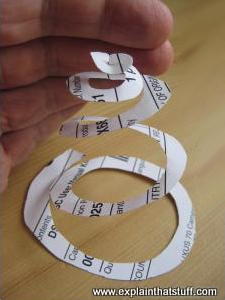
Photo: Make a paper spring by drawing a spiral on some paper or card. Then simply cut round the line with a pair of scissors. You'll be surprised how springy this spring is!
A typical spring is a tightly wound coil or spiral of metal that
stretches when you pull it (apply a force) and goes back to its
original shape when you let it go again (remove the force). In other
words, a spring is elastic. I don't mean it's made from rubber;
I mean that it has elasticity:
it gets longer when stress is applied but (providing
you don't stretch it too much) returns exactly to its original length
when that stress is removed. Depending on how a spring is made, it
can work in the opposite way too: if you squeeze it, it compresses
but returns to its original length when the pushing force is removed.
You can make a spring out of more or less anything—even
paper or orange peel!—but the kinds of springs we use in machines
work effectively only if they're stiff enough to resist a pulling force and durable
enough to be stretched many times without breaking. Typically that
means they have to be made from materials such as
stainless steel or tough alloys such as bronze.
Some alloys have a property called shape-memory, which means they're naturally
springy. Eyeglass frames are often made from a nickel-
titanium shape-memory alloy called nitinol,
sold under brand names such as Flexon®.
How does a spring work?
Imagine you have a piece of straight steel wire about 10cm (4 in)
long—something like a long paperclip you've unwrapped. If you pull it
with your fingers, it's extremely difficult to stretch it. Coil it
around a pencil and with a bit of effort you can make yourself a small but perfectly
functioning spring. Now pull or push it with your fingers and you'll
find you can stretch and squeeze it quite easily.
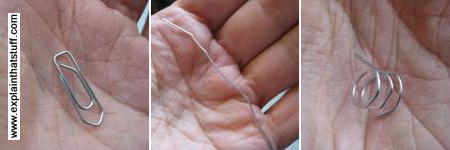
Photo: It's easy to make a simple coil spring from a paperclip.
Why has this once-stubborn piece of metal suddenly become so cooperative? Why is a
spring really easy to stretch and squeeze when the same piece of
metal, in the form of a wire, was so reluctant to change shape in the first place?
Sponsored links
When the material is in its original form, stretching it
involves tugging atoms out of their position in the metal's crystal
lattice—and that's relatively hard to do. When you make a spring (as
you'll discover if you try bending a paperclip), you have to work
a little bit to bend the metal into shape, but it's nowhere near as difficult.
As you bend the wire, you use energy in the process and some of that energy is stored in the
spring; it's prestressed, in other words. Once the spring is formed, it's easy to change its shape a
little bit more: the more windings of metal a spring has, the easier
it is to stretch or squeeze it. You've only to shift each atom in a
spiral spring by a small amount and the entire spring can stretch or
squeeze by a surprising amount.
Photo: Try bending a spring out of shape—and you can feel the
force you have to use to keep it there. It takes energy to deform a spring (change its shape): that energy is stored
in the spring and you can use it again later.
Springs are great for storing or absorbing energy. When you use a
pushing or pulling force to stretch a spring, you're using
a force over a distance so, in physics terms, you're doing work and
using energy. The tighter the spring, the harder it is to deform, the
more work you have to do, and the more energy you need. The energy
you use isn't lost: most of it is stored as potential energy in the
spring. Release a stretched spring and you can use it to do work for
you. When you wind a mechanical clock or watch, you're storing energy
by tightening a spring. As the spring loosens, the energy is slowly
released to power the gears inside and turn the hands around the
clockface for a day or more. Catapults and crossbows work in a
similar way except that they use twists of elastic for their springs
instead of coils and spirals of metal.
"Hooked" on springs
Artwork: The cover of Robert Hooke's 1678 book "Lectures de Potentia Restitutiva, Or of Spring Explaining the Power of Springing Bodies."
The more you stretch a spring, the longer it gets, the more work you do, and the more energy it stores.
If you pull a typical spring twice as hard (with twice the force), it stretches twice as much—but only
up to a point, which is known as its elastic limit.
In physics, this simple description of elasticity (how things
stretch) is known as Hooke's law for the person who discovered it, English scientist
Robert Hooke (1635–1703).
Hooke's law
Here's a chart that shows you Hooke's law in action. You can see that the more "load" you apply to the spring (the greater the force you use, shown on the vertical axis), the more the spring "extends" (shown on the horizontal axis). Hooke's law says the extension (the stretch) is proportional to the load, which is why the lower (red) part of the graph is a straight line. In this region, the spring is elastic: it goes back to its
original size when you let go.
However, you can see there's more to the graph than that. If you keep on stretching beyond the blue dot
(the elastic limit), you'll stretch the spring so much that it won't go back to its original length. In this
part of the graph (shown yellow and red), even a small amount of extra force can make the spring stretch by
a lot—it's almost like liquorice or bubble gum. In this region, the spring is no longer elastic but
"plastic" (it permanently deforms).
More Hooke
Hooke was a perfect polymath: apart from his law of springiness, which he
discovered in 1660 and published in 1678, he's best known as one of the major pioneers of microscopy, but he was active in many other fields, from architecture and astronomy to the study of memory and fossils.
Types of springs
Photo: Leaf springs provide crude suspension for this old railroad truck.
You might think a spring is a spring is a spring—but you'd be
wrong! There are several quite different kinds. The most familiar
ones are coil springs (like the ones you find in pens and the
one we made up above from a paperclip): cylinders of wire wrapped
around a circle of fixed radius. Spiral
springs are similar, but the coil gets progressively smaller as you reach
the center; our paper spring is an example. The delicate hairspring that helps to keep time in a
watch is another example of a spring like this. Torsion springs work like
the elastic in a catapult or an elastic band twisted repeatedly between your fingers: proper ones
are made from stiff pieces of metal that twist on their own axis. Leaf springs are stacks of curved metal bars
that support the wheels of a car or railroad truck and bend up and
down to smooth out the humps and bumps.
Springs also vary in the way they resist forces or store energy. Some are designed to absorb energy and force when you squeeze them; their coils start off slightly extended and squash together
when you apply a force, so they're called compression springs.
The opposite happens with extension springs (sometimes called tension springs): they start off
compressed and resist forces that try to stretch them.
Torsion springs have horizontal bars at their two ends so they can resist something twisting
or rotating.
Animation: Compression springs are designed to absorb forces by squeezing together. Tension springs work the opposite way, stretching apart when you apply a force. Torsion springs have parallel bars on the end that stop something turning (or bring it back to its original position if it does).
Sometimes you want a spring that will expand and contract by a greater distance without losing its shape; volute springs are ideal for this job. They're stiff, strong, compression springs made of flatter sheets of metal that concertina past one another. In these gardening secateurs, for example, the spring allows the "legs" to open a considerable distance and close up tightly again. If we used a conventional spring here, it would probably flex out of shape as we opened and closed the legs and they wouldn't be able to open so far.
Photo: Volute springs are tough compression springs that expand and contract over a long distance while still keeping their shape.
Not all springs work by stretching and squeezing pieces of metal, plastic, or another
solid material. An entirely different design involves using a piston that moves back
and forth in a cylinder of fluid (gas, liquid, or sometimes both), a bit like a bicycle pump that's
very hard to push in and out. Read more about these in our article on
gas springs.
What are springs used for?
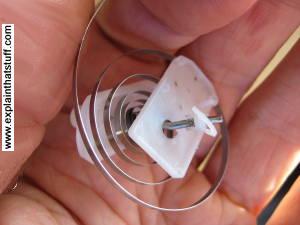
Photo: The mainspring from a clockwork toy.
When you wind up the toy, you compress the spring into a much tighter space to store energy that's
released when the toy starts to move.
Open up a ballpoint pen (one of the ones with a button you click
to retract the ball) and you'll find a spring inside. Look under a
car and there are springs there too, helping the shock absorbers to
smooth out the bumps in the road. There are springs in watches and
clocks, as we've already seen. And there's a spring in a car
speedometer (at least, one of the old-fashioned mechanical ones).
Once you've started spring spotting, you'll find you can see springs
everywhere!
What materials are springs made from?
Photo: When is a spring not a spring? Lots of everyday things need "spring" even if they're not springs. For example, the plastic lapel clip of this fountain pen is designed to flex (to an extent) so it stays firmly in your pocket. It's not a spring as such, but it's been carefully designed in exactly the same way.
Springs are generally made from spring steels, which are alloys based on
iron, with
small amounts of carbon (around 0.6–0.7 percent), silicon (0.2–0.8 percent), manganese (0.6–1 percent), and
chromium (0.5–0.8 percent). The exact composition of a spring steel depends on the properties you want it to have, which will include the
loads it will needs to withstand, how many cycles of stresses and strain it will undergo, the temperatures it has to operate under,
whether it needs to withstand heat or corrosion, how well it needs to conduct electricity, how "plastic" (easy to shape) it needs to be during its initial manufacture and shaping, and so on. Generally, springs are made from steels with a medium to high carbon content (that means a tiny amount of carbon in the total mix, but more than you'd find in other kinds of steel). They're usually given some form of heat treatment, such as tempering, to ensure they're strong and can withstand many cycles of stresses and strain—in other words,
so you can stretch or squeeze them many times without them breaking.
Springs usually fail through metal fatigue, which means they suddenly crack after being repeatedly moved back and forth. At the microscopic level, no spring is truly elastic: every time it goes through a stretching cycle (stretching or compressing and then returning to its original size), its internal structure is altering very slightly and tiny "microcracks" may be forming and growing inside it. At some point in the future, it will definitely fail: the spring will break when a crack grows big enough. Materials science teaches us that how springs are made is hugely important in making them last. For example, if you don't use the correct hardening temperature when the steel is being made, you'll produce weaker steel—and a weaker spring that's likely to fail more quickly.
About the author
Chris Woodford is the author and editor of dozens of science and technology books for adults and children, including DK's worldwide bestselling Cool Stuff series and Atoms Under the Floorboards, which won the American Institute of Physics Science Writing award in 2016. You can hire him to write books, articles, scripts, corporate copy, and more via his website chriswoodford.com.
Making Machines with Springs by Chris Oxlade. Raintree, 2015. A 32-page, hands-on introduction for grades 2–4, ages 7–9.
Magnets and Springs by Carol Ballard. Hachette, 2014. A 32-page guide (grades 2–4, ages 7–9). You might wonder why magnets and springs are covered together; that just happens to be how some science curricula teach it.
Springs by Angela Royston. Heinemann/Raintree, 2003. For younger readers (grades 2–4, ages 7–9).
For older readers
Materials for Springs by Y. Yamada. Springer, 2007. Describes the qualities needed for different types of springs and the various metals, alloys, and other materials (plastics, composites, ceramics, and so on) used to make them. For professional engineers and engineering students.
Materials Selection in Mechanical Design by Michael F. Ashby. Butterworth-Heinemann, 2016. A good introduction to the idea of using materials science in engineering.
Patents
US Patent 3,468,527: Coil spring by Glenn Mather, North American Rockwell/Boeing, 1968. An interesting technical insight into how coil springs are engineered.
Please do NOT copy our articles onto blogs and other websites
Articles from this website are registered at the US Copyright Office. Copying or otherwise using registered works without permission, removing this or other copyright notices, and/or infringing related rights could make you liable to severe civil or criminal penalties.