Have you ever tried lifting the trunk lid (sometimes called
tailgate, hatch, or boot) of your car with just one finger? How come you can lift a heavy piece of metal and glass with so little
force? The answer, if you didn't know already, lies in those clever piston-like hinges that support the lid either side. They're called
gas springs (or gas dampers) and they make our lives a whole lot
easier in all sorts of ways.
If you're sitting on an office chair right now, there's probably a gas spring underneath your body.
Release the height lever and you'll feel (and probably hear) the gas in the spring being compressed as the seat gently falls down. Gas
springs have loads of other uses too. Let's take a closer look at these handy gadgets and find out how they work!
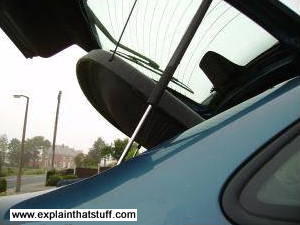
Photo: A sturdy gas spring (the thin black cylinder and the silver rod that slides in and out) supports the tailgate of this car during loading and unloading. It looks a bit like a bicycle pump, but it works in a very different way.
Suppose there were no springs on the hatchback of your car. It
would be really heavy to lift, for one thing. Awkward too, given its length.
There'd be nothing to hold it up in the air when you wanted to load in your shopping, which
would be a real nuisance. You'd have to pin it open with a clumsy metal support, like you do
with the hood (bonnet), which would probably be all dirty and oily. If you let the lid go, it would crash down onto your car's bodywork, probably doing a lot of damage in the process.
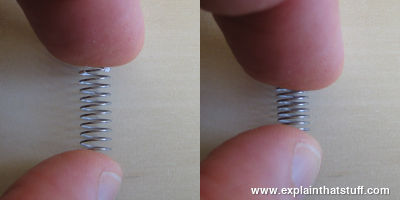
Photo: Ordinary springs tend to work better in one direction than another, so they're not the best option for holding a trunk lid in place or making it easier to move.
Saloon cars with small trunk lids often use normal metal springs, but those are not a great solution for hatchbacks, liftbacks, and similar cars. A simple "tension" spring (one that you have to work to pull apart) would need to be very stiff and heavy, so it would take a huge amount of effort to lift the hatch high in the air. The higher you lifted it, the harder it would get to lift any further. With the lid opened up fully, the spring would be stretched out so much that it would pull straight back down again. You could use a "compression" spring instead (one you have to work to push together), but it's often better to use an entirely different kind of spring: one that doesn't rely on
stretching or squeezing metal to absorb energy.
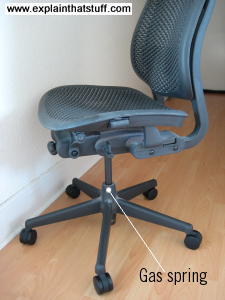
Photo: A vertically mounted gas spring supports the seat of this "gas-lift" office chair, making it easy to adjust the height. Gas springs generally work best in a vertical position like this. There's less chance of them buckling when fully extended and the oil inside lubricates them more smoothly and evenly.
How a gas spring works
The basic idea
A gas spring is a bit like a super-sturdy version of a bicycle pump,
only it's filled with pressurized nitrogen gas (the major constituent of the air around us) and oil and completely sealed up so they can't escape. The gas allows the spring to store energy, while the oil damps (slows and smooths) the movement of the piston and also provides lubrication. Just like in a bicycle pump, there's a tight-fitting piston mounted on a rod that can slide back and forth inside a cylinder (made from heavy gauge steel, not light plastic as in a bicycle pump).
Push on a gas spring and you force the piston rod and piston into the cylinder and this compresses the gas.
Stop pressing and let go and the pressure of the gas pushes the piston back out again. So far, that sounds
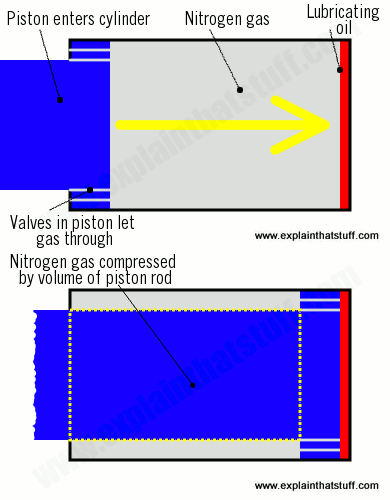
just like a bicycle pump—but it's working in a different way. Unlike with a bicycle pump, gas inside the cylinder can actually flow through or around the piston from one side to the other as it moves back and forward. Exactly how this happens varies from one design of gas spring to another; usually the piston has one or more holes or valves in it. Now if the piston can move through the gas, you might think it isn't compressing the gas at all. But don't forget that the whole cylinder is completely sealed. When the piston rod is inside the cylinder, it's taking up room that the gas previously occupied. In other words, when a gas spring is fully pushed in, you've compressed the gas inside by an amount equal to the volume of the piston rod. If the piston rod occupies virtually the whole cylinder, you can see that the gas is getting compressed quite substantially. The gas pressure can be very high, typically up to about 170 times normal atmospheric pressure!
Photo: The gas inside a gas spring can flow through or around the piston from one side to the other, but
it can't escape from the cylinder. The whole system is sealed so, as the piston enters, the gas is compressed by a volume equal to the space occupied by the piston rod.
How a gas spring generates a force
There's one particularly important difference between a bicycle pump and a gas spring—and that's the
way in which force is generated when you push in the piston. Suppose you cover the end
of a bicycle pump and push on the piston. You'll immediately find there's a force pressing outward
against your hand, because the pressure of the gas on one side of the piston is higher than the
pressure of the air on the other side. In other words, the force is produced by a difference in pressure
on the two sides of the piston.
In a gas spring, things are different. Fluid can flow around or through the piston
from one side to the other, so the pressure is the same on both sides.
However, the pressure acts over a greater area on the inside surface of the piston than on the outside
(because the piston rod takes up some room). That means there's more force on the inside face
than on the outside—and that's how a gas spring produces a force when you push it
in. In other words, the force is produced by a difference in area.
Photo: Where does the force come from? In a gas spring, fluid at equal pressure pushes against both sides of the piston. But the inside of the piston (on the right) has a bigger area than the outside (on the left, where the blue piston rod takes up room). This means there's more force pushing on the inside than on the outside—giving a net outward or "output" force.
The size of the force a gas spring produces (sometimes called its "output force") is equal to the area of the piston times
the internal pressure. The output force is reduced by friction between the piston and the cylinder
(which is one reason why lubrication is important) and increases with temperature (because,
according to the basic gas laws, higher temperatures increase
the pressure of the gas inside the cylinder).
Much like metal springs, gas springs come in all different sizes.
You can choose one with just the right size of cylinder and piston
and the right amount of gas pressure to give precisely
as much force in the spring as you need to do
a particular job. To support the trunk lid of a car, you need the two
gas springs either side to provide roughly as much force when they're
compressed as the weight of the lid. For a gas-lift office chair, you
need the spring to provide a little bit more force than the weight of
the seat. In most chairs, the spring doesn't actually support the
person's weight. Instead, it typically has a lever attached
that grips and locks at a certain height, preventing the seat from moving up or
down any further. The spring is simply designed to let the seat move up and down
gently without your having to supply much force.
Sponsored links
Gas springs as dampers
One thing you'll notice about gas springs is that they work slowly and smoothly. The end of the piston is
designed so the fluid inside the cylinder (gas and liquid) can flow through or around it very slowly.
Different springs are designed in various different ways and some pistons are arranged so the fluid will flow
more quickly past them when the spring moves in one direction than when it moves the opposite way. For example,
when the piston is compressed into the cylinder, the end of the piston may be designed to close up a valve so
fluid can flow through it only very slowly, reducing the speed at which the piston can move.
When the piston moves the other way, the valve can be designed to open up so fluid will travel past it more quickly,
allowing the piston to move much faster. Gas springs are usually designed with a particular size of load in mind so
they expand very smoothly at a particular rate (so many centimeters or inches per second).
A gas spring's job is to make your life easy—and it does it by
storing energy (when there's plenty
available—usually when you're lowering something heavy) and releasing that energy
(when you need extra help—usually when you're lifting something up). Think of a gas spring as a kind of
mechanical battery that stores and releases energy by squeezing
and releasing a gas and you can see why it's so useful.
What's happening with energy when you lift a heavy trunk lid that
has no springs of any kind? There's a lot of mass in the steel and
glass lid so it takes a lot of energy to raise it up against the force
of gravity, which is constantly trying to pull it back down.
Once the lid is high in the air, it has stored potential energy: you
can release the lid and it'll crash straight back down again. If that
happens, the potential energy is instantly converted into
kinetic energy, as the lid accelerates,
and then heat and sound energy when the lid smashes onto the car's body. What a waste!
With a couple of gas springs on either side of the lid, it works a
different way. Now, when you gently lower the lid, the weight of the
metal and glass forces the pistons into the gas springs, compressing the nitrogen gas inside.
As you lower the lid, the potential energy it had when it was up in the air is
slowly converted into potential energy inside the gas springs and
stored there. Next time you want to raise the lid, that potential
energy is waiting inside the springs ready to help you. Release the
lid catch, lift the lid gently, and the potential energy stored in
the gas springs is slowly released. The pistons push out from the gas springs and help you lift the lid back up again.
How a gas spring stores and releases energy
You store energy when you push a gas spring inward:
The spring is fixed to a mounting bracket that can move back and forth with the door, lid (or whatever else it's attached to).
When you apply a force, the bracket moves inward and pushes on the piston rod (blue), which moves into the cylinder (black).
The piston rod pushes the piston (red) through the gas (gray). The piston makes a tight seal as it slides along the cylinder, but gas (and oil) can flow through it from (in this case) the right side to the left (and back again).
The lubricant oil (yellow) greases the piston as it slides in and out.
Tight seals (usually O-rings) allow the piston rod to move
freely but keep the lubricant oil and the gas safely inside the cylinder.
The nitrogen gas (gray) inside the cylinder is compressed as the piston moves in by an amount equal to the
volume of the piston rod. Note that the gas is compressed on
both sides of the piston, to exactly the same pressure, as the piston moves in
(that's different to a bicycle pump where the gas is compressed only on one side).
The other mounting bracket stays in the same place throughout.
When you let the spring move outward, the pressurized nitrogen gas expands, the piston moves back the other way, and the stored energy is released.
How does the gas stay inside?
If you've ever blown up balloons to use as party decorations, you've probably been disappointed
by how quickly they started to deflate. Trapping gas isn't easy. How, then, do gas springs
manage to keep pressurized gas inside them—and carry on working for years or even decades?
It's obviously all in the seal. Up above, I described the seals as simple O-rings, but
a variety of different fluid seals can be used, sometimes individually, sometimes in combination.
Some gas springs use X-rings (similar to O-rings but with an X-shape cross-section, so giving a greater sealing surface area), some use Teflon™ (PTFE) glide rings, which sit snugly between the O-rings and the cylinder wall, some use T-seals (like O-rings with a protruding ridge), and there are various other sealing methods.
Artwork: One way of sealing gas springs. Here we're using traditional O-rings (black) with
PTFE glide rings attached (green) to give an improved, long-lasting, low-friction seal.
Why use a gas spring?
A gas spring can do a similar job as an ordinary metal spring,
though it has a number of advantages. Because of the high pressure of the gas inside it, a gas spring can be much more compact
than a metal spring that would provide the same amount of force. Gas springs expand and contract more smoothly than
metal springs and can be designed to open and close at an exact and constant speed (unlike metal springs, which contract faster when they are
extended further and can be very unpredictable). Mechanically, gas springs are simple and have few
moving parts, so they are relatively cheap, extremely reliable, and often last many years without any maintenance at all.
Metal springs are more likely to break through repeated stretching and releasing
(loading and unloading) because of fatigue.
Gas springs sound great, don't they? But that doesn't mean you'll find them everywhere. Some things that look very much like gas springs turn out to be a little bit different inside. Barber chairs, for example, are hydraulic (powered by a kind of fluid-filled piston). Why not a gas spring? The hydraulic mechanism is more precise and means the person cutting your hair can position the chair exactly where they want it without you having to do anything at all.
Photo: Barber chairs use hydraulic lift mechanisms (pumped up and down by a foot pedal). Photo by Justin Wolpert courtesy of US Navy and
Wikimedia Commons.
Doors often have elbow-like closing devices fitted onto their top edge that pull them shut automatically. At a glance, they look very much like gas springs but, inside, they use a combination of one or two hydraulic (oil-filled) pistons, a rack-and-pinion gear, an ordinary coiled metal spring, and (sometimes) a cam.
Photo: When is a gas spring not a gas spring? Automatic door closer arms like this look like gas springs but actually use a combination of liquid damping cylinders and traditional metal coil springs.
Some "gas springs" use a mixture of gas and liquid in their pistons; the one illustrated below is an example.
Artwork: Despite their name, some gas springs contain liquid as well as gas. This one has a chamber at one end, filled with compressed nitrogen gas (light blue, left), and a liquid chamber right next to it (orange, middle), through which a piston (blue) slides back and forth. The spring would normally be mounted with the left side down and the right side up, propping open the hatch on a car. Using a clever arrangement of O-rings and valves, it allows the piston to move easily to the right (upward)
so the car's hatch lifts easily, but takes extra force to move to the left (downward); in other words, it props the hatch open
until you push it down quite deliberately and forcefully. Using a liquid as well as a gas means the spring stays locked in its open position even in cold weather. The gas in a simple gas spring, without the added liquid (in other words, essentially just the light blue chamber on the left) would tend to compress significantly in cold weather and might be unable to keep the hatch open by itself.
Artwork from US Patent 4,433,759: Gas spring, by Hisao Ichinose, Nissan Motor Co. Ltd., 1984, courtesy of US Patent and Trademark Office.
Hydropneumatic Suspension Systems by Wolfgang Bauer. Springer, 2014. A detailed engineering guide covering springs, shock absorbers, and gas springs.
Patents
US Patent 4,433,759: Gas spring by Hisao Ichinose, Nissan Motor Co. Ltd., February 28, 1984. A typical telescopic gas spring used on an automobile's hatch door.
US Patent 4,309,026: Gas spring by Hermann Reuschenbach and
Willi Schafer, January 5, 1982. A typical suspension-type gas spring with an automatic built-in braking system.
Application of gas spring for robot arm balancing by Doo Hyeong Kim et al, IEEE 14th International Conference on Control, Automation and Systems (ICCAS 2014). Using gas springs to reduce the motor power needed by an industrial robot.
Please do NOT copy our articles onto blogs and other websites
Articles from this website are registered at the US Copyright Office. Copying or otherwise using registered works without permission, removing this or other copyright notices, and/or infringing related rights could make you liable to severe civil or criminal penalties.