Think back 100 years to a world where
people generally got around by
walking or riding horses. What changed things? The invention of the car.
Wheels may be 5500 years old, but the cars we
drive round in today made their debut only in 1885. That was
when German engineer Karl Benz (1844–1929) fastened a small gasoline
(petrol) engine to a three-wheeled cart and made the first primitive,
gas-powered car. Although Benz developed the automobile, another German
engineer, Nikolaus Otto (1832–1891), was arguably even more
important—for he was the man who'd invented the gasoline engine in the
first place, about two decades earlier. It's a testament to Otto's
genius that virtually every car engine made ever since has been
inspired by his "four-stroke" design. Let's take a look at how it works!
Photo: Car engines turn energy locked in liquid fuel into
heat and kinetic energy.
They're full of pipes and cylinders because they work like mini chemical plants.
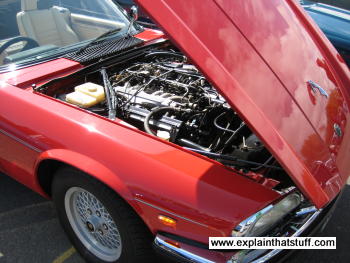
This is the powerful V12 engine on a gloriously restored Jaguar XJS sports car from the late 1970s.
Photo: The restored (and nicely polished!) engine in a classic car from the early 1970s.
That's not quite such an obvious question as it seems. A car is a
metal box with wheels at the corners that gets you from A to B, yes,
but it's more than that. In scientific terms, a car is an
energy converter: a machine that releases the energy locked in a fuel like
gasoline (petrol) or diesel and turns it into mechanical energy in
moving wheels and gears. When the wheels power the car, the
mechanical energy becomes kinetic energy: the energy that the
car and its occupants have as they go along. The challenge
of building a car engine is to get as much energy out of each drop of fuel as possible—to make
the car go as far and as fast as it can.
How do we get power from petroleum?
Cars, trucks, trains, ships, and planes—all these things are powered
by fuels made from petroleum. Also known as
"crude oil",
petroleum is the thick, black, energy-rich liquid buried deep
underground that became the world's most important source of energy
during the 20th century. After being pumped to the surface,
petroleum is shipped or piped to a refinery and separated into
gasoline, kerosene, and diesel fuels, and a whole host of other
petrochemicals—used to make everything from paints to plastics.
Photo: Petroleum can be extracted from the ground
by "nodding donkey" pumps like this one. Photo by Carol M. Highsmith courtesy of The Lyda Hill Texas Collection of Photographs in Carol M. Highsmith's America Project, Library of Congress, Prints and Photographs Division.
Petroleum fuels are made from hydrocarbons:
the molecules
inside consist mostly of carbon and hydrogen atoms (with a fewer other
elements, such as oxygen, attached for good measure).
Wood, paper, and
coal also contain hydrocarbons. We can turn hydrocarbons into useful
energy simply by burning them. When you burn hydrocarbons in air, their
molecules split apart. The carbon and hydrogen combine with oxygen from
the air to make carbon dioxide gas and water, while the energy that
held the molecules together is released as heat. This process, which is
called combustion, releases huge amounts of
energy. When you sit round
a camp fire, warming yourself near the flames, you're really soaking up
energy produced by billions of molecules cracking open and splitting
apart!
Photo: Why does the world use so much oil? There are now about a billion petroleum-powered
cars on the planet and, as this chart shows, even the most energy-efficient model here burns through at least 6.1 barrels (256 US gallons) of petroleum in a year. Drawn using energy impact scores for 2024 models shown on the US Department of Energy's
Fuel Economy website.
People have been burning hydrocarbons to make energy for over a
million years—that's why fire was invented. But ordinary fires are
usually quite inefficient. When you cook sausages on a camp fire, you
waste a huge amount of energy. Heat shoots off in all directions;
hardly any goes into the cooking pot—and even less into the food. Car
engines are much more efficient: they waste less energy and put more of
it to work. What's so clever about them is that they burn fuel in
closed containers, capturing most of the heat energy the fuel releases,
and turning it into mechanical energy that can drive the car along.
Sponsored links
What are the main parts of a car engine?
Car engines are built around a set of "cooking pots" called cylinders
(usually anything from two to twelve of them, but typically four, six,
or eight) inside which the fuel burns. The cylinders are made of
super-strong metal and sealed shut, but at one end they open and close
like bicycle pumps: they have
tight-fitting pistons (plungers) that can
slide up and down inside them. At the top of each cylinder, there are
two valves
(essentially "gates" letting things in or out that can be opened and
closed very quickly). The inlet valve allows
fuel and air to enter the cylinder from a
carburetor or electronic fuel-injector; the outlet valve lets
the exhaust gases escape. At the top of the cylinder, there is also a sparking plug
(or spark plug), an electrically controlled device that makes a spark
to set fire to the fuel. At the bottom of the cylinder, the piston is
attached to a constantly turning axle called a
crankshaft.
The crankshaft powers the car's gearbox which, in turn, drives the wheels.
How does a four-stroke engine make power?
Watch this animation and you'll see that a car engine makes its
power
by endlessly repeating a series of four steps (called strokes):
Intake: The piston (green) is pulled down inside the cylinder
(gray) by the momentum of the crankshaft (gray wheel at the bottom). Most of the time
the car is moving along, so the crankshaft is always turning. The inlet
valve (left) opens, letting a mixture of fuel and air (blue cloud)
into the cylinder through the purple pipe.
Compression: The inlet valve closes.
The piston moves back up the
cylinder and compresses (squeezes) the fuel-air mixture, which makes it
much more flammable. When the piston reaches the top of the cylinder,
the sparking plug (yellow) fires.
Power: The spark ignites the fuel-air
mixture causing a mini
explosion. The fuel burns immediately, giving off hot gas that pushes
the piston back down. The energy released by the fuel is now powering
the crankshaft.
Exhaust: The outlet valve (right)
opens. As the crankshaft
continues to turn, the piston is forced back up the cylinder for a
second time. It forces the exhaust gases (produced when the fuel
burned) out through the exhaust outlet (blue pipe).
The whole cycle then repeats itself.
How many cylinders does an engine need?
One problem with the four-stroke design is that the crankshaft is being
powered
by the cylinder for only one stage out of four. That's why cars
typically have at least four cylinders, arranged so they fire out of
step with one another. At any moment, one cylinder is always going
through each one of the four stages—so there is always one cylinder
powering the crankshaft and there's no loss of power. With a
12-cylinder engine, there are at least
three cylinders powering the crankshaft at any time—and that's why
those engines are used in fast and powerful cars.
Photo: More cylinders mean more power. 1) White: A 4-cylinder, 48hp
Morris Minor engine from the 1960s. This engine is so incredibly tiny, it really looks like there's something missing—but it
can still manage a top speed close to 125 km/h (80mph). 2) Red: A huge V12
Jaguar XJS sports car engine from the mid/late 1970s gives a top speed of about 240 km/h (140 mph). It's something like 300hp (about six times more powerful than the Morris engine). Apart from the number of cylinders, the engines also differ in their cylinder designs. The Morris engine is "undersquare," which means it has quite narrow (small-bore) cylinders that push the piston a long distance (stroke). The Jaguar engine is "oversquare," with wider cylinders whose pistons don't push so far. These terms are explained more fully below.
How big do the cylinders need to be?
It's not just how many cylinders a car has that's important but how much power each one can make as it pushes out its piston.
That depends on the size of the cylinder, which, in turn, depends on two key measurements: the diameter of the cylinder (called its bore) and how far the piston moves out (its stroke). The area of a circle is π × radius2, and since the bore is twice the radius, the useful volume of a car cylinder is (π/4) × bore × bore × stroke. In physics terms, the volume of the cylinder is related to how much work the fuel does as it expands, how much energy it transfers to the piston, and (if we consider how often this happens), how much power the car makes. So the bore and stroke are very important—and that's why they're often quoted in technical specifications for car engines along with the number of cylinders. You'll often see these measurements written in the form bore × stroke (so, for example, 90 × 86mm means a bore of 90mm and a stroke of 86mm).
Artwork: How the bore, stroke, and displacement of one cylinder are measured. The bore is the diameter of the cylinder, the stroke is the distance the piston moves, and the displacement is the effective volume.
You'll also see the total volume of a car's cylinders quoted in a measurement
called the displacement, which is the volume of a car's cylinders multiplied by how many of them there are.
(In other words, it's π/4 × bore × bore × stroke × number of cylinders.)
So when you hear a car described as having a "two-liter engine," that usually means it has four cylinders of 0.5 liters or six cylinders of 0.33 liters. The displacement is a rough guide to how much power a car engine can make and you'll usually see it
quoted in either liters or cc (cubic centimeters); 1 liter is the same as 1000 cc.
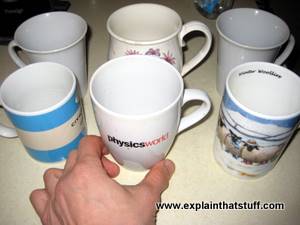
Photo: Make your own two-liter engine! If you find it hard to visualize a two-liter engine, try this. An average coffee mug holds about 0.3 liters and is roughly the same dimensions as a typical car cylinder. Six of these mugs lined up give you a volume of about two liters—the total displacement of the engine in a large family saloon.
Typical bore and stroke sizes are 70–100mm (roughly 3–4 in).
You might think making a more powerful engine is simply a matter of choosing a bigger bore and stroke,
but there's much more to it than that, and there clearly have to be compromises (for example, you can't make small cars with enormous cylinders). In practice, the bore and stroke affect a number of different things, not just how powerful and efficient
the engine is overall, but how much power it makes at different speeds: whether it's optimized for
high power at high speed (as in a race car) or high power and fuel economy at lower speeds (as in a long-distance truck).
If the bore and stroke measurement is more or less the same, the engine is described as square.
A bigger bore and a shorter stroke gives us what's called an oversquare (short-stroke) engine.
It has bigger valves for shifting more gas through the cylinders at higher speeds, so it can
can make high power at higher rpm, and it's a good arrangement for a race car or a superbike (powerful motorbike).
A smaller bore and a longer stroke, in what's called an undersquare
(long-stroke) engine, gives us more power at lower revs, which is great for a slow-moving, heavy truck
or a heavier motorbike.
All of this is a bit of a generalization, because it's easy to find examples of all types of cars that use square, oversquare, and undersquare engines, as the following table of engines past and present clearly shows.
Bore (mm)
Stroke (mm)
Disp (cc)
Cyls
Square
Subaru BRZ
86
86
1998
4
Nissan Qashqai
72.2
73.2
1199
4
Lincoln Town Car
90.2
90
4601
8
Bugatti Chiron
86
86
7993
16
Under square (long stroke)
Harley Davidson (bike)
99.9
111
1746
2
Morris Minor
57
90
918
4
Ford Model T
95
101
2878
4
Lamborghini Huracan
84.5
92.8
5204
10
Over square (short stroke)
Ducatti Panigale (bike)
116
60.8
1285
4
Saab 9000
90
78
1985
4
Land Rover Defender
88.9
71.1
3528
8
Jaguar XJS
90
70
5343
12
See how there are fast sports cars, everyday cars, and utility vehicles in all three categories?
In other words, you can't draw simple conclusions from the size of a car's cylinders alone.
A super-speedy Porsche 911 from the 1980s had cylinder measurements of 91mm × 76.4mm, but a
sedate Saab 9000 from the same era used pretty much the same (90mm × 78mm).
Unless you're designing car engines, you don't really need to worry about the detailed nitty-gritty.
All you need to remember is the bottom line—the basic science from
the law of conservation of energy:
you can't get more energy out of a machine than you put into it.
If you want to get more power from a car engine, you'll either need more cylinders
or the same number of cylinders making more power (which you can achieve in various different ways
according to when and how you want that power to be delivered).
How can we make cleaner engines?
There's no doubt that Otto's gasoline engine was an invention of
genius—but it's now
a victim of its own success. With around a billion cars on the
planet, the pollution produced
by vehicles is a serious—and still growing—problem. The carbon dioxide
released when fuels are burned is also a major cause of global warming.
The solution could be electric cars that get their
energy from cleaner sources of power or hybrid cars that use a combination of
electricity and gasoline power.
So why do we still use gasoline?
There's a very good reason why the overwhelming majority of cars, trucks, and other vehicles on the
planet are still powered by oil-based fuels such as gasoline and diesel: as the chart here shows very clearly, they pack more energy into each kilogram (or liter) than virtually any other substance. Batteries sound great in theory,
but kilogram for kilogram, petroleum fuels carry much more energy!
Chart: Why we still use petroleum-based fuels: a kilogram of gasoline, diesel, or kerosene contains about 100 times as much energy as a kilogram of batteries. Scientists say it has a higher "energy density" (packs more energy per unit volume); in simple terms, it takes you further down the road.
That's not to say that cars (and their engines) are perfect—or anything like. There are lots of steps and stages in between the cylinders (where energy is released) and the wheels (where power is applied to the road) and, at each stage, some energy is wasted. For that reason, in the worst cases, as little as 15 percent or so of the energy that was originally in the fuel you burn actually moves you down the road. Or, to put it another way, for every dollar you put in your gas tank, 85 cents are wasted in various ways!
Chart: Cars waste most of the energy we feed them in fuel. Left: In stop-start city driving, only about 17 percent of the energy in gasoline (green slice) provides useful power to move you down the road. The other 83 percent is wasted (red slices) in the engine, in parasitic losses (in things like the alternator, which makes electricity), and in the drivetrain (between the engine and the wheels). Right: Things are a bit better on the highway, where useful power can nudge up to 25 percent or slightly more. Even so,
the bulk of the energy is still wasted.
Source: Fuel Economy: Where the Energy Goes, US Department of Energy Office of Energy Efficiency & Renewable Energy. [Last retrieved: October 2021.]
Sponsored links
Find out more
On this website
You might like these other articles on our site covering related topics:
How to Build a Car by Adrian Newey. HarperCollins, 2017. An autobiography of the race car designer, this book also gives a great insight into fast-car design and engineering.
Fundamentals of Automotive Technology by Kirk VanGelder. Jones and Bartlett, 2018. A good introduction to how cars work, mainly aimed at mechanics. Section 2 covers engines in detail.
American Horsepower by Mike Mueller. MotorBooks International, 2006. Great photos and detailed descriptions of some of the greatest car engines of the last 100 years.
Legendary Car Engines by John Simister and Tim Andrew. MotorBooks International, 2004. A detailed look at 20 classic engines.
How Cars Work by Nick Arnold. Running Press. Ages 6+. An interactive book/kit for young readers from the writer of Horrible Science.
Car Science by Richard Hammond. Dorling Kindersley, 2007. Cars can teach you about science and science can teach you about cars! I was one of the consultants and contributors to this very colorful, lavishly illustrated book. Most suitable for ages 9–12—and a great read for car-mad "youngsters" of all ages.
Eyewitness Car by Richard Sutton. Dorling Kindersley, 2005. A classic DK Eyewitness book that combines science, technology, and history. Various different editions available since the 1990s. Also for ages 9–12.
Vroom! How Does A Car Engine Work for Kids
by Baby Professor. Speedy Publishing, 2017. A basic 64-page introduction for the youngest of car enthusiasts, probably best for ages 6–8.
The Internal Combustion Engine Is Not Dead Yet by Norman Mayersohn. The New York Times, August 17, 2017. It will take a long time for electrics to replace gasoline engines—and here's why.
Chinese Automaker Adopts New Efficient Engine Design by Martin LaMonica. IEEE Spectrum. March 5, 2014. Fewer cylinders, extra pistons, electric clutches—there are many ways to improve the efficiency of traditional internal combustion engines.
The lab pushing petrol car engines to new extremes by Jon Stewart. BBC News, October 2, 2013. How Argonne National Laboratory is pushing traditional technology to make cleaner, more efficient engines.
Packing 123 Horsepower Into 3 Cylinders by Lindsay Brooke. The New York Times. March 8, 2013. How and why auto makers have developed a new generation of "triples" (three-cylinder engines).
Smaller engines drive petrol revival
by Jorn Madslien. BBC News, May 20, 2012. Small-engined gasoline cars are achieving fuel savings of 15–20 percent.
One Step Closer to the No-Iron Car by Don Sherman. The New York Times. October 22, 2009. Are plastics and composites the future for lighter, more fuel efficient engines?
Please do NOT copy our articles onto blogs and other websites
Articles from this website are registered at the US Copyright Office. Copying or otherwise using registered works without permission, removing this or other copyright notices, and/or infringing related rights could make you liable to severe civil or criminal penalties.