Cough, splutter, chug, choke—is the way cars have been till now. Humm, whirr, whiz, glide—is the way they'll probably be tomorrow. Sooner or later, whether it's in a couple of decades or a distant century, oil-based fuels will be far too precious to
squander on the world's dwindling fleet of gas-powered cars. That's
when a confident majority of electric car drivers will peer back over
the shoulder of history to a time—the twentieth century—when
automotive technology took a drastic wrong turn.
Electric cars use older technology than gasoline cars and, in
their late-19th-century infancy, looked set to rule the world. The first
electric car was built in 1834 and by 1900 some 38 percent of all cars were electric. [1]
But oil was cheap and abundant and, in many ways, offered a better method of
powering fast cars over long distances. Henry Ford's mass-production
of affordable gas-powered cars soon put paid to electric dreams.
Fortunately, as people finally woke up to the environmental and economic drawbacks of
petroleum in the late 20th century, technology turned full circle and
cars powered by the zap of electricity
started to return to our streets.
But is it really inevitable that all cars will go electric?
How long will it take?
Before we can consider that question, it helps to
ask something much more fundamental: how exactly do electric cars work?
What's so good about them anyway—and what are the drawbacks?
Can you really go to work powered by a few buzzing electrons?
Let's take a closer look!
Photo: Has the future finally arrived? We're well used
to seeing electric cars parked up and charging at stations like this
100 percent renewable Beam solar charger. Picture by Jacqueline Hill courtesy of US Army and DVIDS.
All cars—gas, electric, hydrogen, or using any
other "fuel"—are essentially
energy converters: they
turn potential (stored) energy into kinetic (movement) energy. In a
conventional car, the energy is stored in chemical form, locked
inside the gas you've pumped in your tank; you release it through a
chemical reaction happening inside the engine
in which the hydrocarbon molecules in gasoline burn with oxygen in the air to release heat, which pushes
the pistons that turn the wheels (this all happens inside the engine's cylinders, so we call it internal combustion). Electric cars also use stored chemical energy, though they release it
electrochemically, without any kind of combustion, as
electrons ping from their slowly discharging batteries; there's no
burning of fuel, no air pollution spewing from
the tailpipe, and no obvious emissions of any kind are produced by the car itself.
Types of electric cars
Electric cars broadly come in two main varieties: battery electric (sometimes called BEV, or battery electric vehicles), with just an electric motor for power; or hybrid, with both an electric motor and
a conventional gasoline engine. This article is mostly about battery electric cars,
though we'll briefly look at hybrid cars in the box below.
Cars powered by fuel cells are also electric, though they use tanks of hydrogen to generate electricity and power an electric motor instead of banks of batteries. You can read more about them in our separate article
on fuel cell cars.
Photo: Many people's ideas of electric cars are still based on vehicles like the famous
experimental GM Sunraycer, which looks amazingly futuristic—but is now over 30 years old. The whole of the back section (everything to the right of the white cockpit) is covered in thousands of silicon and gallium arsenide solar cells, while the driver sits in the pod at the front. Sunraycer won the 2000-mile World Solar Challenge race in the late 1980s. Picture by Warren Gretz courtesy of US Department of Energy/National Renewable Energy Laboratory (DoE/NREL). Image ref 104535.
Sponsored links
Key parts of an electric car
Gas-powered cars and electric ones have a great
deal in common and the key differences are the stored energy
they use (gasoline versus electricity), the machine they use to
convert it into kinetic energy (an engine or an electric motor), and
the way the stored energy powers that machine (through a gearbox and
transmission, in the case of an ordinary car, but often more directly
in an electric car). Let's examine the two key components of electric
cars—the motor and the batteries—in a bit more detail and
compare them with what we have in a conventional car.
Photo: It's not rocket science—or is it? NASA had to use electric car technology to drive its Apollo Lunar Roving Vehicle (sometimes called the Moon Rover) because there's no air on the Moon to power an internal combustion engine. The Lunar Rover was driven by four electric motors,
one for each wheel, all powered by two 36-volt batteries. It's pictured here in 1972, during the Apollo 17 mission, being driven by astronaut Gene Cernan. Read more about the technology inside the Apollo Lunar Roving Vehicle. Picture courtesy of NASA on the Commons.
Electric motor
Motors are quite different from gasoline engines—and not just in the fuel they burn. An engine needs to spin round relatively quickly to work efficiently (usually thousands of
times a minute), but a car's wheels never go that fast. The power an engine can produce at any given moment
may be very different from what the driver needs. For example, if
you're moving off from a cold start, or a traffic signal, you need
the engine to produce a great deal of force (torque as it's called) at a relatively low
speed, whereas if you're driving steadily on a speedy highway, you'll need
the opposite: more speed and less torque.
Photo: The main power unit from a Nissan Leaf electric car has three separate parts: a charging unit (red, top), which takes AC from an outside power supply ("EVSE") to charge the DC battery; an inverter (yellow, middle), which turns DC battery power into AC to drive the motor; and the electric motor itself (blue, bottom). Picture by Dennis Schroeder courtesy of US Department of Energy/National Renewable Energy Laboratory (DoE/NREL). Image ref 41079.
Instant torque
There's not much you can do to control the
output from a car engine because it's a chemical machine, driven by
an essentially simple chemical reaction between fuel and oxygen that
produces useful mechanical power. In that respect, an internal
combustion engine is just like the external combustion engine
you'll find on something like a steam engine.
If you want more power, you need to burn more fuel more quickly—a basic law of physics called the
law of conservation of energy tells us that—which is
why operating a car's accelerator is informally called "stepping on the gas":
burning gas faster makes more power and ultimately delivers more speed. Apart from the
accelerator (supplying more or less fuel), the other two key controls
of a conventional car engine are the gears (transforming the power
coming from the engine so the wheels turn quickly with low force or
slowly with high force) and the clutch (briefly engaging or
disengaging the engine's power from the gearbox altogether). And we
need the gears and the clutch because of basic limitations in how an
engine works—as a machine that enjoys spinning around thousands of times a minute,
however fast you're driving (the engine keeps turning, burning fuel and costing money,
even if you're stopped at a traffic signal).
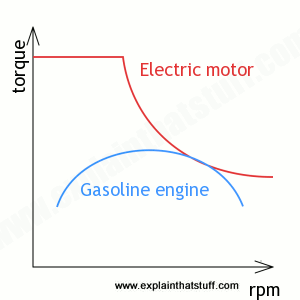
The motor in an electric car is very different: up to a point, it
has no "preference" whether it spins fast or slow—it's
pretty good at delivering the same torque at any moderate speed.
Artwork: A (very!) rough indication of how torque varies with speed (engine rpm) for electric motors and gasoline engines of comparable power. Electric motors produce maximum torque right from the off, whereas gasoline engines need to pick up quite a bit of speed to deliver maximum torque.
Transmission
In theory, an electric motor can drive a full-sized electric car just
as simply as a toy one, without the clumsy old gearbox and transmission you'd use
in a conventional gasoline-engined car. In practice, electric cars
are more complex. Toys are small and go slow, while real cars are much bigger and go faster. When a
real car corners, its two outside wheels are traveling around a curve
of bigger radius than its two inside wheels but in exactly the same
time, which means they have to spin slightly faster. (The same is
true of toy cars, but the effect is too small to notice.) That's why
real cars need complex transmissions with speed-adjusting gears
called differentials that allow one pair of wheels to go at a
slightly different speed—faster on the outside of a curve, slower
on the inside—than the other.
The same happens in an electric car when it goes
around a corner, and that rules out any kind of simple transmission
(for example, a single electric motor driving the two back wheels
from a common axle). One solution is to have a front-located electric motor
driving the same kind of transmission as an ordinary gasoline car,
using a driveshaft (propeller shaft) and differential in the usual way. Another is
to do away with the driveshaft and have a motor, gearbox, and
differential unit between two of the wheels (either front or rear) and driving them both.
A third option is to have two front or rear motors (with or without
gearboxes), each driving one wheel independently. The
final option is to use two or four hub motors (in-wheel motors), which are motors
built into the wheels themselves. That raises a different technical issue:
how to build a motor that's lightweight, compact, and still powerful
enough to drive a car (although if there are four hub motors, you need
to generate only a quarter of the total power with each one).
Artwork: Transmissions: How does power get from the motor to the wheels? Four example arrangements of the electric motor (green), gearbox (orange), differential (scarlet), driveshafts (light blue), and hub motors (red) in an electric car. 1) In this arrangement, the electric motor powers the car much like a traditional engine through a gearbox and driveshaft. 2) A central motor powers both wheels through one or two gearboxes. 3) Two separate motors power two wheels through separate gearboxes. 4) Hub motors power two (or sometimes all four) wheels with no other gearboxes, driveshafts, or other transmission parts.
Batteries
Every car is an electric car inasmuch it uses a
battery to get the engine spinning when you first start off.
Historically, cars were the pioneers of rechargeable batteries. Long
before we had laptops and cellphones, windup torches and all the
rest, back when most of us routinely used batteries one minute and
threw them away the next, cars were demonstrating the possibility of
using batteries over and over again. The only trouble was, car
engines used big and heavy lead-acid batteries that weren't good
enough to power vehicles at high speeds, over long distances, for
long periods of time.
Photo: In a Tesla, the lithium-ion batteries are stowed in this
compartment at the rear. Photo by courtesy of Steve Jurvetson, published on
Flickr in 2007 under a
Creative Commons licence.
Today's electric cars mostly use
lithium-ion batteries, exactly the same technology you'll find in your laptop or
cellphone. They're relatively light, fairly good at storing useful
amounts of power for their weight, last several years and hundreds of
charges, and perform reasonably well at the varied range of
temperatures most car drivers routinely encounter round the world
(though not always that well in the extremes you can find even in
hotter and colder US states). That doesn't mean they're perfect. The main problem with car batteries is
that they still can't carry as much energy as gasoline per unit of
mass; in other words, they have a lower energy density. Lithium-ion
batteries are likely to remain the popular choice for electric cars
for the foreseeable future, though alternatives such as nickel metal
hydride (NiMH), which are safer and cheaper, and other lithium-based
technologies (including lithium-nickel-manganese-cobalt,
lithium-phosphate, lithium-manganese, and lithium-cobalt) are also
waiting in the wings. Supercapacitors (also called ultracapacitors)
are another promising alternative. A bit like a cross between
batteries and capacitors, they offer much faster charging times.
Photo: An electric Smart car boasting that it's powered by lithium batteries. Picture by Kim Shiflett courtesy of NASA.
Hybrid cars—a closer look
So.... electric car or gasoline? Both have their
advantages; both have their drawbacks. That's why many of the
electric cars on the road today are actually hybrids that incorporate
both technologies side by side: they have a smaller than usual gasoline
engine suited to nippy highway driving and an electric motor for all that
stopping and starting in the city.
Photo: Under the hood of this early Toyota Prius, you'll find both a 1.5-liter (42 kW) gasoline engine and a 30kW electric motor. The two are connected to the same sun and planet gear system, which, in turn, is connected to a drive unit and the front wheels.
Picture by Warren Gretz courtesy of US Department of Energy/National Renewable Energy Laboratory (DoE/NREL). Image ref 46009.
Hybrids come in various flavors. In parallel hybrids, the engine and
the motor both send power to the wheels; in series hybrids, only the
motor powers the wheels, while the engine simply drives the motor like a generator, recharging the batteries.
Full hybrids have powerful enough electric motors and batteries to drive the engine
independently, while in mild hybrids, the motor is too puny to power the car by itself
and simply assists the engine (or allows it to switch off when the car is idle in traffic).
Ordinary hybrids charge up their batteries using power from the engine and energy recovered from the regenerative brakes (which we'll come onto in a moment); plugin hybrids can also be "refueled" from a
charging station or domestic power supply, have much bigger batteries, and can be driven by the motor
and batteries alone, so work more like conventional electric cars.
Whatever the coupling of engine and motor, the basic idea is to combine the best of both worlds to
boost fuel economy. The big drawback of a hybrid is that its purchase price is around 20–30 percent more than a comparable gasoline model. It's likely to be 10 percent heavier (despite its lighter engine, it has an electric motor, batteries, regenerative brakes, and all the rest) and have more sluggish performance. But hybrids score far better on both safety and fuel economy than gasoline cars, which makes them popular with eco-conscious families who prize their green credentials.
Overall, they can work out significantly cheaper:
an analysis by
Vincentric found 42 US hybrids (roughly half of those studied) were more cost-effective then their gasoline counterparts.
How does a plug-in hybrid work?
A hybrid car is like two cars in one: it has a conventional gasoline
(petrol) engine for fast freeway driving and
an electric motor for more economic, pollution-free travel (or idling). In different designs,
the wheels are driven by the engine, the motor, or both together.
Gasoline pump is the car's primary source of energy.
Engine powers wheels through conventional gears and transmission.
Electric power outlet connects to car's batteries through a conventional plug-in power lead.
Batteries charge up overnight while car is parked. The battery pack is usually stowed out of the
way behind the rear seats.
Electric motor uses power from batteries to drive either two or all four wheels.
Regenerative brakes: generator slows down the wheels and returns otherwise wasted energy to the batteries.
Advantages and disadvantages of electric cars
What's good?
Emissions
At first sight, electric cars are completely green cars:
sometimes they're even referred to as ZEVs (zero-emission vehicles)—and
the official fueleconomy.gov website actually quotes zero grams of CO2 emissions
per mile for most electric cars.
[2]
Now while it's true that the car itself makes no tailpipe pollution
and produces no CO2 emissions
in the place where you drive it, it's also misleading: unless your
electricity comes from a wind turbine or a
solar panel, some
emissions are still produced in the process of electricity generation
in a distant power plant somewhere.
(It's also important to note that electric cars can produce significant amounts of particulate—dust and dirt—pollution from brake and tire wear and erosion of the road surface.
That's why Professor Frank Kelly, one of Britain's leading experts on
the health effects of dirty air,
says electric cars will not tackle air pollution.)
[3]
Electric cars are considerably more efficient than
gasoline cars because electric motors are inherently more efficient
(about 80 percent) than internal combustion engines (a mere 30 percent for the engine alone,
much less for an entire gas-powered vehicle),
which waste a high proportion of the fuel they burn as
useless heat.
[7]
How do the figures work out in practice?
The 2024 MINI Cooper SE 2-door hardtop electric (list price around $30,900)
manages an average (city and
highway combined) 31 kWh (kilowatt hours) per 100 miles (equivalent to 110 mpg) for an
annual fuel cost of $700 per year, where a
2024 gasoline version of the same car (list price $25,800) comes in at just 32 mpg for an annual fuel
cost of $2000 per year.
[4]
Tesla claim an even bigger difference: an annual 30,000-mile running cost for
a Tesla Model S of $1,048 (at $0.12 per kWh) compared to a typical gas car's $5,318 (based
on $3.90 per gallon of fuel and 2015 figures).
Hybrid cars achieve their higher efficiency and fuel economy largely by switching from gasoline power to electricity whenever it's favorable, such as sitting still in heavy traffic. Where a typical car (a four-cylinder, 2.0-liter Ford Fusion) driven by gasoline might achieve around 25mpg, its equivalent hybrid manages a far more impressive 41 mpg (combined)—over 50 percent better, while the plug-in hybrid version achieves the equivalent of 103mpg.
You can see how hybrids (yellow) line up between electric (green) and gasoline cars (red) in the chart below.
[5]
Chart: How much better are electric cars? This chart compares mpge (mpg equivalent) or mpg ratings for 18 cars with 2023/2024 specifications: six electrics (green), six hybrids (yellow), and six gasoline cars (red). Figures are quoted from fueleconomy.gov.
It's not just the engine that makes an electric car more efficient. With regenerative brakes, you're not throwing energy away every time you stop and stop: the car's electric motor becomes a generator so that when
the brakes are engaged, the car slows down as your kinetic energy turns to electricity that
recharges the battery.
David MacKay sums it all up neatly in his book
Sustainable Energy Without Hot Air: "Electric vehicles can deliver transport at an energy cost of roughly 15 kilowatt hours (kWh) per 100km. That's five times better than our baseline fossil-car, and significantly better than any hybrid cars. Hurray!" According to fueleconomy.gov, his figure is about half the published energy cost of a MINI or Nissan Leaf; even so, the new EVs are still well ahead of the old fossils.
How do electric cars compare?
Let's put that theoretical "15 kilowatt hours (kWh) per 100km" in context. How efficient are electric cars compared to other forms of transportation?
This chart shows how much energy (in kWh) it takes to move one passenger a distance of 100km (~60 miles). Solar cars (tiny one-person experimental vehicles powered entirely by solar panels, like the Sunraycer pictured up above) are most efficient, largely because they weigh so little: most of them don't even have batteries. Electric cars come midway on the scale, though some (such as the Tesla) fare better than others. Gasoline cars are worst by far (largely because of their heavy engines and transmissions) and hydrogen fuel-cell cars aren't much better. Note how very efficient trains and buses are, even though they use conventional technology. That's because they carry large numbers of people and, as thin tubes moving through the air, are relatively aerodynamic.
Chart: How do electric cars compare. This chart (very gratefully) reuses data calculated and explained by Prof. David MacKay in chapter 20 of his superb book
Sustainable Energy Without the Hot Air. Follow that link to read how science can help us make transport more efficient.
Performance
Even in performance, electric cars sometimes outclass
gasoline ones. As we've already seen, electric motors can produce
high torque even at low speeds, which means they can accelerate
from a standstill more quickly than gasoline cars that don't produce their peak torque
until they reach relatively high engine speeds. They're also quieter and smoother. As Tesla have demonstrated, there's no reason whatsoever why electric motors and
batteries—once thought of as dull, worthy, and rather
plodding— can't power racy, exciting sports cars.
A Tesla Model S can accelerate from 0–60mph (100km/h) in just 3.9 seconds,
comparable to a high-performance gasoline-powered BMW M5
(and in at least one test, by Motortrend magazine, rather better).
Photo: Zap! Cars like this Tesla Roadster Sport changed popular perception of electric power—from dull and worthy to racy and exciting.
Introduced in 2010, it could accelerate from 0–60mph (100km/h) in 3.7 seconds!
Picture by Tyler Main courtesy of US Marine Corps and
and DVIDS.
Size is no obstacle for electric power either. Diesel-electric trains (in which diesel engines power electric motors that provide the traction) have been around for years. In Belarus, giant truck manufacturer BelAZ has been spent the last decade or so developing a series of vast diesel-electric mining trucks, in which four giant AC motors are powered by two 16-cylinder diesel engines.
These are among the world's biggest haul trucks. If you can use electric power for trucks like
this, you can probably use it for anything!
Maintenance
Maintenance is also less of a chore, because electric cars are generally simpler than
gasoline ones. According to a report by the Institute of Automobile Economics, electric vehicles
cost about a third less to maintain than equivalent gas or diesel cars.
A team from Argonne National Laboratory found an even bigger difference:
electric cars cost 40 percent less to maintain.
Why? An electric motor is an inherently simpler bit of kit
than a gasoline engine with far fewer moving parts to wear out; if it
uses no transmission or gearbox, that makes the entire car simpler
still. Even the brakes last longer, since regenerative braking means
you need to use the conventional (frictional) brake pads much less
than in an ordinary car. On the other hand, some of the technology used in electric cars
is relatively untested, which means it could be more prone to early failure even if it is, paradoxically,
simpler and theoretically more reliable in the long run.
What's bad?
Batteries
Electric motors and batteries are the two main
points of difference between conventional and electric cars. Where
motors are well understood and highly reliable, giant battery packs
remain the Achilles heel of electric cars. Despite its environmental
and economic drawbacks, kilo for kilo, a tank of gasoline can carry
far more energy than a bunch of batteries (see chart below)—and that will remain
the case for the foreseeable future. You can completely refuel a
gas-powered car in a couple of minutes (as long as it takes to fill
up your tank) and drive several hundred kilometers on the energy
you've pumped in without stopping. But electric cars can take
anything from half-an-hour to a whole night to recharge ("fill up")
and, even then, probably won't get you further than
a few hundred kilometers before the batteries run flat.
Where a gas tank is a relatively compact thing that sits neatly out of sight, the
batteries in an electric car are expensive, bulky, heavy, and take up room you might use for
other things. Having said that, batteries have improved dramatically over the last
few years. Back in 2013, the MIT technology Review reported that batteries represented about a quarter of the cost of a Tesla Model S,
which still worked out at around $20,000.
In 2020, Forbes estimated that the cost of a Tesla battery fell
from about 19 percent of the total vehicle cost in 2016 to around 15 percent in 2019.
Chart: Why we still drive gasoline cars—in a nutshell. Kilo for kilo, gasoline can carry far more energy than batteries. Hydrogen is a much better energy carrier, but there are significant problems in making and storing it. Coal scores highly too, but it's dirty and impractical: steam cars disappeared long ago!
Everyone who owns a cellphone or a laptop powered
by lithium-ion technology will be fully aware that rechargeable
batteries don't last more than a few years (even less if you treat
them badly)—and they can fail with little or no warning. In an
electric car, there are banks of batteries, not just one or two
cells, so you're less at the mercy of a sudden failure and more
likely to find a gradual deterioration in range with the same
charging time. Since batteries are so expensive and remain the
biggest questionmark in electric cars, manufacturers have done their
best to reassure buyers with warranties of around 8–10 years (or
100,000–125,000 miles). Research by the US National Renewable Energy Laboratory (NREL) suggests current batteries could
be made to last 15 years and a 2013 meeting of the American Chemical
Society heard that batteries might well last 20 years, which is probably
the maximum lifetime of most cars. If that sounds impressive and reassuring,
bear in mind that many of us buy our cars secondhand (already several
years old) and it's far from uncommon to drive around in a car that's
10 years old or even more. Another critical factor is that battery
performance and health depends on temperature: using electric vehicles in very hot
or cold climates can affect their battery life (and range).
The only sensible answer about batteries comes from Jeff Cobb of HybridCars.com,
whose excellent article
How Long Will An Electric Car's Battery Last?
reviewed all the evidence and concluded "Ultimately it is too soon to tell."
Photo: Batteries have always been the stumbling block in making successful
electric cars because they carry energy less effectively than gasoline.
Here, gigantic nickel-zinc batteries are being loaded inside a prototype electric car
by NASA engineers in 1977. Picture courtesy of NASA Glenn Research Center (NASA-GRC)
and Internet Archive.
Convenience
The higher energy density of gasoline and its
relative cheapness are two key reasons why the world still prefers
dirty, polluting gas-powered SUVs over clean, green eco machines like
the Toyota Prius and the Nissan Leaf. But the sheer convenience of
the "oil economy" is important too. Wherever you live, you're
never that far from a gas station. Figures from the US
Census Bureau (quoted by Statista) reveal that there are some 115,000 gas stations across
the United States.
By comparison, according to the
Alternative Fuels Data Center, as of 2024, there are now
177,560 alternative fueling "stations" of all kinds
(of which 62,720 are actual electric-charging stations). That sounds impressive, but
about half of them are in just seven states—and over a quarter are in
California alone.
Chart: There's been a huge growth in alternative fueling stations of all
kinds in the United States. However, it's important to drill down into this data by state.
As of 2024, 26% are in California, 5.5% are in New York, another 5.5% are in Texas, 4% are in Massachusetts, and 9% are in Washington, George, and Colorado (about 3% in each). So half of all the stations are in just seven states. Vast Alaska has the fewest stations (just 120).
Please note that these figures include not just electric stations, but also biodiesel pumps,
CNG, renewable diesel, and everything else.
Source: Alternative Fuels Data Center, 2024 and historic data.
Having said that, range is nowhere near as big an issue for electric cars as critics like to claim: the
US Department of Energy points out that most people's daily commute involves a round-trip of less than 30 miles. Technically, the sky is the limit for electric cars: with help from onboard solar panels, future electric cars could go many times further than today's vehicles, which typically now manage
500km (300 miles) or more on a single charge.
Photo: Theoretically, you can recharge an electric car
anywhere, even at home. But what if you work away, travel a lot, or live
in a high-rise apartment? Unfortunately, the world is still not geared up for
mass use of electric cars and lack of charging points remains an issue. Picture courtesy of
NASA.
Status quo
While fuel and running costs are lower for
electric cars, the initial purchase price is often considerably
higher, but not always as much as you might think.
A 2020 Ford Fusion plug-in hybrid cost around $37,000,
whereas a comparable gasoline model came in at about $28,000.
By contrast, a 2021 Toyota RAV4 plug-in hybrid cost around $28,900–$37,430
where the comparable gasoline model was about $26,350–$36,280.
In 2024, a two-door MINI Cooper hard-top electric clocked in at
$30,900, compared to $25,800 for a similar gasoline model.
[6]
Concerns about things like battery life also make it harder for
people to take the plunge. Sticking with what you know is always
easier than taking an expensive risk. Some countries offer tax breaks
for electric cars, but you still have to face that higher purchase
price to begin with.
What does the future hold?
Green-thinking environmentalists tend to see this
issue in black-and-white: if cars have a future at all (they would
prefer more public transportation and greater use of local goods to
reduce the need for transportation altogether), it must be an
electric one. Even setting aside concerns about emissions, electric
cars are certain to become more affordable and economic as oil
supplies dwindle. The bigger the demand for electric cars, the more
economics of scale will kick in. The more electric cars there are,
the better the infrastructure will be, the bigger the choice of
models, and the greater the likelihood of hardened petrol heads
switching allegiance to the clean and green. It all sounds so very
positive, so very inevitable.
"Skyrocketing" growth?
It's easy to fall for strident statistics celebrating the "astonishing" growth in electric cars (so many
hundred percent this year, so many hundred percent next) until you
remember that there are still very few electric cars around: 100
percent growth from not very much is not much more.
Back in October 2014, an
article in Forbes spoke of "skyrocketing" growth in electric cars in the (US) states of California, Georgia, Washington,
Michigan, and Texas. In Texas for example, it cited a 128 percent
growth in electric cars in just 12 months, which sounds extremely
impressive until you look at the actual numbers: there were 6533
electric cars at the time of writing compared to 2862 the year before, but that was less than
1/1000 of the total number of cars registered in Texas at the time (7.7 million).
Where do things stand now? US Energy Information Administration(EIA) [PDF] figures show that battery electric and plug-in hybrid vehicles accounted for just 1.2 percent of all light-duty vehicles (cars and light trucks) in the United States in 2022. Even in California, which leads the States in EV adoption, the proportion of electric cars isn't much better (3.3 percent of all light-duty vehicles, with electrics accounting for just 5.5 percent of new car sales in 2019 (according to the
LA Times).
According to the EIA's market analysis of electric vehicles in May 2018, the reasons for the slow growth in electric cars include relatively low gas prices, improved economy of conventional engines, and the continued barrier to entry for electric vehicles (the initial purchase price is still much higher).
People have been predicting the demise of the
internal combustion engine, caused by our surpassing
"peak oil" production, for over half a century (especially since the energy crisis of the early 1970s)—and we're still surrounded by a billion gas guzzlers.
Improvements in petroleum prospecting and recovery and better car design and efficiency have extended the life of this old technology far beyond what many people thought possible.
Is there any reason why, 40 years on, in the middle of the 21st
century, we're not going to find ourselves in exactly the same
position: a few more electric cars on the roads but the majority of
us still rattling round in gas-powered crates? According to 2015
predictions by the
US Energy Information Administration, even by
2040, around 46 percent of cars will still be using gasoline only,
while another 43 percent will be micro hybrid or flex fuel.
A mere 2 percent will be fully electric or plug-in hybrids, 5 percent will be full hybrids, and 4
percent will be diesel.
Quite a lot has changed since then. That year (2015) brought the
Volkswagen emissions
scandal—and a huge backlash against diesel.
Since then, various manufacturers (including Volvo, GM, and Ford) and governments have announced
dates by which they intend to stop sales of gasoline vehicles—typically around 2030–2035.
[8]
Does that mean we're all signed up to a green-electric transport revolution?
Not a bit of it.
A telling September 2021 analysis by Vaclav Smil revealed that
"growth in SUV use could more than offset carbon savings from electric vehicles."
In other words, we still don't get it.
However rational the arguments in favor of electric cars,
and however much environmentalists would like things to be otherwise,
the world has a huge attachment to dirty gasoline technology—and
that's unlikely to change anytime soon.
A brief history of electric cars
Electric cars have always been radically modern;
from Woody Allen's Sleeper to the 1.21 gigawatt-flux capacitor that powered
Marty McFly's DeLorean Time Machine in Back to the Future, they're the very stuff of science fiction. Yet they're science fact too: Apollo astronauts, you might remember, were bouncing round the Moon in the
battery powered Lunar Roving Vehicle (LRV) about 45 years ago. No-one knows if
electric cars will ever play a dominant role in the future, but
they've certainly had an interesting past. Here's a whistle-stop
tour of electric car history... so far. I've not covered every invention and inventor; just a few
key milestones to give you a flavor!
1800: Italian Alessandro Volta invents the battery (a primitive stack of zinc and silver discs separated by cardboard soaked in saltwater).
1821: English chemist Michael Faraday shows how electricity and magnetism can work together to make a force—the basic scientific principle of the electric motor.
1829: American electricity pioneer Joseph Henry develops a practical motor, though it's still far from a viable machine.
1834: Thomas Davenport develops a viable electric motor and goes on to develop the first battery-powered electric car running on a track. Unlike in modern electric cars, the batteries are not rechargeable.
1837: Robert Davidson of Scotland develops a battery powered car and later (in 1842) an electric train that whizzes along the Edinburgh to Glasgow Railway at a breathtaking 6km/h (4mph).
1859: Frenchman Gaston Planté invents the lead-acid battery, made from nine cells connected in parallel, and demonstrates it to the French Academy of Sciences the following year.
1859: Electricity pioneer and prolific US inventor Thomas Edison develops an electric car.
1881: Siemens constructs the first permanent electric railroad in Lichterfelde, Germany.
Its four-wheel locomotive is powered by a 150-volt dynamo.
1885: Leo Daft uses an electric motor to power a commuter train to 50km/h (30mph) in New York City.
1890: William Morrison develops the first successful American electric car. It can manage a respectable 23km/h (14mph). Power comes from a 4hp motor and 24 battery cells under the seats.
Photo: William Morrison's electric wagon. Artwork
from Scientific American, January 9, 1892, p.18.
1900: German Ferdinand Porsche develops the world's first hybrid, hub-motor electric car (the Lohner-Porsche).
1908: Henry Ford gives his wife Clara a Detroit Electric car as a present after she complains she couldn't start a gasoline car with a hand crank. Later, he buys another one for his friend Thomas Edison as a Christmas present.
1910s–1960s: Ironically, despite Ford's enthusiasm, his development of cheap, mass-produced gasoline cars pushes electric car technology to one side.
1940s–1970s: Electric vehicles are used for little more than powering delivery vehicles, such as
"milk floats" (widely used to deliver dairy products door-to-door in the UK before supermarkets take over).
Photo: A typical electric "milk float". The lead-acid batteries are the black boxes stowed in front of the wheels, underneath the main cargo platform. This one is a Wales and Edwards Rangemaster, very popular in Britain in the 1960s and 1970s.
1971: Apollo 15 astronauts David Scott and James Irwin drive the electric Lunar Roving Vehicle on the Moon for the first time.
1976: US Congress passes the Electric and Hybrid Vehicle Research, Development, and Demonstration Act to encourage the production of electric cars.
1990: The California Air Resources Board spurs the development of electric cars with its zero-emission vehicle program.
1996: General Motors begins leasing its pioneering and futuristic looking EV1. Later, the cars are controversially taken back by GM and crushed.
1997: Toyota launches the Prius in Japan—and it soon becomes the world's best-selling hybrid.
2008: The first Tesla Roadster electric car is shipped to customers.
2013: Toyota announces it has sold over 5 million hybrids worldwide, including 2 million in the United States alone.
2017: European countries, including France and Britain, announce they will ban the sale of new gasoline and diesel cars by 2040.
Volvo reveals it will phase out internal combustion engines much sooner, announcing a plan to offer only hybrids or electric cars from 2019.
Electric vehicles close to 'tipping point' of mass adoption by Damian Carrington, The Guardian. January 22, 2021. Huge increases in ownership and growing commitments from manufacturers are pushing electric cars ever closer to mass adoption.
What Needs to Happen Before Electric Cars Take Over the World by Jack Ewing, The New York Times. December 18, 2017. Comparable purchase price, better batteries, more charging stations, and abandonment of our old ways of doing things are the crucial changes that will steer us to an electric-car future.
Who Killed the Electric Car?: Interesting Wikipedia article about the 2006 documentary movie charging that GM's EV1 car was "killed" by a conspiracy between traditional car makers, the oil industry, and other vested interests.
Practical projects
How to Build an Electric Vehicle: A thorough practical introduction from Frank Didik, who's clearly learned a huge amount from his own experience.
A $672 electric car, built by two DIYers: Don't want to shell out tens of thousands on the latest e-model? You could always build your own in the manner of Darin Cosgrove and Ivan Limburg, of Brockville, Ontario.
↑ Fuel comparison figures from
fueleconomy.gov;
MSRP list prices from edmunds.com.
↑ Fuel comparison figures for 2020 Ford Fusion models from
fueleconomy.gov.
↑ Price comparison figures from edmunds.com, retrieved July 2020 (Ford Fusion) and October 2021 (Toyota RAV4).
↑ According to
fueleconomy.gov, electric vehicles
convert "over 77% of the electrical energy from the grid to power at the wheels. Conventional gasoline vehicles only convert about 12%–30% of the energy stored in gasoline to power at the wheels."
Please do NOT copy our articles onto blogs and other websites
Articles from this website are registered at the US Copyright Office. Copying or otherwise using registered works without permission, removing this or other copyright notices, and/or infringing related rights could make you liable to severe civil or criminal penalties.