If you think electricity plays a big part in our lives today, you "ain't seen nothing yet"! In the next few decades, our fossil-fueled cars and home-heating will need to switch over to electric power
as well if we're to have a hope of averting catastrophic climate
change. Electricity is a hugely versatile form of energy, but it
suffers one big drawback: it's relatively difficult to store in a hurry.
Batteries can hold large amounts of energy, but they take hours to
charge up. Capacitors, on the other hand, charge almost instantly but
store only tiny amounts of energy. In our electric-powered future,
when we need to store and release large amounts of electricity very
quickly, it's quite likely we'll turn to supercapacitors
(also known as ultracapacitors) that
combine the best of both worlds. What are they and how do they work?
Let's take a closer look!
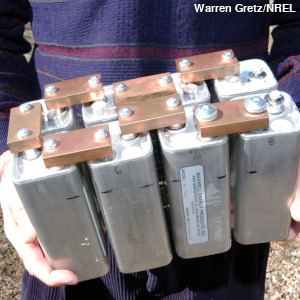
Photo: A stack of Maxwell supercapacitors used to store power in electric vehicles. Photo by Warren Gretz courtesy of US DOE/NREL (US Department of Energy/National Renewable Energy Laboratory), NREL image id#46619.
Batteries and capacitors do a similar job—storing electricity—but in completely different ways.
Batteries have two electrical terminals (electrodes) separated by a chemical
substance called an electrolyte. When you switch on the power,
chemical reactions happen involving both the electrodes and the
electrolyte. These reactions convert the chemicals inside the
battery into other substances, releasing electrical energy as they
go. Once the chemicals have all been depleted, the reactions stop and the
battery is flat. In a rechargeable battery, such as a lithium-ion power pack used
in a laptop computer or MP3 player, the reactions can
happily run in either direction—so you can usually charge and discharge hundreds
of times before the battery needs replacing.
Photo: A typical zinc-carbon battery has electricity stored in it at the factory and can be discharged only once before you have to throw it away. Batteries like this are expensive to use and bad for the environment—billions are trashed worldwide every single year.
Capacitors use static electricity (electrostatics) rather than chemistry to store energy. Inside a capacitor, there are two conducting metal plates with an insulating material called a dielectric in between them—it's a dielectric
sandwich, if you prefer! Charging a capacitor is a bit like rubbing a balloon on your jumper
to make it stick. Positive and negative electrical charges build up on the plates and the separation between them, which prevents them coming into contact, is what stores the energy. A good dielectric allows a capacitor of a certain size to store more charge at the same voltage than a poorer one, so you could say it makes the capacitor more efficient as a charge-storing device.
Photo: Typical electrolytic capacitors in an electronic circuit. Each one stores a fraction as much energy as a battery, but can be charged and discharged instantly, almost any number of times. Unlike in a battery, the positive and negative charges in a capacitor are produced entirely by static electricity; no chemical reactions are involved.
Capacitors have many advantages over batteries: they weigh less, generally don't
contain harmful chemicals or toxic metals, and they can be charged
and discharged zillions of times without ever wearing out. But they
have a big drawback too: kilo for kilo, their basic design
prevents them from storing anything like the same amount of
electrical energy as batteries.
Is there anything we can do about that? Broadly speaking, you can increase the energy a
capacitor will store either by using a better material for
the dielectric or by using bigger metal plates. To store a significant amount of
energy, you'd need to use absolutely whopping plates. Thunderclouds,
for example, are effectively super-gigantic capacitors that store
massive amounts of energy—and we all know how big those are! What
about beefing-up capacitors by improving the dielectric material
between the plates? Exploring that option led scientists to develop
supercapacitors in the mid-20th century.
Artwork: Batteries are great for storing large amounts of energy in a relatively small space, but they're heavy, expensive, slow to charge, of limited lifespan, and often made of toxic materials. Ordinary capacitors are better in almost every respect, but not so good at storing lots of energy.
Sponsored links
What is a supercapacitor?
A supercapacitor (or ultracapacitor) differs from an ordinary capacitor in two important ways: its plates effectively have a much bigger area and the distance between them is much smaller, because the separator between them works in a different way to a conventional dielectric. Although the words "supercapacitor" and "ultracapacitor" are often used interchangeably, there is a difference: they are usually built from different materials and structured in slightly different ways, so they store different amounts of energy. For the purposes of this simple introduction, we'll assume they're the same thing.
Like an ordinary capacitor, a supercapacitor has two plates that are separated. The plates are made from metal coated with a porous substance such as powdery, activated charcoal, which effectively gives them a bigger area for storing much more charge. Imagine electricity is water for a moment: where an ordinary capacitor is like a cloth that can mop up only a tiny little spill, a supercapacitor's porous plates make it more like a chunky sponge that can soak up many times more. Porous supercapacitor plates are electricity sponges!
What about the separator between the plates? In an ordinary capacitor, the plates are separated by a relatively thick dielectric made from something like mica (a ceramic), a thin plastic film, or even simply air (in something like a capacitor that acts as the tuning dial inside a radio). When the capacitor is charged, positive charges form on one plate and negative charges on the other, creating an electric field between them. The field polarizes the dielectric, so its molecules line up in the opposite direction to the field and reduce its strength. That means the plates can store more charge at a given voltage. That's illustrated in the upper diagram you see here.
Artwork: Top: Ordinary capacitors store static electricity by building up opposite charges on two metal plates (blue and red) separated by an insulating material called a dielectric (grey). The electric field between the plates polarizes the molecules (or atoms) of the dielectric, making them align in the opposite way to the field. This reduces the strength of the field and allows the capacitor to store more charge for a given voltage. Read more in our article on capacitors.
Bottom: Supercapacitors store more energy than ordinary capacitors by creating a very thin, "double layer" of charge between two plates, which are made from porous, typically carbon-based materials soaked in an electrolyte. The plates effectively have a bigger surface area and less separation, which gives a supercapacitor its ability to store much more charge.
In a supercapacitor, there is no dielectric as such. Instead, both plates are soaked in an electrolyte and separated by a very thin insulator (which might be made of carbon, paper, or plastic). When the plates are charged up, an opposite charge forms on either side of the separator, creating what's called an electric double-layer, maybe just one molecule thick (compared to a dielectric that might range in thickness from a few microns to a millimeter or more in a conventional capacitor). This is why supercapacitors are often referred to as double-layer capacitors, also called electric double-layer capacitors or EDLCs). If you look at the lower diagram in the artwork, you'll see how a supercapacitor resembles two ordinary capacitors side by side.
The capacitance of a capacitor increases as the area of the plates increases and as the distance between the plates decreases. In a nutshell, supercapacitors get their much bigger capacitance from a combination of plates with a bigger, effective surface area (because of their activated charcoal construction) and less distance between them (because of the very effective double layer).
The first supercapacitors were made in the late 1950s using activated charcoal as the plates. Since then, advances in material science
have led to the development of much more effective plates made from such things as carbon nanotubes (tiny carbon rods built using
nanotechnology), graphene, aerogel, and barium titanate.
How do supercapacitors compare to batteries and ordinary capacitors?
Photos: Supercapacitors can sometimes used as a direct replacement for batteries. Here's a cordless drill powered by a bank of supercapacitors for use in space, developed by NASA. The big advantage over a normal drill is that it can be charged up in seconds rather than hours. Spacewalking astronauts can't always wait overnight for their drills! Photo by courtesy of NASA Glenn Research Center (NASA-GRC).
The basic unit of electric capacitance is called the farad (F), named for pioneering British chemist and physicist
Michael Faraday (1791–1867). Typical capacitors used in electronic circuits store only miniscule amounts of electricity (they're usually rated in units called microfarads (millionths of a farad), nanofarads (billionths of a farad),
or picofarads (trillionths of a farad). In marked contrast, a typical supercapacitor can store a charge thousands, millions, or even billions of times bigger (rated in farads). The biggest commercial supercapacitors made by companies such as Maxwell Technologies® have capacitances rated up to several thousand farads. That still represents only a fraction (maybe 10–20 percent) of the electrical energy you can pack into a
battery. But the big advantage of a supercapacitor is that it can store and release
energy almost instantly—much more quickly than a battery.
That's because a supercapacitor works by building up static electric
charges on solids, while a battery relies on charges being produced slowly through chemical reactions,
often involving liquids.
You often see batteries and supercapacitors compared in terms of their energy and power. In everyday speak, these two words are used interchangeably; in science, power is the amount of energy used or produced in a certain amount of time. Batteries have a higher energy density (they store more energy per unit mass) but supercapacitors have a higher power density (they can release energy more quickly). That makes supercapacitors particularly suitable for storing and releasing large amounts of energy relatively quickly, but batteries are still king for storing large amounts of energy over long periods of time.
Although supercapacitors work at relatively low voltages (maybe 2–3 volts), they can be connected in series (like batteries) to produce bigger voltages for use in more powerful equipment.
Since supercapacitors work electrostatically, rather than through
reversible chemical reactions, they can theoretically be charged and
discharged any number of times (specification sheets for commercial
supercapacitors suggest you can cycle them perhaps a million times).
They have little or no internal resistance, which means they store and release energy
without using much energy—and work at very close to 100
percent efficiency (97–98 percent is typical).
What are supercapacitors used for?
If you need to store a reasonable amount of energy for a relatively short period of
time (from a few seconds to a few minutes), you've got too much energy to
store in a capacitor and you've not got time to charge a battery, a
supercapacitor may be just what you need. Supercapacitors have been
widely used as the electrical equivalents of flywheels in machines—"energy
reservoirs" that smooth out power supplies to electrical and
electronic equipment. Supercapacitors can also be connected to
batteries to regulate the power they supply.
Photos: A large supercapacitor used to store power in a hybrid bus. Supercapacitors are used in regenerative brakes, widely used in electric vehicles. Photo by courtesy of NASA Glenn Research Center (NASA-GRC).
One common application is in wind turbines, where very large supercapacitors help to smooth out the intermittent power supplied by the wind. In electric and hybrid
vehicles, supercapacitors are increasingly being used as temporary
energy stores for regenerative braking (where the
energy a vehicle would normally waste when it comes to a stop is briefly stored and
then reused when it starts moving again). The motors that drive
electric vehicles run off power supplies rated in the hundreds of volts,
which means hundreds of supercapacitors connected in series are
needed to store the right amount of energy in a typical regenerative
brake.
Thanks to applications like these, the future's looking very bright for supercapacitors. A
2020 report by Allied
Market Research valued the global supercapacitor market at a modest $3.27 billion in 2019, but predicted that would
reach $16.95 billion in 2027—a five-fold increase in just a few years!
Supercapacitors: Materials, Systems, and Applications by M. Aulice Scibioh, B. Viswanathan. Elsevier, 2020. Explores the challenge of developing supercapacitors through the lens of materials science: what materials make the best electrodes and electrolytes?
Supercapacitors: Materials, Systems, and Applications by François Béguin and Elzbieta Frackowiak (eds). John Wiley & Sons, 2013. Comprehensive, current review of the electrochemistry and applications of supercapacitors.
Turning Bricks Into Supercapacitors by Maria Gallucci, IEEE Spectrum, 13 August 2020. How to turn ordinary bricks into energy stores using a simple polymer coating.
Flower doubles as supercapacitor: Physics World, 28 February 2017. Swedish scientists who turned a rose into a transistor have now used similar ideas to make a supercapacitor.
How a Microscopic Supercapacitor Will Supercharge Mobile Electronics by Maher F. El-Kady and Richard B. Kaner. IEEE Spectrum, September 28, 2015. Tiny, flat graphene supercapacitors could lead to big advances in
microelectronics, making everyday gadgets smaller, cheaper, and with much longer battery life.
Supercapacitors Take Huge Leap in Performance by Dexter Johnson, IEEE Spectrum, 28 May 2015. Korean scientists achieve a four-fold increase in energy density for graphene-based supercapacitors.
Graphene supercapacitor breaks storage record by Belle Dumé, Physics World, 26 November 2010. How researchers have built a graphene-based supercapacitor with an energy density similar to nickel metal hydride batteries.
"UltraBattery" Could Put a Hybrid in Every Garage by Matthew Phenix, Wired, 25 January 2008. How combining old-fashioned lead-acid batteries and supercapacitors could save on running costs in hybrid cars.
Patents
You'll find much deeper technical detail in patents; here's a small but representative selection:
Please do NOT copy our articles onto blogs and other websites
Articles from this website are registered at the US Copyright Office. Copying or otherwise using registered works without permission, removing this or other copyright notices, and/or infringing related rights could make you liable to severe civil or criminal penalties.