Imagine if you climbed out of the
shower only to discover you'd shrunk in the wash by about 1500 million times! If you
stepped into your living room, what you'd see around you would not be
chairs, tables, computers, and
your family but atoms, molecules, proteins, and cells. Shrunk down to the
"nanoscale," you'd not only see the atoms that everything is made
from—you'd actually be able to move them around! Now suppose you
started sticking those atoms together in interesting new ways, like
tiny LEGO® bricks of nature. You could build all kinds of
fantastic materials, everything from brand new medicines to
ultra-fast computer chips. Making new things on this incredibly small
scale is called nanotechnology and it's one of the most exciting and
fast-moving areas of science and technology today.
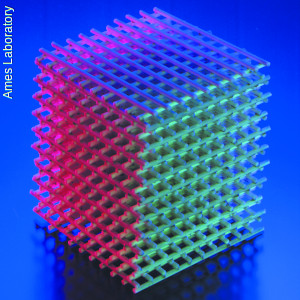
Photo: A model of a photonic crystal, which switches
light on and off roughly
like a silicon chip controls electricity. In the future, nanotechnological devices like this
could be used to make fast, optical (light-based) computers.
Photo by Ames Laboratory and US Department of Energy published on Flickr (public domain).
Artwork: A very tall (2m) person would be 2 billion (2000 million) nanometers from head to toe!
We live on a scale of meters and kilometers
(thousands of meters), so it's quite hard for us to imagine a world
that's too small to see. You've probably looked at amazing photos in
science books of things like dust mites and flies photographed with
electron microscopes. These
powerful scientific instruments make
images that are microscopic, which means
on a scale millionths
of a meter wide. Nanoscopic involves shrinking things down to a whole
new level. Nano means "billionth", so a nanometer is one
billionth of a meter. In other words, the nanoscale is 1000
times smaller than the microscopic scale and a billion (1000 million)
times smaller than the world of meters that we live in.
From nanoscience to nanotechnology
This is all very interesting and quite impressive,
but what use is it? Our lives have some meaning on a scale of meters,
but it's impossible to think about ordinary, everyday existence on a
scale 1000 times smaller than a fly's eye. We can't really think
about problems like AIDS, world poverty, or global warming, because
they lose all meaning on the nanoscale. Yet the nanoscale—the world
where atoms, molecules (atoms joined together), proteins, and cells rule the roost—is a
place where science and technology gain an entirely new meaning.
Photo: Nanotechnology could help us fuse computers and brains together, using
artificial synapses (brain-cell connections) like this prototype, developed by the NIST.
Photo courtesy of the National Institute of Standards and Technology (NIST), U.S. Department of Commerce.
By zooming in to the nanoscale, we can figure out
how some of the puzzling things in our world actually work by seeing
how atoms and molecules make them happen. You've probably seen that
trick TV programs do with satellite photos, where they start off with
a picture of the green and blue Earth and zoom in really fast, at
ever-increasing scale, until you're suddenly staring at someone's
back garden. You realize Earth is green because it's made from a
patchwork of green grass. Keep zooming in and you'll see the
chloroplasts in the grass: the green capsules inside the plant cells
that make energy from sunlight. Zoom in some more and you'll
eventually see molecules made from carbon, hydrogen, and oxygen being
split apart
and recombined inside the chloroplasts. So the nanoscale is good
because it lets us do nanoscience: it helps
us understand why
things happen by studying them at the smallest possible scale. Once
we understand nanoscience, we can do some nanotechnology: we can put
the science into action to help solve our problems. That's what the
word "technology" means and it's how technology (applied science)
differs from pure science, which is about studying things for their
own sake.
The Nanoscale
Ordinary objects are absolutely huge measured on
what scientists call the nanoscale:
Girl 1.2 m (4ft) tall: ~1200 million nanometers tall.
Man 2m (6.5 ft) tall ~ 2000 million nanometers tall.
Empire State Building: 381m (1250 ft) tall: ~381,000 million nanometers tall.
Can you figure out how tall you are in nanometers?
Sponsored links
What's so good about the nanoscale?
It turns out there are some very interesting
things about the nanoscale. Lots of substances behave very
differently in the world of atoms and molecules. For example, the
metal copper is transparent on the nanoscale while
gold, which is
normally unreactive, becomes chemically very active. Carbon, which is
quite soft in its normally occurring form (graphite), becomes
incredibly hard when it's tightly packed into a nanoscopic
arrangement called a nanotube. In other
words, materials can
have different physical properties on the
nanoscale even
though they're still the same materials! On the nanoscale, it's
easier for atoms and molecules to move around and between one
another, so the chemical properties of
materials can also be
different. Nanoparticles have much more surface area exposed to other
nanoparticles, so they are very good as catalysts (substances that
speed up chemical reactions).
Photo: Nanoparticles like these platinum lace nanoballs make very effective catalysts because they're so tiny. As the scale shows, they're about 500 nanometers across—twice the size of
typical bacteria. Photo courtesy of US Department of Energy (Flickr).
One reason for these differences is that different
factors become important on the nanoscale. In our everyday world,
gravity is the most important force we encounter: it dominates
everything around us, from the way our hair hangs down around our
head to the way Earth has different seasons at different times of
year. But on the nanoscale, gravity is much less important than the
electromagnetic forces between atoms and molecules. Factors like
thermal vibrations (the way atoms and molecules store heat by
jiggling about) also become extremely significant. In short, the game
of science has different rules when you play it on the nanoscale.
How do you work on the nanoscale?
Your fingers are millions of nanometers long, so
it's no good trying to pick up atoms and molecules and move them
around with your bare hands. That would be like trying to eat your
dinner with a fork 300 km (186 miles) long! Amazingly, scientists
have developed electron microscopes
that allow us to "see" things on the
nanoscale and also manipulate them. They're called atomic force
microscopes (AFMs), scanning probe microscopes (SPMs), and scanning
tunneling microscopes (STMs).
Photo: The eight tiny probe tips on the
Atomic Force Microscope (AFM) built into NASA's Phoenix Mars Lander.
The tip enlarged in the circle is the same size as a smoke particle at its base (2 microns).
Photo by courtesy of NASA/JPL-Caltech/University of Arizona/University of Neuchatel.
The basic idea of an electron microscope is to use
a beam of electrons to see things that are too small to see using a
beam of light. A nanoscopic microscope uses electronic and quantum
effects to see things that are even smaller. It also has a tiny probe
on it that can be used to shift atoms and molecules around and
rearrange them like tiny building blocks. In 1989,
IBM researcher Don Eigler used a microscope like this to spell out the word I-B-M by
moving individual atoms into position. Other scientists have used
similar techniques to draw pictures of nanoscopic guitars, books, and
all kinds of other things. These are mostly frivolous exercises,
designed to wow people with nanopower. But they also have important
practical applications. There are lots of other ways of
working with nanotechnology, including molecular beam epitaxy, which is a way of growing single crystals one layer of atoms at a time.
Photo: Zooming in on the nanoscale: IBM scientists have measured the charges
on individual atoms using an atomic force microscope, an extremely powerful microscope
that works down to nanoscale dimensions (more about this in a moment). By courtesy of
IBM Research–Zurich
published on Flickr in 2018 under
a Creative Commons Licence (CC BY-ND 2.0).
What can we use nanotechnology for?
Most of nanotechnology's benefits will happen
decades in the future, but it's already helping to improve our world
in many different ways. We tend to think of nanotechnology as
something new and alien, perhaps because the word "technology"
implies artificial and human-made, but life itself is an example of
nanotechnology: proteins, bacteria, viruses, and cells all work on
the nanoscopic scale.
Nanomaterials
It could be you're already using nanotechnology.
You might be wearing nanotechnology pants (that's "trousers" to
you in the UK), walking on a nanotechnology rug, sleeping on
nanotechnology sheets, or hauling nanotechnology luggage to the
airport. All these products are made from fabrics coated with
"nanowhiskers." These tiny surface fibers are so small that dirt
cannot penetrate into them, which means the deeper layers of material
stay clean. Some brands of sunscreens use
nanotechnology in a similar
way: they coat your skin with a layer of nanoscopic titanium dioxide
or zinc oxide that blocks out the Sun's harmful ultraviolet rays.
Nano-coatings are also appearing on scratch-resistant car bumpers,
anti-slip steps on vans and buses, corrosion resistant paints, and
wound dressings.
Photo: Nanomaterials being designed on a computer screen at Brookhaven National Laboratory. The materials shown here are built from precise arrangements of nanoclusters, which are groups of just 10 to 100 atoms. Photo courtesy of
US Department of Energy (Flickr).
Carbon nanotubes are among the most exciting of
nanomaterials. These rod-shaped carbon molecules are roughly one
nanometer across. Although they're hollow, their densely packed
structure makes them incredibly strong and they can be grown into
fibers of virtually any length. NASA scientists have recently
proposed carbon nanotubes could be used to make a gigantic elevator
stretching all the way from Earth into space. Equipment and people
could be shuttled slowly up and down this "carbon ladder to the
stars," saving the need for expensive rocket flights.
Artwork: A typical carbon nanotube is about ten atoms across and 50,000 times thinner than an average human hair.
Nanochips
One form of nanotechnology we all use is
microelectronics. The "micro" part of that word suggests computer
chips work on the microscopic scale—and they do. But since terms
like "microchip" were coined in the 1970s, electronic engineers
have found ways of packing even more transistor
switches into integrated circuits to make computers that are smaller, faster, and cheaper than
ever before. This constant increase in computing power goes by the
name of Moore's Law, and nanotechnology will
ensure it
continues well into the future. Everyday transistors in the early
21st-century are just 100–200 nanometers wide, but
cutting-edge experiments are already developing much smaller devices.
In 1998, scientists made a transistor from a single carbon nanotube.
Photo: Making an electric circuit with carbon
nanotubes.
A carbon nanotube (shown here in light blue at the top) is connected to
an electricity supply
using aluminum (shown in dark blue at the bottom).
Picture by courtesy of NASA Marshall Space Flight Center (NASA-MSFC).
One of the most exciting areas of nanotechnology
is the possibility of building incredibly small machines—things
like gears, switches,
pumps, or
engines—from individual atoms.
Nanomachines could be made into nanorobots (sometimes called
nanobots) that could be injected into our bodies to carry out
repairs or sent into hazardous or dangerous environments, perhaps to
clean up disused nuclear power plants.
As is so often the case,
nature leads humans here. Scientists have already found numerous
examples of nanomachines in the natural world. For example, a common
bacteria called E.coli can build itself a
little
nanotechnology tail that it whips around like a kind of propeller to
move it closer to food. Making nanomachines is also known as
molecular manufacturing and
molecular nanotechnology (MNT).
Sponsored links
How do you make a nanomachine?
A machine is something with moving wheels, gears, and levers that can do useful jobs for us, but how do you make moving parts from something as tiny as a molecule? Just imagine trying to build a clock from gears that are millions of times smaller than usual!
Photo: The world's smallest chain drive. An example of a nanomachine, this nanotechnology "bike chain" and gear
system was developed by scientists at Sandia National Laboratories. The distance between each link of the chain is fractionally smaller
than the width of a typical human hair. Photo courtesy of Sandia National Laboratories.
It turns out there is a way to do it. Some molecules are regularly shaped and symmetrical so they have no overall positive or negative charges. Other molecules are not symmetrical, which means they have slightly more positive charge at one end and slightly more negative charge at the other. These are called polar molecules and water is the best known example. Water sticks to a lot of things and cleans them well because it has a positive "pole" at one end and a negative pole at the other. We can use this idea to make a molecular machine.
Artwork: A simple "nano-escalator." It works by making one molecule (green) move up and down another one (blue and red).
Suppose you take a molecule made from a ring of atoms that has a slightly positive charge in one place.
Now thread it over another molecule made from a rod of atoms, which has slightly negative charges at its two ends. The positive ring will pull toward one of the negative charges so the ring will lift upward. Now add some energy and you can make the ring move back down, toward the other negative charge. In this way, you can make the ring shunt back and forth or up and down, a bit like a nanoscopic elevator! By extending this idea, we can gradually make more complex machines with parts that shuffle back and forth, move around one another, or even rotate like tiny electric motors.
Ingenious ideas like this were developed by three brilliant scientists who won the Nobel Prize in Chemistry in 2016 (more about that below).
History of nanotechnology
“Why not write the entire 24 volumes of the 'Encyclopedia Britannica' on the
head of a pin?”
Natural examples like this tell us that
nanotechnology is as old as life itself, but the concept of the
nanoscale, nanoscience we can study, and nanotechnology we can
harness are all relatively new developments. The brilliant American
physicist Richard Feynman (1918–1988)
is widely credited with kick-starting modern interest in nanotechnology. In 1959, in a famous
after-dinner speech called "There's plenty of room at the
bottom," the ever-imaginative Feynman speculated about an
incredibly tiny world where people could use tiny tools to rearrange
atoms and molecules. By 1974, Japanese engineering professor Norio
Taniguchi had named this field "nanotechnology."
Photo: Creatures of the nanoworld? This is what a
single molecule of the semiconductor material cadmium sulfide looks
like.
Nanoparticles like this could be used to make improved electronic
displays and lasers.
Picture by courtesy of
NASA Marshall Space Flight Center (NASA-MSFC).
Nanotechnology really took off in the 1980s. That
was when nanotech-evangelist Dr K. Eric Drexler first published his
groundbreaking book Engines of Creation: The
Coming Era of Nanotechnology. It was also the decade when microscopes appeared
that were capable of manipulating atoms and molecules on the
nanoscale. In 1991, carbon nanotubes were discovered by another
Japanese scientist, Sumio Iijima, opening up huge interest in new
engineering applications. The graphite in pencils is a soft form of
carbon. In 1998, some American scientists built themselves another
kind of pencil from a carbon nanotube and then used it, under a
microscope, to write the words "NANOTUBE NANOPENCIL" with letters
only 10 nanometers across.
Stunts like this captured the public imagination,
but they also led to nanotechnology being recognized and taken
seriously at the highest political levels. In 2000, President Bill
Clinton sealed the importance of nanotechnology when he launched a
major US government program called the National Nanotechnology
Initiative (NNI), designed to fund groundbreaking research and inspire public interest.
By 2016, the US government was investing over $1 billion a year in nanotechnology through the NNI
alone. Nanotechnology reached another important milestone that year with the award of the
2016 Nobel Prize in
Chemistry to Jean-Pierre Sauvage, Sir J. Fraser Stoddart,
and Bernard Feringa, three scientists whose groundbreaking work had spawned
the idea of turning molecules into machines.
The future of nanotechnology: nanodream or nano-nightmare?
Engineers the world over are raving about
nanotechnology. This is what scientists at one of America's premier
research institutions, the Los Alamos National Laboratory, have to
say: "The new concepts of nanotechnology are so
broad and
pervasive, that they will influence every area of technology and
science, in ways that are surely unpredictable.... The total societal
impact of nanotechnology is expected to be greater than the combined
influences that the silicon integrated circuit, medical imaging,
computer-aided engineering, and man-made polymers have had in this
century." That's a pretty amazing claim: 21st-century
nanotechnology will be more important than all the greatest
technologies of the 20th century put together!
Photo: These nanogears were made by attaching
benzene molecules (outer white blobs) to the outsides of carbon
nanotubes (inner gray rings). Image by NASA Ames Research Center courtesy of
Internet Archive.
Nanotechnology sounds like a world of great
promise, but there are controversial issues too that must be
considered and resolved. Some people have raised concerns that
nanoscale organisms or machines could harm human life or the
environment. One problem is that tiny particles can be extremely
toxic to the human body. No-one really knows what harmful effect new
nanomaterials or substances could have. Chemical pesticides were not
considered harmful when they were first used in the early decades of
the 20th century; it wasn't until the 1960s and 1970s
that their potentially harmful effects were properly understood.
Could the same happen with nanotechnology?
The ultimate nano-nightmare, the problem of "gray
goo," was first highlighted by Eric Drexler. What happens if
well-meaning humans create nanobots that run riot through the
biosphere, gobbling up all living things and leaving behind nothing
but a chewed-up mass of "gray goo"? Drexler
later backed away from that claim. But critics of nanotechnology
still argue humans shouldn't meddle with worlds they don't understand,
but if we took that argument to its logical conclusion, we'd have
no inventions at all—no medicines, no transportation, no
agriculture, and no education—and we'd still be living in the
Stone Age. The real question is whether the promise of nanotechnology
is greater than any potential risks that go with it. And that will
determine whether our nano-future becomes dream—or
nightmare.
Nanotechnology: An Introduction by Jeremy Ramsden. Elsevier, 2016. A wide-ranging overview of the science behind nanotechnology and its many practical applications.
Nanotechnology: Ethics and Society by Deb Bennett-Woods. CRC, 2008/2018. Explores many ethical dimensions, from military and security to environmental issues and social justice.
Nanotechnology 101 by John F. Mongillo. ABC-Clio, 2007. A good, extended, library-style introduction for older teens and adult readers.
The Nobelists and Their Molecular Machines by Dexter Johnson. IEEE Spectrum, March 14, 2017. Reviews the latest progress in research following the 2016 Nobel Prize award to three nanotechnologists.
[PDF] How Molecules Became Machines by Ann Fernholm. Nobel/Royal Swedish Academy of Sciences, 2016. A great introduction to the Nobel-Prize-winning science of molecular machines. [Archived via the Wayback Machine.]
The Guardian: Nano futures: This great collection of recent articles from The Guardian reviews all kinds of future applications of nanotechnology in everyday life, including medicine, food production, textiles, and sports.
How to build an automobile smaller than this dot by Richard Feynman. Popular Science, November 1960, p.114. Feynman helped to inspire the field of nanotechnology. Here's one of his early articles on the topic.
Websites
For younger readers
Nanooze!: A brilliant children's nanotechnology website.
Nanotechnology photos: Are you
looking for photos you to illustrate a school or college project? The Center for Nanoscale Materials (CNM) at Argonne National Laboratory publishes some excellent pictures of nanotechnology research under a Creative Commons Licence, allowing you to use them freely providing you give appropriate credit.
Please do NOT copy our articles onto blogs and other websites
Articles from this website are registered at the US Copyright Office. Copying or otherwise using registered works without permission, removing this or other copyright notices, and/or infringing related rights could make you liable to severe civil or criminal penalties.