Suppose you had to design the perfect
material—what would it be
like? You'd probably want it to be plentiful and relatively
inexpensive, strong and lightweight, easy to combine with other
materials, resistant to heat and corrosion, and a good conductor of electricity. In short, you'd probably come
up with a material like aluminum
(spelled aluminium in some
countries—and that's also the official
IUPAC spelling).
It's the commonest metal in Earth's crust
(making up ~8 percent of it), the third most
plentiful chemical element on our planet (only oxygen and silicon exist
in greater quantity), and the second most popular metal for making
things (after iron/steel).
[4]
We all see and use aluminum every day without even thinking about it. Disposable
drinks cans are made from it and so is cooking foil. You can find this
ghostly gray-white metal in some pretty amazing places, from jet engines in airplanes to the hulls of
hi-tech warships. What makes aluminum such a brilliantly useful
material? Let's take a closer look!
Photo: Aluminum is a wonderfully weather-proof material.
At the Federal Building and U.S. Courthouse, Wheeling, West Virginia, it features
prominently in the striking windows and other internal features.
Photo by Carol M. Highsmith, courtesy of Photographs in the Carol M. Highsmith Archive, Library of Congress, Prints and Photographs Division.
Aluminum is soft, lightweight, fire-proof and heat-resistant, easy
to work into new shapes, and able to conduct electricity. It reflects
light and heat very effectively and it doesn't rust. It reacts easily with other chemical elements, especially oxygen, and readily forms an
outer layer of aluminum oxide if you leave it in the air.
We call these things aluminum's physical and chemical properties.
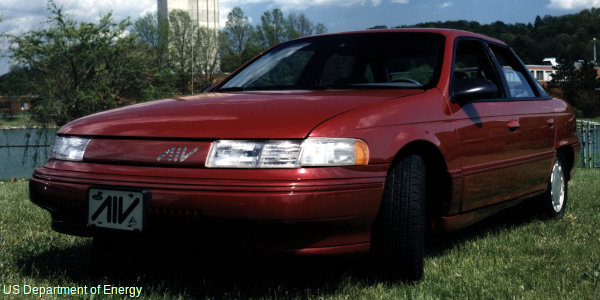
Photo: The experimental aluminum Ford Sable
car, produced over 25 years ago in 1995, was 180 kg (400 lbs) lighter than a comparable
steel-bodied car and considerably more energy efficient.
Today, as fuel economy becomes ever more important, full-bodied aluminum cars are commonplace.
A new Ford F-150 truck, with a full aluminum body, is a whopping 39 percent (320kg or 700lbs) lighter than its predecessor,
according to the Aluminum Association.
But that switch proved to be a mixed bag for Ford.
Photo courtesy of US Department of Energy (DOE).
Alloys
Aluminum really comes into its own when you combine it with other
metals to make aluminum alloys
(an alloy is a metal mixed together with other elements to make a new material
with improved properties—it might be stronger or it might melt at a higher temperature).
A few of the metals commonly used to make aluminum alloys include boron,
copper, lithium, magnesium, manganese, silicon, tin, and zinc. You mix aluminum with one or more of these depending on the job you're trying to do.
There are several hundred different aluminum alloys. Three of the best known are alnico, made from iron, aluminum, nickel, and cobalt,
and used in loudspeaker magnets;
duraluminum, mostly made of aluminum and copper, and used in aircraft and automobile parts; and magnox,
made of magnesium and aluminum and used in nuclear reactors.
[5]
Photo: A typical alnico (aluminum, nickel, cobalt, iron alloy) loudspeaker from an old portable radio. Alnico magnets have now largely
been replaced by ceramic (and other kinds of) magnets.
There are so many different aluminum alloys that we need a clear system for organizing and referring to them.
First, they're classified as either wrought (hammered or otherwise mechanically shaped) or cast (shaped
by being poured into molds). Wrought alloys are resistant to corrosion, conduct heat and
electricity very well, are strong but still light, are tough and don't fracture,
are very workable, and are easy to recycle.
Cast alloys, on the other hand, are easy to cast (flow and fill their molds well),
strong, and offer a superior finish.
[7]
According to a widely used classification system (the International Alloy Designation System or IADS) introduced by the Aluminum Association, wrought alloys are divided into nine series, numbered with four digits, beginning with a number that defines the main alloying element:
[8]
1xxx: Almost pure (over 99%) aluminum.
2xxx: Copper: High-strength aerospace and automative alloys with less corrosion resistance.
3xxx: Manganese: Moderate strength, widely used in roofing materials, home cookware, and heat exchangers, as well as aluminum drinks cans.
4xxx: Silicon: Lower melting points, used in automobile engine components, welding and brazing wires.
5xxx: Magnesium: High strength and greater corrosion resistance, so widely used in marine applications where resistance to saltwater is crucial, as well as storage tanks and building construction materials.
6xxx: Magnesium and silicon: A good compromise between strength and workability, used in housing parts such as aluminum window frames and truck and ship structures.
7xxx: Zinc: Extremely strong, used in structural airplane components. The Apple aluminum watch
used a 7xxx series alloy.
8xxx: Other alloying elements (typically lithium).
9xxx: Not assigned.
Cast aluminum alloys are also divided into eight series, but the numbering is slightly different:
1xxx: Almost pure (maximum 99%) aluminum.
2xxx: Copper.
3xxx: Silicon with copper and/or magnesium.
4xxx: Silicon.
5xxx: Magnesium.
6xxx: Not used.
7xxx: Zinc.
8xxx: Tin.
9xxx: Other alloying elements.
Composites
Aluminum can be combined with other materials in a quite different way
in composites (hybrid materials made from two or more materials that retain
their separate identity without chemically combining, mixing, or dissolving). So, for example, aluminum can act as the "background material" (matrix) in what's called a metal matrix composite (MMC), reinforced with particles of silicon carbide, to make a strong, stiff, lightweight material suitable for a wide variety of aerospace, electronic, and automobile uses—and (crucially) better than aluminum alone.
Sponsored links
What's aluminum used for?
Pure aluminum is very soft. If you want to make something stronger
but still lightweight,
hard-wearing, and able to survive the high temperatures in an airplane
or car engine, you mix aluminum and
copper. For food packaging, you don't need anything like the same
strength, but you do need a material that's easy to shape and seal. You get
those qualities by alloying aluminum with magnesium.
Suppose you want to carry electricity over long distances from power
plants to homes and factories. You could use copper, which is
generally the best conductor (carrier) of electricity, but it's heavy
and expensive. Aluminum might be an option, but it doesn't carry
electricity so readily. One solution is to make power cables from
aluminum alloyed with boron, which conducts electricity almost as well as copper but is
a great deal lighter and less droopy on hot days. (Typically, aluminum-boron
alloys contain 90–97 percent aluminum and 3–10 percent boron.)
[6]
Chart: Aluminum consumption in the United States. Transportation (planes, ships, trucks, and cars) is now by far the biggest single use for the metal and its alloys. Source: US Geological Survey,
Mineral Commodity Summaries: Aluminum. January 2023.
How is aluminum made?
Aluminum reacts so readily with oxygen that you never naturally find
it in its pure form. Instead, compounds of aluminum exist in huge
quantities in Earth's crust as an ore (raw rocky material) called bauxite.
This is the common name for hydrated alumina, a substance typically made from about two thirds
aluminum oxide (chemical formula Al2O3) with one
third water molecules
(H2O) locked into its crystal
structure.
Depending on where on Earth it's
found, bauxite also contains a range of different impurities such as
iron oxide, silicon oxide, and titanium oxide.
The world currently has about 55–75 billion tons of bauxite resources—enough to
meet demand "well into the future" (according to the US Geological Survey's Mineral
Commodity Summaries, January 2023).
Photo: Ready for recycling: These squashed mats of aluminum cans are called biscuits. They're ready to melt
down and recycle. According to the Aluminum Association, nearly 70 percent of the aluminum ever mined is still in use today, thanks to effective recycling programs. It's much cheaper and more environmentally friendly to recycle used aluminum than to dig bauxite from the ground and process it: recycling saves about 95 percent of the energy that would be needed to make brand new aluminum.
Photo courtesy of US Air Force.
If you want to turn bauxite into aluminum to make useful things like
cans, cooking foil, and space rockets,
you've got to get rid of the impurities and the water and split the
aluminum atoms from the oxygen atoms they're locked onto. So making
aluminum is actually a multi-stage process.
First, you dig the bauxite from the ground, crush it up, dry it (if
it contains too much water), and purify it to leave just the aluminum
oxide. Then you use an electrical technique called
electrolysis to
split this into aluminum and oxygen. (Electrolysis is the opposite to
what happens inside a battery. In a
battery, you have two different metal connections inserted into a
chemical compound and complete a circuit between them to generate
electricity. In electrolysis, you pass electricity, via two metal
connections, into a chemical compound, which then gradually splits
apart into its atoms.) Once separated out,
the pure aluminum is cast into blocks known as ingots, which can be
worked or shaped or used as a raw material for making aluminum alloys.
Making usable, shiny aluminum from rocky lumps of bauxite that
you've dug from the ground is a lengthy, dirty, incredibly
energy-intensive process. That's why the aluminum industry is so keen
on recycling things like used drink cans.
It's far quicker, cheaper, and easier to melt these down and reuse them
than it is to process bauxite. It's also much better for the
environment
because it saves a huge amount of energy.
Chart: Why recycling aluminum makes sense. The amount of energy it takes to recycle metal for reuse (orange bars) is a fraction of what it takes to produce virgin metal in the first place (blue bars), but the difference is much greater for aluminum (center) than for either steel (left) or copper (right) because it's so hard to extract and refine aluminum in the first place. Data source: "Table 7.11 Embodied energy of selected materials" in
Energy and Carbon Emissions by Nicola Terry, UIT Cambridge, 2011, based on data from the Inventory of Carbon and Energy (ICE) by the Sustainable Energy Research Team, University of Bath.
A brief history of aluminum
Photo: Building an aluminum boat.
This high-speed aluminum boat, known as the Littoral Surface
Craft-Experimental (LSC-X) or X-Craft,
is shown here during construction in Freeland, Washington.
Photo by John F. Williams courtesy of US Navy and Wikimedia Commons.
Who discovered aluminum, how, and when? Here's the story as it happened...
1746: German chemist
Andreas Marggraf
(1709–1782) realizes that alum (a natural aluminum compound used
for dying textiles since ancient times) contains an unknown metal. It's
aluminum, of course, but he doesn't know that.
1809: English chemist Sir Humphry Davy (1778–1829) names this metal
"alumium" and (later) "aluminium",
but is unable to separate it out.
1825: Danish chemist and electrical pioneer Hans
Christian Øersted (1777–1851) turns
aluminum oxide into aluminum chloride and then uses potassium to turn
the chloride into pure aluminum. Unfortunately, he cannot repeat the
trick a second time!
1827: German chemist Friedrich Wöhler (1800–1882) also makes a small
quantity of aluminum by heating
aluminum oxide with potassium metal.
1855: French chemist Henri Sainte-Claire
Deville (1818–1881) uses sodium to separate out
aluminum. Since sodium is cheaper and easier to obtain than potassium,
Deville is
able to produce more aluminum—enough to make an ingot. He puts this
on display at a public exhibition in Paris, France. Deville's new
method means aluminum starts to become more widely available and the
price begins to fall.
1886: Working independently, the American team of Charles Martin Hall (1863–1914) and his sister
Julia Brainerd Hall (1859–1925) and Frenchman Paul-Louis-Toussaint
Héroult
(1863–1914) discover the modern method of splitting aluminum oxide with
electrolysis to make pure aluminum. Their highly efficient technique,
known as the
Hall-Héroult process, is still used to produce most
of the world's aluminum today.
1888: Austrian chemist Karl Bayer
(1847–1904) finds a less expensive way of turning bauxite into
aluminum oxide—the raw material needed for the Hall-Héroult
process.
Together, the Bayer and Hall-Héroult processes drastically
reduce the price of aluminum, enabling the metal to be used in much greater
quantities.
1893: Studebaker launches an aluminum farm wagon for the Chicago World's Columbian Exposition.
1899: A Dürkopp sports car with an aluminum body is unveiled at the Berlin International Motor Show.
A few years later, the
Pierce Arrow Motor Car Company produces its cars with cast aluminum bodies.
1901: Motor pioneer Carl Benz produces the first aluminum car engine.
Early 1900s: First aluminum recycling programs.
1913: Aluminum foil first produced.
1920s: Modern aluminum alloys begin to appear.
1925: American Chemical Society officially changes the name from
"aluminium" to "aluminum" in the United States.
1946: Aluminum is used for the bodywork of the lightweight, mass-produced
Panhard Dyna X.
1957: The first aluminum power lines are introduced.
1959: Coors produces the first all-aluminum drinks can.
1975: Daniel Cudzik invents the stay-on ring-pull tab for drinks cans.
1990: The International Union of Pure and Applied Chemistry (IUPAC) officially adopts "aluminium"
as its spelling.
1994: The Audi A8
sets new standards in lightweight car production with an aluminum body framework weighing just 249kg (almost half the
weight of a comparable steel shell).
2015: Ford launches an all-aluminum bodied version of its hugely popular F-150 truck.
Fast facts: Aluminum
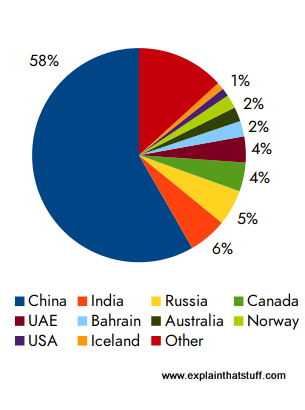
Chart: World aluminum production 2022: Although aluminum is produced in many countries, China now accounts for over half of world smelter production. US production declined by almost half in 2016, and fell by another 10 percent in 2017 to its lowest level since 1951, before increasing again in 2018, 2019, and 2020, then falling again in 2021 and 2022. Source: US Geological Survey, Mineral Commodity Summaries: Aluminum. January 2023.
8% of Earth's outer crust (by weight) is made of aluminum.
A block of aluminum weighs one third as much as a block of steel the same size.
(In other words, the density of steel is about three times greater than the density of aluminum.)
Aluminum foil is typically less than 0.15 mm (0.0060 in) thick.
It can be about 15 times thinner—as thin as 0.01mm (0.0004in)!
[1]
Pure aluminum reacts rapidly with air to form a rustproof protective layer of aluminum oxide.
Many cooking pots, pans, and tools are made of aluminum.
Packaging represents about a fifth of all the aluminum used in the United States.
[Source: US Geological Survey, Mineral Commodity Summaries, January 2023.]
It takes up to 4 kg of bauxite (aluminum ore) to make just 1 kg of pure aluminum metal.
[2]
Commercial ingots of aluminum are huge and can weigh as much as 30 tons—about as much as six adult African elephants!
It takes over 20 times less energy to make pure aluminum from recycled cans than from
bauxite.
[3]
860 million (metric) tons of aluminum worth $2.90 billion was produced in the United States in 2022. That's dramatically down on the ~1,700 million (metric) tons of aluminum worth $3.94 billion produced in 2014, but up on the 2017 figure of 741 million (metric) tons [Source: US Geological Survey, Minerals Yearbook 2014 and Minerals Commodity Summaries 2020, 2021, and 2023.]
67% of US aluminum beverage cans were recycled in 2012. [Source: Aluminum Association Inc, October 2013.] Typically, aluminum cans are made from 70% recycled metal. [Source: The Aluminum Association, 2016.]
Aluminum is produced in around 40 countries, with about three quarters coming
from just four countries (China, India, Russia, and Canada).
[Source: US Geological Survey, Mineral Commodity Summaries, January 2023.]
In 2022, China was producing over half the world's aluminum (roughly
40,000 thousand metric tons), and about 47 times more than the
United States. [Source: US Geological Survey, Mineral Commodity Summaries, January 2023.]
Key data
Artwork: Aluminum is in group 13 (III) of the periodic table,
which means it loses three electrons to form positive ions (it has a
valency of 3). Since it's near the top of the table, its atoms are relatively light compared to elements lower down the
table such as lead.
Melting point: 660°C (1220°F).
Boiling point: 2467°C (4473°F).
Atomic number: 13 (one aluminum atom contains 13 protons, 13 electrons, and 14 neutrons).
USGS: Aluminum: Reliable statistics about US and world aluminum production from the US Geological Survey.
Books
For older readers
The Environmental Chemistry of Aluminum by Garrison Sposito. CRC Press, 2020. A detailed look at how aluminum behaves in the natural environment, such as in soils and water.
Aluminum: Properties and Physical Metallurgy by John E. Hatch. American Society for Metals, 1984. A classic guide covering the physical nature of aluminum and its various applications.
Handbook of Aluminum Edited by George E. Totten and D. Scott MacKenzie. M. Dekker, 2003. Two volumes covering properties, metallurgy, alloy production, and manufacturing.
For younger readers
Aluminum by Heather Hasan. Rosen, 2007. A simple 48-page into covering the history of aluminum, physical and chemical properties, compounds, production, and uses.
The Elements: Aluminum by John Farndon. Benchmark Books (Marshall Cavendish), 2001. A simple, solid, 48-page overview for 9-12 aged readers.
Articles
Aluminum's Allure Draws New Attention by Amy Elliott. The New York Times. March 29, 2023. Why aluminum is attracting attention from jewelers and other crafts people.
Steel Industry Feeling Stress as Automakers Turn to Aluminum by Jaclyn Trop. The New York Times. February 24, 2014. Despite its advantage in price, steel is feeling the pinch from aluminum as car makers try to build lighter and more fuel economic vehicles.
For cars, aluminum is a back-to-the-future metal by Tudor Van Hampton. The New York Times. February 16, 2014. Why aluminum has come back into fashion—and a brief look at when it was first used in transportation.
Green row over Iceland aluminum by Nick Higham. BBC News, 1 November 2009. A 2-minute video exploring why environmentalists are upset by energy-hungry aluminum smelting in Iceland.
Power driven by Susan Demuth. Guardian, 29 November 2003. An article describing opposition to the Karahnjukar hydroelectric development.
Bjork scorns 'crazy' Iceland smelter plan by Alex Kirby. BBC News, 2 January 2003. An early article describing opposition to the Karahnjukar hydroelectric development.
↑ Food-grade aluminum foils ranges from about 0.01mm to 0.2mm.
↑ Estimates vary around the world, but most sources give a figure of 2–4kg of bauxite for each 1kg of alumina.
According to the [PDF] US Geological Survey, for example: "As a general rule, 4 tons of dried bauxite is required to produce 2 tons of alumina, which, in turn, produces 1 ton of aluminum."
↑ "The Commoner Chemical Elements in Earth's Crust" (p.F-199),
and "Aluminum" (p.B-7) in CRC Handbook of Chemistry and Physics by Robert Weast (ed), CRC Press, 1978.
Please do NOT copy our articles onto blogs and other websites
Articles from this website are registered at the US Copyright Office. Copying or otherwise using registered works without permission, removing this or other copyright notices, and/or infringing related rights could make you liable to severe civil or criminal penalties.