The most exciting thing you can possibly
do on Earth is to get away from it: jump in a rocket and blast into space! Rockets
always seem to be firing us into the future, but their basic
technology is rooted far in the past—in firework-like missiles
developed almost 800 years ago in 13th-century China. Since the first modern
liquid-fueled rocket soared to the sky in 1926, rockets have ferried
about 500 people, several thousand satellites, and quite a few unmanned probes
to the deep darkness beyond Earth. While exploring space is obviously
the main point of all that effort, it's worth remembering that
"stepping outside" Earth gives us a better understanding of our
own planet: weather forecasting, climate research, and navigation are
just three of the things we can do better thanks to the development of
the space rocket. Now rockets are useful things, but they're
also very complex and highly dangerous. How exactly do they work? Let's take a closer look!
Photo: Looking up at the base of a Saturn V rocket like the ones that put astronauts on the Moon in the 1960s. The five red things are the five engines of the lowest rocket stage (technically called S-IC). Picture courtesy of
NASA.
Photo: Space as we know it. Photo of stellar swarm M80 (NGC 6093), a dense star cluster in the Milky Way galaxy, taken by the Hubble Space Telescope and courtesy of NASA on the Commons.
If you want to understand space rockets, you need to understand space.
Strapped to your rocket, whistling your way to the stars, you
won't pass any road signs: "Space: Population 0, Please drive
carefully." There's no neat dividing line between the end of
Earth and the beginning of space. That's because gravity (the force
that sucks air molecules toward our planet, creating Earth's
atmosphere) reaches out to infinity. In other words, Earth's atmosphere ends gradually,
blurring invisibly with the start of space.
Where does space start?
Most jet planes don't fly above
15km (9.5 miles, 50,000ft), where there's still enough oxygen to
burn fuel in their engines and keep them flying, but that's nowhere near
the start of space. Space is generally defined as starting at about 100km (60 miles) above Earth
(an arbitrary point sometimes called the Kármán line), which is where
conventional planes would struggle to make enough lift to stay in the air.
That doesn't mean Earth's atmosphere is all done and dusted by that point; far from it!
The lowest satellites (known as low-earth orbit (LEO) satellites) fly at heights above 160km or 100 miles from Earth, which is over 10 times higher than planes fly. Even so, they still feel some drag
(aerodynamic resistance) from the outer reaches of our atmosphere, which fizzles on up to 800km (500 miles) or higher.
You might think space is a long way away, but a hundred kilometers is not so far: a car, hurtling along at highway speed, would take just an hour to get you there; a rocket will get there about 20 times faster—in just 3 minutes.
What is space like?
From the point of someone designing a rocket, space is the place
effectively beyond Earth's reach—beyond most of its gravity and atmosphere.
Although we tend to think of it as a vacuum, it's not
completely empty. There's radiation zipping through it (there must
be—how else would we see all those distant stars and planets?),
meteorites nipping past, "cosmic dust," and even bits of space
junk (broken bits of satellites and rockets). Perhaps the best way to
think of space is as a place of wild extremes: emptiness,
weightlessness (when you're far from any planets). One minute, deep
darkness and extreme cold (when you're shaded from the sun); the
next, blinding light, dangerous cosmic radiation, and extreme heat.
Is there more than one kind of space?
Mostly we're interested in the interplanetary space of our own
Solar System (the area round the Sun), which is measured in distances of
millions of kilometers. But space telescopes and unmanned probes also
study the further reaches of what's called interstellar space
(the space between stars), measured in vastly greater distances
called light years (the distance light travels in one year, which is
almost 10 trillion kilometers). The Milky Way galaxy, of which our solar
system is just one part, measures about 100,000 light years (1 million, million, million km) across.
Space, if you haven't figured it out already, is a pretty big place!
Now we know what space is, it's easier to understand what a rocket is and how it works.
A space rocket is a vehicle with a very powerful jet engine
designed to carry people or equipment beyond Earth and out into space.
If we define space as the region outside Earth's atmosphere, that means
there's not enough oxygen to fuel the kind of conventional engine you'd find
on a jet plane. So one way to look at a rocket is as a very special
kind of jet-powered vehicle that carries its own oxygen supply.
What else can we figure out about rockets straight away?
They need great speed and a huge amount of energy
to escape the pull of gravity and stop them tumbling back down to
Earth like stones. Vast speed and energy mean rocket engines
have to generate enormous forces. How enormous? In his famous
1962 speech championing
efforts to go to the Moon, US President John F. Kennedy
compared the power of a rocket to "10,000 automobiles with their accelerators on the floor."
According to NASA's calculations, the Saturn V moon rocket "generated 34.5 million newtons (7.6 million pounds) of thrust at launch, creating more power than 85 Hoover Dams."
Forces
Rockets are great examples of how forces make things move. It's a common mistake to think that rockets move forward by "pushing back against the air"—and it's easy to see that this is a mistake when you remember that there's no air in space to push against. Space is literally that: empty space!
When it comes to forces, rockets perfectly demonstrate three important scientific rules called the laws of
motion, which were developed about 300 years ago by English scientist
Isaac Newton (1642–1727).
A space rocket obviously doesn't go anywhere
unless you start its engine. As Newton said, still things (like
rockets parked on launch pads) stay still unless forces act on them
(and moving things keep moving at a steady speed unless a force acts to stop them).
Newton said that when a force acts on something, it makes it
accelerate (go faster, change direction, or both). So when you fire
up your rocket engine, that makes the force that accelerates the
rocket into the sky.
Rockets move upward by firing hot exhaust gas downward, rather like jet planes—or
blown-up balloons from which you let the (cold) air escape. This is
an example of what's often called "action and reaction" (another
name for Newton's third law of motion): the hot exhaust gas firing
down (the action) creates an equal and opposite force (the
reaction) that speeds the rocket up. The action is the force of
the gas, the reaction's the force acting on the rocket—and the two
forces are of equal size, but pointing in opposite directions, and acting on different things
(which is why they don't cancel out).
Photo: Action and reaction: rockets work by firing jets of hot gas downward (the action), which makes them move upward (the reaction). The gas isn't pushing against anything to make the rocket move: the very act of the gas shooting back moves the rocket forward—and that can happen in "empty" space just as well as inside Earth's atmosphere.
This picture shows Space Shuttle mission STS-26 in 1988, when the Shuttle made its brave and confident return to
space after the Challenger disaster two years earlier. Photo courtesy of NASA on the Commons.
Thrust and drag
The force that pushes a rocket upward is called thrust;
it depends on the amount (mass) and speed of gas that the rocket
fires and the way its exhaust nozzle is shaped to squirt out that gas
in a high-pressure jet. When a rocket's engine develops enough
power, the thrust force pushing it upward will be bigger than its own
weight (the force of gravity) pulling it down, so the rocket will
climb into the sky. As the rocket climbs, air resistance
(drag) will try to pull it back too, fighting against the thrust. In an
upward-climbing rocket, thrust has to fight both drag and weight.
This is slightly different to an airplane, where thrust from the
engines makes the plane fly forward, drag pulls the plane backward,
and the forward motion of air over the wings generates lift, which
overcomes the plane's weight. So a key difference between a rocket
and a jet plane is that a rocket's engine lifts it directly upward into the sky,
whereas a jet's engines simply speed the plane forward so its wings
can generate lift. A plane's jet engines fire it forwards so its
wings can lift it up; a rocket's engines lift it up directly.
The faster things move and the more their shape disturbs the air,
the more drag they create and the more energy they waste, uselessly,
as they speed along. That's why fast-moving things—jet airplanes,
high-speed trains, space rockets... and even leaping salmon—tend to be
long, thin, and tube-shaped, compared to slower-moving things like
boats and trucks, which are less affected by drag.
Artwork: Forces acting on a plane (left) and a rocket (right). When a plane flies at steady speed,
the forward thrust made by the engines is equal to the air resistance (drag) pulling back. The upward force of lift created by the wings is equal to the downward force of the plane's weight. In other words, the two pairs of forces are in perfect balance. With a rocket, thrust from the engines pushes upward while weight and drag try to pull it back down. When the rocket accelerates upward, the thrust is greater than the combined lift and drag. The various surfaces of a rocket can also produce lift, just like the wings of a plane, but it acts sideways instead of upwards. Although this sounds confusing, it's easy to see why if you imagine the blue plane rotated through 90 degrees so it's flying straight up like a rocket: the lift would also be pointing sideways.
Escape velocity
Rockets burn huge amounts of fuel very quickly to reach escape velocity of at least 25,000 mph (7 miles per second or 40,000 km/h), which is how fast something needs to go to break away from the pull of Earth's gravity.
"Escape velocity" suggests a rocket must be going that fast at launch or it won't escape from Earth, but that's a little
bit misleading, for several reasons. First, it would be more correct to refer to "escape speed," since
the direction of the rocket (which is what the word velocity really implies) isn't all that relevant and will
constantly change as the rocket curves up into space. (You can read more about the difference between speed and velocity in our article on motion). Second, escape velocity is really about energy, not velocity or speed. To escape from Earth, a rocket must do work against the force of gravity as it travels over a distance.
When we say a rocket has escape velocity, we really mean it has at least enough kinetic energy to escape
the pull of Earth's gravity (though you can never escape it completely). Finally, a rocket doesn't get all its kinetic energy in one big dollop at the start of its voyage: it gets further injections of energy by burning fuel as it goes.
Quibbles aside, "escape velocity" is a quick and easy shorthand that helps us understand
one basic point: a huge amount of energy is needed to get anything up into space.
Parts of a space rocket
A rocket contains about
three million bits, of all shapes and sizes, but it's simpler to think of it as being made up of four
separate parts. There's the structure (the framework that
holds the whole thing together, similar to the fuselage on a plane),
the propulsion system (the engine, fuel tanks, and any outer
rocket boosters), the guidance system (the onboard,
computer-based navigation that steers the rocket to its destination),
and the payload (whatever the rocket is carrying, from people
or satellites to space-station parts or even nuclear warheads).
Modern space rockets work like two or three independent rockets stuck
together to form what are called stages. Each stage may have
its own propulsion and guidance system, though typically only the
final stage contains the rocket's all-important payload. The lower
stages break away in turn as they use up their fuel and only the upper
stage reaches the rocket's final destination.
Some rockets (the Space Shuttle and the European Ariane) look like a whole bunch of rockets "strapped" together: a fat one in the middle with some skinnier ones either side. The big
central rocket is the main one. The thinner rockets either side are what are called
booster rockets. They're little more than fat fireworks: disposable
engines that provide a thump of extra power during liftoff to get the
main rocket up into space.
Artwork: Little pieces of history: An interesting cutaway showing the main component parts of the now-retired Space Shuttle orbiter. Picture courtesy of NASA Marshall Space Flight Center (NASA-MSFC). Browse the hi-resolution version of this image (via Wikimedia Commons).
Rocket engines
Photo: Test firing the Space Shuttle's main engine. Picture courtesy of NASA on the Commons.
The biggest (and arguably the most interesting) part of a rocket
is the propulsion system—the engine that powers it into the sky. As
we've already seen, rockets differ from jet planes (and other
fuel-powered vehicles that work on Earth) because they have to carry their own
oxygen supply. Modern space rockets have main engines powered by
a liquid fuel (such as liquid hydrogen) and liquid oxygen (which does
the same job as the air sucked into a car engine) that are pumped in
from huge tanks. The fuel (also called the propellant) and oxygen
(called the oxidizer) are stored at low temperatures and high pressures
so more can be carried in tanks of a certain size,
which means the rocket can go further on the same volume of fuel.
External rocket boosters that assist a main rocket engine typically burn solid fuel instead
(the Space Shuttle's were called solid rocket boosters, or SRBs, for exactly that reason).
They work more like large, intercontinental ballistic missiles, which also burn solid
fuels.
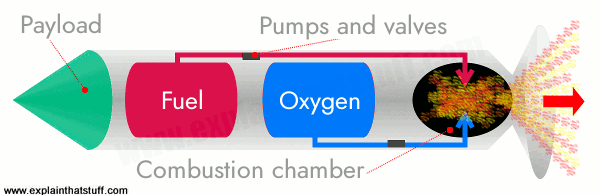
Artwork: How a space rocket works—greatly simplified: Unlike airplane jet engines, which take in air as they fly through the sky, space rockets have to carry their own oxygen supplies (oxidizers) with them because there is no air in space. Liquid hydrogen (the fuel) from one tank is mixed with liquid oxygen (the oxidizer) from a separate tank using pumps and
valves to control the flow. The oxidizer and fuel mix and burn in the combustion chamber, making a hot blast of exhaust gas that propels the rocket. The payload (the cargo—such as a satellite) occupies a relatively small proportion of the rocket's total volume in the nose-cone at the top.
A typical space rocket: Ariane 5
How many space rockets can you name? The mighty
Saturn V that took
astronauts to the Moon is probably top of your list. Or what about the super-versatile
Atlas rockets?
The first one took off on June 11, 1957 and the latest version, Atlas
5, is still blasting off today. The highlights of that half-century
history include putting the first US astronaut into space, sending the Pioneer-10 space probe to Jupiter and beyond, and launching the ten
Mariner program missions to explore Mars, Venus, and Mercury.
Outside the United States, there's the European Ariane rocket. Originally dreamed up in 1973 as a joint project between France, Germany, and the UK, it's gradually established itself as one of the most reliable of rockets, launching over
half of the world's commercial satellites from its base on French
Guiana. The latest version, Ariane 5, has launched about 90 times
since its maiden voyage in 1996 (with only two major failures).
Sitting on the launchpad, Ariane has three main parts: the central
rocket (up to 53m or 174ft high), powered by the main engine (Vulcain 2), and
two 31m/101ft-high solid rocket boosters (one either side). The main rocket consists of two stages. The first (lower) stage is called the Cryogenic Main Stage (or EPC). Powered by the Vulcain engine, and assisted by the two SRBs, its job is to get the rocket and its payload out of Earth's atmosphere and into space.
The second (upper) stage is called the Cryogenic Upper Stage (ESC-A).
It's powered by a much smaller engine called Aestus, which produces
a tiny 2.6 tonnes of thrust, just enough to put the rocket
into its final orbit ready for the release of the satellites it
carries as payload. The payload travels in the very top part of the
rocket behind a detachable fairing (streamlined outer cover)
that measures 17m high by 5.4m in diameter (56ft high by 18ft in diameter). The usual payload is either one or two satellites fixed either side of a launching structure called the Speltra (or a slightly different
one called the Sylda).
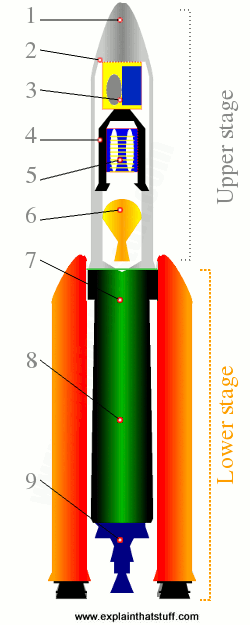
Artwork: The parts of an Ariane 5 rocket. The central rocket comprises two stages: the lower Cryogenic Main Stage (EPC, orange dotted line) and the Cryogenic Upper Stage (ESC-A, gray dotted line). Solid rocket boosters (orange) stand on each side. Inside the central rocket, the main parts are: 1) Detachable fairing to protect payload as the rocket blasts through Earth's atmosphere; 2) Payload consisting of (in this mission) two satellites to be launched; 3) Satellite mounted on top is launched last; 4) Speltra structure allows two satellites to be launched in the same mission; 5) Satellite mounted underneath Speltra is launched first; 6) Small Aestus engine; 7) Liquid oxygen tank; 8) Liquid hydrogen tank; 9) Vulcain main engine.
A typical Ariane mission
It takes Ariane less than an hour to put two satellites into space:
Liftoff: At liftoff, the rocket weighs up to 780 tonnes (as
much as about 500 cars), of which the payload represents 10 tonnes at most.
In other words, the cargo represents just 1 percent of the total
weight! To put this huge mass into space, Ariane 5 has to produce
a total of about 1340 tonnes of thrust: 1200 from the two SRBs (600 each) and
140 from the Vulcain engine. At liftoff, the Vulcain fires first;
the SRBs start up a few seconds later.
SRBs jettisoned: The SRBs fire for about two and a half
minutes before separating from the main stage when it reaches an
altitude of about 69km (42 miles). The SRBs reenter Earth's
atmosphere, then fall into the Atlantic Ocean.
Payload fairing jettisoned: Once the rocket is safely outside
Earth's atmosphere, about three minutes after launch and an altitude
above 100km (62 miles), explosive (pyrotechnic) charges split the
protective payload fairing apart and it's jettisoned.
Cryogenic main engine jettisoned: The main Vulcain engine
fires for about nine minutes in total (from the launch),
during which time it burns 25 tonnes of liquid hydrogen and 150
tonnes of liquid oxygen. At a height of about 200km (124 miles), the main stage (EPC)
shuts down and is jettisoned from the rest of the craft. It reenters Earth's
atmosphere, also destined for the ocean.
Upper stage moves into orbit: The upper stage engine (ESCA) ignites
and positions the remainder of the rocket in orbit before shutting down
roughly 25 minutes into the mission at an altitude of 640km (400 miles).
First satellite separates: Just over 27 minutes into the
mission, the first satellite splits away from the Speltra and maneuvers itself into
orbit, leaving the second satellite still attached to the launch
vehicle.
Second satellite separates: About 35 minutes into the
mission, the second satellite splits away from the Speltra and maneuvers into orbit.
End of mission: The entire mission takes roughly 50 minutes
from launch to completion.
A closer look at a scientific rocket
Artwork: Early design for a high-altitude rocket camera from
US Patent: 1,102,653: Rocket Apparatus by Robert Hutchings Goddard, July 7, 1914, courtesy of US Patent and Trademark Office (with some details removed and colors added for ease of explanation).
It's not rocket science, even when it is! Rockets might be super complex, but if you think about
them carefully, you'll find the bits inside are arranged in a very logical way that soon makes sense.
To see what I mean, let's explore a very early rocket design in a bit more detail.
It was developed by Robert Hutchings Goddard (1882–1945), an American physicist widely considered to be the father of the modern space rocket.
This artwork comes from a patent that Goddard filed in 1914 for a rocket that could rise to high altitudes and take
photos. Remember that this was back in the early 20th century, long before satellites had entered space or astronauts
had plodded over the moon.
Goddard's clever idea here was to put a rocket inside a rocket, which is a bit like the modern idea of a rocket with stages.
You can see the entire rocket in Figure 1 on the right. The main rocket engine is colored red. You light it with a fuse (14),
which burns up and ignites disks of fuel (12). Once all the fuel is burned up and the rocket has reached a fairly high altitude,
the second rocket (blue) mounted on top ignites, separates, and fires off even higher. Because the second rocket weighs much less than the first one, a certain amount of fuel will make it rise very much higher into the sky than if that fuel had to lift both rockets together.
The rocket keeps its stability by spinning round at high speed as it flies along, just like a bullet fired from a gun. Figure 3 shows how this happens. It's a cross-section through the rocket at the point marked 3—3 in Figure 1 (where the blue and red rockets meet). Inserts of fuel (16) burn and send jets of hot gas outward at tangents, making the rocket body rotate. Unlike the main rocket engine, the spinning jets are ignited by an electrical circuit shown as 18, 19, and 20, which enables them to fire simultaneously. In practice, you'd fire up these tangential rockets to make the rocket spin around on its stand (Figure 5), on ball bearings (22) and, once it's spinning, light the main fuse (14) to blast it into the sky.
The business part of the rocket—the part that does our useful work—is the payload section on the top. This is shown in Figure 2 on the left. Goddard's rocket was designed for taking photographs from high altitude, so we have a camera (orange, 36) and a gyroscope and induction motor (purple, top) which keeps it pointing in the same direction while the rocket spins.
So it's nothing like as complicated as it looks!
Who invented rockets? A brief timeline of rocket history
Early milestones
~700–900: Chinese inventors develop gunpowder.
1232: Chinese warriors use firework-like rockets, which they
called "arrows of flying fire," to defend the city of Kaifeng
from Mongol attack.
1865: French writer Jules Verne stimulates an appetite for space
travel by publishing his classic book
From the Earth to the Moon.
1869: Edward Everett Hale publishes a story called
The Brick
Moon, describing the idea of an artificial navigation satellite.
1903: Russian teacher
Konstantin Tsiolkovsky (1857–1935) publishes A Rocket
into Cosmic Space. His notable achievements include proposing the idea of liquid-fueled rockets,
rocket stages, and the rocket equation (the basic math of space
travel).
1916: US physics professor
Robert Hutchings Goddard (1882–1945),
often named "the father of modern rocketry," sets out his ideas
in a 70-page report called A Method of Reaching Extreme Altitudes.
Buried among its pages are a suggestion for sending a rocket to
the Moon.
Photo: The father of modern rocketry, Robert Hutchings Goddard, pictured in November 1925 with
one of his inventions, the double-acting rocket engine. Goddard first got the idea of traveling into space as a teenager, after climbing a cherry tree in his family's garden: "I imagined how wonderful it would be to make some device which had even the possibility of ascending to Mars..." His many inventions included powering rockets with liquid fuels and constructing rockets with
multiple stages—two fundamentally important ideas used in virtually every successful space rocket launched to date. Picture courtesy of NASA on the Commons.
1920: On January 12, 1920, an
editorial in The New York Times calls Goddard's ideas for a Moon rocket "absurd," arguing that they "lack the knowledge ladled out daily in high schools."
1923: German physicist,
Hermann Oberth (1894–1989) publishes an
influential book called The Rocket into Interplanetary Space,
explaining how rockets can operate in the vacuum of space.
1924: Scientists in the Soviet Union (an alliance of Russia and
neighboring states) found a Society for the Study of Interplanetary
Travel. A US equivalent, the American Interplanetary Society, is set
up six years later.
1926: Robert Hutchings Goddard launches the first practical
liquid-fueled rocket on March 16, 1926.
1942–1945: During World War II,
German scientists lead by
Wernher von Braun (1912–1977)
develop the V-2 long-distance rocket-based missile that launches devastating attacks
on enemy cities, including London, England. After the war ends, von
Braun and over 100 other German rocket scientists relocate to the United States, where
they begin working for the US military and, eventually, the American
space agency NASA.
Photo: An early Atlas rocket photographed in 1963. Picture courtesy of NASA on the Commons.
Human spaceflight
1957: Soviet Union launches Sputnik 1, the first Earth-orbiting satellite, on October 4, 1957. Sputnik 2 blasts off a month later,
on November 3, with a canine cosmonaut, Laika the dog, onboard.
1959: Part conventional airplane and part rocket, NASA and the US
Air Force's experimental
X-15 rocket plane makes its maiden voyage in September 1959. Over the next few years, it helps military pilots
train for high-speed, high-altitude rocket flight and sets the world
speed record for a human-crewed airplane of almost 7 times the speed of
sound.
1961: Soviet cosmonaut Yuri Gagarin (1934–1968) becomes the first person to venture into space and orbit Earth on April 12, 1961. The following
month, on May 5, Alan Shepard (1923–1998) of the US Navy becomes the first
American astronaut in space flying in a Mercury spacecraft.
1963: Valentina Tereshkova
(1937–) becomes the first woman in space in the Soviet Vostok 6 mission.
1969: On July 20, 1969, Neil Armstrong and Edwin "Buzz" Aldrin
are the first men to set foot on the Moon during the
Apollo 11
mission, helped by their colleague Michael Collins, who remains in
lunar orbit. Five more Apollo missions successfully explore the Moon until
the final one, Apollo 17, concludes on December 19, 1972.
The day after the Moon landing, The New York Times
apologizes for mocking Goddard's original idea of Moon rockets:
"It is now definitely established that a rocket can function in a vacuum as well as in an atmosphere. The Times regrets the error."
1971–1982: The Soviet Union launches a series of seven manned
Salyut space stations where cosmonauts set a number of endurance
records for the longest continuous time spent in space.
1973: The United States launches its rival space station, Skylab. It remains in orbit until 1979, when it finally crashes back to Earth
1982: The US Space Shuttle, a reusable space plane, makes its
maiden voyage.
1986: The Shuttle program comes to an abrupt end on January 28,
1986 when Challenger, one of the Shuttle fleet, explodes one minute
after launch of mission STS-51-L, killing all seven people onboard.
1986: The Soviets launch Mir, a continuously crewed space station. It remains in orbit until 2001, over three times its planned
lifespan.
1998: Construction of the International Space Station begins on November 20, 1988. It gradually takes shape following a
further 115 space flights. The current structure is four times bigger than Mir, five times bigger than
Skylab, and as long as an (American) football field.
Photo: A SpaceX Falcon 9 rocket being launched in 2020.
Picture courtesy of NASA on the Commons.
21st century
2002: Maverick inventor Elon Musk founds SpaceX, which launches the first privately funded liquid-fueled rocket into orbit in 2008.
2004: SpaceShipOne wins the Ansari X Prize (a competition to develop the first reusable, non-government space plane), making its
maiden flight into space on June 21, 2004.
2010: NASA and the US Air Force successfully test a 9m- (30ft)- long reusable, unmanned space drone called the
X-37B, built by Boeing.
2018: NASA launches InSight, a new mission to Mars that will probe the secrets of the red planet's inner structure (its crust, mantle, and core).
2019: China's uncrewed Chang'e-4 probe becomes the first spacecraft to land on the far side of the Moon. Later in 2019, India's Chandrayaan-2 mission narrowly fails to place a working lunar lander and rover on the Moon.
2020: China's Chang'e-5 probe brings the first Moon samples back to Earth since the Apollo missions, decades ago.
2022: NASA unveils a giant new Moon rocket named Space Launch System (SLS), slated to be 15 percent more powerful than the Saturn V that took astronauts to the Moon first time around.
Photo: The Space Launch System (SLS) under construction in the vast Vehicle Assembly Building at NASA’s Kennedy Space Center in Florida. Picture courtesy of NASA Image and Video Library.
Space.com: One of the web's most popular space news sites.
Books
For older readers
Apollo 11: The Inside Story by David Whitehouse. Icon, 2019. On the 50th anniversay of the Apollo moon landing, this book takes a new look at one of the most inspiring scientific success stories of all time.
Rocket: Owners' Workshop Manual: 1942 Onwards by David Baker. Haynes, 2015. Some great cutaways accompanied by lavish photos. This book covers both the general principles of how rockets work and examples of classic rockets from the last half century.
Eyewitness: Space Exploration by Carole Stott et al. DK, 2014. What's out there, beyond the sky, in the darkness where we can only imagine? A colorful introduction from Dorling Kindersley.
Man on the Moon by Andrew Chaikin. Penguin, 2010. An engaging read that charts the historic Apollo missions and the men who made them possible.
Eyewonder: Space by Carole Stott. DK, 2016. A short (56-page) introduction for ages 5–9.
Space: Smithsonian by Robert Dinwiddie et al. DK, 2015. An information-packed but visually very engaging introduction for ages 9–12.
Articles
Fueling up
and Heading out
by Neil deGrasse Tyson, Natural History Magazine, June, 2005. These two engaging essays explain how a rocket gets off the ground and how it moves around in space once it gets there.
Please do NOT copy our articles onto blogs and other websites
Articles from this website are registered at the US Copyright Office. Copying or otherwise using registered works without permission, removing this or other copyright notices, and/or infringing related rights could make you liable to severe civil or criminal penalties.