How many times every day do you hear
recorded music on the radios on
TV,
in stores, in elevators—even in the street? You'd never hear music
at all if it weren't for loudspeakers: electric sound-making machines.
Most of the music we hear around us is played back with big
loudspeakers attached to stereos or tiny earbud headphones.
Radios, televisions,
computers, cellular phones, intercoms, and talking
toys are just some of the electric gadgets that make sounds with
loudspeakers. But what exactly are loudspeakers and how do they work?
Photo: These neat little Sony bookshelf speakers have a built-in amplifier and a long jack lead, so you can plug them into a CD player, MP3 player,
computer, or anything else with a standard headphone socket. They pack quite a punch for something so tiny because they have a reasonably high sensitivity, which is explained below.
When things shake about, or vibrate, they make the sounds we can
hear in the world around us. Sound is invisible most of the time, but sometimes you can
actually see it! If you thump a kettle-drum with a stick, you can see
the tight drum skin moving up and down very quickly for some time
afterward—pumping sound waves into the air. Loudspeakers work in a
similar way.
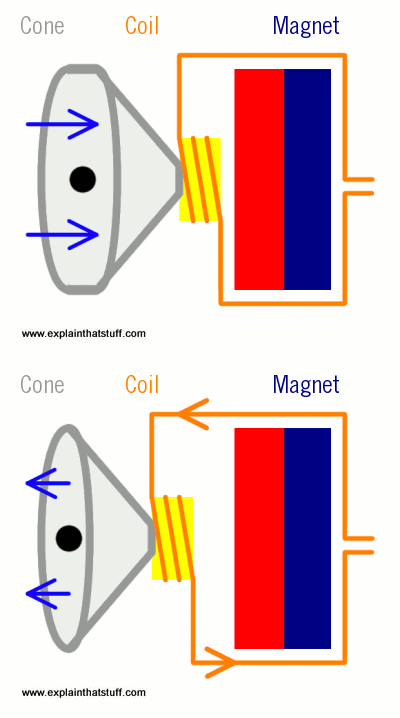
At the front of a loudspeaker, there is a fabric, plastic,
paper, or lightweight metal cone (sometimes called a diaphragm) not
unlike a drum skin (colored gray in our picture below). The outer part of the cone is fastened to the outer
part of the loudspeaker's circular metal rim. The inner part is fixed
to an iron coil (sometimes called the voice coil, colored orange in the diagram) that sits in a hollowed-out ring at the front of a permanent magnet (sometimes called the field magnet, and colored yellow). When you hook up the loudspeaker to a stereo, electrical signals feed through the speaker cables (red) into the coil.
This turns the coil into a temporary magnet or electromagnet.
As the electricity
flows back and forth in the cables, the electromagnet either attracts or repels the
permanent magnet. This moves the coil back and forward, pulling and
pushing the loudspeaker cone. Like a drum skin vibrating back and
forth, the moving cone pumps sounds out into the air. This is why loudspeakers
are technically called drivers: they "drive" (move) the air to produce sound.
Animation: How a loudspeaker works. When a fluctuating electric current flows through the coil (orange), it becomes a temporary electromagnet, attracted and repelled by the permanent magnet (blue/red). As the coil moves, it moves the cone (gray) back and forth, pumping sound waves into the air (light blue).
Sponsored links
How speakers make sounds of different volume and frequency
Loudspeakers will play loud when the cone vibrates a large amount, or
soft when it moves a small amount. Why? Think about drums.
Banging a drum skin really hard makes the
skin vibrate a greater distance and produce a louder sound. In the same
way, sending a bigger pulse of electricity into a loudspeaker makes the
cone move further and generates a louder noise. Quieter sounds are made
by smaller pulses of electricity.
Photo: Large loudspeakers (like these old Celestions of mine) typically contain two separate speakers: a small tweeter that makes high frequencies (top) and a large woofer that makes low frequencies (bottom).
We can reach the same conclusion by thinking about energy. The laws of
physics tell us that we can't make energy out of thin air. So if we want to make
a loud sound (one that carries lots of energy), we need to create
a vibration with lots of energy in the first place (in other words,
hit something really hard).
Some drums have pedals on them that make the skin tighter or looser.
If the skin is tight, it vibrates more quickly when you bang the drum
and produces a higher-pitched sound; if the skin is loose, the opposite
happens and you get a much lower note. A similar thing happens in a
loudspeaker. Bigger speakers with large cones (known as
woofers) move more slowly than smaller speakers with smaller cones (known as
tweeters)—so
they are better for producing lower frequencies. Any speaker can
produce a wide range of different sound frequencies by moving back and
forth quickly (for higher notes) or slowly (for lower notes).
A typical home loudspeaker, in a wooden case, will contain both a large woofer
and a small tweeter so it can produce a full range of frequencies.
It uses a circuit called a crossover to divide the incoming electrical signal
into a low-frequency part, which is sent to the woofer, and a high-frequency part,
which goes to the tweeter.
Speakers that need to produce high-frequency sounds
(or ultrasound, well beyond the range of human hearing)
sometimes use piezoelectric transducers,
based on vibrating crystals, instead of the traditional magnetic coil setup.
Often referred to as crystal loudspeakers or just "buzzers," they're also used to produce piercing
sounds in things like telephone ringers and smoke alarms, where
the effectiveness of the alert is much more important than its quality.
Photos: Speaker cones are generally made from paper, though plastic and even light metals such as
aluminum and titanium are also used. 1) Paper cone: The Sony loudspeaker in our top photo with its protective plastic cover removed. Now you can see the white speaker cone in closeup. The small black dome in the middle is called the dust cap. The black outer rim between the white cone and the frame that supports it is called the surround. The frame itself is called the basket. 2) Metal cone: The tiny titanium speakers in this laptop computer have titanium foil diaphragms less than 1cm in diameter.
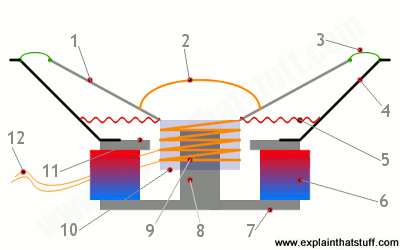
What are the parts of a loudspeaker... and what do they do?
Diaphragm (cone): Moves in and out to push air and make sound.
Dust cap (dome): Protects the voice coil from dust and dirt.
Surround: A piece of elastic rubber, foam, or textile that flexibly fastens the diaphragm to the basket (outer frame).
Basket: The sturdy metal framework around which the speaker is built.
Spider (suspension): A flexible, corrugated support that holds the voice coil in place, while allowing it to move freely.
Magnet: Typically made from ferrite or powerful neodymium.
Bottom plate: Made of soft iron.
Pole piece: Concentrates the magnetic field produced by the voice coil.
Voice coil: The coil that moves the diaphragm back and forth.
Former: A cylinder of cardboard or other material onto which the coil is wound.
Top plate: Also made of soft iron.
Cables: Connect stereo amplifier unit to voice coil.
Photo: A typical compact loudspeaker in a portable radio, photographed from behind. You can see the permanent (field) magnet and the cone quite clearly and the two cables sending an electric current into the speaker. You can't actually see the (voice) coil, though I've indicated roughly where it is (in front of and underneath the magnet, attached to the cone in the center). The gold framework is the strong metal basket holding the whole thing together.
How to make your speakers sound better
Photo: As speaker designers know only too well, psychology plays an important part in
making us appreciate loudspeakers: it they look good, we're tempted to believe they'll sound good as well.
Here's an early example: this old 1920s phonograph has a wonderful
Sterling Primax loudspeaker attached.
Although the cone is only paper, it's made to appear very striking and attractive
with a gold-painted, fluted design. It's powered by a moving magnetic coil in the usual way.
It's not just the moving cone that determines how a speaker sounds.
Have you noticed how most speakers are built into wooden or plastic
cases? That's not just to make them look nice: it drastically changes
the sound. You probably know that a guitar's wooden body amplifies the
sound the strings make by a process called sympathetic resonance.
As the strings vibrate, they make the air around them vibrate too. That
starts the air vibrating inside the guitar body in sympathy—and this is
what makes the sound loud enough to hear. A loudspeaker case,
which is technically called an enclosure or cabinet, works in
exactly the same way. Without the resonance of the case, you'd hardly
hear a guitar or a loudspeaker at all. (If you ever take a radio or a loudspeaker apart
and switch it on with the case open, you'll notice an immediate absence of rich, deep sound.)
Except for earphones, loudspeakers are usually some
distance from our ears. The sound waves produced by the speaker cones
have to travel through the air in a room before we can hear them. But
sound waves travel out from speakers in all directions. They travel
backward from the speaker as well as forward; they travel down to the
floor and up to the ceiling as well. In practice, one single push or
pull of a speaker cone sends sound waves traveling in all directions.
These reflected waves bounce off the walls, floors, and furniture in
your room and interact in many different ways, sometimes adding
together and sometimes canceling out. With the same set of speakers,
an empty room will sound very different to a room full of furniture; a
living room with rugs and soft furnishings will sound very different to
a kitchen or bathroom with lots of hard surfaces.
You can dramatically alter the quality of the sound your speakers
make by putting them in different places. Always arrange them
symmetrically (so if one is six inches from a wall, the other needs to
be six inches from a wall too). Never fasten speakers directly onto a wall or stand them on the floor.
Instead, try to mount them roughly at ear level.
Put each speaker nearer to the center of the room so there
are unequal distances from the speaker to the walls, ceiling, and
floor. That will help to stop reflected sounds from interfering with
the main speaker sounds. Speaker stands are a great investment: they usually make speakers sound
twice as good, although sound quality is clearly a matter of personal taste—and you might
prefer to kave your speakers on a shelf or sitting on the floor.
Changing the position of your speakers in this way will emphasize or demphasize certain sound frequencies,
so the type of music you enjoying listening to is also a factor here. Chamber music (such as classical string quartets)
tends to benefit from crisp, clear higher frequencies, while dance music and rock is enhanced by plenty of bass. Sitting
speakers on the floor might give your Neil Young the thump you're looking for, but it will have a very different
effect on your Schubert sonatas.
Listening with both ears: stereo, quad, and binaural
When sound comes from a single loudspeaker, we say it's
mono or monaural. Mono is like the sound of one person talking: the sound
source is fixed in one place.
Stereo (stereophonic sound) is very different. The first time
you hear stereo, it sounds like a miracle. Where are the sounds coming
from? How do they move around your head like that? Stereo is a simple
trick: two loudspeakers each play slightly different sounds and our
ears and brains reassemble the noises into a two-dimensional soundscape. If you
listen to music with headphones, you'll be used to the way stereo sound
jumps back and forth between your ears. You might hear a drum beating
in one ear and a guitar playing in the other, for example.
Photo: Most old audio systems had only one speaker, like this, and reproduced sound in mono. This is a wonderfully preserved Amplion speaker made in 1928. It's an exhibit at Think Tank, the science museum in Birmingham, England.
Although stereo is a big improvement on mono, it's still only
two-dimensional sound. It is possible to make loudspeakers sound
three-dimensional, but you need more speakers to do it. Quad
(quadrophonic) sound is like double stereo: you have two speakers in
front of you and two behind. Now the sound can move behind you or in
front as well as from side to side. Surround sound
used in
movie theaters (cinemas) works in a similar way.
Binaural is a way of making a sound recording seem
three-dimensional with only two speakers. Our ears are more than just
holes through which sounds enter. The hills and valleys in our outer
ears (pinnae) help us to work out where sounds are coming from and give the
sounds we hear in the world their three-dimensional quality. Normal
stereo recordings don't pick up this directional information, because
ordinary microphones don't have the hills and valleys that our ears
have. Binaural recordings are made a different way using a dummy's head
with plastic ears shaped like a human's. Two microphones are placed
inside the ear holes so they pick up noises like human ears would. When
sound is recorded binaurally, in this way, and then played back with
conventional headphones, it sounds strikingly different to stereo—and almost
lifelike. A binaural recording of a jet plane taking off sounds scarily
like it's moving through your head.
Why bigger and more powerful isn't always louder
Generally speaking, the more noise you want to make with your speakers, the bigger they'll need to be. Why?
Because the amount of noise something makes is related to the amount of sound energy it sends
out into the air. Bigger speakers sound louder because they have bigger cones that can pump out more energy per second,
which means they're more powerful.
In the everyday world, words like "energy" and "power" are often used in quite a vague way, but
they have very strict scientific meanings. In science, we measure energy in units called joules (named for English physicist James
Prescott Joule) and the amount of energy something produces in one second is called its power, measured
in units of watts (named for Scottish engineer, James Watt). A power of one watt means something is making or using one joule of energy every second. An ordinary 60-watt incandescent lamp takes in 60 joules of electrical energy every second, though probably puts out only about 3–6 watts of light and wastes the other 54–57 watts as heat. You might think a loudspeaker rated
100 watts would produce 100 watts of sound—but it's not quite that simple. Speakers are also fairly inefficient: much of the electrical energy you feed into the back of a speaker doesn't emerge from the front as sound energy but is wasted in the coil as useless heat energy.
Power
If you want to compare the output of two loudspeakers, you might do it by putting them side by side, switching them (in turn)
up to maximum, and walking off into the distance to see how far you could go before the sound disappeared. In theory, an easier way
to achieve the same end is to find out their power rating in watts and compare. This is what most people do when they buy speakers or home stereo systems.
You might expect that the higher the number of watts, the louder and more powerful your speakers would be. So, for example, those little Sony bookshelf speakers in the top photo are rated a puny 7 watts, whereas big, old-fashioned, home stereo speakers are more like to be rated at something like 50 watts. However, straight power measurements can be very misleading and are often deliberately used as a marketing trick by speaker and amplifier manufacturers: two similarly rated speakers may produce sound in very different ways and in practice, for various reasons that I'm not going to go into here, speakers that claim to have a higher power rating might sound quieter than ones with a lower power rating. Not only that, but simple power ratings tell you little or nothing about how you'll be able to use your speakers in the real world: I used to own some huge speakers that were so powerful I could never play them at anything other than minimum volume for fear of upsetting my neighbors. I had to
play them so quietly that they simply never worked properly. It was like owning a Ferrari and driving at walking speed.
Photo: Now that's what I call loud! The gigantic 1400-watt "loud hailer" loudspeaker on the side of this Sea Knight HH-46D helicopter was designed for use during search and rescue missions at sea, but just how loud was 1400 watts in practice? And was it loud enough? Large outer photo by JO1 Snaza; pullout closeup photo by PH3 Sue Cain. Both photos courtesy of
Defense Imagery.
Sensitivity
Instead of power, it's often better to look at a measurement called the sensitivity of a speaker, which is how much noise the speaker produces in decibels at a distance of 1 meter for an input power of one watt. (In effect, sensitivity is a rough guide to the efficiency of a speaker—or how much output it produces for each unit of input.) The higher the sensitivity, the more efficiently the speaker is converting energy from your amplifier into sound—and, often, the better it is. Most home speakers have sensitivities of about 80–90dB; the little Sony ones in our top photo come in at 82dB, which means if you put 1 watt of power into them and stand 1m away they'll produce a perfectly respectable 82dB of sound. Now the decibel scale is logarithmic, so small increases in decibels translate into very much louder sound. Small bookshelf loudspeakers often pack a surprisingly powerful punch because, although they have low power ratings, they have high sensitivity.
How do electrostatic speakers work?
Unless you're a real audiophile, you'll probably never come across electrostatic speakers
(sometimes known as condenser or capacitor speakers). Unlike the speakers we've considered so far, which
generally have rounded cones mounted in square boxes pumped back and forth by electromagnetism, electrostatic speakers often look more like closets or radiators and resemble capacitors. A capacitor is a device for storing electricity
using two parallel metal plates separated by some sort of an insulator (usually air or plastic).
Suppose you take a huge capacitor and rapidly change the electric charge on the plates. Since unlike
charges attract and like charges repel, if the plates can move, the changing charge is going to
make them vibrate, sending sound into the air.
Artwork: Inside an electrostatic loudspeaker: In this design, two large pieces of slate (gray, 1 and 3) are hollowed out to make an air space in between (21). Two conducting metal plates (red, 17 and 19) are fixed to the sides of the slate and a third, low-mass aluminum foil plate (orange, 23) is suspended between them to act as the moving loudspeaker diaphragm. A transformer (green) at the bottom applies a varying voltage, causing the central plate to wobble back and forth. As the diaphragm vibrates, it pushes air in and out through holes (white, 25) in the two outer plates, sending sound into the room. From US Patent: 1,930,518: Electrostatic loudspeaker by Jurjen S. High, Westinghouse Electric and Manufacturing Company, granted October 17, 1933, courtesy of US Patent and Trademark Office.
In practice, electrostatic speakers
have two fixed plates on either side and a very thin moving plate (the diaphragm) that vibrates in between them, which is
analogous to the moving cone in a traditional magnetic loudspeaker. Although they can produce
excellent sound, they have a number of drawbacks: they generally don't work well at low frequencies unless they are very large
(to compensate for having a thin diaphragm that doesn't move much); they need to use high voltages to work effectively, which means they need large transformers that consume a lot of power; and they're extremely expensive compared to traditional speakers. The best known maker of electrostatic speakers is English company Quad Electroacoustics.
Essentially, they're just loudspeakers in miniature.
To see what headphones look like when you take them apart,
take a look at our separate article on headphones.
Who invented loudspeakers?
As with many inventions, it's a little problematic to credit loudspeakers to a single inventor...
Today's speakers are recognizable descendants of the very first moving-coil loudspeaker developed
between 1921 and 1925 by Edward W. Kellogg and Chester W. Rice of General Electric (where Rice's father,
Edwin
was President).
[1]
The first commercial speaker to use their invention was the
RCA Radiola Model 104, a home radio loudspeaker released in 1925. Kellogg later pioneered the electrostatic speaker, and was granted US Patent 1,983,377: Production of Sound for that idea on December 4, 1934.
So were Kellogg and Rice the inventors? It's a bit more complex than that. There were clearly earlier speakers than theirs. How about Alexander Graham Bell's 1876 telephone, for example, or
the earlier version of the telephone developed by Johann Philipp Reis in 1861?
Sir Oliver Lodge, the British physicist and radio pioneer, was granted a patent for a crude magnetic
speaker on April 27, 1898.
[2]
Danishman Peter Jensen and American Edwin Pridham came up with another design in 1915,
which they sold as the Magnavox ("Big Voice").
So others have a claim to the invention too.
Even so, it was Kellogg and Rice who perfected the simple, effective, and practical
magnetic-coil technology that we still use to this day.
[3]
Handbook for Sound Engineers by Glen Ballou (ed). Focal Press/Elsevier, 2015. Detailed reference for sound engineers, covering acoustics and sound recording in theory and practice.
Loudspeaker Handbook by John Eargle. Springer, 2013. Detailed technical guide for speaker designers and students.
Loudspeakers: For Music Recording and Reproduction by Philip Newell and Keith Holland. Focal, 2007. A more theoretical reference for home audiophiles, though still with plenty of practical advice (underpinned by science).
Sound and Recording: An Introduction by Francis Rumsey, Tim Mccormick, Elsevier, 2012. A clear, illustrated guide to all aspects of sound recording and reproduction. "Chapter 4: Loudspeakers" is a clear overview that leads on nicely from my own simple introduction, with more detailed coverage and extra topics like transmission lines and how crossover networks split signals.
Sound Recording: The Life Story of a Technology by David Morton. Johns Hopkins University Press, 2006. Although this book is mostly about recording technologies, there's also plenty of fascinating information about loudspeakers.
Nanoparticles Enable Novel Loudspeaker Design by Dexter Johnson. IEEE Spectrum, November 21, 2013. Audio scientists at KTH Royal Institute of Technology have found how to do away with the bulky permanent magnet in a loudspeaker.
Prick Up Your Ears by Robert Sullivan. The New York Times. March 28, 2012. Explores the work of Jonathan Weiss, of Oswaldsmill Audio, and his quest for great sound reproduction.
High-end Hemp Speakers are All the Buzz by Chuck Squatriglia. Wired, March 8, 2010. What are the advantages of using hemp in place of paper for a speaker cone?
Thin speaker offers 'crisp sound': BBC News, 1 April 2009. How the flat, flexible loudspeaker (FFL) was designed by Warwick University professor Dr Duncan Billson.
↑"Notes on the Development of a New Type of Hornless Loudspeaker" by Chester W. Rice and Edward W. Kellogg. Transactions of the American Institute of Electrical Engineers 44, 1925, p. 461–475. There's a good account and a photo of the inventors
in Schenectady's General Electric Realty Plot by Chris Leonard, Arcadia Books, 2019, p.39.
↑Classic Keys: Keyboard Sounds That Launched Rock Music by Alan S. Lenhoff and David E. Robertson, University of North
Texas Press, 2019, p.19. The authors argue that the history of sound technology is "cluttered with names" who deserve credit for contributing to modern speaker design.
Please do NOT copy our articles onto blogs and other websites
Articles from this website are registered at the US Copyright Office. Copying or otherwise using registered works without permission, removing this or other copyright notices, and/or infringing related rights could make you liable to severe civil or criminal penalties.