Bend me, shape me, anyway you want me. Those are the words of an
old love song, but it could just as easily be a song about
plastics—the most versatile materials in our modern world. Plastics
are plastic, which means we can mold them into pretty much
anything, from car bodies and washing-up bowls to toilet seats and
toothbrushes. That's partly because there are many different kinds of
plastic but also because each kind can be used for many things. What
exactly is plastic? How do we make it? How do we get rid of it when
we no longer need it? Let's take a closer look!
Photo: Fantastic plastic! It's cheap, cheerful, and colorful; tough or gentle; and easy to make into all kinds of shapes. We just have to be careful what we make it from and how we dispose of it when we're done.
We talk about "plastic" as though it's a single material, but
there are in fact many different plastics. What they have in common
is that they're plastic, which means they are soft and easy to
turn into many different forms during manufacture.
Plastics are (mostly) synthetic (human-made) materials, made from polymers,
which are long molecules built around chains of carbon atoms,
typically with hydrogen, oxygen, sulfur, and nitrogen filling in the
spaces. You can think of a polymer as a big molecule made by
repeating a small bit called a monomer
over and over again; "poly" means many, so "polymer" is simply short for "many
monomers." If you think of how a long coal train is made
from many trucks coupled together, that's what polymers are like. The
trucks are the monomers and the entire train, made from lots of
identical trucks, is the polymer. Where a coal train might have a
couple of dozen trucks, a polymer could be built from hundreds or
even thousands of monomers. In other words, polymers typically have
very large and heavy molecules.
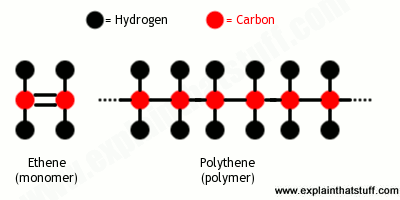
Artwork: Polymers are made from long chains of a basic unit called a monomer. Polyethylene (polythene) is made by repeating the ethene monomer over and over again.
Types of plastics
Photo: Natural plastic: Sticky tape is made from cellulose, a natural polymer found in plants. The first plastic sticky tape was developed in 1930.
There are many different plastics, so we need ways of making sense
of them all by grouping similar ones together. Here are a few ways we
can do that (and there are others I've not listed):
We can split them into natural (ones easily obtained from
plants and animals) and synthetic (ones artificially made by complex
chemical processes in a factory or lab). Cellulose is a natural
polymer used for making sticky tape (among other things), whereas
nylon is a synthetic polymer made in a factory.
We can group them according to the structure of the monomers
that their polymers are made from. That's why we talk about
polyesters, polyethenes, polyurethanes and so on—because they're
different polymers made by repeating different monomers.
When it comes to recycling, we need to separate plastics into
different kinds that can be processed together without causing
contamination. That depends on their chemical
properties, physical properties, and the polymer types from which they're made,
and gives us seven main kinds. (You've probably noticed seven
different recycling symbols numbered 1-6 and "null" on plastic
packaging, if you've looked carefully.)
We can group by what they're made from (say
bioplastics—artificially made from natural ingredients) or how
they behave when they're buried in landfills (biodegradable,
photodegradable, and so on).
We can split them into two broad kinds according to how they
behave when they're heated: thermoplastics (which soften when
they're heated) and thermosets (thermosetting
plastics, which never soften after they're initially molded).
Thermoplastics and thermosets
The last one on my list is such an important way of grouping plastics that we'd
better look at it in a bit more detail. What's the difference between
thermoplastics and thermosets—and how can we explain it?
Thermoplastics
Photo: Thermoplastic: Silky nylon stockings are probably as far away from your idea of plastic as it's possible to get—yet they're just as much plastic as washing-up bowls and toothbrushes. The secret science of condensation polymers, which powers these leggy wonders, was figured out by Wallace Carothers in the 1930s.
You can make something like a plastic bottle by injecting hot,
molten plastic into a mold, then letting it cool down. Your bottle
stays solid, but if you heat it up again later, it'll soften and melt. We say
it's made from a thermoplastic: something that becomes plastic (soft
and flexible) when it meets thermal energy
(heat). In a
thermoplastic, the long polymer molecules are joined to one another
by very weak bonds, which easily break apart when we heat them, and
quickly reform again when we take the heat away. That's why
thermoplastics are easy to melt down and recycle. Some everyday
examples you will have come across are polyethylene/polythene
(plastic bottles and sheets), polystyrene (crumbly white packaging
material), polypropylene (plastic ropes), polyvinylchloride/PVC (toys
and credit cards), polycarbonate (hard plastic windows and car
headlamps), and polyamide (nylon—used in everything from stockings
and swimming shorts to toothbrushes and umbrellas).
Thermosetting plastics (thermosets)
Photo: Thermosetting plastic: A typical nonstick Teflon (PTFE) cooking pan.
Thermosets are usually made from much much bigger polymer chains
than thermoplastics. When they're initially manufactured, they're
heated or compressed to form a dense, hard, structure with strong
cross-links binding each of these long molecular chains to its
neighbors. That's very different from thermoplastics, where the
polymer chains are held to one another only by very weak bonds. And
that's why we can't simply heat thermosets to remold or reform them.
Once they're "set" (cured) during manufacture, they stay that
way. You'll be less familiar with thermosets than with
thermoplastics; even so, you may have come across examples like
polyurethane (insulating material in buildings),
polytetrafluoroethylene/PTFE (nonstick coatings on cooking pots and
pans), melamine (hard plastic crockery), and epoxy resin (a tough
plastic used in strong adhesives and wood fillers).
Sponsored links
How do we make plastics?
Photo: Plastic pipes and hoses are made by a process called extrusion, described below.
We've already seen that plastics are made from polymers, but how
are polymers made? They're based on hydrocarbons (molecules built
from hydrogen and carbon atoms) that we get mostly from things like
petroleum, natural gas, or coal. Crude oil drilled from the land or
sea is a thick gloopy mixture that contains thousands of different
hydrocarbons, which have to be separated out before we can use them.
That happens in an oil refinery, through a process called fractional
distillation. It's a more involved version of the distillation
you might have used to purify water. If we heat water, it eventually
turns into steam, which we can then collect, cool, and condense back
to water; that's distillation, and it produces highly purified or
"distilled" water. We can heat and distill crude oil the same
way, but all those many hydrocarbons it contains have molecules that
are different sizes and weights, so they boil off and condense at
different temperatures. Collecting and distilling the different parts of crude oil
at different temperatures gives us a bunch of simpler mixtures of hydrocarbons, called fractions, which we can then use for making different types of plastics.
Hydrocarbons made in this way are the raw materials for
polymerization, the name we give to the chemical reactions that make polymers.
Some polymers are made simply by fastening hydrocarbon monomers
together, like daisy chains, which is a process called addition
polymerization. Others are made by joining together two small
hydrocarbon chains and removing a water molecule (two hydrogen atoms
and one oxygen), making a bigger hydrocarbon chain in a process known
as condensation polymerization. The more often you repeat this, the
longer the polymer gets.
Photo: Solid plastic things are made by injection molding, described below.
Typically, we need to use other chemicals called catalysts
to kick-start polymerization. Catalysts are simply substances we can
add that make a chemical reaction more likely to happen and, though
they may change temporarily during the reaction, they re-emerge at
the end in their original form; in other words, they're not
permanently changed as the reaction takes place. Ziegler-Natta
catalysts, some of the most important for making polymers, were
developed through the work of German chemist
Karl Ziegler and Italian
Giulio Natta, which won them a joint Nobel Prize in Chemistry in 1963.
Because we need plastics to do all sorts of things, we often have
to add other ingredients to the basic hydrocarbons to produce a
polymer with exactly the right chemical and physical properties.
These extra ingredients include colorants (which, as the name
suggests, turn plastics into all kinds of bright and happy colors),
plasticizers (which make plastics more flexible, viscous, and easier
to shape), stabilizers (to stop our plastics breaking apart in
sunlight and heat), and fillers (typically low-cost minerals that mean
we need less of the expensive, oil-based hydrocarbons to make our final
plastic product—so we can make and sell it more cheaply).
Artwork: Four common processes for making things out of plastic. 1) Injection molding involves squirting hot plastic into a mold. The plastic grains (light blue) are passed over an auger
(Archimedes screw) and heated to make molten plastic, which can then be squirted through a needle (injected) into a mold. 2) Blow molding is similar, but air (yellow arrow) is blown into the plastic afterward to make it expand and fill the mold. 3) Extrusion involves squeezing out plastic through a nozzle and shaped die to make something like a pipe. 4) Calendering uses rollers to make flat, thin, smooth sheets of plastic.
The plastic-making process doesn't end there. What we've got at
this point is a plastic polymer known as a resin, which can be used
for making all kinds of plastic products. Resins are supplied as
powders or grains that are loaded into a machine, heated, and then
shaped by one or more processes to make our finished plastic product.
The shaping processes include injection and blow molding (where we
squirt hot plastic through a nozzle into a mold to make things like
plastic bottles), calendering (squashing between heavy rollers, for
example, to make plastic sheets or films), extruding (squeezing
plastic through a nozzle, perhaps to make pipes or straws), and
forcing plastics through a kind of microscopically small sieve,
called a spinneret, to make thin fibers (which is how fibers are made
for things like toothbrushes or nylon stockings). There are many
other plastic-making processes as well.
What are plastics like?
The many kinds of plastics all have different
properties (if they didn't, we wouldn't need so many of them in the
first place). Having said that, they do have things in common.
Generally, plastics are flexible and easy to shape in a variety of
ways (remember, that's why we call them plastics); easy to make in
all different shapes, sizes, and colors; lightweight; electrically
insulating; waterproof; and relatively inexpensive. Some of them are
meant to be very strong and durable (car bits and prosthetic body
parts are examples), while others are designed to fall apart in the
environment relatively quickly (biodegradable plastic bags, for
example). The properties of a plastic can also be deliberately
engineered. Suppose we want plastics to be resistant to static
electricity so they don't pick up so much dust; then we can use
anti-static additives during the manufacturing process to make them slightly electrically conducting.
What do we use plastics for?
In the early 20th century, plastics were quite a
novelty; there were only a handful of plastics and very few uses.
Zoom the clock forward 100 years and it's hard to find things that we
don't use plastics for. Materials science means understanding the
properties of different materials so we can use them to best
advantage in the world around us. Given what we've just learned about
the properties of plastics, it comes as no surprise to find them
helping us out in building construction, clothing, packaging,
transport, and in many other parts of everyday life.
Photo: A small selection of the hundreds of plastic things you can find in your home.
In buildings, you'll find plastics in things like secondary
glazing, roofs, heat insulation and soundproofing, and even in the
paints you slap on your walls. There are plastics insulating your electrical
cables and carrying water and waste-water in and out of your home.
Look around you now and you'll see plastics everywhere, from picture
frames and lamp shades to the clothes on your back and the shoes on
your feet. How do all these things get into your life? Up to a third
of all the plastic we use finds its way into the packaging we use to
protect products (sometimes even plastic products) on the journey
from factory to home.
Photo: Plastics in action: NASA's plastic Pathfinder aircraft in flight. There's no better way to show that a plastic is strong and lightweight than using it to build a plane! Picture by Nick Galante courtesy of NASA.
Because plastic means flexible, by definition, we tend to think
plastics are relatively weak materials. Yet some are incredibly
strong and long-lasting. If you have a rotten wooden door or window,
for example, you might chisel out the rot and replace it with epoxy
resin filler, a very strong thermosetting plastic that will turn rock hard in a
matter of minutes and stay that way for years. Car fenders are now
mostly made of plastic—and lightweight car and boat bodies are
often made from composites such as fiberglass (glass-reinforced
plastic), which are plastics mixed with other materials for added
strength. Some plastics are soft or hard as the mood suits them.
An amazing plastic called D3O® has an astonishing ability to
absorb impacts: normally it's soft and squishy, but if you hit it very suddenly,
it hardens instantly and cushions the blow. (Find out more about it in our article
on energy-absorbing materials.)
Plastics and the environment
Most plastics are synthetic, so they're carefully designed by
chemists and laboriously engineered under very artificial conditions.
They'd never spontaneously appear in the natural world and they're
still a relatively new technology, so animals and other organisms
haven't really had chance to evolve so they can feed on them or break
them down. Since a lot of the plastic items we use are meant to be
low-cost and disposable, we create an awful lot of plastic trash. Put
these two things together and you get problems like the
Great Pacific
Garbage Patch, a giant "lake" of floating plastic in the middle
of the North Pacific Ocean made from things like waste plastic
bottles. How can we solve horrible problems like this? One solution
is better public education. If people are aware of the problem, they
might think twice about littering the environment or maybe they'll
choose to buy things that use less plastic packaging. Another
solution is to recycle more plastic, but that also involves better
public education, and it presents practical problems too (the need to
sort plastics so they can be recycled effectively without
contamination). A third solution is to develop bioplastics and biodegradable plastics
that can break down more quickly in the environment.
It's easy to dismiss plastics as cheap and nasty materials that
wreck the planet, but if you look around you, the reality is
different. If you want cars, toys, replacement body parts, medical
adhesives, paints, computers, water pipes, fiber-optic cables, and a
million other things, you'll need plastics as
well. Maybe you think we struggle to live with plastics? Try
imagining for a moment how we'd live without them. Plastic is pretty
fantastic—we just need to be smarter and more sensible about how we
make it, use it, and recycle it when we're done.
A brief history of plastics
Early history
Ancient people start using plastics (natural materials like
rubber, animal horn, and tortoiseshell are made from polymers).
1838: Injection molding is developed for diecast metal products
(a technology that will later revolutionize plastic-making).
1839: Charles Goodyear develops vulcanized (heat and sulfur
treated) rubber—an example of a tough, durable cross-linked
polymer.
1855: Georges Audemars, a Swiss chemist, makes the first
synthetic plastic silk fibers using mulberry bark and rubber gum.
1856: Alexander Parkes develops the first artificial plastic,
Parkesine, by making nitrocellulose from cellulose and nitric acid.
1875: Alfred Nobel invents gelignite, a plastic explosive also
based on nitrocellulose.
1885: George Eastman (of Kodak camera fame) revolutionizes
photography by making plastic photographic film from cellulose.
1894: Viscose, the first commercially successful artificial silk
(a form of rayon), is produced by Charles Cross, Edward Bevan, and
Clayton Beadle.
Early 20th-century plastics
1907: Belgian-born chemist
Leo Baekeland makes the first fully synthetic thermosetting plastic, Bakelite, from phenol and
formaldehyde. He experiments with injection molding around the same time.
Photo: Bakelite, an important early thermosetting plastic, was widely used to make telephones, lamp fittings, and other electrical equipment during the first half of the 20th century because it's tough, hard, heatproof, and an excellent insulator. If you see a phone in this characteristic brownish-black color, with a dull finish, it's probably made of Bakelite (although it's worth noting that Bakelite also came in other colors). This power adapter from England dates from the early 1960s.
1920: American John Wesley Hyatt develops the first injection
molding machine for plastics.
1930: American chemist Wallace Carothers and his team at DuPont
accidentally discover a weird new material. It soon becomes
nylon, a wildly successful plastic that revolutionizes textile
manufacture.
1930: Transparent, "Scotch" sticky tape is invented by
Richard G. Drew of 3M.
1930s: German chemist Eduard Simon accidentally makes
polystyrene, initially called styrol oxide and, later, metastyrol.
1938: Roy Plunkett of DuPont accidentally discovers PTFE
(Teflon).
1942: Harry Coover of Eastman Kodak invents plastic superglue
(methyl cyanoacrylate).
1949: Lycra (a type of polyurethane) is invented by DuPont.
1949: American Bill Tritt builds the Glasspar G2, the first
production sports car with a body made entirely from fiberglass (a
plastic composite).
Mid-late 20th-century plastics
1953: Karl Ziegler develops aluminum catalysts for speeding up polymerization.
1954: Giulio Natta develops polypropylene, first made by Italian chemical company, Montecatini.
1955: Building on earlier work by Karl Ziegler, Natta perfects Ziegler-Natta catalysts.
1954: Dow Corning invents expanded polystyrene.
1958: George de Mestral files a patent for VELCRO®, the reusable plastic hook-and-loop fastener.
1966: Stephanie Kwolek and Paul Morgan of DuPont are granted a
patent for Kevlar®, a super-tough plastic similar to nylon. It's
commercially introduced in 1971. Also in 1966, another DuPont
chemist, Wilfred Sweeny, is granted a patent for a chemically similar
nylon-relative called Nomex®, a revolutionary fireproof material.
1982–1983: Various countries (and regions with their own currencies), including Costa Rica, Haiti, Ecuador,
El Salvador, and Britain's Isle of Man, experiment with banknotes made from a flexible, paper-like plastic called Tyvek®.
1982: The Jarvik 7, a complete artificial heart, made from plastic polyurethane, is first implanted in a human.
1988: Australia becomes the first country to issue high-security plastic banknotes properly (not as part of a temporary trial).
It switches all its notes to polymer versions by 1996.
1990s: The first modern 3D-printers are developed. They can make
realistic models of objects by squirting out layers of hot
ABS (acrylonitrile butadiene styrene) plastic.
1997: Captain Charles Moore discovers the Great Pacific Garbage Patch.
1998: Smart cars made from composites enter production.
21st-century plastics
2001: Scott White, Nancy Sottos, and collaborators at the University of Illinois at Urbana-Champaign
develop remarkable self-healing materials from plastics.
2002: British inventor Richard Palmer files a patent for a revolutionary
energy-absorbing plastic, which he calls D3O, that can soak up
the force from impacts.
2016: Japanese scientists report the
discovery of bacteria that can eat plastic bottles.
2017: China refuses to recycle waste plastic trash from the rest of the world.
2019: Microplastics (tiny fragments), long known to cause water pollution, are found in long-range air pollution as well.
Plastic Pollution by by Hannah Ritchie and Max Roser, Our World in Data, 2018/2022. This is a great compilation of statistics, but the top-heavy emphasis on pollution is a bit
unfortunate; the value of plastics (not a single material as this page implies) is buried.
Articles
'War on plastic' could strand oil industry's £300bn investment by Liam Stack, The Guardian, 4 September 2020. Growing public disapproval of plastics could prove fatal for a petroleum industry already hampered by the switch to fossil-free technologies.
In defence of plastic by Susan Mossman, BBC News, 15 September 2008. Plastics are criticized for their environmental impact, but could we really live without them?
Identifying plastics: BBC News. A useful guide to the seven types of plastic you'll find identified on recycling symbols: PET (polyethylene terephthalate), LDPE (low-density polyethylene), HDPE
(high-density polyethylene), PVC (polyvinyl chloride), PP (polypropylene), PS (polystyrene), and "other" (including acrylics and perspex).
Fantastic Plastic: Product Design and Consumer Culture by Susan Mossman. Black Dog, 2008. Explores how plastics have made possible all kinds of consumer goods we take for granted. Lots of interesting text and plenty of great color photos make this an enjoyable read.
Plastics 2 by Chris Lefteri. Rotovision, 2008. A fascinating look at how we can use plastics in innovative and creative ways (and mainly intended for product designers).
Plastics: America's Packaging Dilemma by Nancy A. Wolf and Ellen D. Feldman. Island Press, 1991. Slightly dated but still interesting examination of the environmental impact of plastics.
For younger readers
Plastic: Past, Present, and Future by Eun Ju Kim, Scribe, 2020. A much more thoughtful approach than the tired and usual "all plastics are bad." Ages 6–9.
Be Plastic Clever by Amy and Ella Meek. DK, 2020. A good overview of the plastic problem. Optimistically described as "ages 5–9," but weighing in at 192 pages, I'd put it well toward the older end of that range (or a little beyond).
The Adventures of a Plastic Bottle by Alison Inches. Simon & Schuster/Little Simon, 2009. Start 'em young? The kind of book eco-friendly parents might like to read to aspiring eco-friendly children. Also useful to support environmental activities in class for ages 6–9.
Plastics by Ruth Thomson. Black Rabbit, 2006. Encourages young readers to reuse and recycle plastics, rather than throw them away. Ages 8–10.
How we use Plastic by Chris Oxlade. Raintree, 2004. A general introduction to the chemistry of plastics and their applications. Ages 9–12.
Trade organizations
Society of the Plastics Industry: US-based plastics trade association. Website has quite a lot of background information filed under "About plastics."
Please do NOT copy our articles onto blogs and other websites
Articles from this website are registered at the US Copyright Office. Copying or otherwise using registered works without permission, removing this or other copyright notices, and/or infringing related rights could make you liable to severe civil or criminal penalties.
Teflon, Nomex, Kevlar, Tyvek, and DuPont are trademarks or registered trademarks of E. I. du Pont de Nemours and Company.
D3O is a registered trademark of D3O.