Nature has given us
some amazing materials. There's wood: a material so strong and
versatile you can use it for everything from making paper to building
houses. There's also wool, with insulation so effective it lets sheep
stand outside in the snow all winter. Or how about skin: a material
that will repair itself automatically and often completely invisibly
in only a matter of days? Truly incredible though these materials
are, they're far from perfect for every application,
especially in the modern world where the challenges we face are ones
nature could never have anticipated. That's why we now rely on
synthetic materials such as Kevlar®. It's a plastic strong enough to
stop bullets and knives—often described as being "five times
stronger than steel on an equal weight basis."
[1]
It has many other uses too, from making boats and bowstrings to reinforcing tires and brake pads.
[2]
Let's take a closer look at how it's made and what makes
it so tough!
Photo: Kevlar is best known as a protective material, but it's much
more versatile than that. This is a piece of woven Kevlar being used as part
of a proposed, inflatable "space tent" for use on the Moon or Mars.
Photo by Paul Hudson published on Wikimedia Commons under a Creative Commons (CC BY 2.0) licence.
Kevlar is one of those magic modern materials people talk about all the time without ever
really explaining any further. "It's made of Kevlar", they say,
with a knowing nod, as though that were all the explanation you
needed.
Kevlar is simply a super-strong plastic. If that sounds
unimpressive, remember that there are plastics—and there are plastics.
There are literally hundreds of synthetic plastics made by
polymerization (joining together long chain molecules) and they have
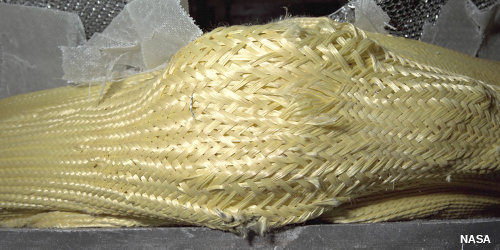
widely different properties. Kevlar's amazing properties are partly due to its internal structure (how its molecules are naturally arranged in regular, parallel lines) and partly due to the way it's made into fibers that are knitted tightly together.
[3]
Photo: Kevlar textiles get their properties partly from the inherent strength
of the polymer from which the fibers are made and partly from the way the fibers are knitted tightly together, as shown here
in a NASA ballistics test. Picture courtesy of NASA Glenn Research Center (NASA-GRC) and Internet Archive.
Kevlar is not like cotton—it's not something anyone can make from the right raw
materials. It's a proprietary material made only by the DuPont™
chemical company and it comes in two main varieties called Kevlar 29
and Kevlar 49 (other varieties are made for special applications).
[4]
In its chemical structure, it's very similar to another versatile
protective material called Nomex.
Kevlar and Nomex are examples of
chemicals called synthetic aromatic polyamides or aramids for short.
Calling Kevlar a synthetic aromatic polyamide polymer makes it sound unnecessarily complex.
Things start to make more sense if you consider that description one word at a time:
Synthetic materials are made in a chemical laboratory
(unlike natural textiles such as cotton, which grows on plants, and
wool, which comes from animals).
Aromatic means Kevlar's molecules have a strong, ring-like
structure like that of benzene.
Polyamide means the ring-like aromatic molecules connect
together to form long chains. These run inside (and parallel to) the
fibers of Kevlar a bit
like the steel bars ("rebar") in reinforced concrete.
Polymer means that Kevlar is made from many identical
molecules bonded together (each one of which is called a monomer). Plastics are the most familiar polymers
in our world. As we've seen,
the monomers in Kevlar are based on a modified, benzene-like ring
structure.
Like Nomex, Kevlar is a distant relative of nylon, the first commercially successful
"superpolyamide", developed by DuPont in the 1930s. Kevlar was introduced in 1971,
having been discovered in the early 1960s by US chemist
Stephanie Kwolek
(1923–2014), who earned US Patent 3,287,323 for her invention, with Paul Morgan, in 1966. Originally developed as a lightweight replacement for steel bracing in vehicle tires,
it's probably best-known today for its use in things like body armor; by the time of
Kwolek's death in 2014, one million Kevlar body vests had been sold—and countless lives saved.
[5]
What's so good about Kevlar?
Photo: Braided Kevlar can be used to make super-strong rope. Compared on
a strength-to-weight ratio, Kevlar is about 5–6 times stronger than steel wire and twice as strong
as ordinary nylon fiber. Picture by Casey H. Kyhl courtesy of US Navy and
Wikimedia Commons.
These are some of Kevlar's properties:
It's strong but relatively light. The specific tensile
strength (stretching or pulling strength) of both Kevlar 29 and Kevlar 49 is over eight times greater
than that of steel wire.
[6]
Unlike most plastics it does not melt: it's
reasonably good at withstanding temperatures and decomposes only at
about 450°C (850°F).
Unlike its sister material, Nomex, Kevlar can be ignited but burning
usually stops when the heat source is removed.
Very low temperatures
have no effect on Kevlar: DuPont found "no embrittlement or
degradation" down to −196°C (−320°F).
Like other plastics, long
exposure to ultraviolet light (in sunlight, for example) causes
discoloration and some degradation of the fibers in Kevlar.
Kevlar can resist attacks from many different chemicals, though long exposure to strong
acids or bases will degrade it over time.
In DuPont's tests, Kevlar remained "virtually unchanged" after exposure to hot
water for more than 200 days and its super-strong properties are
"virtually unaffected" by moisture.
And what's bad?
It's worth noting that Kevlar also has its drawbacks. In particular, although it has
very high tensile (pulling) strength, it has very poor compressive strength (resistance to
squashing or squeezing). That's why Kevlar isn't used instead of steel as a primary
building material in things like buildings,
bridges, and other structures where compressive forces are common.
Sponsored links
How is Kevlar made?
There are two main stages involved in making Kevlar. First you have to produce the basic
plastic from which Kevlar is made (a chemical called poly-para-phenylene
terephthalamide—no wonder they call it Kevlar). Second, you have to
turn it into strong fibers. So the first step is all about chemistry;
the second one is about turning your chemical product into a more
useful, practical material.
Polyamides like Kevlar are polymers (huge molecules made of many identical parts joined
together in long chains) made by repeating amides over and over
again. Amides are simply chemical compounds in which part of an
organic (carbon-based) acid replaces one of the hydrogen atoms in
ammonia (NH3). So the basic way of making a polyamide is to take an
ammonia-like chemical and react it with an organic acid. This is an
example of what chemists call a condensation reaction because two substances fuse
together into one.
[7]
Artwork: Kevlar's monomer: C=carbon, H=hydrogen, O=oyxgen, N=nitrogen, — is a single chemical bond, and = is a double bond. This basic building block is repeated over and over again in the very long chains that make up the Kevlar polymer. Source: "US Patent: 3287323: Process for the production of a highly orientable, crystallizable, filament" by Stephanie Kwolek et al.
Kevlar's chemical structure naturally makes it form in tiny straight rods that pack
closely together, like lots of stiff new pencils stuffed tightly into
a box (only without the box). These rods form extra bonds between one another (known as hydrogen bonds)
giving extra strength—as though you'd glued the pencils together as well.
This bonded rod structure is essentially what gives Kevlar its amazing properties.
(More technically speaking, we can say the Kevlar rods are showing what's called
nematic behavior (lining up in the same direction), which is also
what happens in the liquid crystals used in LCDs (liquid crystal displays).)
You probably know that natural materials such as wool and cotton have to be spun into fibers
before they can turned into useful textile products—and the same is
true of artificial fibers such as nylon, Kevlar, and Nomex.
The basic aramid is turned into fibers by a process called wet spinning, which involves forcing a hot, concentrated, and
very viscous solution of poly-para-phenylene terephthalamide through a spinneret (a metal former a bit like a sieve) to make long, thin,
strong, and stiff fibers that are wound onto drums. The fibers are then cut to length and woven into a tough mat to make the super-strong, super-stiff finished material we know as Kevlar.
[8]
Artwork: How Kevlar is made. 1) The rodlike Kevlar molecules start off in dilute solution. 2) Increasing the concentration increases the number of molecules but doesn't make them align. At this stage, the molecules are still tangled up and not extended into straight, parallel chains. 3) The wet-spinning process causes the rods to straighten out fully and align so they're all oriented in the same direction—forming what's called a nematic structure—and this is what gives Kevlar its exceptionally high strength. Image based on an original artwork from DuPont's Kevlar Technical Guide (see references below).
What's Kevlar used for?
Kevlar can be used by itself or as part of a composite material (one material combined with
others) to give added strength. It's probably best known for
its use in bulletproof vests and knifeproof body armor, but it has
dozens of other applications as well. It's used as reinforcement in
car tires, in car brakes, in the strings of archery
bows, and in car, boat, and even aircraft bodies. It's even used in buildings
and structures, although not (because of its relatively low compressive strength) as the primary structural material.
[9]
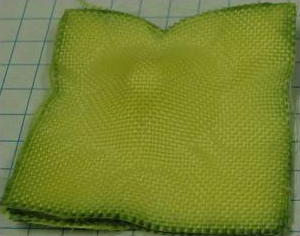
Photo: Super-strong Kevlar is best known for its use in body armor—and this
photo shows you why: it's a piece of Kevlar after being hit by a projectile.
You can see a dent (coming up toward the camera)—but you can't see a hole.
You might be bruised by this impact (or suffer what's called a "blunt trauma" injury), but you wouldn't die.
Picture courtesy of US Army.
Sponsored links
What makes Kevlar such a good antiballistic material?
Photo: Think of Kevlar as a lightweight modern alternative to heavy, cumbersome, medieval suits of armor! Photo by Staff Sgt. Nate Hauser courtesy of US Marine Corps and
Internet Archive.
If you've read our article on bullets, you'll know that they
damage things—and people—because they travel at high speeds with huge
amounts of kinetic energy. Although there's no such thing as completely "bulletproof," materials like
bulletproof glass do a good job at protecting us by absorbing (soaking up)
and dissipating (spreading out) the energy of a bullet.
Kevlar is an excellent antiballistic (bullet- and knife-resistant) material because
it takes a great deal of energy to make a knife or a bullet pass through it. The tightly woven
fibers of highly oriented (lined-up) polymer molecules are extremely hard to move apart: it takes energy to separate them. A bullet
(or a knife pushed hard by an attacker) has its energy "stolen" from it as it tries to fight its way through.
If it does manage to penetrate the material, it's considerably slowed down and does far less damage.
Although Kevlar is stronger than steel, it's about 5.5 times less dense (the density of Kevlar
is about 1.44 grams per cubic centimeter, compared to steel, which is round about 7.8–8 grams
per cubic centimeter). That means a certain volume of Kevlar will weigh 5–6 times less than the same volume of steel.
Think back to medieval knights with their cumbersome suits of armor: in theory, modern Kevlar gives just as much protection—but it's light and flexible enough to wear for much longer periods.
More layers = more protection
If you think of Kevlar "soaking up" the energy of a bullet, it's fairly obvious
that a greater thickness of Kevlar—more layers of the material bonded
together—will give more protection.
How much Kevlar do you need to stop a bullet? It depends on the Kevlar and it depends on the weight, type, and speed of the bullet. Kevlar comes in different weights—and bullets also come in different types and weights and travel at very different speeds, with different amounts of energy. The bigger the bullet and the faster it's travelling, the more kinetic energy
it has, the further it will penetrate, and the more damage it will do. You need more layers of Kevlar to stop
bigger, faster bullets than smaller, slower ones. Typically, bulletproof vests have at least 8–16 layers of Kevlar and often
32–48 layers or even more. Some vests combine Kevlar with other materials, while others use different materials
instead of Kevlar, such as Spectra®.
[10]
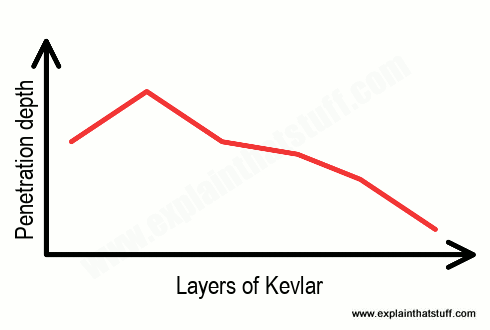
Chart: You need a greater thickness of Kevlar body armor to stop higher-speed (velocity)
bullets. In theory, the thicker the Kevlar, the shorter the distance a bullet should be able to pass through (the shorter the penetration depth); in practice, it's a little bit more complicated than that.
Generally speaking, the more layers of heavier Kevlar you have, the more protective your "bulletproof" armor, but the heavier,
bulkier, and hotter it will be to wear, and the more it will restrict your movement. You could cover yourself with a million layers of Kevlar, which might stop most everyday bullets, but it's hardly going to be practical. So there's a tradeoff to be made between protection and usability. And, where Kevlar's concerned, it's not always a matter of "thicker equals better": there's another qualification too. Bullets travel fast—a rifle bullet can be going 10 times faster than a race car—and they're designed to deform when they hit things so they do more damage. According to
some recent ballistics research, the Kevlar in a bulletproof vest will affect this process, sometimes making a bullet travel further into a target than if no (or less) Kevlar were used. That's why you need a lot of Kevlar in effective bulletproof vests, both to allow for how it might alter the bullet and to soak up all the bullet's energy.
Kevlar isn't always enough
If you want to protect soldiers against high-velocity rifle bullets, you're going to need much thicker
armor than if you simply want to protect police officers against handgun bullets,
which have lower velocity and less kinetic energy.
It's important to remember that no material is 100 percent bulletproof—and sometimes even Kevlar isn't enough.
You can see this clearly in the official US National Institute of Justice Body Armor Classification,
which ranks bulletproof vests and other body protection (made of Kevlar and other materials)
on a scale from I to IV for its ability to protect against bullets fired from weapons of different power. At the low end of the scale,
type IIA armor has to protect against smaller handgun bullets (typically 9mm full metal jacketed
bullets weighing 8.0g or 0.3 oz and fired at about 373 m/s or 834 mph); you need at least 16 layers of Kevlar for that.
Higher up the scale, type IIIA armor has to resist more powerful handheld bullets
(such as .44 Magnum bullets weighing 15.6 g or 0.6 oz and fired at 436 m/s or 975 mph); that needs twice as much Kelvar—at least 30 layers. It's important to note that even Kevlar has its limits. For protection against rifle bullets (ordinary ones or armor-piercing ones), which travel much faster (850–900 m/s or 1900–2000 mph) with considerably higher kinetic energy, Kevlar isn't enough: you need body armor made from steel or ceramic plates (classified as type III and IV).
About the author
Chris Woodford is the author and editor of dozens of science and technology books for adults and children, including DK's worldwide bestselling Cool Stuff series and Atoms Under the Floorboards, which won the American Institute of Physics Science Writing award in 2016. You can hire him to write books, articles, scripts, corporate copy, and more via his website chriswoodford.com.
Kevlar Technical Guide: Definitive information from DuPont. This will take you to a 4MB PDF format version of the Technical Guide, which can take a while to download depending on your Internet connection.
Kevlar's uses and applications: DuPont run through about 20 different common uses of Kevlar, from adhesives to vehicle armor.
Enough for One Lifetime: Wallace Carothers, Inventor of Nylon by Matthew Hermes. Chemical Heritage Foundation, 1996. A dry but nonetheless interesting biography of the inventor of nylon (a material very similar to Kevlar). It gives a good sense of how modern, revolutionary materials tend to be "corporate inventions" rather than the work of single inventors, and how inventors can completely fail to foresee the consequences of their ideas.
DuPont wins $900m Kevlar spy case: The Guardian, 15 September 2011. Kevlar is an extremely valuable invention and, like other technological pioneers, DuPont has to fight big legal cases to protect its "intellectual property."
High-modulus, high-strength organic fibers in Concise Encyclopedia of Composite Materials by Anthony Kelly (ed). Pergamon Press, 1989. This is a great introduction to the chemistry and physical properties of Kevlar and similar materials.
↑ Bear in mind that there are many
different types of steel, with widely differing properties, and note the part about
"on an equal weight basis." DuPont's website is the original source for the claim; for example, on its page Kevlar Fibers. Many books repeat this information; see this selection from Google Books.
Checking the Kevlar Technical Guide, we find the tensile strength of both Kevlar 29 and 49 is about 3600MPa,
while the ultimate tensile strength of high-strength steels is more like 500–800Mpa.
↑Kevlar Technical Guide, DuPont, 2017, p5.
Other varieties include Kevlar 100 (for ropes), Kevlar 129 (for lightweight motorcycle gear), and
quite a few more described in Kevlar® Fibers.
↑ According to Kwolek's New York Times obituary, her team's task was "trying to develop a lightweight fiber that would be strong enough to replace the steel used in radial tires."
↑ The source for all the information in this list is the Kevlar Technical Guide, DuPont, 2017.
↑ For more on how synthetic fibers are manufactured, and how they get their strength, see "Chapter 4: Synthetic polymeric fibers" in Fibrous Materials by K. K. Chawla, Cambridge, 1998, p.73.
Please do NOT copy our articles onto blogs and other websites
Articles from this website are registered at the US Copyright Office. Copying or otherwise using registered works without permission, removing this or other copyright notices, and/or infringing related rights could make you liable to severe civil or criminal penalties.