Toilet, lavatory, loo, water closet, WC, John,
crapper, can—it's amazing we have so many names for something we
care to talk about so little. Toilets are hardly the most glamorous
of inventions, but imagine trying to live without them.
A fifth of the world's people (some 1.7 billion of us) are in that unhappy position,
lacking even basic sanitation.
[1]
At the opposite end of the scale, in Japan, people have
amazing
electronic toilets that do everything from opening and closing the
lid automatically to playing music while you use them.
Most of the world's toilets are more modest than this, but they're still pretty
ingenious "machines." Let's take a closer look!
Photo: Poop-tastic! Like most new toilets, this low-flush model is designed to save water; the two buttons on top let you choose whether to flush with a large or a small amount. Exactly how much difference that will make to your water consumption varies from one household to another. An old-style flush toilet typically uses 13 liters (3.4 US gallons), where a low-flush model will use only 6 liters (1.6 US gallons) and some models use only 4.8 liters (1.3 US gallons). If you save 7 liters (1.8 US gallons) per flush and people in your home flush 10 times a day, you'll save at least 25,500 liters (6700 US gallons) per year. You'll save more or less depending on how many people there are in your household.
At first sight, toilets seem quite
simple: you have a waste pipe going through the floor and a tank of water
up above (called a cistern) waiting to flush into it when someone
pushes a button or pulls a lever or a chain. Most flush toilets are
purely mechanical: pull the chain and the cistern empties through the
force of gravity, washing the bowl clean for use again.
They are literally mechanical because they flush and refill using levers inside—and
levers are examples of what scientists call simple machines.
There's a little bit more to toilets than this. When you flush, the cistern
has to refill automatically from a kind of faucet on the
side and the refilling operation has to last just long enough to fill
the tank without making it overflow. The "hole in the ground"
is more sophisticated than it looks as well. You may have noticed
that toilets always have a little water in the bottom of them; even
when you flush them, they never empty completely. Some water is
always trapped in a big curved pipe at the base of the toilet known
as the S-bend (or S-trap). This little bit of water effectively seals off the
sewage pipe beneath it, stopping germs and bad smells from coming up
into your bathroom. The S-bend also means that the pipe running out from the toilet bowl curves upward, before curving back down again. That means when water flows into the bowl
from the cistern, and drains out through that pipe, it has enough momentum to produce a siphon (sucking) effect, which properly empties the bowl.
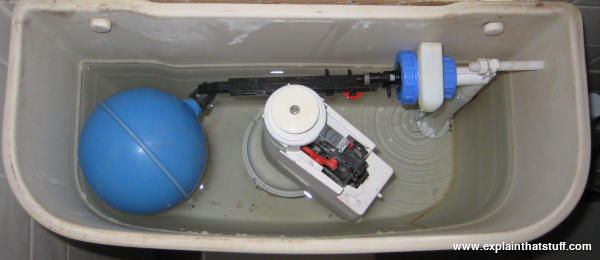
Photo: Lift the cistern on a toilet and this is what you'll find inside.
The cistern (upper tank of water) drains through a valve in the center through the force of gravity. The valve and flushing mechanism in the middle is called the siphon. The blue, balloon-like object on the left is a plastic float that drops when the water level falls.
This tilts the white plastic lever, opening a ball valve (sometimes called a ball cock) and allows the cistern to refill. As the water rises, the float rises with it, tilting the lever and slowly shutting off the ball
valve.
What happens when you flush?
Press the handle to flush the toilet and you operate a lever (dotted line) inside the
cistern.
The lever opens a valve called the flapper (green) that allows the cistern to empty into the toilet bowl beneath through a mechanism called a siphon.
Water flows from the cistern through holes in the rim so it washes the bowl as well as flushing the contents away.
There's enough water flowing down from the cistern to flush the toilet around the S-bend (S-trap). This produces a siphon effect that sucks the bowl clean. It also ensures some water remains at the bottom of the bowl, which improves hygiene.
The contents of the toilet are flushed down the main drain.
As the cistern empties, the plastic float (red) falls downward, tilting a lever.
The tilting lever opens the ball valve (ball cock) (green) at the base of the cistern (or on one side of it), which works a bit like a faucet (tap). Pressurized water flows in, refilling the cistern, and pushing the float back up again. When the float reaches the correct level, the ball valve switches off the water supply and the toilet is ready to flush again.
Sponsored links
Macerating toilets
Flush toilets come in many shapes and sizes, but one thing they all have in common is a relatively large and ugly outlet
for the waste, sometimes known as a soil pipe. These pipes are so large and wide that they limit the places where
normal toilets can be fitted. If you need a bathroom in the middle of a building where it's impossible to route
a large soil pipe, what can you do? Most toilets also work through the gravity-siphon effect, but what if you need
to put one in a basement and the drain you want flush into is up above it?
One solution to problems like this is to fit a macerating toilet (sometimes called an upflush toilet), which is a bit like a cross between a conventional toilet and a waste disposal unit. The waste passes into a kind of blender that mashes it up into a liquid, before pumping it up through a thin pipe connected, eventually, to the large, main soil pipe. The big advantage of toilets like this
is that you can fit them almost anywhere in a building where there's both water (for the flush) and
electricity (to power the macerator and pump). Unfortunately, they're often bigger and bulkier than
conventional flush toilets, noisier and less discreet, and (since they have more moving parts) less reliable. Although
they're more expensive than normal toilets, they can still work out cheaper than replumbing your house for a conventional
toilet. According to Saniflo, one of the leading manufacturers, a typical macerating toilet can pump waste an impressive
distance: with an upward rise of 5m (16ft), a horizontal distance of 20m (66ft); or with an upward rise of 1m (3.3ft), a horizontal distance of 100m (328ft). That's more than enough for most homes and many commercial buildings.
Artwork: How a macerating toilet works. The toilet itself is much like any other, but it has a macerating and pumping unit (red) behind and underneath its cistern. The electrically powered pump (black) sucks waste in from the toilet's large soil pipe (substituting for the suction effect of a normal toilet), chops it into a liquid, and then pumps it out through a small pipe on top. This type of macerator is separate from the main toilet unit and can be placed in a different room; it's effectively an adapter
that makes a conventional toilet work with a small-bore (small diameter) waste outlet pipe.
Who invented the flush toilet?
Although it's popularly believed that flush toilets were invented by an English plumber called
Thomas Crapper (c.1836–1910), it's an unhelpful myth, for two reasons: flushing toilets are an ancient technology, and no single person can really claim to have invented them (dozens of different inventors have been involved in their development over the years, especially since Crapper's lifetime). Archaeological evidence shows that primitive toilets using river water to flush wash away waste are over 5000 years old and date back to ancient Mesopotamia in the fourth millennium BCE. The two inventors who have the best claim to our modern toilet-flushing system were born hundreds of years before Crapper. Among his many other achievements, prolific Arabic inventor and engineer Al-Jazari developed a flushing hand-washing device in 1206, while
English writer and courtier Sir John Harington (1561–1612) described a method for flushing a toilet in 1596 in his article A New Discourse of a Stale Subject, Called the Metamorphosis of Ajax.
Search through the invention records at the US Patent and Trademark Office and you'll find literally hundreds that relate to toilets and their flushing mechanisms. I've chosen two examples from 1874 to give you a flavor of what you can find. On the left (and drawn in plan view, from above), we have the self-disinfecting water-closet basin developed by Jabez Burns, Charles Higgins, and William Higgins ("Improvement in Water-Closet Basins", US Patent#149,195).
Their simple innovation was to make the pipe that fills the toilet basin squirt sideways over a bar of soap, thus
disinfecting the basin and stopping any smell. On the right, you can see Archibald McGilchrist's trap-less water closet ("Improvement in Water-Closet Apparatus", US Patent#157,211).
Unlike with an S-bend closet, there is no water trap to stop odors. Instead, the flush mechanism raises and lowers a ball-shaped
valve that seals the waste pipe. A rising and falling float (I've colored it green in the artwork) operates a valve mechanism (colored yellow) to refill the basin in the usual way. You can explore lots more similar inventions with a
search for "water closet" on Google Patents (it just gave me 13,000 results!).
Artwork: Two examples of 19th-century improvements in water closets (toilets) by American inventors. Images courtesy of US Patent and Trademark Office with added coloring and annotations by Explainthatstuff.com.
Vacuum toilets
One of the biggest drawbacks of conventional flush toilets is the sheer amount of clean water they squander.
Even the leanest, greenest, most efficient toilets waste several liters (over one US gallon) of water
per flush, which poses a real problem for vehicles like trains, planes, and long-distance buses:
do you really want to carry a giant, heavy tank of water just for flushing the toilet?
That's why mobile public toilets typically now flush with air instead of water; they're
the toilet equivalents of vacuum cleaners: vacuum toilets, in other words. Vacuum toilets might sound like a strange idea until you remember that a conventional toilet flushes not just by washing the waste down but by sucking it away with the siphon effect. A vacuum toilet does exactly the same, but the sucking is created by low air pressure instead of the dragging power of draining water.
Photo: A typical vacuum toilet on a train. Toilets like this are designed to use minimal amounts of water but tend to be more mechanically complex (and therefore less reliable) than ordinary flush toilets.
How does a vacuum toilet work? There's a sliding valve in the floor of the toilet bowl sealing it off
completely from the rest of the mechanism. When you flush the toilet, a small amount of water
rinses out and partly fills the bowl (typically no more than
about 0.4–0.5 liters, or about 10 percent as much as in a low-flow, conventional flush toilet).
Meanwhile, out of sight, behind the wall, a small, plastic, intermediate tank has the air rapidly pumped out of it to create, in effect,
a vacuum. The valve under the toilet bowl slides open, creating a huge difference in air pressure between the room and the intermediate tank.
This sucks the waste from the toilet into the tank and the sliding valve closes again.
Air is now blown into the intermediate tank, flushing its contents into a much larger waste tank that can be emptied
periodically (for example, when a train arrives at a station or a plane lands on the ground).
Animation: How a vacuum toilet works (simplified). The main parts of the toilet are
a toilet bowl (blue), an intermediate tank (gray), a vacuum pump (red), a pressurizer (green), and a main waste tank (orange),
all separated by valves (black). 1) To begin with, there is waste in the bowl (blue) and
the intermediate tank is full of air. 2) When you flush, the vacuum pump sucks the air from the
intermediate tank, leaving a partial vacuum. 3) The valve under the toilet bowl opens and
the intermediate tank sucks the waste out of it. 4) The pressurizer blows the waste from the
intermediate tank into the main waste tank. Water plays a relatively small part
in a toilet like this so I've missed it off this diagram for clarity.
Sponsored links
Composting toilets
Flush—and it's gone. Toilets are one of
those inventions we really take for
granted. Until you stop to think about the two billion or so people
in developing countries who don't enjoy the same luxury, you might
not realize just how lucky you are to be able to solve such a
horrible little problem with a quick press of a switch.
There's just one slight difficulty: your toilet doesn't actually
dispose of sewage: it just washes the problem down a long smelly pipe so it ends
up somewhere else—and it uses lots of water in the
process. Even in the world's richest and most sophisticated
countries, sewage disposal is a major issue. We still have dirty
beaches, algal blooms on rivers, and major health issues like
shellfish poisoning caused by sewage pollution. Wouldn't it be better
if toilets could actually convert sewage into a form we could dispose
of safely and simply? That's the basic idea behind composting
toilets, which turn the stuff we don't like to talk about into
compost we can use to fertilize our land. How do they work?
Photo: Despite what you might think, composting toilets are just as convenient as
flush toilets. They're also more civilized, since you're not dumping your waste elsewhere
and expecting someone else to deal with it. This is a composting toilet at Kibbutz Lotan, Arava Valley, Israel
(note the bag of sawdust and straw at the back to help the aeration process).
Photo by
Hanan Cohen published on Flickr in 2007 under a Creative Commons Licence.
What's the problem with ordinary toilets?
In nature, there's no such thing as waste. Leaves fall to the ground, rot
down, and fertilize the trees that dropped them. Long ago in history,
humans would have been just as clever without even thinking: all our
"soil" would have disappeared harmlessly into the soil and
made things grow again in future. Unfortunately, when the Industrial
Revolution kicked off, and masses of
people started living very close together in towns and cities,
sanitation became a major issue and a massive public health problem.
That's how we came to have toilets, sewers, and sewage treatment
plants. Now, sewage is still a problem but for different reasons.
Water is much scarcer than it used to be and
climate change will make
it even more precious in future. Do we really want to use something
so valuable for something as crude and basic as flushing away our
waste? Probably not. One solution to the problem is for homes to have
a separate greywater system, where
relatively clean wastewater from things like
baths and showers is stored temporarily and used to flush toilets.
Composting toilets are a different solution.
What is a composting toilet?
Photo: A sophisticated composting toilet and the system it feeds. The toilet part is
the white bit at the top. You can also see the large black waste tank and a silver ventilator on top.
Most of this would normally be hidden inside a building, but it's on show here in an exhibition.
Photo by Sustainable Sanitation Alliance published on Flickr in 2005 under a Creative Commons Licence.
The idea is simple. Instead of flushing your waste down a pipe,
from where it could travel maybe several miles to a treatment plant,
a composting toilet turns sewage simply and safely to compost in your
own home. Although there are many different types of composting
toilet, the principle is the same in all cases: the waste falls into
a well-ventilated container where, over a period of time, aerobic
bacteria (supplied with lots of oxygen) greatly reduce its
volume (much like kitchen waste on a compost heap) and destroy
harmful pathogens (the bacteria, viruses, and so on that cause
diseases). The end-product looks a bit like rich soil. Some
composting toilets separate out the liquid and solid wastes, both of
which may be suitable for use as "humanure" garden compost (though not
for growing food). Generally, composting toilets can also be
used to dispose of food waste and other materials you might put on
your compost heap.
Composting toilets vary greatly in sophistication. At the simplest end, it's
perfectly possible (subject to all the usual planning rules and
regulations) to build your own composting toilet using a few bits of
wood and a shop-bought seat (the excellent
Humanure Handbook is a good starting point). Next up come ready-made, self-contained composting toilets that
look a bit like traditional toilets. Instead of a flush handle,
you'll typically find a little bowl positioned near the toilet filled
with sawdust or similar material. You sprinkle some of this down the
bowl to help separate the waste and build up air pockets inside it to
encourage rapid digestion. More sophisticated models are electrically
powered, with macerating cutter blades to chop up the waste, fans to aerate it,
and heating elements to maintain reasonably high temperatures and
promote aerobic digestion. (Roof-mounted solar cells are sometimes
used to power fans, so minimizing environmental impact.) Other models
have rotating drums you turn to tumble the waste and help it compost.
Bigger buildings and public toilets use "fall-through" toilets
where the waste drops down, out of sight, into a much larger
receptacle that can be emptied after weeks, months, or even years.
How does a composting toilet work?
Real composting toilets are nothing like as earthy and hippie as you might imagine; the most
sophisticated ones look as sleek and neat as ordinary flush toilets and sit just as happily
in a contemporary bathroom. They're also convenient and easy to use, with handles to rotate
the waste drum and neat little drawers for removing the composted waste.
Here's an example of a typical, modern composting toilet developed by Henric Sundberg for Sun-Mar in the early 1990s. The
diagram is a cutaway taken from one of the original patent drawings, but I've simplified the numbering quite a lot and colored the
main features to make it quick and easy to understand.
Advantages and disadvantages of composting toilets
Advantages
Although there are savings to be made on your water bill
(a composting toilet could save as much as 50,000 gallons of water a year), having a composting
toilet fitted isn't about selfishness, but exactly the opposite.
It's a great example of environmentalism: by disposing
of your own waste, you're taking a more responsible attitude and
living in a more sustainable way for the long-term benefit of
humankind and the planet. You won't be worsening problems like sewage washing up on
beaches or nutrients overloading rivers, and you'll be recycling a
handy amount of nutritious compost for your garden! Another great
advantage of composting toilets is that they can be used in remote
places where mains sewers are not fitted.
Photo: Despite millions of years of civilization, humans are still far worse at disposing of their sewage than animals like these cows, who recycle their waste effortlessly and with no fuss whatsoever. Cows are natural masters of composting toilets.
Disadvantages
The main drawback of composting toilets is that they need more thoughtful use
in everyday operation. Just like a traditional garden compost heap,
you have to be careful you don't let the composting mixture get too
wet or too dry; if the waste doesn't mix up and compost properly, it
will start to smell and could even become a health hazard (a problem
that doesn't affect properly installed composting toilets operating
normally). Also, you have to empty the container, periodically,
though in a properly operating toilet the waste you'll be removing
will be dry and odorless, like garden compost, and shouldn't be a
bother. Smaller toilets without a fall-through system and hidden
container may leave waste on display, which can be troublesome to
some people. If that's a worry, opt for a different, more
sophisticated system.
If you are planning your own composting toilet, be sure to check with your state or local
authority exactly what the regulations are on sewage waste disposal before you start.
You may be required to bury the compost in a certain way or have it removed by a licensed septic hauler.
Photo: Portable toilets are a godsend for outdoor events like rock festivals,
where traditional plumbed toilets aren't available, but almost none of them are composting;
most have to be emptied by hand after use. This pair is stationed in a remote carpark near a
clifftop beauty spot.
Sponsored links
Find out more
On this website
Water: What makes Earth's most definitive, most important chemical so special?
Water pollution: How human waste can spoil the environment if we don't dispose of it carefully.
On other sites
How Things Work/Flush Toilet: Here's an alternative explanation of flush toilets with some nice cutaway diagrams showing the mechanism inside very clearly.
Save Water: The Waterwise campaign explains how toilets waste vast amounts of water—and what you can do to make a difference.
US EPA: Fact Sheet: Composting toilets: A good simple overview of the benefits and drawbacks of composting toilets. [PDF document served via the Wayback Machine].
The Humanure Handbook by Joseph Jenkins: Perhaps the definitive guide to the practicalities of composting toilets.
Composting toilets (engineered): A great collection of photos by Sustainable Sanitation Alliance, showing the huge variety of composting toilets.
News articles
For India, Toilets Are a (Mostly) Serious Issue by Jeffrey Gettleman. The New York Times, September 3, 2017. India's Prime Minister pushes forward with a plan to build 100 million new public toilets.
The Cult of the Toto Toilet by Steven Kurutz. The New York Times, November 18, 2015. Why the Japanese love their hi-tech, automated toilets.
Bill Gates Can't Build a Toilet by Jason Kassnov. The New York Times, November 18, 2013. A critical look at the Gates Foundation's attempt to "reinvent the toilet."
Sanitation
Organizations
WaterAid: What if you had no toilet and no clean water? WaterAid is one of the groups working with people in developing countries to help them achieve the standard of living the rest of us take for granted.
Sanitation: BBC News, 5 January 2007. Why sanitation is one of the most important medical breakthroughs since the mid-19th century.
In pictures: The sewers of London: BBC News, 13 September 2010. A slideshow history of Joseph Bazalgette's engineering miracle beneath the streets of London. Without an extensive network of sewers, flush toilets would be useless.
US Patent #3,921,228: Decomposition Toilet by Tommy Mikael Sundberg. November 25, 1975. The Swedish Sundberg family founded Sun-Mar, a leading manufacturer of composting toilets. Here's one of their early designs from 1974.
US Patent #5,345,620: Composting Toilet by Henric Sundberg. September 13, 1994. This much more sophisticated Sun-Mar toilet from the early 1990s includes a rotating drum that increases aeration and promotes decomposition of waste.
↑Sanitation, World Health Organization Fact Sheet, 21 March 2022.
↑ Why don't modern toilets have high cisterns? Clearly they don't need them: they can flush perfectly well without. High-level cisterns need a lot more space and are difficult to maintain without the help of a ladder. Putting the cistern higher up creates a bit more flushing power, but not enough to justify the inconvenience. Better pipe and siphon design gave us more compact toilets that flush just as satisfactorily with much less water.
Please do NOT copy our articles onto blogs and other websites
Articles from this website are registered at the US Copyright Office. Copying or otherwise using registered works without permission, removing this or other copyright notices, and/or infringing related rights could make you liable to severe civil or criminal penalties.