Sound—it's almost impossible to imagine a world without it. It's probably the first thing you experience when you wake up in the morning—when you hear birds chirping or your alarm clock bleeping away. Sound fills our days with excitement and meaning, when people talk to us, when we listen to music, or when we hear interesting programs on the radio and TV. Sound may be the last thing you hear at night as well when you listen to your heartbeat and drift gradually into the soundless world of sleep. Sound is fascinating—let's take a closer look at how it works!
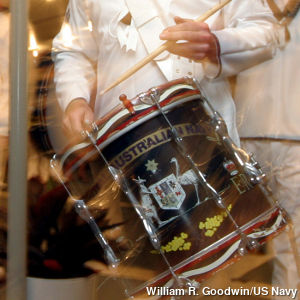
Photo: Sound is energy we hear made by things that vibrate. Photo by William R. Goodwin
courtesy of US Navy and
Wikimedia Commons.
Sound is the energy things produce when they vibrate
(move back and forth quickly).
If you bang a drum, you make the tight skin vibrate at very high speed (it's so fast that you can't usually see it), forcing the air all around it to vibrate as well. As the air moves, it carries energy out from the drum in all directions. Eventually, even the air inside your ears starts vibrating—and that's when you begin to perceive the vibrating drum as a sound. In short, there are two different aspects to sound: there's a physical process that produces sound energy to start with and sends it shooting through the air, and there's a separate psychological process that happens inside our ears and brains, which convert the incoming sound energy into sensations we interpret as noises, speech, and music. We're just going to concentrate on the physical aspects of sound in this article.
Sound is like light in some ways: it travels out from a definite source (such as an instrument or a noisy machine), just as light travels out from the Sun or a light bulb. But there are some very important differences between light and sound as well. We know light can travel through a vacuum because sunlight has to race through the vacuum of space to reach us on Earth. Sound, however, cannot travel through a vacuum: it always has to have something to travel through (known as a medium), such as air, water, glass, or
metal.
Photo: Sensing with sound: Light doesn't travel well through ocean water: over half the light falling on the sea surface is absorbed within the first meter of water; 100m down and only 1 percent of the surface light remains. That's largely why mighty creatures of the deep rely on sound for communication and navigation. Whales, famously, "talk" to one another across entire ocean basins, while dolphins use sound, like bats, for echolocation. Photo by Bill Thompson courtesy of US Fish and Wildlife Service.
Robert Boyle's classic experiment
The first person to discover that sound needs a medium was a brilliant Irish scientist known as
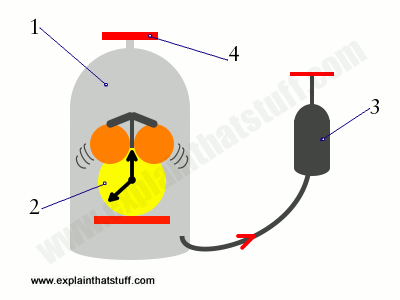
Robert Boyle (1627–1691). He carried out a classic experiment that you've probably done yourself in school: he set an alarm clock ringing, placed it inside a large glass jar, and while the clock was still ringing, sucked all the air out with a pump. As the air gradually disappeared, the sound died out because there was nothing left in the jar for it to travel through.
Artwork: Robert Boyle's famous experiment with an alarm clock.
Put a ringing alarm clock inside a large glass case with a valve on top. Close the valve so no air can get in.
You can easily hear the clock ringing because the sound travels through the air in the case and the glass, before continuing to your ears.
Switch on the vacuum pump and remove the air from the case. As the case empties, the ringing clock sounds fainter and fainter until you can barely hear it at all. With little or no air in the case, there's nothing to carry the sound to your ears.
Switch off the pump. With the clock still ringing, open the valve on top of the case. As air rushes back in, you'll hear the clock ringing once again. Why? Because with air once again inside the case, there's a medium to carry the sound waves from the ringing clock to your ears.
Sponsored links
How sound travels
When you hear an alarm clock ringing, you're listening to energy making a journey. It sets off from somewhere inside the clock, travels through the air, and arrives some time later in your ears. It's a little bit like waves traveling over the sea: they start out from a place where the wind is blowing on the water (the original source of the energy, like the bell or buzzer inside your alarm clock), travel over the ocean surface (that's the medium that allows the waves to travel), and eventually wash up on the beach (similar to sounds entering your ears). If you want to learn more about how sea waves travel, read our article on surfing science.
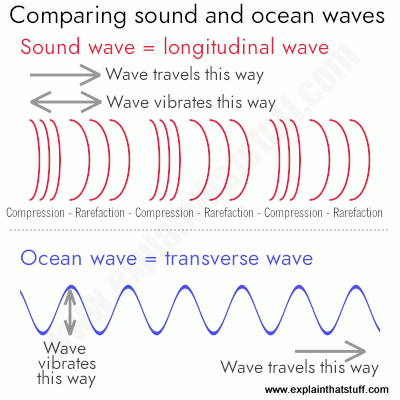
Artwork: Sound waves and ocean waves compared. Top: Sound waves are longitudinal waves: the air moves back and forth along the same line as the wave travels, making alternate patterns of compressions and rarefactions. Bottom: Ocean waves are transverse waves: the water moves back and forth at right angles to the line in which the wave travels.
There is one crucially important difference between waves bumping over the sea and the sound waves that reach our ears. Sea waves travel as up-and-down vibrations: the water moves up and down (without really moving anywhere) as the energy in the wave travels forward. Waves like this are called transverse waves. That just means the water vibrates at right angles to the direction in which the wave travels. Sound waves work in a completely different way. As a sound wave moves forward, it makes the air bunch together in some places and spread out in others. This creates an alternating pattern of squashed-together areas (known as compressions) and stretched-out areas (known as a rarefactions). In other words, sound pushes and pulls the air back and forth where water shakes it up and down. Water waves shake energy over the surface of the sea, while sound waves thump energy through the body of the air. Sound waves are compression waves. They're also called longitudinal waves because the air vibrates along the same direction as the wave travels.
To get the difference between transverse and longitudinal waves clear in your mind, take a look at these two little animations on Wikimedia Commons:
If you've ever got time on your hands while you're lazing on the beach, try watching the different ways in which waves can behave. You'll notice that waves traveling on water can do all kinds of clever things, like smashing into a wall and reflecting straight back with more or less the same intensity. They can also spread out in ripples, creep their way up the beach, and do other clever stuff. What's happening here with water waves doesn't actually have anything to do with the water: it's simply the way energy behaves when it's carried along by waves. Similar things happen with other kinds of waves—with light and with sound too.
You can reflect a sound wave off something the same way light will reflect off a mirror or water waves will bounce off a sea wall and go back out to sea. Stand some distance from a large flat wall and clap your hands repeatedly. Almost immediately you'll hear a ghostly repeat of your clapping, slightly out of step with it. What you hear is, of course, sound reflection, better known as an echo: it's the sound energy in your clap traveling out to the wall, bouncing back, and eventually entering your ears. There's a delay between the sound and the echo because it takes time for the sound to race to the wall and back (the bigger the distance, the longer the delay).
Picture: Reflected sound is extremely useful for "seeing" underwater where light doesn't really travel—that's the basic idea behind sonar. Here's a side-scan sonar (reflected sound) image of a World War II boat wrecked on the seabed. Photo courtesy of U.S. National Oceanographic and Atmospheric Administration, US Navy, and
Wikimedia Commons.
Sound waves lose energy as they travel. That's why we can only hear things so far and why sounds travel less well on blustery days (when the wind dissipates their energy) than on calm ones. Much the same thing happens on the oceans. Crisp water waves can sometimes travel vast distances across the ocean, but they can also be messed up when squally weather dissipates their energy over shorter distances.
Sound waves are like light and water waves in other ways too. When water waves traveling long distances across the ocean flow around a headland or into a bay, they spread out in circles like ripples. Sound waves do exactly the same thing, which is why we can hear around corners. Imagine you're sitting in a room off a corridor and, much further up the corridor, there's an identical room where someone is practicing a trumpet inside. Sound waves travel out from the trumpet, spreading out as they go. They ripple out down the corridor, race along it, ripple through the doorway into your room and eventually reach your ears. The tendency waves have to spread out as they travel and bend around corners is called diffraction.
Whispering galleries and amphitheaters
You might not think you could hear someone whispering if they sat a long way away, but if they can make the sound of their voice bounce off something into your ears, their voice will travel much further than usual.
If you're inside a building with a giant dome, the sounds you make will reflect off the curved roof like light rays bouncing off a mirror. Buildings that work this way are sometimes called whispering galleries. The dome of the US Capitol and the famous reading room in the British Museum in London are two well known examples. You can hear the same effect at work outside when you sit in a naturally curved landscape
or building called an amphitheater. You can talk in a normal voice and still be heard very clearly a considerable distance away.
Photos by Carol M. Highsmith: 1) The Capitol in Washington, DC has a whispering gallery inside its dome.
Photo credit: The George F. Landegger Collection of District of Columbia Photographs in Carol M. Highsmith's America,
Library of Congress, Prints and Photographs Division.
2) It's easy to hear people talking in the curved memorial amphitheater building at Arlington National Cemetery,
Arlington, Virginia. Photo credit: Photographs in the Carol M. Highsmith Archive,
Library of Congress,
Prints and Photographs Division.
Sponsored links
Measuring waves
All sound waves are the same: they travel through a medium by making atoms or molecules shake back and forth. But all sound waves are different too. There are loud sounds and quiet sounds, high-pitched squeaks and low-pitched rumbles, and even two instruments playing exactly the same musical note will produce sound waves that are quite different. So what's going on?
The energy something makes when it vibrates produces sound waves that have a definite pattern. Each wave can be big or small: big sound waves have what's called a high amplitude or intensity and we hear them as louder sounds. Loud sounds are equivalent to larger waves moving over the sea (except that, as you'll remember from up above, the air is moving back and forth, not up and down as the water does).
Apart from amplitude, another thing worth noting about sound waves is their pitch, also called their frequency. Soprano singers make sound waves with a high pitch, while bass singers make waves with a much lower pitch. The frequency is simply the number of waves something produces in one second. So a soprano singer produces more energy waves in one second than a bass singer and a violin makes more than a double bass.
Artwork: The amplitude of a wave is how big its up-down or side-to-side vibrations are. The frequency is how often it vibrates.
Understanding amplitude and frequency
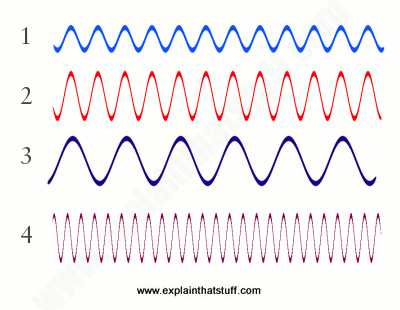
This artwork shows four waves that would sound different. If you're using a fairly up-to-date web
browser, you can compare how they sound by playing the samples below. (If you don't see the sound clips,
please try a different browser.)
The top wave represents a typical sound wave vibrating at a certain amplitude (its height) and frequency (how many peaks and troughs there are in a certain amount of time).
This wave has the same frequency as the first wave (the same number of peaks and troughs) but twice the amplitude (it's twice as high). A sound wave like this would sound louder than the first wave but the same pitch.
This wave has half the frequency of the second wave (half the number of peaks and troughs) but the same amplitude (it's exactly the same height). A sound wave like this would sound deeper (lower pitched) than the second wave, about as loud as the second wave, and louder than the first wave.
This wave has twice the frequency of waves 1 and 2 and four times the frequency of wave 3, so it would sound much higher in pitch than the other waves. It has the same amplitude as waves 2 and 3, so it would sound just about as loud.
Remember, however, that sound waves don't look like this as they travel. These up-and-down patterns are what you'll see if you study sound wave signals with an oscilloscope (a kind of electronic graph-drawing machine). Sound waves travel through the air as squashed-up compressions and stretched-out rarefactions. They only look like this on an oscilloscope trace.
Sponsored links
Why instruments sound different
But here's a conundrum. If a violin and a piano make sound waves with the same amplitude and frequency, how come they sound so different? If the waves are identical, why don't the two instruments sound exactly the same? The answer is that the waves aren't identical! An instrument (or a human voice, for that matter) produces a whole mixture of different waves at the same time. There's a basic wave with a certain amplitude and pitch, called the fundamental, and on top of that there are lots of higher-pitched sounds called harmonics or overtones. Each harmonic has a frequency that's exactly two, three, four, or however many times higher than the fundamental.
In the next sound clip, you can hear the first four harmonics for a musical note of frequency 400Hz, playing one after another, each for a duration of about 2 seconds. The fundamental (also called the first harmonic) is 400Hz; the second harmonic is 800Hz (twice the fundamental); the third harmonic is 1200Hz (three times the fundamental); and the fourth harmonic is 1600Hz (four times the fundamental).
Every instrument produces a unique pattern of a fundamental frequency and harmonics, called timbre (or sound quality). All these waves add together to give a unique shape to the sound wave produced by different instruments, and that's one reason why they sound different. The other reason is that the amplitude of the waves made by a particular instrument changes in a unique way as the seconds tick by. Flute sounds are immediate and die quickly, while piano sounds take longer to build up and die out more slowly as well. You'll find a much longer explanation of this in our article about electronic music synthesizers.
The speed of sound
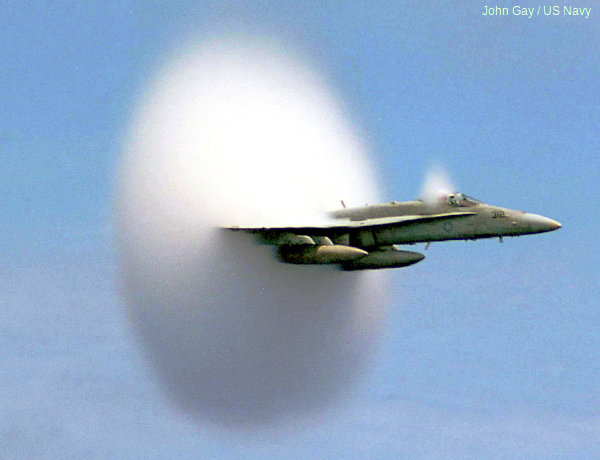
When we talk about the speed of sound, what exactly do we mean? Now you know that sound carries energy in a pattern of waves, you can see that the speed of sound means the speed at which the waves move—the speed at which the energy travels between two places. When we say that a jet airplane "breaks through the sound barrier," we mean that it accelerates so fast that it overtakes the incredibly high-intensity (that is, noisy) sound waves its engines are making, producing a horrible noise called a sonic boom in the process. That's why you'll see a fighter plane whizz overhead a second or two before you hear the vicious scream of its jet engines.
Photo: Breaking through the sound barrier creates a sonic boom. The mist you can see, which is called a condensation cloud, isn't necessarily caused by an aircraft flying supersonic: it can occur at lower speeds too. It happens because moist air condenses due to the shock waves created by the plane. You might expect the plane to compress the air as it slices through. But the shock waves it generates alternately expand and contract the air, producing both compressions and rarefactions. The rarefactions cause very low pressure and it's these that make moisture in the air condense, producing the cloud you see here. Photo by John Gay courtesy of US Navy and
Wikimedia Commons.
The speed of sound in air (at sea level) is about 1220 km/h (760 mph or 340 meters per second). Compared to light waves, sound waves creep along at a snail's pace—about a million times slower. You see lightning much sooner than you hear it because the light waves reach you pretty much instantly, while the sound waves take about 5 seconds to cover each 1.6 km (1 mile).
Why does sound go faster in some things than in others?
One thing to note about the "speed of sound" is that there's really no such thing. Sound travels at different speeds in solids, liquids, and gases. It's generally faster in solids than in liquids and faster in liquids than in gases: for example, it goes about 15 times faster in steel than in air, and about four times faster in water than in air. That's why whales use sound to communicate over such long distances and why submarines use SONAR (sound navigation and ranging; a sound-based navigation system similar to radar only using sound waves instead of radio waves). It's also one of the reasons why it's very hard to figure out where the noise of a boat engine is coming from if you're swimming in the sea.
Chart: Generally, sound travels faster in solids (right) than in liquids (middle) or gases (left)... but there are exceptions!
Sound travels at different speeds in different gases—and can go at different speeds even in the same gas. How fast it goes in a particular gas depends on the gas, not on the sound. So whether it's a loud sound or a soft sound, a high-pitched sound or a low-pitched one doesn't actually make any difference to its speed: the amplitude and frequency don't matter. What does matter are two properties of the gas itself: its temperature and how heavy its molecules are (its "molecular mass"). So sound travels much faster in warm air near the ground than in colder air higher up, for example. And it travels roughly three times faster in helium gas than in ordinary air, because helium has much lighter molecules. That's why people who breathe in helium talk in funny voices: the sound waves their voices make travel faster—with higher frequency. (Sound goes even faster in hydrogen, which is lighter again than helium.)
But why is sound faster in solids than in gases? Haven't I just said that it goes faster in lighter gases than in heavier ones, which ought to suggest it would go much slower in solids (which are much more dense than gases). The simple reason is that sound travels in a completely different way in a solid and a gas. As we've already seen, sound moves by squashing and stretching gases like the air. But things are different in solids, which are impossible to squash and stretch in the same way. Where the molecules in a gas can bounce back and forth to carry sound energy in pressure waves, the atoms or molecules in solids are essentially locked in place. When sound enters solids, its vibrations are carried at high speeds by "sort of" particles called phonons. Exactly how that happens is far beyond the scope of this simple, introductory article. Just think of phonons carrying sound waves through a solid in a roughly analogous way to how molecules carry them through a gas, often much faster. Just as different gases carry sound at different speeds, so the speed of sound also varies dramatically from one solid to another. It's about 80 times faster in steel than in rubber, for example, and two and a half times faster in diamond than in steel!
How to measure the speed of sound
If you want to measure the speed of sound, echoes offer a simple way to do it. You'll need a good-sized tape measure and a stopwatch.
Stand about 100m or so from a large wall. Measure the distance carefully, double it, and
write it down.
Now clap 20 times, listen for the echo, clap again as soon as you hear it, and keep doing so.
Measure the total time from the very first clap to the very last echo. In that time, sound has traveled a total of 20 × 2 × 100m (or the distance between you and the wall), which is about 4000m (4km).
To find the speed of sound, divide the total distance by the total time you measured (which, to give you a rough idea, should be something like 12 seconds for that kind of distance). That should give you a speed of sound in meters per second (something like 340 meters per second), which you can then convert into any other units you like.
If your measurement is way off, try standing further from the wall or clapping more times to increase the distance.
Artwork: Measuring the speed of sound by the clap-echo method.
Sound in practice
Photo: Musical sound is arguably humankind's greatest invention. This superb Steinway
grand piano dates from 1876 and sits in the amazing gallery at the National Trust's
Lanhydrock country house in Cornwall, England.
Sound is a hugely important part of life on Earth. Most animals listen out for noises—things that signal the possibility of eating or being eaten. Many creatures also exchange meaningful sounds, either to communicate with members of the same species or warn off predators and rivals. Humans have evolved this ability into spoken language (as a way of exchanging information) and music (essentially, a sound-based system for communicating emotion).
We've also developed a variety of different sound technologies. We've invented musical instruments that can make a huge range of different musical sounds, from simple drums and percussion instruments to sophisticated electronic synthesizers that can generate any sound you care to imagine. We can record sounds on such things as compact discs or with newer technologies like MP3 (sound files stored in highly compressed forms on computers). We can also use very high frequency sounds, known as ultrasound, for everything from cleaning false teeth to studying the development of a baby inside a mother's womb. We've even taught computers to listen to our spoken words and turn them into written language using voice recognitionsoftware—appropriately enough, that's how I wrote this article for you today!
About the author
Chris Woodford is the author and editor of dozens of science and technology books for adults and children, including DK's worldwide bestselling Cool Stuff series and Atoms Under the Floorboards, which won the American Institute of Physics Science Writing award in 2016. You can hire him to write books, articles, scripts, corporate copy, and more via his website chriswoodford.com.
Explore Sound: A comprehensive educational site from the Acoustical Society of America, with activities for students of all ages.
Sound Waves: A great collection of interactive science lessons from the University of Salford, which explains what sound waves are and the different ways in which they behave.
Books
Educational books for younger readers
Sound (Science in a Flash) by Georgia Amson-Bradshaw. Franklin Watts/Hachette, 2020. Simple facts, experiments, and quizzes fill this book; the visually exciting design will appeal to reluctant readers. Also for ages 7–9.
Sound by Angela Royston. Raintree, 2017. A basic introduction to sound and musical sounds, including simple activities. Ages 7–9.
Experimenting with Sound Science Projects by
Robert Gardner. Enslow Publishers, 2013. A comprehensive 120-page introduction, running through the science of sound in some detail, with plenty of hands-on projects and activities (including welcome coverage of how to run controlled experiments using the scientific method). Ages 9–12.
Cool Science: Experiments with Sound and Hearing by Chris Woodford. Gareth Stevens Inc, 2010. One of my own books, this is a short introduction to sound through practical activities, for ages 9–12.
Master Handbook of Acoustics by F. Alton Everest and Ken Pohlmann. McGraw-Hill Education, 2015. A comprehensive reference for undergraduates and sound-design professionals.
The Science of Sound by Thomas D. Rossing, Paul A. Wheeler, and F. Richard Moore. Pearson, 2013. One of the most popular general undergraduate texts.
Please do NOT copy our articles onto blogs and other websites
Articles from this website are registered at the US Copyright Office. Copying or otherwise using registered works without permission, removing this or other copyright notices, and/or infringing related rights could make you liable to severe civil or criminal penalties.