Humans spend hours preening themselves in mirrors and, given half
the chance, apes,
elephants,
pigs,
and dolphins
would do too. Peacocks
are a different
kettle of fish entirely. Park a shiny blue car near one of these
pesky hooting birds and it'll peck and beat the panels to a pulp,
convinced it's looking at a rival or a mate! Reflections in mirrors
are amazing things that tell us literally (and psychologically) a
great deal about how we see ourselves. But what do reflections tell
us about the mirrors themselves? What
exactly is a mirror... and how does it work?
If you're a fan of recycling, you'll
love one of the most fundamental scientific laws in the universe called the
conservation of energy.
The basic idea is really simple: you can't make energy
out of thin air or throw it away. It doesn't matter what you do or how hard you try, you can never
create energy or destroy it: the best you can do is to convert it into a different form—recycle it, if you prefer.
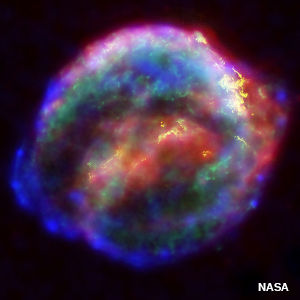
Picture: Energy always has to come from somewhere... and go somewhere.
This bubble-shaped explosion of gas and dust is 14 light-years wide and
is expanding at 4 million miles per hour (2,000 kilometers per second).
It's the remnant of a supernova (exploding star).
Photo courtesy of NASA Jet Propulsion
Laboratory (NASA-JPL).
Think what happens when you switch on an
electric lamp, you're not creating light from
nothing. The light is
being made from electricity flowing
into your home from a power
plant. But even a power plant doesn't make energy: it extracts
energy locked in a fuel such as oil or coal and turns it into electricity.
How did the energy get into the coal? It originally came from the
Sun. Where did the Sun get the energy? From nuclear reactions
happening deep inside its core. And so on...
No matter what you do, the conservation of energy is always looking
over your shoulder.
You need energy to do things, but the energy has to come from
somewhere to begin with and go somewhere else when you're done. If
you kick a football, potential energy stored in your muscles is
transferred into the ball and makes it fly through the air with
kinetic energy. When the ball rolls over the ground, friction (the
rubbing force between the ball and whatever it touches) steals away
its energy and brings it to rest.
The conservation of energy is the reason why you can't build a
machine that will run by itself forever (known as a perpetual motion
machine). It's also the reason why your car inevitably runs out of
petrol and why you always get an electricity bill coming through your
letterbox every few weeks.
But what's all this got to do with mirrors...?
What happens when light hits a mirror?
When you stand in front of a mirror, what you see is the conservation of energy in action,
working its magic on light. Light is energy traveling at high speed
(300,000 km or 186,000 miles per second) and, when it hits an object,
all that energy has to go somewhere. There are three things that can
happen when light hits something: it can pass through (if the object
is transparent), sink in and disappear (if the object is opaque and
darkly colored), or it can reflect back again (if the object is
shiny, light-colored, and reflective). Either way, the conservation
of energy is at work: there is just as much energy around before
light hits something as afterward, though some of the light may be
converted into other forms.
Artwork: There's no such thing as a perfect mirror.
All objects absorb, reflect, and transmit the light falling on them
(called the "incident" light) to different extents,
depending on the materials they're made from. Things we call "mirrors" are a special class of objects
that reflect an unusual amount of that light. A typical silver mirror reflects
95 percent of the light hitting it, while an aluminum mirror might reflect only 90 percent.
What happens when you look in a mirror? In the daytime, light
reflects off your body in all directions. That's why you can see
yourself and other people can see you. Your skin and the clothes
you're wearing reflect light in a diffuse
way: light rays
bounce off randomly, haphazardly, in no particular direction. Stand
in front of a mirror and some of this light from your body will
stream in straight lines toward it. Rays of light (which are really
packets of light energy called photons, fired in a stream like
bullets from a machine gun) shoot through the glass
and hit the
silver coating behind it (possibly a real coating of silver or more likely something less expensive
such as polished aluminum). The light will
reflect off the mirror in a more orderly way than it reflects off
your clothes. We call that specular
reflection—it's the
opposite to diffuse reflection.
Artwork: How a mirror works: silver atoms inside catch and reflect
light beams. For the conservation of energy to hold true, light beams must reflect back
at the same angle they hit the mirror. The backboard is a protective backing
that stops the mirror surface from being scratched.
How does the mirror reflect light? The silver atoms
behind the glass absorb the photons of incoming light energy and become excited.
But that makes them unstable, so they try to become stable again by
getting rid of the extra energy—and they do that by giving off
some more photons. (You can read about how atoms take in and give out photons
in our article about light.) The back of a mirror
is usually covered with some sort of darkly colored, protective material to stop
the silver coating from getting scratched, and also to reduce the risk of any light seeping
through from behind. Silver reflects light better than almost anything else and that's
because it gives off almost as many photons of light as fall on it in
the first place. The photons that come out of the mirror are pretty
much the same as the ones that go into it.
Photo: Most of what we see in the world gets into our eyes by
diffuse (fuzzy, irregular) reflection; it takes a highly polished surface like a mirror to give precise, specular reflection.
Left: Specular—How this building would look if the lake reflected it precisely, like a mirror.
Right: Diffuse—How the building actually appears in the water through fuzzy, diffuse reflection.
Photo by Carol M. Highsmith courtesy of US Library of Congress.
Sponsored links
What different types of mirrors are there?
Have you ever been in a hall of mirrors at a fun fair? If so,
you'll have seen amazingly distorted reflections of yourself looking
short and fat or tall and skinny. In the words of the old
cliché,
it's all done with mirrors. What you see when you look at a mirror is
not what's really there but what your brain thinks
is there
based on how it thinks the image is being created. In other words,
what you see is an optical illusion. Even
the image in a
normal mirror is an optical illusion, because you're not really
standing eight feet in front of yourself grinning back. What you see
is a virtual image, not a real object.
Broadly speaking, there are three types of mirror:
If the surface of a mirror is perfectly flat (what's known as a plane mirror), what you see in the glass is a reasonable approximation to what's really there—but with one
crucial difference: the image appears to be shifted from left to right (we say
it's mirrored, but scientists say it's "laterally inverted"). Lots of people
find this very confusing, and I explain why it happens in the box below.
If the mirror bows inward at the center
(known as a converging mirror or concave mirror),
light rays will appear to come from in front of the mirror, the reflection will be nearer to you, and
reflections will appear bigger than they really are.
That's why a converging mirror magnifies. Shaving mirrors work like this.
In a mirror that bulges
outward at the center (a diverging mirror or convex mirror),
the opposite happens. Light rays seem to come from behind the mirror and
reflections will appear smaller and further away than they would in a plane mirror.
Driving mirrors work like this (and so does the back of a spoon if you hold it just right).
Photo: Two kinds of mirrors that work in opposite ways.
1) A shaving mirror is a converging (concave) mirror.
2) A spoon is a very imperfect diverging (convex) mirror. All the scratches
in its surface mean it reflects less perfectly than a mirror but better than most random
pieces of metal.
Artwork: 1) A converging (concave) mirror makes a bigger (magnified) image: The rays appear to come from a point in front of the mirror, closer to you (orange star), so your brain thinks the image is nearer than it really is—and therefore bigger.
2) A diverging (convex) mirror makes a smaller (diminished) image: The rays appear to come from a point behind the mirror, further away from you (orange star), so your brain thinks the image is further than it really is—and therefore smaller.
Why do mirrors seem to reverse things left-to-right but not top-to-bottom?
Photo: Does a mirror really reverse things left to right? Try this cunning experiment yourself to prove that they don't!
We learn in books that plane (flat) mirrors "laterally invert things" (flip them from left to right),
but that's not really correct—and it's not a satisfying explanation. If mirrors
flip you left to right, why don't they also flip you upside down? And do they really flip
things left to right anyway? As you can see in the photo here, if you write something non-symmetrical (like the letter "F") on a piece of clear
plastic and hold it up to a mirror, what you write isn't inverted at all: what you see in front of your eyes is exactly what you
see in the mirror. Lots of people find this very confusing—and that's probably because science books
make it far more confusing than it needs to be. So what's actually going on?
What you see is what you get
Think back to our explanation up above. A mirror works because the atoms inside it catch
light and throw it back. For the conservation of energy to hold, the atoms have to throw the
light back at the same angle at which they receive it. There's a perfect mapping between
the object and the image it makes in a plane mirror: those parts of the object closest to the mirror
appear closest in the image that's "inside the mirror," while more distant parts of the object
appear deeper "inside the mirror." A plane mirror reflects exactly what's in front of it.
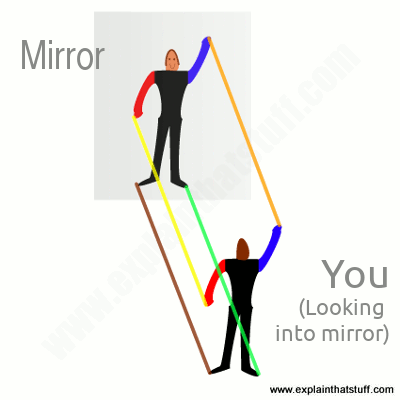
Artwork: Why a mirror appears to flip things left-to-right (invert things laterally)
but not top-to-bottom.
Looking at the diagram here, you can see what happens when you stand in front of a mirror. Light rays from your left arm (shown in red)
bounce back and forth along the path shown in yellow, while rays from your right arm (shown
in blue) follow the path shown in orange. The rays from your head and feet follow the paths
shown in green and brown. What you see in the mirror appears to be flipped left-right but
not top-bottom. Why is that?
If you're a person looking, as we are now, from behind the person standing in front of a mirror, you can
get a slightly different understanding of what's happening: the mirror shows the person's front,
while we can see the person's back. The mirror shows you the front of the person standing before it,
but if the person were to walk forward and "climb inside" the mirror, you'd see their back.
So what a mirror is really doing is inverting things from front-to-back,
though we can also explain things in a simpler way.
Mirroring without a mirror
When you hold a clear plastic sheet up to a mirror with a letter written on
it, as in our top photo, the letter appears the same in the mirror as it does looking at it normally.
How do we explain that? In this case, the light rays travel through the object we're looking at
and carry on into our eyes, in perfectly straight lines, so the "normal" and "mirrored" views must be
exactly the same. If you write the letter "F" on a piece of white paper (which is facing you), you have to
turn it around (to face away from you) to see it in the mirror. As you turn it around, you switch
the right side of the paper over to the left and the left side over to the right. That's why letters
written on ordinary paper seem to be inverted: you've inverted the paper when you've turned it to
face the mirror! With the clear plastic sheet, you simply hold it up to the mirror as it is, without turning
it around. You don't invert the sheet so the letter "F" doesn't appear inverted. If you take your
piece of clear plastic and turn it around to face the mirror, as you would turn an ordinary white piece of paper,
the letter "F" is immediately inverted. Now it's obvious why: you've inverted it yourself. The mirror
plays no part in it!
Photo: Draw a letter "F" on a thin piece of paper, turn it to face away from you, and hold it up to a window or a light. What you see is a "mirrored" version of the letter "F," even though there's no mirror! The explanation is really obvious: you have turned the paper round yourself and that's why the letter is inverted. Exactly the same explanation holds for mirrors. To see something in a mirror, we turn it around to face the glass. This is what causes the left-right, lateral inversion: the mirror itself is irrelevant.
You are the mirror!
So that's the real explanation of why most things seem to be left-right reversed in a mirror: we've turned
them left-right to face the mirror to see them but conveniently forgotten that's what we've done. We've done the mirroring ourselves. That applies to our own bodies as much as to writing on a piece of paper. You could just as easily take a piece of paper that's facing you and rotate it upside down to face a mirror, in which case what you see in the mirror will be inverted up-down and not left-right. That applies
to your own body too. If you're facing away from a mirror but flip yourself upside down to face toward it, so you're standing on your
hands to support yourself, you'll find your body is upside down in the mirror. But the mirror hasn't caused this:
you've caused it by flipping yourself upside down!
Oh flip!
It would be wrong to conclude from this that mirrors don't flip things in any way. What they really do is flip things front-back along the axis (line) that passes perpendicular to the mirror. So, if you look at the illustration above, the real man has his back closest to us but the reflected man in the mirror has his face closest. That's how a mirror really flips things. If you bring a card up sideways to a mirror, with the word
"MIRROR" written on it, the "M" will be closest to you but in the mirror, it will be furthest away.
Sponsored links
Why do polished objects shine like mirrors?
You can make things more mirror-like by polishing them. If
something is flat and light-colored, you can make it reflect light
better by rubbing it clean. What you do when you polish is a
combination of rubbing away some dirt, filling in bumps and
scratches, and adding a surface layer of a chemical such as wax, all
of which make the surface smoother and more like a mirror. When light
hits, it's more likely to be reflected back in an orderly, specular fashion
with parallel incoming rays of light reflected back again as parallel
outgoing rays of light. That's why people talk about polishing a pair
of shoes until you can "see your face in them."
Photo: One good reason to polish your GORE-TEX® boots: you can think about the science of light reflection and the conservation of energy as you're doing it.
Of course, if you're polishing something like a car, you have a
big advantage: it's made of flat metal,
smooth, and often light-colored. So removing the dirt and rubbing the
surface smooth is really all you need to do to make it shine. Some
polishes contain optical brighteners to trick you into thinking
things are cleaner and shinier than they really are. These chemicals
are widely used in washing detergents and appear to reflect more
light back than they actually absorb. That's not a violation of the
conservation of energy—quite the opposite: the atoms inside optical
brighteners absorb and re-emit the light that falls on them in such a
way that energy is precisely conserved.
They do this by absorbing invisible ultraviolet light (the blueish light in sunlight
that our eyes can't see) and converting it into a blue light we can
see. So as well as reflecting the light we can see, they're reflecting
light we can't see and turning it into light we can—and that's how they make things seem brighter
without violating the laws of physics.
How does a mirror "know" there's something there?
Just recently, a lot of people have been coming to this page after being baffled
by an optical illusion doing the rounds on social media. You take something like a ball and hold it front
of a mirror. Next, you place a piece of paper or a book so it blocks the "line of sight" between the object and the mirror then peer round it... and to your amazement, the object is still there in the mirror! So how does the mirror "know" the object is there if you've blocked the mirror's "view" of it?
Photo: How does the mirror "know"? Physics, not magic.
Well, it's not magic: it's physics! As we saw above, most objects reflect light in all directions (diffuse reflection). When light from the sun or a table lamp hits the ball, the ball bounces some
light rays directly into your eyes, while it bounces other rays off into the mirror.
The mirror reflects those light rays, in straight lines, at the same angle—and some of them end up in your eyes (red line). Now your eyes and brain—which work as a cunning team called the "visual system"—have an intuitive understanding of physics and know that light rays travel in straight lines. So
you see these reflected rays and assume they have travelled from points "inside" the mirror (red dotted line).
Artwork: Looking from above, it's clear how the illusion
works. Odd camera-phone angles and distances also distort the illusion, making what you see seem
impossible. But remember: everything you can see in the mirror is also in the real world and it gets there
by simple reflection.
That's why you can see things—virtual images—inside mirrors in the first place.
And it's why you can see the ball in the mirror even when there's another object in the way.
Mirrors in space
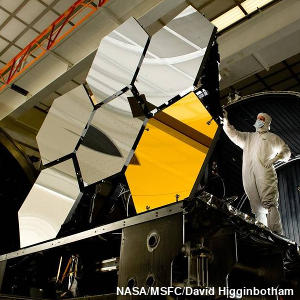
Photo: Large mirrors are difficult to make, so giant space mirrors like this one are often made from multiple, separate hexagonal elements fitted together in a honeycomb pattern. This mirror is about 5m (18ft) in diameter and made from precision fabricated aluminum segments. Photo courtesy of NASA Marshall Space Flight Center (NASA-MSFC) and Internet Archive.
Imagine gazing into a mirror and seeing not your face
but distant stars and galaxies. The world's biggest telescopes work
in exactly the same way as the mirrors on your walls at home, only
they are more precise, point toward the sky, and are much bigger.
There is a limit to how big a mirror can be made (typically around 8m
or 27 ft across) without buckling under its own weight. Some
telescopes have bigger mirrors made from smaller pieces joined
together. The two Keck telescopes on Mauna Kea mountain in Hawaii
have mirrors 10m (33 ft) across, each one made from 36 separate
mirror tiles. At home or in space, mirrors must have completely
smooth surfaces to make undistorted images. Making space mirrors
involves particularly laborious and elaborate polishing, as
this great photo of the Hubble Space Telescope's mirror being polished shows you very clearly.
Next time you have to spend a little while polishing a mirror at home, spare a thought for
the optical scientists who manufacture space mirrors: they can take
months (and sometimes years) to buff up to perfection!
History of Mirrors Dating Back 8000 Years: by Jay Enoch. Optometry & Vision Science: October 2006, Volume 83 Issue 10, pp 775-781. Covers "the ancient history and early development of mirrors."
Corning Museum of Glass: Quite a bit of useful information here about telescopes and how they use mirrors.
Light in a Flash by Georgia Amson-Bradshaw. Franklin Watts, 2017. Activities and information in a 32-page introduction for ages 7–9.
Explore Light and Optics!: With 25 Great Projects by Anita Yasuda and Bryan Stone. Nomad Press, 2016. Activities to the fore once more in this 96-page guide for ages 7–10. A solid introduction with plenty of science history worked in.
Light: Investigating Visible and Invisible Electromagnetic Radiation: by Chris Woodford, Rosen, 2013/Blackbirch, 2004. One of my own children's books for ages 9–12, this 48-page volume charts the story of light science from ancient philosophers to modern innovations like fiber optics.
Eyewitness: Light: by David Burnie, Dorling Kindersley, 2000. A good introduction for ages 9–12 covering both the theory, practical uses, and history of light science.
For older readers
Optics: by Eugene Hecht, Addison Wesley, 2017. Still a great college textbook (and the one I used myself as an undergraduate).
The Mirror: A History: by Sabine Melchoir-Bonnet, Routledge, 2002. Charts the history of mirrors, through science and culture, from ancient times to the present.
Is that me in the mirror?: BBC Horizon, 20 October 2009. What do mirrors tell us about our self-awareness? At what age do we figure out that the person we see is... us?
Hubble's painful birth: BBC News, 10 February 2000. A look at how the Hubble's mirror was laboriously constructed, why it went wrong, and how it was fixed.
Please do NOT copy our articles onto blogs and other websites
Articles from this website are registered at the US Copyright Office. Copying or otherwise using registered works without permission, removing this or other copyright notices, and/or infringing related rights could make you liable to severe civil or criminal penalties.