Who are the world's best musicians?
Everyone has their own personal
view on this, but for my money concert pianists win hands down.
If you've ever seen a world-class pianist playing a great piece of
music, like a Beethoven sonata, you'll understand exactly what I'm
talking about. It takes amazing physical, intellectual, and emotional
brilliance to play such a complex instrument in such a captivating
way—and only a tiny proportion of the world's pianists are up to the
job. But it's not just the musician who makes the music sound so
fantastic: the instrument plays a huge part too. Let's take a closer
look inside a piano and find out how it works!
Photo: An ornate Baldwin piano owned by the flamboyant pianist Liberace and now in a museum in Las Vegas. Credit: Photographs in the Carol M. Highsmith Archive, Library of Congress, Prints and Photographs Division.
A piano sounds quite unlike any other instrument and, if you heard
it on the radio, you'd probably never guess how it was making a noise.
The confusing thing about a piano is that it's two different kinds of
instrument in one: it's a string instrument, because the sounds
are made with strings, but it's also a percussion instrument
(like a drum) because the strings make sounds when something hits them.
Listen to the music of a composer like Bartok and you'll often hear the
piano
being played percussively—almost beating like a drum!
Photos (below): On a high note: Steinway is generally considered to be the Rolls Royce of grand pianos. This is a superb Steinway grand dating from 1876 in the gallery at Lanhydrock, Cornwall.
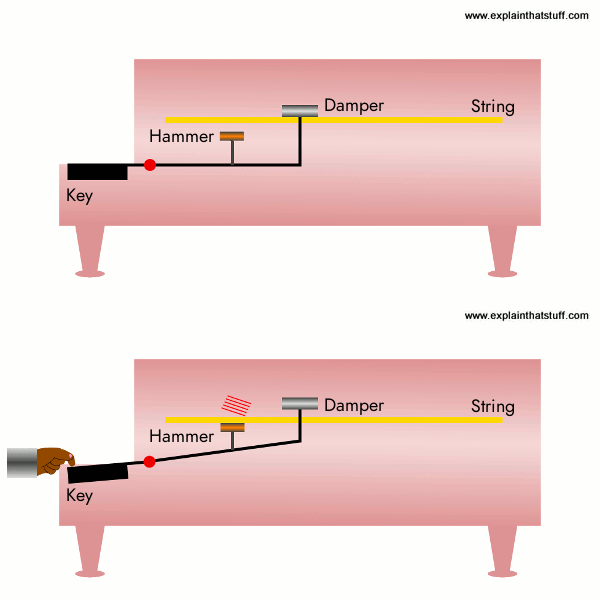
So what happens when you press the key of a piano? The key
is actually a wooden lever, a bit
like a seesaw but much longer at one end than at the other. When you
press down on a key, the opposite end of the lever (hidden inside the
case) jumps up in the air, forcing a small felt-covered hammer
to press against the piano strings, making a musical note. At
the same time, at the extreme end of the lever behind the hammer,
another mechanical part called a damper is also forced up into
the air. When you release the key, the hammer and the damper fall back
down again. The damper sits on top of the string, stops it vibrating,
and brings the note rapidly to an end.
Artwork: How a piano works: Press down on a key and you make a small hammer shoot up and strike the corresponding strings from beneath. Release the key and the damper at the back falls down onto the strings, stopping the note.
How does a piano action work?
Artwork: A typical upright piano action, from US Patent 334,511: Piano by Isaac Bullard. Artwork courtesy of US Patent and Trademark Office.
The little diagram up above is a hugely simplified version of what happens in a real piano. A piano's keys control the hammer and the damper through an intricate mechanism, which is known as the piano's action. Here's a typical action for an upright piano, devised
by inventor Isaac Bullard of Hyde Park, Massachusetts in the late 19th century. It's an example of what's called a French-repeating action, because it allows notes to be played rapidly in quick succession.
Key (gray).
Key pivots about center point (blue).
Rod (green, sometimes called the extension) leading up from the back end of the key to the damper and hammer.
Rocker (red) to which the hammer and damper are attached.
Rocker pivots about this point.
Spoon or tongue runs up from rocker to damper.
Damper lever (orange).
String (turquoise) mounted vertically in this upright piano.
Damper (orange).
Jack (yellow) operates hammer and damper.
Hammer knuckle (yellow).
Hammer rest (gray) supports hammer after string has been hit.
Hammer (yellow) strikes string.
Back check.
Even this diagram is a simplification—I've left out quite a few pieces for clarity!
Sponsored links
Soft and loud: piano et forte
If a piano consisted of nothing but an action—the mechanical connection between keys and strings—no-one in the audience would
hear very much. So there are lots of other parts in a piano designed to make notes sound louder or last longer. The strings of
a piano stretch out horizontally away from the pianist sitting at the
keyboard, just as though a piano were a guitar laid flat on its back.
Photo: (Below) Looking from
the back of a piano, under the lid and into the case, you can see the strings stretched taut across the sturdy
cast-iron frame. The long bass strings are on the right in this picture
and the shorter treble strings are on the left. The open lid reflects
the music into the audience like
a giant, wooden sound "mirror".
Annotated picture adapted from an original photograph by John M. Foster and US Air Force courtesy of
US
National Archives.
When you pluck a string, it vibrates, sets air molecules in motion and
sends the sounds of the strings out toward your ears. To make the
sounds louder, there is a large piece of wood mounted underneath them,
called the soundboard (or sounding board). When the strings
vibrate, the soundboard also vibrates in sympathy (resonance), just as
a wine glass vibrates when a soprano sings a high note nearby. The
soundboard effectively amplifies the strings so they are loud enough to
hear. The lid helps the audience too: sound from the strings
and the soundboard travels straight up, through holes in the frame called rosettes,
hits the lid, and reflects out toward the audience. That's why it's always better to sit on the right of the
pianist and why concert hall seats to the left of (and behind) the
pianist are generally much cheaper.
Photo: A grand piano being assembled at the historic Steinway factory in Queens, New York.
Note the sturdy cast-iron plate hovering up above, ready to be lowered into position. Its job is to stop the
piano "imploding" from the tension of the strings. Credit: Photographs in the Carol M. Highsmith Archive,
Library of Congress, Prints and Photographs Division.
How do the pedals change the sound?
“The piano ain't got no wrong notes.”
Thelonius Monk
While the 88 keys on a piano control the musical notes that the
pianist can make, the three pedals determine how loud or soft
these notes are and how long they last. The pedal on the left is called
the soft pedal (or sometimes the "una corda"). Most of the keys on the keyboard hit two or
three strings simultaneously when you press them, so you get a richer
and louder note. However, if you press the soft pedal down, the hammers
that play the notes shift slightly to one side so they contact fewer
strings—making a quieter note. The middle pedal is called the sostenuto
pedal: when you press it down, it temporarily deactivates the
dampers for the notes that you're playing at the time, and makes them
last quite a bit longer. The pedal on the right is called the sustaining
pedal (also called the sustain or damper pedal). Pressing it down raises all the dampers up in the air so all the notes last longer.
Photo: The three pedals on a piano subtly change the character of the notes you play. Photograph of a Steinway piano at Perry Belmont House, Washington, DC, by Jack E. Boucher,
Library of Congress, Library of Congress, Prints and Photographs Division, HABS DC-866-32 (CT).
Strings and things
Photo (above): Another view of the Lanhydrock Steinway Grand.
If you've ever wondered why pianos are such a funny shape, that's
easy to answer too. Remember that they're string instruments. Lower
notes need longer strings than higher notes, so the bass strings
for the low notes on the left-hand side of the keyboard need to be much
longer than the treble strings for the high notes on the
right-hand side. That's why the case is longer on the left than on the
right and why it has that funny curved rim. In fact, the
strings on the left are so long that they cross over, on top of the
middle and treble strings to save space. (You can see that very clearly on the artwork here
and also in the photo up above.)
Since each note can have up to three strings, it turns out that
there are well over 200 strings inside a piano—each one stretched
really tight. To stop the strings from collapsing the entire piano
inwards, the rim and case are reinforced by a huge, heavy cast-iron
plate. The plate sits just above the sound board and large metal
holes around its edge (known as rosettes or portholes)
allow the sound to come up through it.
Artwork: How the strings are supported inside a piano frame—as shown in a typical Steinway design from the 19th century. The keyboard is at the bottom, so the long bass strings (green) are on the left, the mid-pitch strings are in the middle (orange), and the high treble strings are on the right (yellow). Note how the deepest and longest base strings have to cross over and above the treble strings. The incredible tension of so many taut strings is balanced by the strong metal "skeleton" framework (blue) inside the wooden case (brown). Design for a piano frame by Theodor Steinway from US Patent 314,742: Piano Frame, March 31, 1885, courtesy of US Patent and Trademark Office.
In an upright piano, things are slightly different. The strings run vertically at the back of the case and the
hammers strike them by moving horizontally. It's like a grand piano standing on its end—literally upright.
Photo: As its name suggests, the mechanism of an upright piano is upright: the strings are arranged vertically instead of horizontally (as in a grand piano). Credit: Photographs in the Carol M. Highsmith Archive, Library of Congress, Prints and Photographs Division.
That's a very quick tour of a piano, one of the world's most amazing
instruments!
Photo: Tuning a piano is a skilled job that involves tightening the strings by precise amounts
using a tuning hammer (really a wrench) like this. Here the tuner is using a handheld, electronic tuner
to check the pitch of the strings as he adjusts them. Picture by Joshua Valcarcel courtesy of US Navy
and Wikimedia Commons.
Piano: The Making of a Steinway Concert Grand by James Barron. New York: Times Books, 2006. A very readable little paperback that describes the fascinating story of how one Steinway piano was put together, starting
from the forest that supplied the trees and ending in the concert hall where the instrument made its musical debut.
People and Pianos by Theodore Steinway. Hal Leonard Corporation, 2005. An insider's view of Steinway by one of the members of the family, originally written in the 1950s and since revised and updated.
Playing piano
There are zillions of books on learning to play piano. Any decent book should really convince you to take proper piano lessons with a good teacher, if you're serious about playing properly.
The Piano Handbook by Carl Humphries. Backbeat, 2003. An alternative guide that seems to score highly in Amazon reviews.
Patents
Patents are always worth exploring if you like real technical detail. Here are a few (of the many hundreds) of piano patents filed by Steinway that you can find at the US Patent and Trademark Office and European Patent Offfice.
US Patent 314741: Piano Frame by C. F. Theodor Steinway, March 31, 1885. Steinway's 19th-century piano frame design explained in detail.
EP 1913575: Method for improving the sound of musical instruments by Hans-Ulrich Rahe, December 17, 2008. A very interesting example of the latest in scientific thinking on piano design: how can the primary sound made by the strings be improved by reducing the effects of vibrations happening in other parts of the instrument?
Articles
Why Do Pianists Know So Little About Pianos? by Anthony Tommasini. The New York Times, November 12, 2020. Pianos are intricate and complex—and even pianists often don't understand them. Here's why.
Steinway's Grand Ambitions for Its Pianos in China by Javier C. Hernández. The New York Times, July 9, 2016. Can growing Asian interest in the piano save the fortunes of the leading, luxury instrument maker?
Notes of Sorrow in Changes at Steinway by James Barron. The New York Times. July 12, 2013. How the sale of Steinway worried pianists, who fear the company's tradition of excellence might be compromised.
For More Pianos, Last Note Is Thud in the Dump by Daniel J. Wakin. The New York Times. July 29, 2013. Where do old pianos go when they die? Instead of being recycled or repaired, many are now smashed to pieces with sledgehammers.
Please do NOT copy our articles onto blogs and other websites
Articles from this website are registered at the US Copyright Office. Copying or otherwise using registered works without permission, removing this or other copyright notices, and/or infringing related rights could make you liable to severe civil or criminal penalties.