You may not believe in astrology, but
there's no question the planets rule our lives. We get up when the Sun rises (or some time
after) and go to bed when it sets. We have a calendar based on
days, months, and years—periods of time that relate to how the
Moon and Earth move around the Sun in the sky. For most of history,
people found this kind of "astronomical timekeeping" good enough for
their needs. But as the world became ever more frantic and
sophisticated, people needed to keep track of hours, minutes, and
seconds as well as days, months, and years. That meant we needed
accurate ways of keeping time. Pendulum clocks and mechanical
watches used to be the best way of doing this. Today, many people use
quartz clocks and watches instead—but what are they and how do they
work?
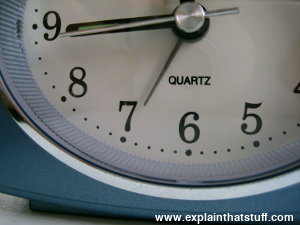
Photo: Quartz is really cheap and the clocks that use it need hardly any moving parts. That's why it's now used in even the most inexpensive timepieces. Because it's so accurate and reliable, it's very much a selling point—which is why clocks like this proudly have the word "quartz" plastered prominently across their dials. Note that this is an analog
clock (one with hands): quartz clocks and watches don't have to be digital (have numeric displays).
We all know that a clock keeps time, but have you ever stopped to
think about how it does so? Probably the simplest clock you could
make is a speaking clock. If you count seconds by repeating a phrase
that takes exactly one second to say (Like "elephant one", "elephant
two", "elephant three"...), you'll find you can keep time pretty
accurately. Try it out. Say your elephants from one to sixty and see
how well you keep time over a minute, compared to your watch.
Not bad, eh? The trouble is, most of us have better things to do all
day than say "elephant." That's why people invented clocks. Some of the
earliest clocks used swinging pendulums to keep time. A pendulum is a
long rod or a weight on a string that swings back and forth. In 1583,
the Italian physicist Galileo Galilei (1564–1642) discovered that a
pendulum of a certain length always takes the same time to swing back
and forth, no matter how heavy it is or how big a swing it makes. He
figured this out by watching a huge lamp swinging on a chain from the
ceiling of Pisa Cathedral
in Italy, and using his pulse to time it as it moved
back and forth. In a clock, the pendulum's job is to regulate the speed
of the gears (interlocking wheels with teeth cut into their edges).
The gears count the number of seconds that pass and convert
them into minutes and hours, displayed on the hands that sweep round
the clockface. To put it another way: the gears in a pendulum clock are
really just counting elephants.
Photo: Pendulum power: This swinging rod (with a weight at the bottom) is what keeps the time in a grandfather clock. It was one of the great discoveries we owe to Galileo.
You can make a pendulum clock by tying a weight to a piece of
string. If the string is about 25cm (10 inches) long, the pendulum will
swing back and forth roughly once each second. Shorter strings will
swing faster and longer strings slower. The trouble with a clock like
this is that the pendulum will keep stopping. Air resistance and
friction will soon use up its energy and bring it to a halt. That's why
pendulum clocks have springs in them. Once a day or so, you wind up a
spring inside the clock to store up potential energy to keep the pendulum moving
for the next 24 hours. As the spring uncoils, it powers the gears
inside the clock. Through a see-saw mechanism called an escapement,
the pendulum forces the gears to turn at a precise rate—and this is how
the gears keep time. A pocket watch is obviously too small to have a
pendulum inside it, so it uses a different mechanism. Instead of a
pendulum, it has a balance wheel that turns first one way and
then the other, controlled by a much smaller escapement than the one in
a pendulum clock.
You can find out more about all this in our separate article on pendulum
clocks.
The trouble with pendulum clocks and ordinary watches is that you
have to keep remembering to wind them. If you forget, they stop—and you
have no idea what time it is. Another difficulty with pendulum clocks is that they
depend on the force of gravity, which varies very slightly from place to place;
that means a pendulum clock tells time differently at high altitudes from at sea level!
Pendulums also change length as the temperature changes,
expanding slightly on warm days and contracting on cold days, which makes them less accurate
again.
Quartz watches solve all these problems. They
are battery powered and, because they use
so little electricity, the battery can often last several years before you need to replace it.
They are also much more accurate than pendulum clocks. Quartz watches
work in a very different way to pendulum clocks and ordinary watches.
They still have gears inside them to count the seconds, minutes, and
hours and sweep the hands around the clockface. But the gears are
regulated by a tiny crystal of quartz instead of a swinging pendulum or
a moving balance wheel. Gravity doesn't figure in the workings at all so a quartz clock
tells the time just as well when you're climbing Mount Everest as it does when you're at sea.
Photo: The quartz oscillator from a watch. You can see how small it is by looking at the very last photo on this page. This is the part numbered "5" in that picture.
You can see what's inside the container—effectively a little electronic tuning
fork—in two great Wikimedia Commons photos
here
and
here.
Quartz sounds exotic—with a "q" and a "z," it's a great word to play in
Scrabble—but it's actually one of the most common
minerals on Earth. It's made from a chemical compound called silicon
dioxide (silicon is also the stuff from which computer chips are made),
and you can find it in sand and most types of rock.
Perhaps the most interesting thing about quartz is that it's piezoelectric.
That means if you squeeze a quartz crystal, it generates a tiny
electric voltage. The opposite is also true: if you apply a voltage to
a piece of quartz, it vibrates at a precise frequency (it shakes an exact number of times each second).
Photo: Maybe you have a decorative, violet-colored amethyst crystal like this in your home? It's a type of quartz that gets its color from iron substituting for some of the silicon in pure quartz.
Inside a quartz clock or watch, the battery sends electricity to the
quartz crystal through an electronic circuit.
The quartz crystal oscillates (vibrates back and forth) at a
precise frequency: exactly 32768 times each second. The
circuit counts the number of vibrations and uses them to generate
regular electric pulses, one per second. These pulses can either power an
LCD display (showing the time numerically) or they can drive a small electric motor (a tiny stepping motor, in fact), turning gear wheels that spin the clock's second, minute, and hour hands.
Inside a quartz clock
In theory, it works like this:
Battery provides current to microchip circuit
Microchip circuit makes quartz crystal (precisely cut and shaped like a
tuning fork) oscillate (vibrate) 32768 times per second.
Microchip circuit detects the crystal's oscillations and turns them into
regular electric pulses, one per second.
Electric pulses drive miniature electric stepping motor. This converts electrical energy into mechanical power.
Electric stepping motor turns gears.
Gears sweep hands around the clockface to keep time.
In practice...
And this is what the inside of a quartz watch looks like in reality.
Don't, under any circumstances, take yours apart if you ever want it to work again. You cannot see all these parts just by taking the back off a watch.
The watch shown here came free with a packet of cornflakes (seriously!) and it was broken before I opened it up.
But it was even more broken afterwards...
Battery.
Electric stepping motor.
Microchip.
Circuit connects microchip to other components.
Quartz crystal oscillator.
Crown screw for setting time.
Gears turn hour, minute, and second hands at different speeds.
Tiny central shaft holds hands in place.
How does the motor work?
If you have a battery-powered quartz clock that's broken and you feel like taking it apart,
you may be able to see exactly how it works, because the parts are very much bigger
and, with the battery in place, it's often possible to see the stepper motor in action.
Here's the stepper motor from a typical quartz alarm clock. In the left photo, you can see just the static bit of the motor (the bit that doesn't move), which
comprises the copper-colored coil at the top and the silver-colored arms of what looks like a tuning
fork running through it. The metallic coil magnetizes and unmagnetizes the two silver arms, which are the
stator (static part) of the motor.
Photo: Left: The stator of the stepper motor. Right: The completed motor with the rotor (white gear) safely in place.
In the right photo, I've put the rotating part
back into the motor. It's a little circular-shaped permanent magnet with a north pole and a south pole (which you can't see) and a white plastic gear bonded to the top. As the quartz pulses drive the motor, the stator is magnetized and unmagnetized, and attracts or repels the circular permanent magnet, flicking it around once a second, driving the other gears that, in turn, spin the hands of the clock.
This particular clock broke in a really helpful way, leaving the mechanism largely intact. Put a battery in it and you can hear the once-per-second pulses and see the little white gear rotating in time with them, so it's very obvious how it's working. Put the gears back one by one and you can see how the once-per-second quartz pulses tell you the time!
Photo: With the gears back in place, it becomes clear how the completed clock actually works: the stepper motor drives the small white gear at the top (the rotor), which then powers the bigger gears in turn (and more gears hidden from view), which spin the hands round the clock.
Why is a quartz clock so noisy?
It's no surprise why old-fashioned pendulum clocks make their characteristic "tick-tock" sound: they have mechanical pendulums and escapements rattling back and forth. If you're wondering why some quartz clocks tick so loudly when their key component is a crystal, vibrating at a much higher frequency than people can hear, look no further than the clunky stepper motor. In the clock picture above, the stepper motor is really noisy and its once-per-second vibrations are amplified by a poorly designed plastic case that, I suspect, acts a bit like the resonant case of a guitar.
Why do quartz watches gain or lose time at all?
If quartz is so amazing, you might be wondering why a quartz watch doesn't keep time with absolutely accuracy forever.
Why does it still gain or lose seconds here and there? The answer is that the quartz
vibrates at a slightly different frequency at different temperatures and pressures
so its timekeeping ability is affected to a tiny degree by the warming, cooling, ever-changing world around us.
In theory, if you keep a watch on your wrist all the time (which is at more or less constant
temperature), it will keep time better than if you take it on and off (causing quite a dramatic temperature change
each time). But even if the quartz crystal could vibrate at a perfectly constant frequency, the way it's mounted in its circuit, tiny imperfections in the gearing, friction, and so on can also introduce minute errors in timekeeping.
All these effects are enough to introduce an inaccuracy of up to a second a day in typical quartz clocks and watches
(bear in mind that a second lost one day may be compensated by a second gained the next day, so the overall accuracy may be
as good as a few seconds a month).
But how does the quartz crystal bit actually work?
You might find that enough of an explanation and, if so, you can stop reading now.
What follows is a more detailed discussion of how the quartz crystal oscillator
actually works for those who want to a bit more depth. I should warn you that unless you have a degree in electronic
engineering, quartz crystal circuits get very complex very quickly. I'm going to give you a
very brief, simplified version of what's happening and some pointers for further reading so you
can dig deeper if you care to.
The key thing to remember about quartz is that it's piezoelectric:
it will vibrate when you put electricity into it, or it will give out electricity when you vibrate it.
A quartz crystal oscillator uses piezoelectricity in both ways—at the same time!
The way I've drawn my diagram up above makes it look like the quartz crystal is separate from
the microchip circuit but, in reality, the crystal is an intimate part of that circuit, wired into it
by two electrodes. You can see them clearly in the large photo of the watch's insides and in the
photo of the oscillator itself: they're the two little silver-colored legs poking out from the cylindrical metal
case. In effect, the quartz crystal oscillator is just another component wired into the microchip circuit, just like a resistor or a capacitor.
I say "circuit" but it's simplest to think of the oscillator as being part of two separate circuits, both of which are on the same microchip. The first circuit (we'll call it the input) stimulates the quartz crystal with bursts of electricity.
Feeding electricity into quartz makes it vibrate (or, if you prefer, oscillate or resonate)
through what's sometimes called the reverse piezoelectric effect (where electricity produces vibrations).
The oscillator is set up so the quartz vibrates exactly 32768 times a second.
But now remember the normal piezoelectric effect: when a piece of quartz vibrates,
it generates an electrical voltage. The second circuit on the microchip detects this "output voltage"
(fluctuating 32768 times a second) and divides its frequency to produce once-a-second
pulses that drive the motor powering the gears. In a watch with a digital display, instead of using gears, a chip repeatedly divides the oscillator frequency to drive the hours, minutes, and seconds segments (as shown in the artwork below).
Artwork: How a quartz oscillator drives a digital watch with an hours and minutes display and a flashing colon between them ("12:32") to indicate the passing seconds. The oscillator (yellow) vibrates 32,768 times a second. A binary divider (blue, left) divides this by two 15 times (so that's 32768 ÷2 ÷2 ÷2 ÷2
÷2 ÷2 ÷2 ÷2 ÷2 ÷2 ÷2 ÷2 ÷2 ÷2 ÷2 = 1)
to create a 1 Hz (one per second) pulse that drives the flashing colon. The 1Hz signal from the divider is itself divided by 60 to make minutes and another 12 to make hours. These signals operate a series of drivers (red) that power the segments in the digital display. Artwork from US Patent 3,863,436: Solid state quartz watch by Jack Schwarzschild and Raymond Boxberger, Timex. February 4, 1975, courtesy US Patent and Trademark Office.
In one early form of quartz oscillator, the quartz crystal had two sets of electrodes mounted on it. The first set was
connected to the input circuit and fed electricity into the crystal to make it vibrate. When the crystal
vibrated, it generated a piezoelectric voltage. That was detected by the second set of electrodes (stuck
to a different part of the same crystal) and fed to the output circuit.
When quartz technology was miniaturized for use in compact wristwatches, it became clear that smaller
oscillators were needed and there wasn't room for two pairs of electrodes. That's why modern oscillators
use a single pair of electrodes both to stimulate the crystal with energy and detect its vibrations.
That's as much as I'm going to tell you. If you want to find out more, you might like to take a look at the following
sources. Be warned that they are complex and hard to follow unless you have some knowledge of electronic engineering.
Further reading
General
Crystal oscillator: A detailed introduction from Wikipedia. This is one of those slightly baffling Wikipedia articles likely to make sense only to people who know enough about the subject to write the article in the first place. Nevertheless, it's a reasonable starting point for further research.
The Crystal Clock by W. A.
Marrison, Proceedings of the National Academy of Sciences of the United States of America, Vol. 16, No. 7 (Jul. 15, 1930), pp. 496–507. One of the earliest papers on quartz crystal technology, written by one of its pioneers.
History
The Evolution of the Quartz Crystal Clock by Warren A. Marrison, The Bell System Technical Journal, Vol. XXVII, pp. 510–588, 1948. This is a superb, fascinating, definitive, and detailed paper setting out the history of quartz timekeeping. But note that it is a complex article from a technical journal. [Archived via the Wayback Machine and available in various other formats from the
Internet Archive.]
Modern developments in precision clocks by A. L. Loomis (Loomis Laboratory) and W. A. Marrison, IEE Electrical Engineering, Vol. 51, No. 2, February 1932. Another classic account from the archives by two of the key pioneers. (Subscription article electronically uploaded in 2013.)
Patent #2,133,642: Electrical system by George W. Pierce, US Patent and Trademark Office, 1924. Pierce was a Harvard physicist who made a number of important contributions to electronics in the early 20th century. This key patent of his includes a definitive (but extremely detailed) description of how various different Pierce oscillators (one of the more popular types of oscillator circuits) work.
About Time by Adam Frank. Oneworld, 2013. A whistle-stop history of clocks from sundials to quantum clocks.
Time Warped by Claudia Hammond. HarperCollins, 2013. How do we perceive time—and is it true to say that our sense of time is "all in the mind"? Essentially, a pop-sci guide to the psychology of time.
Pip Pip: A Sideways Look at Time by Jay Griffiths. HarperCollins, 2000. How we experience time as our lives pass by. An offbeat, thought-provoking guide to how time paces through our lives and vice-versa.
The Quartz Analog Watch: A Wonder Machine by H. Richard Crane. The Physics Teacher, November 1993. A brief overview, with some good diagrams, and a simplified explanation of how the tiny stepper motor in a watch works.
Patents
For much deeper technical detail, try:
US Patent 3,863,436: Solid state quartz watch by Jack Schwarzschild and Raymond Boxberger, Timex. February 4, 1975. This relatively easy to understand patent describes a typical modern electronic watch with a digital display. Figure 3 and the accompanying text show how the signal from a 32,768 Hz quartz oscillator is repeatedly divided by an integrated circuit chip for the hours, minutes, and seconds drivers that power the display.
US Patent 3,803,828: Resistor trim for quartz oscillator by Eugene Keeler and Robert Shapiro, Timex. April 16, 1974. This earlier patent describes a typical "trimming" circuit through which a quartz oscillator can be used to power a watch with high accuracy.
Please do NOT copy our articles onto blogs and other websites
Articles from this website are registered at the US Copyright Office. Copying or otherwise using registered works without permission, removing this or other copyright notices, and/or infringing related rights could make you liable to severe civil or criminal penalties.
Woodford, Chris. (2006/2023) Quartz clocks and watches. Retrieved from https://www.explainthatstuff.com/quartzclockwatch.html. [Accessed (Insert date here)]
Bibtex
@misc{woodford_2FA,
author = "Woodford, Chris",
title = "Quartz clocks and watches",
publisher = "Explain that Stuff",
year = "2006",
url = "https://www.explainthatstuff.com/quartzclockwatch.html",
urldate = "2023-07-14"
}