You've probably used piezoelectricity (pronounced "pee-ay-zo-electricity")
quite a few times today. If you've got a quartz watch,
piezoelectricity is what helps it keep regular time. If you've been
writing a letter or an essay on your computer with the help of
voice recognitionsoftware, the
microphone you spoke into probably used
piezoelectricity to turn the sound energy in your voice into
electrical signals your computer could interpret. If you're a bit of
an audiophile and like listening to music on vinyl, your gramophone
would have been using piezoelectricity to "read" the sounds from
your LP records. Piezoelectricity (literally, "pressing electricity")
is much simpler than it sounds: it just means using crystals to convert mechanical energy into
electricity or vice-versa. Let's take a closer look at how it works
and why it's so useful!
Photo: What makes the ear-piercing shriek when a
smoke alarm goes off? It's a little piezoelectric transducer like this.
Despite its tiny size, it really packs a punch, producing an ear-splitting 85
decibels of noise—enough to damage your hearing
at very close range.
Squeeze certain crystals (such as quartz) and you can make
electricity flow through
them. The reverse is usually true as well: if you pass electricity
through the same crystals, they "squeeze themselves" by vibrating
back and forth. That's pretty much piezoelectricity in a nutshell
but, for the sake of science, let's have a formal definition:
Piezoelectricity (also called the piezoelectric effect) is the
appearance of an electrical potential (a voltage, in other words)
across the sides of a crystal when you subject it to mechanical
stress (by squeezing it).
In practice, the crystal becomes a kind of
tiny battery with a positive charge on one face and a negative charge
on the opposite face; current flows if we connect the two faces
together to make a circuit. In the reverse piezoelectric effect, a
crystal becomes mechanically stressed (deformed in shape) when a
voltage is applied across its opposite faces.
Sponsored links
What causes piezoelectricity?
Think of a crystal and you probably picture balls (atoms) mounted on bars (the bonds that
hold them together), a bit like a climbing frame. Now, by crystals,
scientists don't necessarily mean intriguing bits of rock you find
in gift shops: a crystal is the scientific name for anysolid whose
atoms or molecules are arranged in a very orderly way based on
endless repetitions of the same basic atomic building block
(called the unit cell). So a lump of
iron is just as much of a crystal as a piece of quartz.
In a crystal, what we have is actually less like a climbing frame
(which doesn't necessarily have an orderly, repeating structure) and
more like three-dimensional, patterned wallpaper.
Artwork: What scientists mean by a crystal: the regular, repeating arrangement of atoms in a solid. The atoms are essentially fixed in place but can vibrate slightly.
In most crystals (such as metals), the unit cell (the basic repeating unit) is symmetrical; in piezoelectric crystals, it isn't. Normally, piezoelectric crystals
are electrically neutral: the atoms inside them may not be
symmetrically arranged, but their electrical charges are perfectly
balanced: a positive charge in one place cancels out a negative
charge nearby. However, if you squeeze or stretch a piezoelectric
crystal, you deform the structure, pushing some of the atoms closer
together or further apart, upsetting the balance of positive and
negative, and causing net electrical charges to appear. This effect
carries through the whole structure so net positive and negative
charges appear on opposite, outer faces of the crystal.
The reverse-piezoelectric effect occurs in the opposite way. Put a
voltage across a piezoelectric crystal and you're subjecting the
atoms inside it to "electrical pressure." They have to move
to rebalance themselves—and that's what causes piezoelectric
crystals to deform (slightly change shape) when you put a voltage
across them.
How piezoelectricity works
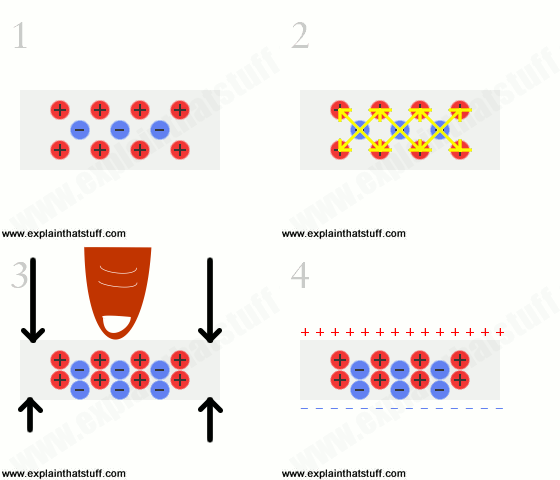
Here's a quick animation showing how piezoelectricity occurs. It's somewhat simplified, but it gives you the basic idea:
Normally, the charges in a piezoelectric crystal are exactly balanced, even if they're not symmetrically arranged.
The effects of the charges exactly cancel out, leaving no net charge on the crystal faces. (More specifically, the electric dipole moments—vector lines separating opposite charges—exactly cancel one another out.)
If you squeeze the crystal (massively exaggerated in this picture!), you force the charges out of balance.
Now the effects of the charges (their dipole moments) no longer cancel one another out and net positive and negative charges appear on opposite crystal faces. By squeezing the crystal, you've produced a voltage across its opposite faces—and that's piezoelectricity!
What is piezoelectricity used for?
Photo: A typical piezoelectric transducer. This one is the ringer inside my landline telephone: it makes a particularly shrill and horrible chirping noise when the phone rings!
There are all kinds of situations where we need to convert mechanical energy (pressure or
movement of some kind) into electrical signals or vice-versa. Often we can
do that with a piezoelectric transducer. A transducer is simply
a device that converts small amounts of energy from one kind into another (for example,
converting light, sound, or mechanical pressure into electrical signals).
In ultrasound equipment, a piezoelectric transducer converts electrical energy into extremely rapid mechanical vibrations—so fast, in fact, that it makes sounds,
but ones too high-pitched for our ears to hear. These ultrasound vibrations can be used for
scanning, cleaning, and all kinds of other things.
In a microphone, we need to convert
sound energy (waves of pressure traveling through
the air) into electrical energy—and that's something piezoelectric
crystals can help us with. Simply stick the vibrating part of the
microphone to a crystal and, as pressure waves from your voice
arrive, they'll make the crystal move back and forth, generating
corresponding electrical signals. The "needle" in a gramophone
(sometimes called a record player) works in the opposite way. As the
diamond-tipped needle rides along the spiral groove in your LP, it
bumps up and down. These vibrations push and pull on a lightweight
piezoelectric crystal, producing electrical signals that your stereo
then converts back into audible sounds.
Photo: Record-player stylus (photographed from underneath): If you're still playing LP records, you'll use a stylus like this to convert the mechanical bumps on the record into sounds you can hear. The stylus (silver horizontal bar) contains a tiny diamond crystal (the little dot on the end at the right) that bounces up and down in the record groove. The vibrations distort a piezoelectric crystal inside the yellow cartridge that produces electrical signals, which are amplified to make the sounds you can hear.
In a quartz clock or watch, the reverse-piezoelectric effect
is used to keep time very precisely. Electrical energy from a battery is fed into a crystal to
make it oscillate thousands of times a second. The watch then uses
an electronic circuit to turn that into slower, once-per-second beats
that a tiny motor and some precision
gears use to drive the second, minute, and hour hands around the clock-face.
Piezoelectricity is also used, much more crudely, in spark lighters for gas stoves and
barbecues. Press a lighter switch and you'll hear a clicking sound
and see sparks appear. What you're doing, when you press the switch,
is squeezing a piezoelectric crystal, generating a voltage, and
making a spark fly across a small gap.
If you've got an inkjet printer sitting on your desk, it's using precision "syringes" to squirt droplets of
ink onto the paper. Some inkjets squirt their syringes using electronically controlled piezoelectric crystals, which squeeze their "plungers" in and out; Canon Bubble Jets fire their ink by heating it instead. (You'll find more details of both methods in our article about inkjet printers.)
Photo: NASA has experimented with using piezoelectric materials to reduce the vibration and noise from rapidly spinning helicopter rotors. Photo courtesy of NASA.
You'll also find piezoelectricity playing a part in some types of strain gauges. If you want to detect whether something like an airplane wing is vibrating too much, strap a strip of piezoelectric material to it and you can measure how much it deforms from the current it generates as it bends.
If you can make a tiny bit of electricity by pressing one piezoelectric crystal once, could you make a significant amount by pressing many crystals over and over again? What if we buried crystals under city streets and pavements to capture energy as cars and people passed by? This idea, which is known as energy harvesting, has caught many people's interest. Inventors have proposed all kinds of ideas for storing energy with hidden piezoelectric devices, from shoes that convert your walking movements into heat to keep your feet warm, and cellphones that charge themselves from your body movements, to roads that power streetlights, contact lenses that capture energy when you blink, and even gadgets that make energy from the pressure of falling rain.
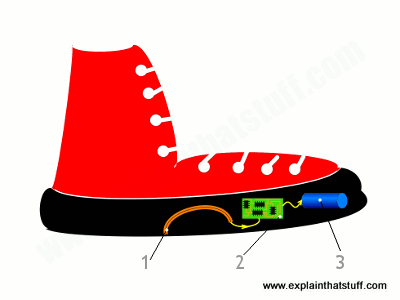
Artwork: Energy harvesting? Inventors have been filing lots of patents for wearable gadgets that will generate small amounts of electricity from your body movements. This example is a shoe with a built-in piezoelectric transducer (1) that springs up and down as you walk, sending electricity to a circuit (2) and then storing it in a battery (3).
Is energy harvesting a good idea? At first sight, anything that minimizes waste energy and improves efficiency sounds really sensible. If you could use the floor of a grocery store to capture energy from the feet of hurrying shoppers pushing their heavy carts, and use that to power the store's lights or its chiller cabinets, surely that must be a good thing? Sometimes energy harvesting can indeed provide a decent, if rather modest, amount of power.
The trouble is, however, that energy harvesting schemes can be a big distraction from better ideas. Consider, for example, the concept of building streets with piezoelectric "rumble strips" that soak up energy from passing traffic. Cars are extremely inefficient machines and only a small amount (15 percent or so) of the energy in their fuel powers you down the road. Only a fraction of this fraction is available for recovery from the road—and you wouldn't be able to recover all that fraction with 100 percent efficiency. So the amount of energy you could practically recover, and the efficiency gain you would make for the money you spent, would be minuscule. If you really want to save energy from cars, the sensible way to do it is to address the inefficiencies of car transportation much earlier in the process; for example, by designing engines that are more efficient, encouraging people to car share, swapping from
gasoline engines to
electric cars, and things of that sort.
That's not to say that energy harvesting has no place; it could be really useful for charging mobile devices using energy that would otherwise go to waste. Imagine a cellphone that charged itself automatically every time it jiggled around in your pocket, for example. Even so, when it comes to saving energy, we should always consider the bigger picture and make sure the time and money we invest is producing the best possible results.
Who discovered piezoelectricity?
The piezoelectric effect was discovered in 1880 by two French physicists, brothers
Pierre and Paul-Jacques Curie, in crystals of quartz, tourmaline, and
Rochelle salt (potassium sodium tartrate). They took the name from
the Greek work piezein, which means "to press."
Jacques summed up the observation in an 1889 paper in Annales de Chimie et de Physique
(my own very rough translation from the French):
"If one pulls or squeezes along the main axis [of a quartz block], there appears at the ends of this axis equal quantities of electricity of opposite signs, proportional to the acting force and independent of the dimensions of the quartz."
Chris Woodford is the author and editor of dozens of science and technology books for adults and children, including DK's worldwide bestselling Cool Stuff series and Atoms Under the Floorboards, which won the American Institute of Physics Science Writing award in 2016. You can hire him to write books, articles, scripts, corporate copy, and more via his website chriswoodford.com.
Better Ultrasound Imaging and Sonar Through Samarium by Charles Q. Choi. IEEE Spectrum, 18 April 2019. Samarium allows piezoelectric transducers to generate much more charge, potentially giving medical imaging equipment much higher resolution (showing more detail).
A Fitbit for the Stomach by Megan Scudellari. IEEE Spectrum, 11 October 2017. Researchers develop a piezoelectric stomach sensor.
Good Vibrations? California to Test Using Road Rumbles as a Power Source by Philip E. Ross. IEEE Spectrum, 19 April 2017. Could piezoelectric rumble-strips generate useful amounts of power? Given how much energy cars waste in converting fuel to motion, thinking about harvesting a tiny fraction of this energy could, itself, be a waste of (mental) energy.
Future Helicopters Get SMART: NASA, 25 February 2009. NASA scientists think piezoelectric blades could make helicopters quieter and more economical.
A step closer to self-powered kit: BBC News, 4 December, 2008. Describes how small, piezoelectric generators could be used to make a variety of self-powered gadgets.
Implant may help deaf hear music: BBC News, 19 October 2005. How piezoelectric materials are being used in new cochlear implants to improve deaf people's hearing.
More scientific and technical
From explanation to description: Molecular and phenomenological theories of piezoelectricity
by Shaul Katzir, Historical Studies in the Physical and Biological Sciences, Vol. 34, No. 1 (2003), pp. 69–94.
A history of how scientists have tried to explain piezoelectricity since it was originally discovered,
including a comparison of the theories put forward Jacques and Pierre Curie, Paul Czermack, Woldemar Voigt, Eduard Riecke, and Lord Kelvin.
Piezoelectric Materials: Applications in SHM, Energy Harvesting and Biomechanics by Suresh Bhalla, Sumedha Moharana, Naveet Kaur, and Visalakshi Talakokula. Wiley/Athena, 2017. An up-to-date introduction that connects theoretical aspects of piezoelectricity with practical applications in medicine and energy production.
Piezoelectric Ceramics: Principles and Applications: APC International, Ltd. 2011. A pithy (114-page) introduction to the principles of piezoelectricity and how it's used in different kinds of generators, sensors, actuators, and transducers.
Piezoelectricity: Evolution and Future of a Technology by Walter Heywang, Karl Lubitz, and Wolfram Wersing. Springer, 2008. What is piezoelectricity and how can we apply it in medicine, defense, and other important areas of society?
Patents
Inventors have been dreaming up all kinds of imaginative uses for piezoelectricity for years. Here are a few examples from the US Patent and Trademark Office database:
Please do NOT copy our articles onto blogs and other websites
Articles from this website are registered at the US Copyright Office. Copying or otherwise using registered works without permission, removing this or other copyright notices, and/or infringing related rights could make you liable to severe civil or criminal penalties.