No more candles, no more gas lamps—just imagine how amazing people
found the very first practical electric lamps toward the end of the 19th century.
Incandescent lamps (ones that make light by making heat) are getting
something of a bad press these days because they waste so much
energy, but they've long been
considered among the greatest inventions of all time and a burning-bright light
bulb is still widely used as the symbol of a great idea. Let's take a
look at these marvels of technology and find out how they work!
Photo: Thomas Edison was rightly proud of his contribution to lighting
up the world. This marble statue of a woman holding an electric light stood in his office.
Credit: Photographs in Carol M. Highsmith's America Project in the Carol M. Highsmith Archive, US Library of Congress, Prints and Photographs Division.
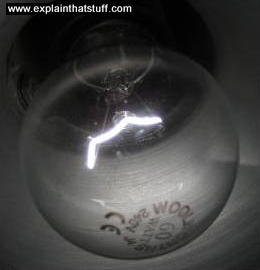
Photo: An incandescent lamp makes light by passing electricity through a very thin wire filament. The filament gets red or white hot and gives off light (as well as lots of heat). You can see the filament clearly as a bright white stripe in this short-exposure photograph.
Set fire to a big bunch of logs and you'll get a nice red glow as
well as a warm
feeling. People have known that hot things give off light ever since
the discovery of fire, somewhere between one and two million years
ago. But just why do hot things give off light?
When things burn, what's actually happening is a chemical reaction called
combustion in
which a fuel (such as the wood in the logs) reacts with oxygen in the
air to produce carbon dioxide gas, water (in the form of steam), and a
great deal of energy. Some of that energy is
heat, some is light,
and there's even a bit of sound energy produced too (in the crackling and
hissing of the logs). Hot things give off light when the atoms
they're made of gain energy and become excited. That makes them
unstable and, to become stable again, they give off the energy they
gained as particles of light called photons.
(Read more and see a diagram of this in our main article on light.)
Candles used to be our main way of making light from heat.
A candle is a mini-chemical factory that produces a continuous flame
by slowly
converting the energy stored in its oily wax into heat and light. A
basic law of physics called the conservation of energy tells us
exactly why candles always burn out eventually: all the energy we need
to make continuous candlelight has to come from the wax, which must slowly
burn away. Now just imagine if you could make a candle that never
burned out—one that never needed replacing. You'd need a
flame that never died and an endless supply of energy. And that's
pretty much what you have in an incandescent electric light.
Sponsored links
How incandescent lights work
Why do incandescent lamps glow when electricity flow through them?
Electricity flows better through some
materials than others. Metals that let
electricity flow easily are good conductors that have low electrical
resistance; plastics,
wood, and other insulators have a high
resistance. Some metals are better conductors than others:
silver is
better than gold, gold is better than copper, and copper is better
than aluminum. Not all conductors are metals, however.
Carbon is a good conductor and it has little in common with most metals.
Take a piece of a conducting material and you can make
electricity flow through it a little bit better by doing two things: first, by making
it shorter (the longer your conductor, the more work electricity has to do to
get through it); second, by making it thicker (the fatter the conductor, the
easier it is for the electric current to flow). Now suppose you could make
a conductor that's both short and thin and pass electricity
through it. Fashion it just right and it'll have
enough resistance to make the current work hard and not so much
that it stops the current completely.
Switch on the electric current and your conductor (which is
usually called a filament) will heat up. Use enough electricity
and the filament will heat up so much that it'll glow red or white hot
and give off light. That's the basic idea behind the incandescent electric light.
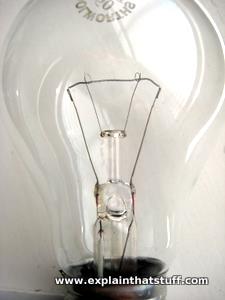
Photos: 1) A modern, electric incandescent lamp. The filament is a length of tightly coiled tungsten metal stretched between two terminals that let the current flow through it. 2) Zooming in closer, you can clearly see the coils in the filament in this shot.
The only trouble is that an incandescent lamp has to produce an
incredible amount of heat to make a decent amount of light. Roughly 95 percent of the
electricity you feed into a lamp like this is wasted as heat. That's
why people are now so keen on switching away from incandescent
technology to energy-saving
lamps (compact fluorescent lamps, also known as CFLs, or LEDs), which last several times longer and save roughly 80 percent of the energy (a typical incandescent lasts only about 1000 hours—from a few months to a year or two depending on how much you use it).
Photos: The filament inside a strip lamp runs almost the whole length of the tube. In a lamp like this, the electrical contacts are mounted in metal caps at the two ends.
Other features of filament lamps
The glowing filament is obviously the most important bit of a lamp like this—but by no means the
only interesting part.
The glass bulb itself isn't filled with air, as you might expect, but something that makes it hard for the filament to burn (such as nitrogen or argon), which greatly extends its life. In a lot of lamps, it's actually impossible to see the gas, the filament, or anything else, because the glass is completely frosted. That's to prevent glare, effectively by diffusing the pinpoint brightness of the filament over a much bigger area.
The fitting is another important feature. In some countries, screw-in (Edison screw, ES) bulbs are commonplace; elsewhere, bayonet fittings (with two prongs holding the bulb into the holder) are more popular.
Two of the best features of incandescent lamps stem directly from Edison's own design. First, because lamps like this contain little more than a filament, a glass bulb, and a metal base, they're
very cheap to manufacture and purchase. Second, the brightness of an incandescent lamp is directly related to the size of the electric current zipping through the filament. That means it's relatively simple
to make a range of bulbs of different brightness (such as 40W, 60W, 100W and so on), but also to make bulbs that can be dimmed.
Artwork: Reinventing the filament lamp. Unlike other electrical appliances, light bulbs often have no fuse inside them. If the filament burns out or breaks, it can produce a dangerous arc that causes the glass to explode. In the 1950s, Samuel Gray, John Fellows, and Robert Reed of Sylvania invented this bulb with a built-in fuse to get around the problem. As with a basic lamp, there's a filament (1, yellow) and electrical terminals (2, red) connecting it to the power supply. But in one of the terminals, there's also a simple fuse (3. blue) that will simply burn out if the current becomes too great, giving greater protection than an ordinary, unfused bulb. Artwork courtesy of US Patent and Trademark Office, from US Patent 2,859,381: Fuse for incandescent lamp.
Dimmable filament lamps
If you've ever watched a torch bulb dim like a mini-sunset as the battery runs to nothing, you'll know the basic idea of making a dimmable lamp. All you need to do is reduce the current through the lamp to make the filament
glow less brightly. The simplest form of dimmer switch uses a variable resistor (rheostat), but that essentially just wastes the energy you're not using as light by turning it into heat.
A better solution is to change the waveform of the electricity using something
like a thyristor (also called a silicon-controlled rectifier),
which tends to buzz and can cause electrical interference, or transistor, which, very crudely speaking, switches the power on and off very rapidly to dim your lamp without wasting so much energy.
Who invented the electric lamp?
Most people associate American Thomas Edison (1847–1931)
with the electric filament lamp, but he wasn't solely responsible for what was arguably one of the
greatest inventions of all time. Edison's electric lamp built on a number of
earlier inventions including the electric arc lamp, developed in the early 19th century, which worked by buzzing
high-voltage electricity between two carbon rods to make continuous
bright sparks of light. The trouble with arc lamps was that the
carbon rods quickly burned up in the air, so they had to be regularly
replaced. Imagine having to change your light bulbs after only a few days—or even hours!
Artwork: Thomas Edison's original 1880 electric lamp patent, courtesy of the US Patent and Trademark Office. I've colored and labeled it to show four of the key parts: 1) Glass bulb from
which the air has been removed; 2) Coiled filament; 3) Wires connected to filament; 4) Connections running outside bulb to electricity supply.
Edison's great contribution was to make a much longer-lasting and more practical lamp.
In his inventing laboratory at Menlo Park in New Jersey, he tested something like 6,000 different materials—including
red hair—before discovering that bamboo coated with carbon was the
best thing to use as a filament. He sealed his
filament inside a vacuum using a glass bulb
from which the air had been removed, figuring correctly that the lack of air would prevent
the filament from burning up too rapidly. Edison patented his
light in 1880, around the same time as a rival design
developed by an Englishman named Joseph Swan (1828–1914). After a
short dispute, the two men decided to work together and sold the
invention jointly from 1883 under the name of the Edison and Swan
United Electric Light Company.
Photo: Thomas Edison with one of his electricity generators.
Photo by H.C. White Co., courtesy of US Library of Congress.
In his own words
Here's Edison's own pithy description of his invention from his patent (number 223898 of January 27, 1880):
"The object of this invention is to produce electric lamps
giving light by incandescence, which lamps shall have high resistance, so as to allow of
the practical subdivision of the electric light.
The invention consists in a light-giving body of carbon wire or sheets coiled or arranged
in such a manner as to offer great resistance to the passage of the electric current,
and at the same time present but a slight surface from which radiation can take place.
The invention further consists in placing such burner of great resistance in a nearly
perfect vacuum to prevent oxidation and injury to the conductor by the atmosphere..."
Photo: We take electric light for granted in the 21st century, but it was a
jaw-dropping spectacle when it first became widely available. This 60m (200ft) tall Electric Tower at Luna Park, Coney Island, New York was made from 20,000 incandescent lamps and drew huge crowds in the early years of the 20th century. Detail from a 1903 photo by Detroit Publishing Co. courtesy of US Library of Congress.
How halogen lamps work
Photo: This car's headlamps are fitted with super-bright halogen bulbs.
Halogen lamps are similar to normal incandescent light bulbs— only hotter and brighter.
When electricity flows through the filament, the lamp gives off light
and gets hot in the usual way. In a normal incandescent lamp, the filament is made of tungsten metal
and surrounded by a nonreactive ("inert") gas such as argon.
The gas is there to make the filament last longer: if the filament
were surrounded by air, the oxygen in the air would make the filament burn up very
quickly. But even with a gas like argon, the tungsten filament still gradually
disintegrates over time, causing the bulb to blacken and grow dimmer
before it eventually "blows." This happens because tungsten is vaporized from
the filament and deposited on the inside of the glass,
In a halogen lamp, the bulb is filled with a noble gas such as krypton or xenon,
plus a tiny amount of a halogen gas such as iodine or bromine, which is at a higher temperature and
pressure than in a normal bulb. The halogen constantly regenerates the tungsten filament, effectively
"bouncing back" tungsten atoms to rebuild the filament when it starts to disintegrate.
This means the filament lasts much longer than it does in a normal
lamp. The temperature of a halogen lamp (typically 250–600°C or
480–1100°F) is plenty hot enough for cooking food, which is why
you'll find these things inside some ceramic cooktops (hobs).
They cook mostly by beaming infrared radiation
up into your pan, though since the cooktop gets hot, there's also some direct
heating by conduction as well.
Animation: How a tungsten halogen lamp works: 1) Tungsten atoms (yellow) vaporize from the filament and would normally deposit on the inside of the glass. 2) In a halogen bulb, halogen atoms (red) combine with the tungsten atoms, forming a tungsten halide gas (blue rectangles). 3) This halide moves around until it nears the high-temperature filament, when it splits apart. The tungsten atoms return to the filament and help to regenerate it; the halogens become available for trapping and "recycling" more tungsten atoms.
Read more
How halogen works: A more technical explanation from the Osram Sylvania lighting company gives you detailed facts and figures. [PDF file, archived via the Wayback Machine]
Edison's Electric Light: The Art of Invention by Robert Friedel, Paul Israel, and Bernard S. Finn. Johns Hopkins University Press, 2010. Explores the process of invention using Edison's light as the example. Draws on considerable material from Edison's notes and archives.
The Wizard of Menlo Park: How Thomas Alva Edison Invented the Modern World by Randall E. Stross. Crown Publishing Group, 2008. I enjoyed this alternative view of Edison's life; it's a kind of "reinvention" of the light-bulb pioneer, painting him as a much more flawed genius than the conventional biographies.
For younger readers
Thomas Edison by Kay Banham. Raintree, 2015. A 32-page biography for ages 8–10 with double-page spreads covering key inventions or periods in Edison's life.
DK Biographies: Thomas Edison by Jan Adkins. DK, 2009. A well-illustrated, curriculum linked, short biography for younger readers aged 9–12.
Inventing the Electric Light by Lisa Mullins. Crabtree Publishing Company, 2007. A simple account of the early years of electric light, including how the work of Edison and Swan built on earlier electricity research by figures such as Benjamin Franklin. Ages 8–10.
A Defense of the Incandescent Light Bulb by Leora Broydo Vestel. The New York Times, April 24, 2009. A lighting designer, concerned about the quality of light from CFLs, mounts a passionate defense of old bulb technology.
Kissing Edison's Light Bulb Goodbye by James Kanter. The New York Times, March 18, 2009. How greater environmental awareness made Edison's invention obsolete.
Edison Bulb Turns 100; Research Flourishes by Culver Picmes. The New York Times, February 6, 1979. An article from the Times archive celebrates a century of Edison incandescent light. It's interesting that the efficiency drawbacks don't merit a mention, even though the 1970s was the first properly eco-conscious decade.
Please do NOT copy our articles onto blogs and other websites
Articles from this website are registered at the US Copyright Office. Copying or otherwise using registered works without permission, removing this or other copyright notices, and/or infringing related rights could make you liable to severe civil or criminal penalties.