Humans can be pretty contrary at the best of times. When it's cold, we want to warm up; when it's hot, we want to cool down. That's because we're
warm-blooded creatures who need to keep our body temperatures more or
less constant, at around 37°C (98.6°F), just to survive. Vacuum
flasks are a bit like people in this respect: they like to keep things at steady temperatures.
If you put hot drinks in them, they keep them hot; if you put cold drinks in them, they
keep them cool. They're simple, neat, and effective—but how exactly
do they work?
Photo: A typical Thermos® vacuum flask. Vacuum flasks are widely known as
"Thermos" flasks for the German company, founded by Reinhold Burger, that commercialized the technology in 1904.
Before we can understand why flasks are so fantastic, we need to
understand a bit more about how heat travels.
Heat is a kind of energy that moves
around our world in three different ways called
conduction, convection, and radiation. If you touch something hot,
heat flows straight into your body because there's a direct
connection between you and the hot object. Heat conduction
happens only when things touch.
Convection, on
the other hand, can happen without the need for direct contact. If
you switch on a fan heater, it blows hot air through a grille into
your room. Hot air is less dense (lighter, effectively) than cold air
so it rises upwards. As hot air starts to climb up from a fan heater,
it has to push colder air out of its way. So the cooler air near the
ceiling of your room moves back toward the floor to get out of the
way. Pretty soon, there's a kind of invisible conveyor belt of
warming, rising air and cooling falling air and this gradually warms
up the room. When heat moves in this way, using a moving liquid or
gas to travel from one place to another, we call it convection.
Heating soup in a saucepan is another way of using convection.
Radiation is
slightly different again from conduction and convection. When objects
are hot, they give off light. That's why camp fires glow red, orange,
and yellow. This happens because the atoms
in hot objects become "excited" and unstable when they gain extra heat energy from the
fire. Since they're unstable, the atoms quickly return to their
normal state—and give off the energy they had as light. (Read more
about how and why this happens in our longer article about light.)
Sometimes we can see the light that atoms produce and sometimes not.
If the light they produce is just a bit too red for our eyes to see,
it's called infrared radiation
and, rather than seeing it, we feel it as heat.
You can feel the infrared given off by hot objects even if
you're not touching them (so there's no conduction) and there's no
air or liquid present to carry heat either (so there's no
convection). Radiation explains why we can feel heat "beaming" from
hot things nearby even when we're not touching them (conduction)
or being warmed by the hot air they're generating (convection).
You can read much more about heat energy in our main article on heat.
Sponsored links
Why your coffee goes cold
Suppose you've just made a hot pot of coffee. You'll be well aware that you need to drink
it quickly before it goes cold—but why does it go cold? Boiling
water has a temperature of 100°C (212°F), while room
temperature is more likely to be 15-20°C (60-70°F), depending on the
weather and
whether you have your heating on. Since the water in your drink is so
much hotter than the room, heat flows rapidly from the coffee pot
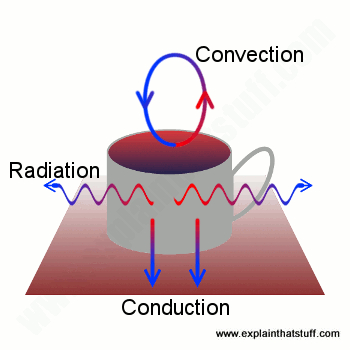
into the surroundings. Some heat will be lost by conduction: because
your coffee pot is standing on a table or worktop, heat will flow
directly downward and disappear that way. The air directly above and
all around the pot will be warmed by it and start moving around, so
more heat will be lost by convection. And some heat will also be lost
by radiation.
Artwork: Your coffee cools through a mixture of conduction, convection, and radiation.
Together, conduction, convection, and radiation will turn piping hot coffee into something
cold, miserable and yucky in less than an hour. If you want your
coffee to stay hot, you need to stop conduction, convection, and
radiation from happening. And you can do that by putting your coffee
into a vacuum flask.
How vacuum flasks work
A vacuum flask is a bit like a super-insulated jug. Most versions have an inner chamber and an outer
plastic or metal case separated by two layers of glass
with a vacuum in between. The glass is usually lined with a reflective metal layer.
Unbreakable flasks do away with the glass. Instead, they have two layers of stainless steel with a vacuum and a reflecting layer in between them. There's also a tight, screw-down stopper on the top.
Photo: With the stopper removed, you can clearly see the reflective glass inside this Thermos flask. Two more things to note as well: first, the neck is quite narrow (so helping to reduce heat losses) and the liquid-carrying capacity of the flask is much less than you'd expect from its overall size. That's because quite a lot of space is taken up by the insulating air gap between the inner container and the outer plastic wall.
These few, simple features
prevent virtually all heat transfer by either conduction,
convection, or radiation. The vacuum prevents conduction. The tight
stopper prevents air from entering or leaving the flask, so
convection isn't possible either. What about radiation? When infrared
radiation tries to leave the hot liquid, the reflective lining of the
inner chamber reflects it straight back in again. There's virtually
no way heat can escape from a vacuum flask and a hot drink stored
inside will stay steaming hot for several hours.
Flasks also work for cold drinks. If heat can't escape from a vacuum
flask, it follows that heat can't penetrate into a flask from outside either. The
sealed stopper stops heat getting in by convection; the vacuum stops
conduction, and the metal lining between the outer case and the inner chamber
stops heat radiating in either.
Whether you like your coffee piping hot or icy cold, vacuum flasks
are an absolutely brilliant way to keep your drinks just the way you want. Some heat still escapes
(or gets in) eventually, mostly through the stopper, but flasks like this are still a vast
improvement on virtually every other kind of insulated drinks container.
Inside a vacuum flask
Let's take a quick look at what's going on inside a flask:
Screw-on stopper.
Outer plastic or stainless steel case.
Outer layer of glass coated with reflective material (or stainless steel in unbreakable flasks).
Vacuum.
Inner layer of glass (or stainless steel in unbreakable flasks).
One or more supports keep inner vacuum container in place.
Additional insulation reduces heat losses and cushions flask against impacts.
Photo: Above: Here's what it looks like in reality. This is the inner vacuum container of our blue Thermos flask, coated with reflective metal, and it corresponds to items 3, 4, and 5 in the diagram up above. The neck of the container (where you pour drinks in and out) is facing to the right and the bottom support is on the left (item 6 in the diagram above).
Photo: Above: Here's the container mounted inside its outer, blue plastic case, looking up from the bottom (with the base of the flask unscrewed). In this flask, the inner vacuum container and the outer plastic container are separated by air (item 7). The black round thing at the top is a single plastic stand that separates the inner and outer containers (item 6).
Who invented the vacuum flask?
Scientists also use vacuum flasks, but they tend to call them Dewar flasks or Dewar bottles. That's because the idea was originally conceived in the early 1890s by a Scottish scientist named Sir James
Dewar (1842–1923). According to John Rowlinson's biography (see references below), Dewar used his flasks only for keeping laboratory chemicals cold, didn't anticipate the huge commercial market for
keeping drinks hot, and consequently never patented the idea.
(He did, in fact, patent part of his idea—removing air from a vessel to make a "high vacuum"—but not enough to protect the entire invention of the vacuum flask.)
Photo: In this photo, a NASA scientist is pouring very cold liquid nitrogen from a Dewar flask.
Photo by Tom Tschida courtesy of NASA.
“The double-walled glass vessels may be internally coated with silver, or a little mercury may be placed at the bottom of the space between the walls in order to secure better heat isolation.”
Thermos flasks were developed by Reinhold Berger and Albert Aschenbrenner, partners in the German glass-blowing company Burger and Aschenbrenner. Dewar had hired the Germans to make the flasks for his own laboratory experiments—and they quickly realized its commercial potential, applying for a German patent
(DE170057: Vessel with double walls enclosing an evacuated cavity) in 1903. In 1904, they formed the Thermos company to market their idea, which was effectively a commercial exploitation of James Dewar's original invention.
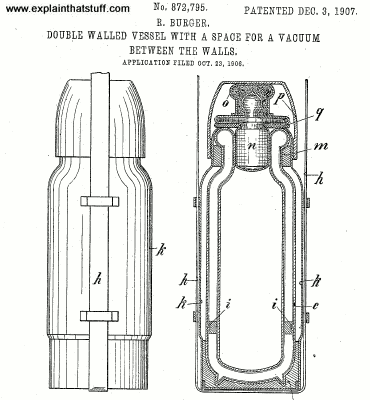
Here's one of the original US patents that Burger was granted in December 1907 (US Patent #872,795: Double-walled vessel with a space for a vacuum between the walls—which you'll probably recognize as a translation of the German patent's title). As you can see by comparing this diagram with my own illustration above, the basic idea has changed little: vacuum flasks still use a double-walled fluid container, with a vacuum between the walls, to stop heat loss.
Artwork: Reinhold Burger's Thermos vacuum flask patent, which was granted in 1907. Artwork courtesy of US Patent and Trademark Office.
How Does Heat Move by Alicia Klepeis, Cavendish Square, 2019. This is a fairly solid introduction to conduction, convection, radiation, and the basics of kinetic theory for ages 8–10.
Eyewitness Energy by Jack Challoner and Dan Green.
Dorling Kindersley (DK), 2016. This covers the history of how humans have harnessed energy and put it to amazing use. Best suited to ages 9–12.
Heat by Darlene Still.
Raintree, 2012. A solid introduction to the science of heat—what it is, how it travels, and how it changes things.
It includes a few basic activities, a glossary, and some suggestions for further reading. Ages 7–9.
For older readers
Sir James Dewar, 1842–1923: A Ruthless Chemist by John Rowlinson. Routledge/Ashgate, 2012. Contains a short account of Dewar's invention and how it was commercially exploited by Burger's Thermos company.
Modern problems spur changes at Thermos. The New York Times. October 22, 1984. An old (but nevertheless still interesting) article from the Times archive about the growing popularity of steel Thermos flasks and the dwindling demand for a product made obsolete by ubiquitous takeaway coffee shops.
Please do NOT copy our articles onto blogs and other websites
Articles from this website are registered at the US Copyright Office. Copying or otherwise using registered works without permission, removing this or other copyright notices, and/or infringing related rights could make you liable to severe civil or criminal penalties.