Next time you get a really big
electricity or gas bill, your
thoughts may turn to solar panels. Wouldn't it be good if you could
catch all the power you need from the Sun? Millions of people already
do get their energy this way, though mostly in the form of heat
rather than electricity. Solar electric panels (also called solar cells
or photovoltaic cells) that convert sunlight to electricity are
only just becoming really popular; solar thermal panels, which use sunlight to
produce hot water, have been commonplace for decades. Even in relatively cold,
northern climates, solar hot-water systems can chop
significant amounts off your fuel bills. Typical systems generate
anything from 10–90 percent of your hot water and pay for
themselves in about 10–15 years (even sooner if you're
using them for something like a swimming pool). Let's take a closer look at how they
work!
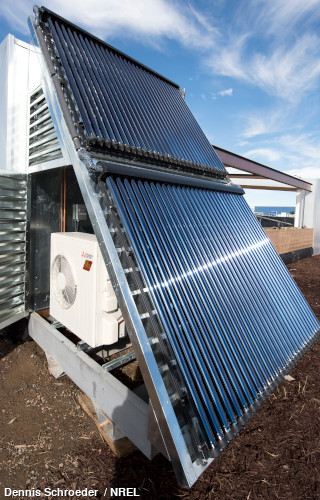
Photo: Making hot water for free (well, once you've paid for the equipment, anyway). This is a roof-mounted evacuated-tube type collector, described in more detail below.
Photo by Dennis Schroeder courtesy of US Department of Energy/National Renewable
Energy Laboratory (DOE/NREL) (image #68937).
Imagine you're an inventor charged with the problem of developing
a system that can heat all the hot water you need in your home.
You've probably noticed that water takes a long time to heat up?
That's because it holds heat energy very well.
We say it has a high specific heat capacity and that's why we use
it to transport heat energy in central heating systems. So can we devise a simple solar
heating system using water alone?
Stand a plastic bottle filled with cold water in a window, in the Sun, and
it'll warm up quite noticeably in a few hours. The trouble is, a
bottle of water isn't going to go very far if you've a house full of
people. How can you make more hot water? The simplest solution would be to
fill lots of bottles with water and stand them in a row on your window-ledge.
Or maybe you could be more cunning. What if you cut the top and
bottom off a plastic bottle and fitted pipes at each end, feeding the
pipes into your home's hot water tank to make a complete water
circuit. Now fit a pump somewhere in that loop so the water
endlessly circulates. What will happen is that the sunlight will
systematically heat all the hot water in your tank (although it'll
never get particularly warm because plastic bottles standing on
window-ledges aren't that brilliant at collecting heat). But, in
theory, you've got a working solar heating system here that's not a
million miles away from the ones people have installed on their
homes. It's very crude, but it works in exactly the same way.
Photo: The pipes that carry hot water to and from a roof-top, solar-thermal collector and into your house.
Tight rubber seals (collars) keep cold rain from entering too! Photo by Warren Gretz courtesy of US Department of Energy/National Renewable Energy Laboratory (DOE/NREL). NREL photo id#25991.
Sponsored links
The parts of a solar-thermal hot-water system
In practice, solar heating systems are a little bit more sophisticated than this. These are the main parts:
Collector
This is the technical name for the big black panel that sits on your roof. Smaller homes (or ones
in hotter climates) can get away with much smaller panels than larger
homes (or ones in colder climates); typically collectors vary in size
from about 2–15 square meters (~20–160 square feet). Not surprisingly, collectors work
most efficiently on roofs that have a direct, unblocked
view of the Sun (with few trees or buildings in the way). Broadly
speaking, there are two types of collectors known as flat-plate and
evacuated tube.
Flat-plate collectors
Flat plates are the simplest collectors: at their most basic,
they're little more than water pipes running through shallow metal
boxes coated with thick black glass. The glass collects and traps the
heat (like a greenhouse), which the water running through the pipes
picks up and transfers to your hot water tank.
Photo: A typical solar hot water panel uses a flat-plate collector like this. Photo by Warren Gretz, courtesy of US Department of Energy/National Renewable Energy Laboratory (DOE/NREL).
Evacuated tubes
These are a bit more sophisticated. They look like a row of
side-by-side fluorescent strip lights, except that they absorb light rather than giving it out.
Each tube in the row is actually made of two glass tubes, an inner one and an outer one, separated by an insulating vacuum
space (like vacuum flasks).
Photo: An evacuated-tube collector. Note the gray manifold at the top and the white water pipe flowing through it. Photo by Dennis Schroeder, courtesy of US Department of Energy/National Renewable Energy Laboratory (DOE/NREL).
How does it work? Briefly, we have a number of parallel, evacuated tubes (blue) that receive concentrated solar energy from parabolic reflectors either side (yellow), which they send to a combined heat-exchanger and manifold (brown), through which hot water (or some other fluid) flows from entry and exit pipes.
In a bit more detail: The inner tube is coated with a light-absorbing chemical and filled with a copper conductor and
a volatile fluid that heats up, evaporates, carries its heat up the inner tube to a collecting
device (called a manifold) at the top, where it condenses and returns to the bottom of the tube pick up more heat.
The manifold collects the heat from the whole row of tubes and ferries it to your hot water tank.
Unlike flat-plate collectors, evacuated tubes don't let as much heat escape back
out again, so they're more efficient. However, since
they're a bit more hi-tech and sophisticated, they are usually much more
expensive.
Artwork: A closer look at how an evacuated tube collector works. 1) The copper in the inner tube absorbs solar heat and evaporates the volatile fluid. 2) The evaporated fluid rises up the tube to the manifold at the top and gives up its heat. 3) Water flowing through the manifold picks up heat from all the tubes plugged into it. 4) The fluid condenses and falls back down the tube to repeat the process.
Hot water tank
There's no point in collecting heat from your roof if you have
nowhere to store it. With luck, your home already has a
hot-water tank (unless you have a so-called gas "combi" boiler
that makes instant hot water) that can be used to store heat from your collector; it's a kind of "hot water"
battery that you heat up at conveniently economic times (usually at
night) ready for use during the day. If you don't have a hot-water tank,
you'll need to have one fitted. The more people in your household, the
bigger the tank you'll need. A typical tank for a
family home might be about 100–200 liters (30–60 gallons).
Heat exchanger
Typically, solar panels work by transferring heat from the
collector to the tank through a separate circuit and a
heat exchanger.
Heat collected by the panel heats up water (or oil or
another fluid) that flows through a circuit of pipes into a copper
coil inside your hot-water tank. The heat is then passed into the hot
water tank, and the cooled water (or fluid) returns to the collector
to pick up more heat. The water in the collector never actually drains
into your tank: at no point does water that's been on your roof exit
through a faucet!
Photo: A different and much bigger solar hot-water system. This one uses parabolic mirrors to collect the Sun's energy
and focus it onto water pipes running through their centers. The water is pumped back to the building in the background
(Jefferson County Jail in Golden, Colorado). Photo by Warren Gretz courtesy of US Department of Energy/National Renewable Energy Laboratory (DOE/NREL).
Pump
Water doesn't flow between the collector and the tank all by
itself: you need a small electric pump to make it circulate.
If you're using ordinary electricity to make the water flow, the energy
consumed by the pump will offset
some of the advantage of using solar-thermal power, reduce the gains
you're making, and lengthen the payback time. Cleverly, some
solar-thermal systems use solar-electric (photovoltaic) pumps
instead, which means they are entirely running on renewable energy.
A good thing about a design like this is that the solar pump is most
active on really sunny days (when most hot water is being produced)
and less active on cold, dull days (when, perhaps, you don't want your
solar panel to be working at all).
Control system
If it's the middle of winter and your roof is freezing cold, the
last you thing you want is to transfer freezing cold water into your
hot water tank! So there is also generally a control system attached
to a solar-thermal panel with a valve that can switch off the
water circuit in cold weather. A typical control system may incorporate some or all of
the following: a pump, flowmeter, pressure gauge, thermometer
(so you can see how hot the water is), and thermostat (to switch off the pump if
the water gets too hot).
How solar-thermal panels work
In theory
Here's a simple summary of how rooftop solar hot-water panels work:
In the simplest panels, Sun heats water flowing in a circuit through the collector (the panel on your roof).
The water leaving the collector is hotter than the water entering it and carries its heat toward your hot water tank.
The water doesn't actually enter your tank and fill it up. Instead, it flows into a pipe on one side of the tank and out of another pipe on the other side, passing through a coil of copper pipes (the heat exchanger) inside the tank and giving up its heat on the way through.
You can run off hot water from the tank at any time without affecting the panel's operation. Since the panel won't make heat all the time, your tank will need another source of heating as well—usually either a gas boiler or an electric immersion heater.
The cold water from the heat exchanger returns to the panel to pick up more heat.
An electric pump (powered by your ordinary electricity supply or by a solar-electric (photovoltaic) cell on the roof keeps the water moving through the circuit between the collector and the water tank.
In practice
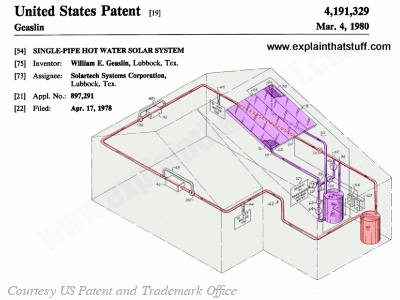
Of course, it's a bit more complicated than this! What if it's winter and there's no useful solar heat outside? You don't want the solar system pumping cold water down into your home, but you still need hot water. And what if it's really cold? You'll need to stop your solar system from freezing up, so it would be useful to pump hot water from your home through it occasionally. That's why a typical solar system will look more like this one, with two interlinked water circuits.
Artwork: A single-pipe solar heating system. Artwork from US Patent 4,191,329: Single-pipe hot water solar system by William E. Geaslin, Solartech Systems Corporation, published March 4, 1980, courtesy of US Patent and Trademark Office.
One (purple) pumps water through a solar panel as we saw above and down into a tank inside your home. This is connected to a second circuit (red) with a conventional hot water tank that can be heated by electricity, a natural gas furnace, or some other standard form of heating. On hot days, you effectively capture hot water in the purple circuit and then divert it around the red circuit into your home. On cold days, you can switch off the purple circuit using various valves or divert water from the red circuit through the purple circuit to stop it from freezing.
How good is solar thermal?
"... One of the most effective and efficient steps the government can take is to encourage the use of solar hot-water systems—a well-developed and relatively low-tech method for using the sun's energy."
Larry Hunter, The New York Times (Op Ed), 2009
In pure efficiency terms, solar-thermal panels are over three times as efficient (50 percent or so) at harvesting
energy as solar-electric (photovoltaic) panels (typically around 15 percent), but that doesn't mean they're
three times better: it all depends what you want from solar energy.
If you live in the kind of family home where people are taking baths and showers all the time,
especially in summer, solar thermal makes perfect sense.
A decent system should be able to produce around half to two thirds of a home's total, annual hot water needs
(all your hot water in the height of summer and very much less in winter).
The obvious drawback of solar thermal is that it produces nothing but hot water—and you can only do so much with that; unlike photovoltaics, solar-thermal panels can't help you heat your home or produce truly versatile, high-quality energy in the form of electricity.
The typical payback time for solar thermal (when your original capital investment has paid for itself in fuel savings) is
about a decade, with a range of 5–15 years (depending on the cost of the fuel you're saving, how much sun
your home gets, and how much hot water you use).
Here's a very rough comparison of the payback times for different types of green energy.
It does depend entirely on what you're installing, what you're replacing, what existing fuel you're not
using instead, how much you used the old and new systems, and various other factors (such as tax incentives),
so please don't take the figures too literally.
Solar thermal panels latest to be hit by UK subsidy cuts by Press Association. The Guardian. March 4, 2016. There's no more important time to invest in green energy, but cuts in government subsidies now make it a less attractive course of action.
Interest in Solar Water Heating Spreads Globally by Kate Galbraith. The New York Times, September 3, 2014. This article compares uptake of solar water heating around the world, from Cyprus (where 90 percent of homes have the technology) to China (where installation is less than a tenth the cost of a US system).
Solar heating 'can provide over half of households' hot water' by Adam Vaughan. The Guardian. October 13, 2011. A major study of solar hot water systems finds they're very effective in the UK, but don't save much money each year compared to the high initial cost of installation.
Experiments in District Heating by John Lorinc, The New York Times, March 3, 2009. How solar-thermal power can work at community scale.
Here Comes the Sun Shower by Larry Hunter. The New York Times. February 9, 2009. Why the US government should be encouraging greater uptake of solar hot water systems.
Concentrating solar thermal power by Hans Müller-Steinhagen. Philosophical Transactions: Mathematical, Physical and Engineering Sciences, Vol. 371, No. 1996, 13 August 2013, pp. 1–21. A detailed look at large-scale solar thermal power plants and the part they might play in our low-carbon future.
Solar Home Heating Basics: A Green Energy Guide by Dan Chiras. New Society, 2012. This book explores the various differnet kinds of solar energy we can tap into. Chapter 9 covers solar hot water heating systems in detail.
Solar: In this chapter from his book Sustainable Energy Without Hot Air, David MacKay runs the numbers and examines how much energy we can usefully make from solar thermal and photovoltaic panels.
Design of Solar Thermal Power Plants by Zhifeng Wang. Chemical Industry Press, 2019. Although this doesn't touch on domestic solar thermal, it's likely to be of interest if you want to explore how solar-thermal technologies can be deployed at much bigger scale.
Please do NOT copy our articles onto blogs and other websites
Articles from this website are registered at the US Copyright Office. Copying or otherwise using registered works without permission, removing this or other copyright notices, and/or infringing related rights could make you liable to severe civil or criminal penalties.
Woodford, Chris. (2009/2020) Solar hot-water systems. Retrieved from https://www.explainthatstuff.com/solar-hot-water-systems.html. [Accessed (Insert date here)]