When you wake up in the middle of the night, not sure where you
are, there's nothing more reassuring than the luminous dial of a
watch. You don't need to find a light: just glance at your wrist and
you know exactly what time it is. Watches like this glow all day
long—we just don't notice their ghostly shine in the daytime.
Luminescence is the scientific trick that makes them glow at night,
long after all the other sources of light are dim...
but what is it, and how exactly does it work?
Photo: Bioluminescence (an eerie blue glow produced by ocean creatures) in the East China Sea, witnessed from the side of a ship. Photo by Jordan Crouch courtesy of
US Navy.
Luminous simply means giving off light; most things in our
world produce light because they have energy that originally came
from the Sun, which is the biggest, most luminous thing we can see.
Strictly speaking, although the Moon appears to give off light, it's
not actually luminous because it's simply reflecting light from the
Sun like a giant mirror made of rock.
[1]
Luminous is quite a vague word really. Arguably, even a flashlight bulb is luminous, because it turns
electricity (electrical energy) into light and shines it toward us. But bulbs like
this are incandescent and make light by making heat. Luminescent
things, by contrast, make light when their atoms become excited in a process that needs little or no heat
to make it happen.
Photo: Luminous doesn't mean "glows in the dark": it means an object is giving off light it produces itself. Strictly speaking, that means the Sun (top) is luminous but the Moon (bottom) is not.
Pictures courtesy of NASA Goddard Space Flight Center (Sun) and NASA Jet Propulsion Laboratory (Moon), via NASA on the Commons.
What's the difference between luminescence, fluorescence, and phosphorescence?
Photo: This "luminous" watch dial is coated with phosphorescent paint so it glows in the dark. It's surprisingly hard to photograph (without cheating!) because it gives off very little light.
Fluorescent materials produce light instantly, when the atoms
inside them absorb energy and become "excited." When the atoms return
to normal, in just a few nanoseconds, they
give out the energy that excited them as tiny particles of light
called photons.
[2]
Shine ultraviolet (UV) light light on a stolen
TV or camera and you might find someone's address shining back at you, written in invisible ink. The ink is made of
fluorescent chemicals that absorb energy from the UV light, become
excited, and then give out the energy as photons of visible light.
Switch off the UV light and the ink disappears again. You can read
more about how atoms make light in the feature box in our article on
light.
When we talk about "luminous" watches and paint,
what we really mean is phosphorescence, which is
very similar to fluorescence: the process by which energy-saving
lamps make light.
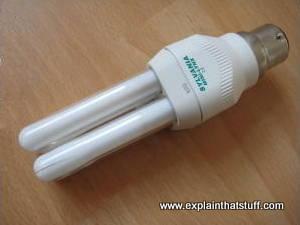
Photo: An energy-saving compact fluorescent lamp (CFL). The fluorescent chemical is a kind of chalky white coating on the inside of the thin glass tubes. You might have noticed that lamps like this continue glowing a little bit even after you switch them off? Like luminous watches, the phosphor chemicals are still excited enough to give off light for some time after they've been stimulated.
Phosphorescent materials work in much the same way as fluorescent
ones, except that there's a delay between them absorbing energy and
giving out light. Sometimes phosphorescence lasts for a few seconds
after the stimulating energy has been removed; sometimes—as in
luminous watches—it lasts for hours. You've probably noticed that it
takes a bit of time to "charge up" a luminous watch with energy
before it will glow in the dark. You might have also noticed that a luminous watch
shines most in the early part of the night. By the time dawn breaks,
it's typically run out of energy and stopped glowing.
That should come as no real surprise. A watch can't make
light out of nothing at all without violating one of
the most basic laws of physics—the
conservation of energy.
Sponsored links
What other types of luminescence are there?
Shine light on a luminous watch and it shines straight back at you. That's
an example of what we call photoluminescence: luminescence made by
light. But you can make things give off light by exciting their atoms
with many other kinds of energy. You give the atoms one kind
of energy (light, heat, sound, or whatever) and they give the same energy back
to you as light. Scientists almost have an entire A-Z
(well a B-T anyway!) of words to describe the different kinds of
luminescence:
Bioluminescence: made by living creatures such as
fireflies, glow-worms, and many marine creatures.
Chemoluminescence: made by a chemical reaction. Glow
sticks work this way.
Electroluminescence: made by passing electricity
through something like a gas.
Photoluminescence: made by shining light at
"luminous" (phosphorescent) paints.
Röntgenoluminescence: made by shining X-rays at
things. (The curious name comes from Wilhelm Röntgen (1845–1923), the discoverer of
X-rays.)
Sonoluminescence: made by passing energetic sound waves
through liquids.
Thermoluminescence: made when photons are emitted from
hot materials.
Triboluminescence: made by rubbing, scratching, or
physically deforming crystals.
Photo: A blue-green glow stick makes light using chemoluminescence. Photo by
Demetrius Kennon courtesy of US Navy.
Lights in the night
Fireflies and glow-worms
Fireflies and glow-worms (their larvae) are the best-known examples of bioluminescent
creatures. They use a complex reaction to make light from a
pair of chemicals called luciferin and luciferase stored in their
tails. Bioluminescence is a special kind of chemoluminescence that
happens inside living things.
Creatures of the deep
Squid, shrimp, sardines, plankton, starfish, and all kinds of
other marine creatures use bioluminescence for communication,
camouflage, or defense—flashing to attract mates or warn off
predators.
Photo: Bioluminescence in action. Left:
Corals and
crinoids bioluminescing in the North Atlantic.
Photo courtesy of Bioluminescence 2009 Expedition, NOAA/OER,
published on Flickr
under a Creative Commons Licence.
Right: A bioluminescent ctenophore.
Photo courtesy of NOAA Okeanos Explorer Program, Gulf of Mexico 2012 Expedition,
published on Flickr
under a Creative Commons Licence.
Sponsored links
What can we use luminescence for?
Photo: The ghostly glow of this oven timer is caused by phosphors that make green light when electrons strike them, briefly "charging" them with energy. It's an example of what's called
a vacuum fluorescent display.
"Luminous" (phosphorescent) paints,
energy-saving fluorescent
lamps, and fluorescent (high-visibility) jackets are obvious
examples. But there are many other ways we use luminescence too.
Old-style, cathode-ray television sets (and
oscilloscopes) make pictures by
firing electron guns at a screen coated with phosphors
(phosphorescent chemicals). Lasers make their powerful beams by a
process called stimulated emission, which happens when atoms are
forced to give off photons over and over again. UV lights are used to
produce phosphorescence in a variety of medical tests, in
archaeological research, and in forensic science to aid the detection
of crime.
Photo (below): Crack-testing: Machine parts are often inspected for potentially dangerous cracks using a technique called dye penetrant testing. Each part is dipped or sprayed with a fluorescent dye, which gets sucked into any tiny, hidden cracks and stays there, while the rest of the dye is washed off. The tester then inspects the dye in darkness with an ultraviolet lamp, which makes the remaining dye shine and show up, so revealing the cracks. Photo by Christopher Boitz courtesy of US Air Force.
Some uses of luminescence are even more surprising. Many
washing detergents contain ingredients known as optical
brighteners, which are actually phosphorescent chemicals. Sunlight contains a mixture of ordinary, visible light
(which our eyes can see) and ultraviolet light (which we can't see). When sunlight falls on recently washed clothes, atoms of the optical-brightener chemicals, left behind by the detergents, become excited and convert the sun's ultraviolet
light into ordinary light.
As a result, when you look at freshly washed white
clothes, you're supposed to see brighter, slightly bluer reflected light produced
by the optical brighteners.
The idea is that your clothes look cleaner and
brighter, which is why TV commercials used to talk about "bluey
whiteness" and featured smiling people holding their clothes up to a window (where there's more
UV-rich sunlight) to see it.
It's amazing some of the places where
you find science—even lurking in your laundry!
Photo: Safety stripe: old-style, fluorescent silver paint makes this black jacket show up at night in car headlights or, in this case, in the flash of my camera. This is the sort of low-tech, high-visibility that has been around for decades and its big drawback is that it dulls and loses its reflectiveness.
Newer high-visibility jackets and vests have retroflective fabric sewn directly into them.
It's made from materials such as 3M™ Scotchlite™, which uses tiny reflective beads to throw back more light. It's far brighter than old-style paint and lasts much longer.
The best intruder alarm in the world can't always keep thieves out
of your home and if your valuables get stolen they're often gone
for good. Even if the police catch the crooks and recover some of
their loot, how can they ever return it to its rightful owners? Who
knows which camera or TV belongs to which person? Science offers a
really easy solution! All you have to do is mark your property with
an invisible, fluorescent ink that shows up only in
ultraviolet light. When the police recover stolen property, they wave an ultraviolet lamp
over it, the markings (maybe your name or zip code) show up, and they
instantly find out to whom it belongs.
Now, if the ink is invisible and shows up only in invisible
ultraviolet light, how come you can see it when you shine one of
those special lights on it? As we've already seen, atoms make light when they absorb energy,
then emit (give out) the same energy a few moments later. What happens with invisible security ink is that the atoms absorb
ultraviolet light, but then give out a slightly
different, blueish light that our eyes can see. (This is like the
process that happens in the white outer coating of a
fluorescent lamp, which converts ultraviolet light made inside the tube into visible light that brightens up our homes.)
Photo: How invisible security inks and paints work, compared to normal inks and paints. 1) In ordinary
white light (colored yellow here so it shows up), normal inks show up because they absorb all light rays except those of their own color, which they reflect. So red ink looks red in white light. 2) In UV light, ordinary inks tend to turn black. 3) When white light (again colored yellow in this diagram) shines on invisible UV ink, the ink reflects the light as light our eyes can't see—so it remains invisible. 4) In UV light, the invisible ink reflects visible light—so it shows up red or another color.
Introduction to Fluorescence by David M. Jameson.
Taylor & Francis, 2014. An accessible but comprehensive introduction to the science and uses of fluorescence.
Luminescence: From Theory to Applications by C. R. Ronda (ed). Wiley-VCH, 2008. A collection of papers that begin with the light emission processes, before covering phosphors and their applications.
Phosphor Handbook by Phosphor Research Society. CRC Press, 2007. A comprehensive reference covering all aspects of phosphors and their uses.
More Mammals Are Hiding Their Secret Glow by Cara Giaimo, The New York Times, December 18, 2020. Is there a reason why certain animal species glow (fluoresce) in ultraviolet light?
The Mystery of a Scorpion's Glow by C. Claiborne Ray, The New York Times, December 4, 2017. Why does a scorpion glow in "black" (ultraviolet) light?
Photoluminescent Nanoparticles Kill Cancer by Dexter Johnson. IEEE Spectrum, April 17, 2014. Researchers discover how tiny particles of copper-cysteamine (Cu-Cy) can be stimulated with X rays to produce luminescence that will fight cancer cells.
Fluorescence Is Widespread in Fish, Study Finds by James Gorman. The New York Times. January 8, 2014. There are 180 species of fluorescent fish, according to scientists from the American Museum of Natural History.
The light fantastic: Harnessing Nature's glow by Paul Rincorn. BBC News, 24 January 2013. Describes some of the practical applications of bioluminescence, particularly in medicine.
Bioluminescence: lighting up the natural world: BBC Nature Features, 16 January 2013. A great overview of bioluminescence, including video footage and photos. [Archived via the Wayback Machine.]
Biological Luminescence
by William D. McElroy and Howard H. Seliger, Scientific American,Vol. 207, No. 6 (December 1962), pp. 76–91.
Activities
Jack-o'-luminescence
by Rick Broniec, The Science Teacher, Vol. 55, No. 7, October 1988, p.62. A classroom demonstration of
chemoluminescence using luminol.
↑ Back in the 1960s,
Professor Zdenêk Kopal argued that there's more to it than this.
Moonlight isn't entirely reflected sunlight: the moon does produce a tiny bit of its own light when it's
bombarded by solar wind. For a discussion see
The Luminescence of the Moon by Zdenêk Kopal, Scientific American, Vol. 212, No. 5 (May 1965), pp. 28–37.
↑ The time for which atoms remain excited varies, but "nanoseconds" is a decent estimate, according to
many sources.
Please do NOT copy our articles onto blogs and other websites
Articles from this website are registered at the US Copyright Office. Copying or otherwise using registered works without permission, removing this or other copyright notices, and/or infringing related rights could make you liable to severe civil or criminal penalties.