Fire gobbles its way through trees and buildings like a hungry
animal—and in a sense that's exactly what it is: a living, breathing animal.
Fire is a chemical reaction that feeds on fuel and oxygen. Give it plenty of both
and it'll keep on burning indefinitely. Thank goodness, then, for firefighters, those brave men and women who set
themselves the job of stopping fire in its tracks. Fire fighting is
one of the toughest jobs there is and it calls for some equally tough
equipment. Let's take a closer look at how to tackle those flames!
Photo: Firefighting—an extraordinary job for extraordinary people. Firefighters wear all-over aluminum suits to tackle the worst blazes; suits made of fireproof Nomex® and Kevlar® are used for less severe fires. Photo by Liam Kennedy courtesy of
US Navy.
Firefighting is a dangerous and demanding job that calls for total teamwork: it can take several people just to hold a powerful fire hose working at full pressure. Men and women make equally good firefighters, but most
fire departments have a list of entry requirements: in
New York City, for example, firefighters must be no younger than 21 at the
time of appointment and no older than 29 at the time they apply.
Firefighters have to pass strict medicals and physicals and also take written theory and computer tests. They're constantly trained in new firefighting techniques.
Firefighting is a stressful job with long periods of waiting. In big cities, firefighting is a full-time occupation;
firefighters are kept busy much of the time with all kinds of emergencies, from road accidents to chemical spills. In rural areas, where fires seldom happen and there's no need for full-time staff, people called "retained firefighters" combine occasional firefighting duties with other, full-time jobs. Typically they work only a few hours a week for training and equipment maintenance or when they receive emergency callouts.
Photo: Fire has a voracious appetite for oxygen and, when it burns materials such as plastics, it can give off highly toxic chemicals. That's why firefighters often have to wear breathing apparatus. It's worth remembering that firefighters often have to work in darkness and thick smoke, which makes their job even more difficult and dangerous. Photo by Dalton Swanbeck courtesy of US Navy and Wikimedia Commons.
Amazing vehicles
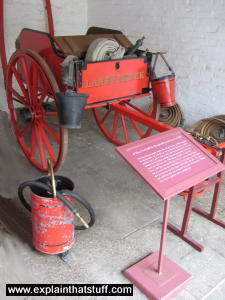
Photo: Fire trucks as they used to be. This is a horse-drawn fire cart dating from 1880. Note the primitive, bucket-style fire extinguisher pump on the left. It's currently an exhibit at
the National Trust's Lanhydrock country house in Cornwall, England.
What turns an ordinary man or woman into a firefighter? Apart from
heroic bravery and determination, it's the clothes they wear and the
equipment they use. Firefighters wear jackets made from synthetic
materials such as Nomex® and Kevlar®. They are fireproof,
insulate against heat, and resist many different chemicals. Helmets, made from carbon-based composite
materials, are hard-wearing and shockproof. A special mixture of glass
and plastic protects
visors against high temperatures.
Fire trucks
A fire truck (sometimes called a fire engine) has to carry firefighters and equipment to burning buildings. It also has to pump large volumes of water, sometimes over long distances, to extinguish the flames. Typical fire trucks carry about 1900–3800 liters (500–1000 US gallons) of water and draw bigger supplies from hydrants (like giant faucets positioned on streets—described more fully below) near the scene.
[1]
They also carry assorted portable extinguishers for tackling smaller or more unusual fires.
Photo: A modern Pierce fire truck. This one has a 3785 liter (1000 US gallon) water tank.
Photo by David R. Krigbaum courtesy of US Navy and DVIDS.
A fire truck is hooked up to hoses and controlled from its pump panel, a collection of controls and instruments usually mounted on the side of the vehicle (though sometimes on the rear or the top). You can see some examples below:
Photo: A closeup of the pump panel on the side of a typical fire truck. You can connect several different hoses at once and each one has separate controls. There are stopcocks (valves) to turn the water on and off and dials to tell you the water pressure.
The big silver Storz coupling (5) is where the engine hooks up to a fire hydrant (an on-street water supply).
I've numbered a few of the key parts:
1 Hoses; 2 Assorted tools; 3 Cord reel control; 4 Color-coded hose connectors;
5 Storz 125 connector to fire hydrant; 6 Drain control; 7 Foam selector;
8 Tank flush; 9 Water gauges; 10 Lights.
Photo by William Smith courtesy of US Army
and DVIDS.
Photo: A close-up view of an old-fashioned pump panel on another airport fire truck. Note the hose and foam connections ("Water discharge") at the bottom, the water gauges at the top, and the throttle over on the left. Modern trucks tend to have electronic gauges and controls. Photo by Brus E. Vidal courtesy of
US Air Force.
What's inside a fire truck?
Not just water! Here are a couple of photos of some of the equipment stashed inside a typical military fire truck.
Photo: A close up of the equipment carried on a fire truck, by Jeanette Copeland courtesy of RAF Mildenhall and Defense Imagery.
Large trucks carry up to 300 m (1000 ft) of hose.
Multiple hoses allow several firefighters to work at once. Hoses are often different colors to prevent confusion in the chaos of a major fire. After use, the hoses are hung up to dry from tall towers back at the station to stop them getting damaged.
Different hose nozzles can make hard jets, soft spray, or fine mist.
Axes, cutters, rams, and blades are stored in secure cabinets on the truck to help firefighters gain entry to buildings.
Tank of foam can be added to water to tackle chemical fires.
Shuttered doors conceal main pumping unit controls and more tools.
(Not shown) Several ladders carried on roof, each up to 40 ft (12 m) long.
Aluminum fire suit and breathing apparatus.
Chemical-proof rubber boots.
Toughened, flameproof glass and plastic helmet visor.
Ladder trucks
Firefighters often tackle a burning building with hoses and a "hook and ladder" truck (a fire truck equipped with huge onboard ladders and other rescue equipment). One way of using a truck like this is to spray water down from the top of the extended ladder. The "hose" is actually a sturdy pipe running up the inside of the ladder (inset). It can be operated safely by firefighters standing at the bottom, who pull on a cable or swivel the turntable ladder to direct the water. In this case, it's safer because the firefighters don't have to stand so near the flames and heat from the burning roof.
Photo: Operating a ladder truck. Photo by Holden S. Faul courtesy of US Air Force and DVIDS.
Photo: Detail of the ladder. Note how the "hose" and spray nozzle are built into the ladder. Photo by Christopher Gross courtesy of US Air Force and DVIDS.
Rescue Vehicles
Firefighters don't just put out fires. Most fire departments have dedicated rescue trucks designed for tackling automobile accidents, which carry hydraulic jacks and airbags for lifting overturned vehicles, a punch for breaking windscreens, and high-temperature gas torches that can cut people free from crashed cars. Another interesting tool is a steering-wheel cover to stop a car's airbag from inflating and injuring firefighters as they work.
Fire ambulances
Ambulances are like miniature hospitals inside, allowing paramedics
to give rapid treatment to casualties at the scene. Firefighters tackle
three quarters of all medical emergencies. Fire ambulances carry
equipment to deal with common fire injuries. Respirators help people
breathe normally after inhaling smoke, while defibrillators
are portable electric-shock machines that can often restart someone's heart
if it stops beating properly. Special bandages and
hydrocolloidal dressings provide treatment for burns. There are also masks, gloves, and
overalls to isolate people contaminated by chemical spills.
Sponsored links
Firefighting on the street
Fire engines can carry only so much water—plenty for a small house fire but nowhere near enough for
a large blaze that could be raging for hours or days. Time is critical when you're tackling a fire, and
firefighters don't have time to drive away and refill their engines. When it comes to bigger blazes,
they turn to street-side water supplies from fire hydrants and water tanks.
Fire hydrants
Photo: Fire hydrants are like faucets that stop up water supplies
under high pressure. That's why the water really sprays out when they're opened.
Photo by Stephen Schester courtesy of US Air Force.
A fire hydrant is really nothing more than a large outdoor faucet (or tap, as it's called
in some countries) designed to supply huge amounts of water to fire trucks, very quickly,
whenever and wherever fires break out. A typical hydrant has
up to four nozzles, one on each side, to which up to four sturdy fire-hoses can
be tightly screwed. To prevent tampering, the nozzles are held shut
by pentagonal (five-sided) nuts that can be opened only with a
special wrench. At the top, there is a similar nut and sometimes a
wheel directly beneath it. Turning the nut and the wheel unscrews a
valve inside the hydrant. This allows water to flow up from an
underground pipe and out through whichever nozzles have been opened.
Unlike an ordinary faucet, a fire hydrant is designed to operate either
completely on or completely off.
It can take an enormous amount of water, sprayed for several hours, to
put out a large urban fire—and time is always of the essence for
firefighters. Ordinary faucets could not possibly supply enough water
to do this job quickly enough: they are designed to supply small
amounts of water over short distances and at quite low pressures. In
this respect, fire hydrants are very different. Where a domestic faucet
can provide just enough water to power a garden hose around 2 cm
(0.75 inch) thick, a fire hydrant can fill a hose up to eight times
thicker. Even the most powerful domestic faucet can deliver only a few
gallons of water every minute. But a typical fire hydrant can supply
water up to a thousand times faster. The water from a fire hydrant is
at several times higher pressure than the water in your faucets at home:
it can come out of the hydrant at 80 psi or more (roughly six times
the pressure of the air we breathe).
Photo: Hooking up a fire hose to a hydrant. Note the wrench on top, which opens the water flow once the hose is in place. Photo by Jim Bentley courtesy of US Air National Guard and DVIDS.
Tanked up
Fire hydrants are the most visible part of our emergency water systems—but
they are not the only part. The water that supplies hydrants comes
from large tanks or reservoirs usually located on hilltops. Each of
these is designed to supply enough water to operate fire hydrants for
hours at a time. The tanks are connected to the hydrants by a system
of pipes laid out in a grid pattern. This means the water can travel
from any tank to any hydrant via several different routes, so a
hydrant will continue to work even if one of the pipes springs a
leak.
When a firefighter opens the valve on a hydrant, the force of
gravity makes water run downhill from the tank, through the grid of
pipes, to whichever hydrant nozzles are open. The higher the tank is
located, the more speed and pressure the water will build up, the
quicker it will be delivered—and the faster the fire will be put
out.
Parts of a fire hydrant
Photo: Six key parts of a fire hydrant. Photo by Perry Aston taken at Joint Base Andrews, Md, and published courtesy of US Air Force.
Fire hydrants are just fire hydrants, right? Wrong! Here are some of the little details
you might not have noticed:
Operating nut on top of hydrant turns main water valve on or off
Hose is attached to one of the four sides of the hydrant. A clapper valve just inside the hydrant stops water from flowing backwards. Water can flow out of the hydrant into the hose but not in the opposite
direction.
Raised metal body of hydrant ensures it operates at the same height as a fire truck's water inlet.
This helps to stop fire hoses from kinking.
Breakable bolts on base are designed to snap if a vehicle strikes the hydrant.
Safety chain stops nozzle caps from getting lost when hydrant is in
operation.
Outlet nozzles have screw threads inside to which fire hoses can be securely attached. Remember that the
water is at very high pressure and the hoses will come off if they're not screwed on tight!
The science of fighting fires
Understand the science behind a fire and you're halfway to putting it out.
Fire is a chemical reaction between oxygen (from the air) and fuel (something that will burn to release energy), but it doesn't happen all by itself: you need to add some energy (in the form of heat) to kick it off.
Break the fire triangle!
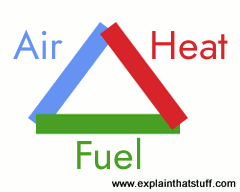
Artwork: Breaking the fire triangle: removing one or more of heat, air (oxygen), or fuel is the way to tackle most everyday fires.
Another way of looking at it is to say that most everyday fires need three things to be present: heat, oxygen, and fuel. As long as there's plenty of all three, a fire can go on burning indefinitely. But take away one of them
and the fire will go out. This idea is called breaking
the fire triangle and it's the basic theory of fighting most
fires. You can put out a fire by cooling it down (removing the heat),
cutting off the air supply (reducing the oxygen that can get to it), or getting rid of the fuel (the usual way
to do this is to remove combustible materials from near a fire and
stopping it from spreading with things like fire breaks).
The fire triangle at work
Here are some examples of how different fire fighting methods work by breaking one or more sides of the fire triangle:
Removing heat: Cold water takes a lot of energy to heat up. If you spray lots of water onto burning material, the water removes heat very effectively, breaking the fire triangle and putting out the fire.
Removing oxygen: If you cut off a fire's air supply, you can put it out very rapidly. Beating a forest fire with a brush works this way. So does spraying foam onto a gasoline or oil fire. If someone's clothes have caught fire, rolling them on the ground cuts off the air (and possibly removes heat), putting out the flames. Fire blankets (see below) also work by removing oxygen.
Removing fuel: When huge forest fires break out, one of the first things firefighters will do is create firebreaks: areas of ground that the fire cannot get past. They might spray water or foam on the ground or even burn it in a controlled way. If a car is burning in a parking lot, removing nearby cars stops the fire spreading the same way: you're effectively breaking the triangle by removing extra fuel (the other cars) from the flames.
Fire fighting at home
Photo: A basic fire blanket removed from its
protective plastic case and ready to use. Note the black tapes at the bottom that
you pull on to release it. Get one of these and hang it up in your kitchen, away
from the stove, where it's ready if you need it.
So far, we've been looking at how firefighters tackle big fires using things like giant fire trucks hooked up to hydrants.
Most big fires (especially most household fires) start out as little fires. If someone had tackled them straightaway, the minute they started, they might have saved a great deal of damage. Now most of the time, it's best to leave firefighting to the professionals. But there are times when it's okay to tackle small fires yourself, as long as you're certain that it's safe to do so.
If you're going to fight a fire, you need to learn how to do it correctly beforehand. Do it the wrong way and you could put yourself at great danger and make things worse.
How not to tackle a chip-pan fire
Before you can tackle a fire the right way, it helps to know how people often tackle it the wrong way.
Here's the golden rule. Never, ever throw water onto a hot oil (chip-pan) fire. What happens is
that the water will boil and turn to steam extremely quickly,
throwing a huge spray of burning oil droplets high into the air.
Because the oil is burning, spreading it out like this gives it rapid
access to much more oxygen—and this is what causes a fireball. If
you want to see how deadly this can be, watch this
public service fire safety video
on YouTube made by a British Fire Brigade. It shows you how to tackle a kitchen fire safely and calmly.
Never use a fire extinguisher on a chip-pan fire, for the same
reason. A water extinguisher will have the same effect as throwing on
water, a carbon dioxide extinguisher will blast and spread the hot
burning oil, and a powder extinguisher can cause an explosion. That's
why a fire blanket is generally the best thing to use.
What is a fire blanket?
Fire blankets are made from thick wool treated with a flameproof coating, fiberglass, or flameproof synthetic materials such as Nomex® and Kevlar®. They're not just for
chip-pan fires: you can use them to help tackle chemical fires wherever it's safe to do so. You
can also wrap them around someone whose clothes have caught fire, or
you can wrap them around your body to help you escape from flames.
Photo: You can clearly see the woven fiberglass in this blanket. It looks and feels a bit like a sturdy, flameproof tablecloth.
How does a fire blanket work?
If a fire breaks out in your home, generally the best thing to do
is get out as quickly as possible without panicking, close the doors
behind you, and call the fire service (fire brigade). It may be safe for you to
tackle a small fire yourself, in the early stages, with a fire extinguisher or a fire blanket,
but if you have any doubts at all, leave it and get yourself and others to safety:
you can replace anything except your own life.
If you have a hot oil (chip pan) fire in your kitchen, the most effective way to tackle it is to place a
fire blanket on top of it to cut off the oxygen supply.
This method breaks the fire triangle by removing air.
How to use a fire blanket
If you're not sure how to use a fire blanket, be sure to read the
instructions on the container when you buy one so you know how to do
it properly should the need ever arise. The basic idea is:
Turn off the heat if it's safe to do so.
Don't move the pan.
Go to the fire blanket. Pull on the tapes to release the blanket from its container.
Wrap the blanket around your hands before you go near the fire so you don't burn yourself in the process.
Put the blanket over the container to smother the flames.
Leave the pan to cool completely. If necessary, leave it a couple of hours to be on the safe side.
Now leave the fire alone, get out, and if necessary call the fire service (fire brigade). Do not go back to the fire and do not uncover it again
until it is completely cool.
If you have the slightest doubt about whether you can tackle a fire safely without risk to yourself or others, just leave it alone, alert any other people nearby, get yourselves well away, and call the fire service immediately.
And remember: if in doubt, just get out! Leave the fire and get yourself to safety.
Why doesn't a fire blanket burn?
Fire, as we saw up above, is a chemical reaction between a fuel and oxygen that's kick-started
by heat energy. Not everything burns when you apply heat. Apply heat to a block of ice and it doesn't
burst into flames: instead of a taking part in a chemical reaction, it undergoes a physical transformation:
it changes from its solid state (ice) to a liquid (water) or gas (steam).
Fireproof materials (such as those used in fire blankets) are chosen for the job because
they don't burn at the kinds of temperatures we see in everyday fires; apply
heat and they do eventually change form—but in other, safer ways. Take Nomex®, for example. It's a nylon-like plastic, based on carbon, that simply doesn't burn. Apply enough heat to it and you'll char it—reduce it mostly to carbon—but it doesn't actually burn in the same way as other carbon-rich materials (such as wood) and it doesn't melt or drip.
Always replace a fire blanket after you've used it on a fire because it's most likely coated or impregnated with oil, food, or other flammable materials. That means if you try to use it a second time, it could actually burn!
More ways to fight fires at home
Fire blankets are great for kitchen fires, but they're not always appropriate or effective for tackling other kinds of fire at home. If you have a home workshop, it makes sense to have one or more fire extinguishers. If you're often away from home, fire sprinklers can be a good investment. And every home should have at least one smoke detector to safeguard the people inside, particularly from fires that break out at night.
Fire facts and statistics
Charts: The USA has about the same number of fire deaths per 100,000 people as European countries, but far fewer than Russia and the Ukraine. Data source: CTIF World Fire Statistics 2022 No.27, by Nikolai Brushlinksy, Sergei Sokolov, Peter Wagner, Birgitte Messerschmidt, International Fire and Rescue Services, Center of Fire Statistics.
World fire statistics
United States
Annual fires: 1,388,500
Annual fire deaths: 3500
Annual fire deaths per 100,000 persons = 1.1
UK
Annual fires: 189,266
Annual fire deaths: 289
Annual fire deaths per 100,000 persons = 0.4
France
Annual fires: 282,800
Annual fire deaths: 249
Annual fire deaths per 100,000 persons = 0.4
Russia
Annual fires: 454,206
Annual fire deaths: 8,313
Annual fire deaths per 100,000 persons = 5.7
Source: CTIF World Fire Statistics 2022 No.27
by Nikolai Brushlinksy, Sergei Sokolov, Peter Wagner, Birgitte Messerschmidt, International Fire and Rescue Services, Center of Fire Statistics.
Charts: Incidents in people's homes are by far the most common cause of fires
in the United States. Drawn using data from: "Fire Loss in the United States During 2021" by Shelby Hall and Ben Evarts, National Fire Protection Association (NFPA) Research, September 2022.
Fire facts
First fire station: Rome, 24 BCE.
First US fire department: 1648.
First UK fire brigade: 1666.
Pressure of typical fire truck pump: 10 atmospheres (1034 kilopascals, 150 psi).
Temperature inside a burning building: 815°C (1500°F).
Fire blanket live demo: A clear guide to using a fire blanket, which shows how to hold the blanket so it protects your body. Unfortunately, the demonstrator makes the mistake of not turning the heat off first. First turn the heat off, second apply the blanket.
Fire blanket training: A longer (6.5 minute) but much more comprehensive training session with a fire blanket, where the instructor shares a number of useful tips and explains the right and wrong ways to use a blanket.
For younger viewers
Firefighting's Weird History and Fascinating Future: Did you know that yesterday's firefighters used their own beards to filter smoke from the air they breathed? These and other wonderful "then" and "now" comparisons from the National Fire Protection Association.
All about fire engines: Sparky the Fire Dog (from the
National Fire Protection Association) checks out what's onboard a fire engine.
↑ 2000 liters (~500 US gallons) is a typical figure.
E-One (a fire truck manufacturer) quotes 2000 liters (530 US gallons) for its electric Vector truck and
3785 liters (1000 US gallons) for its VM8 Rescue Pumper.
Please do NOT copy our articles onto blogs and other websites
Articles from this website are registered at the US Copyright Office. Copying or otherwise using registered works without permission, removing this or other copyright notices, and/or infringing related rights could make you liable to severe civil or criminal penalties.