Yum, what could be better than a
nice crisp piece of buttered toast first thing in the morning? If you don't like standing by the
stove watching and waiting for your bread to turn brown, an electric
toaster could be just the thing for you.
You probably know that a machine like
this turns the power of electricity into heat that can cook your bread
in a jiffy. But you do you know how the electricity that flows into the
toaster gets transformed into a totally different kind of
energy? Let's take a closer look inside.
Photo: An electric toaster takes in electrical energy from the power outlet and converts it into heat, very efficiently. If you want your toast to cook quickly, you need a toaster that radiates as much heat as possible each second onto your bread. For that to happen, according to the laws of physics, it needs to consume the maximum amount of electrical energy per second. In other words, it needs the highest power rating (wattage) you can find. A toaster with a higher watt rating will invariably cook more quickly than one with a lower rating.
Energy is a kind of magic, invisible
form of energy that lets you do things. Heat is one kind of energy and
electricity (generated by power plants
and stored inside things like batteries) is another. You can't make
toast by standing a slice of bread on top of a battery—and nor should
you try! But you can make toast with electricity if you use an electric
toaster. So what's the difference?
If you've ever looked down inside a toaster, you'll have noticed
rows of glowing red wires facing the bread. When electricity
flows through these wires, they get hot and then fire their heat toward
the bread like dozens of miniature radiators.
WARNING: You must never ever touch these wires (which
are called filaments or elements), either with your fingers or with any other object, because
they are dangerously hot and carry large electric currents that could
zap through your body, electrocute you, and kill you. If you need to remove
some bread stuck in a toaster, always unplug it first.
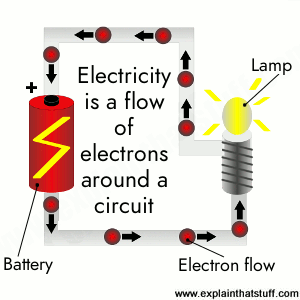
When electricity flows through a wire, energy is transmitted from
one end of the wire to another. The movement of energy is a bit like
water flowing down a pipe. The electrical energy is carried down the
wire by electrons, the tiny particles inside the atoms of metal that
make up the wire. As the electricity flows, the electrons jostle about
and collide with one another, and with the atoms in the metal wire,
giving off heat in the process. The thinner the wire, and the greater
the electric current, the more
collisions happen and the more heat is generated.
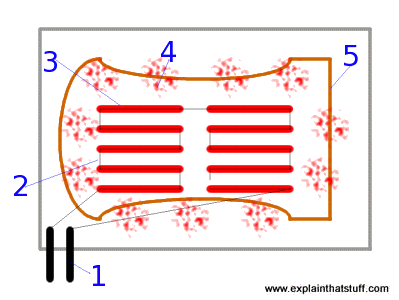
What happens inside a toaster?
Electrical energy flows into the toaster from a wire plugged into the domestic electricity supply.
The electric current flows through a series of thin filaments connected together but spaced widely enough apart to toast the whole
bread surface.
The filaments are so thin that they glow red hot when the electricity flows through them.
Like a series of small radiators, the filaments beam heat toward the bread in the toaster.
The steady supply of heat rapidly cooks the bread. There are filaments on each wall of the toaster so the two sides of the bread
cook at the same time.
Sponsored links
Heat and light
Heat is not the only thing that's produced when electricity flows
down a wire. If the wire is thin enough, and providing it's not covered
with plastic insulation, its temperature
may rise so much that it glows red hot. What's happening here? If the wire is glowing, it must be
giving off light. The atoms inside the metal wire are being heated up
by the electrons flowing through it. They're absorbing some energy as
heat, becoming unstable, and then giving off some of the energy as
light to try to become stable again. (See our article on light for more details of how atoms produce light.)
Old-fashioned electric lamps use this trick to produce their light. Inside
their large glass bulbs, they have a filament made from an incredibly
thin piece of coiled wire. When electricity flows through the filament,
it becomes extremely hot and produces both light and heat. Making light
by heating something up in this way is called incandescence.
Incandescent lamps waste most of the electrical energy they
consume. About 90 percent of the electricity in a light bulb like this
turns immediately into heat, which is incredibly wasteful.
That's why many people are now switching over to energy-efficient fluorescent
lightbulbs, which produce just as much light without producing heat.
In a toaster, the opposite is the case: we're obviously much more
interested in producing heat and the small amount of light produced by
the glowing filaments is wasted energy.
It's elementary
Toasters and incandescent electric lights are just two examples of
many household appliances that make heat when electricity flows through
them. Electric showers, coffee machines,
radiators, fan heaters, hair dryers, hair curlers, irons, tumble
dryers, washing machines, and
cookers work in a very similar way. (Microwave
ovens, however, work in a completely different way, using
electromagnetic radiation to zap heat into water molecules inside your
food.)
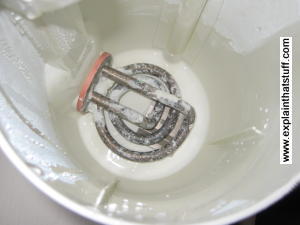
Appliances such as showers and kettles that heat up water with
electricity have to do it in a safe way to ensure they don't
electrocute you. Instead of using a thin bare wire (like the ones you
can see inside your toaster), they use a different kind of heating unit
called an element, which has the bare wires safely contained inside it.
The element is the shiny curved piece of metal you can see at the
bottom of an electric kettle. Don't ever attempt to
touch it because you'll burn or otherwise injure
yourself.
Photo: 1) The glowing elements inside a
toaster. 2) You can clearly see the coiled electrical element at the bottom of this kettle. As electricity flows
through the thick metal coil, electrons inside make the metal heat up
and that heat is rapidly passed onto the water inside the jug.
How do toasters know when to switch themselves off?
The first electric toasters didn't switch themselves off: they were completely manual.
You put a slice of bread in a pivoting metal toasting rack and closed it up so the rack stood
against a bank of heating elements. When you could see or smell that your toast was done, you opened the rack, lifted the bread out, and put it back in the other way to toast the other side. Automatic toasters were a later development.
Photo: Old-style toasting. A wartime photo from 1943 by John Vachon for the US Farm Security Administration/Office of War Information courtesy of US Library of Congress.
Your toaster most likely uses either a timer or a thermostat to switch itself off when your bread is done,
but some sophisticated models use electronic light-detector circuits based on photoelectric cells.
Timers
It's reasonable to assume that most people always use the same kind of bread, sliced in a similar way, so their toast will usually take about the same length of time to cook. A simple clockwork
or electronic timing circuit can be used to switch off the heating element after
a certain period has elapsed. With this kind of toaster, turning up the control simply extends the cooking time.
Thermostats
A thermostat is a mechanical, electrical, or electronic device that switches an electric circuit
on or off to keep something (perhaps the room where you're living or the ice compartment of a refrigerator) at
a fairly constant temperature. We can also use it to switch a toaster off when the bread is cooked. Suppose there is a bimetal-strip thermostat (two different metals welded together) fitted very close to a toaster's heating element. The thermostat will heat up as the bread cooks and the metals will expand by different amounts, so the thermostat will gradually bend into a curve. When the right temperature is reached, it will bend just enough to snap open and switch off the toaster's heating element. In this kind of toaster, turning up the control adjusts the distance by which the thermostat has to bend before it switches off the heater.
Artwork: A typical Hoover electric toaster from 1950 used an elaborate bimetallic thermostat as its timing mechanism. The bread sits in a carriage that clicks down from the light blue to the dark blue position.
A secondary heating element (orange, left) heats a bimetallic strip thermostat (red, left) as the bread toasts in the usual way. When the strip is hot enough, it clicks straight, activating an elaborate switching mechanism that turns off the heating elements and pops up the bread. Artwork from US Patent 2,502,655: Electric toaster by William Kitto, courtesy of US Patent
and Trademark Office.
Sponsored links
Photoelectric cells
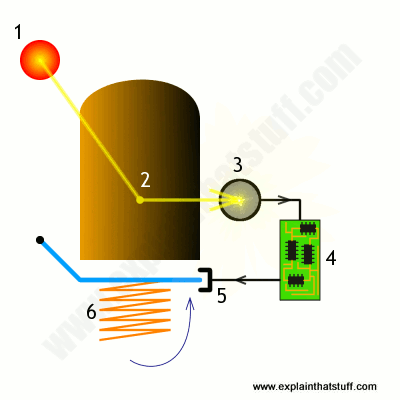
A photoelectric cell (or photocell) is an electronic component that generates electricity
according to how much light falls on it. Suppose you build your toaster with a miniature flashlight inside it, shining at an
angle towards the bread. As toast slowly cooks, the bread effectively turns from white to brown (hopefully not black), so
the light reflected off it should slowly decrease in intensity. Place a photocell nearby to measure the reflected light and, in theory, you have an accurate means of figuring out when your toast is cooked that's much more reliable than timers and thermostats.
Artwork: A photoelectric toaster uses heating/lighting elements (1) to do the cooking. Light reflected from the bread (2) is collected by a lens, prism, and photocell (3), and amplified by an electronic circuit (4) to produce an electric current that releases a catch (5), allowing a spring (6) to flip up the bread once it's done.
Sounds like science fiction? The oldest toaster I've found using this idea is described in
US Patent 2,631,523: Automatic electric toaster, granted in 1953 to Bror G Olving and the
McGraw Electric Company (though there might have been earlier ones);
you can see a more modern version of the same idea in
US Patent 6,730,888: Bread toasting control in a toaster by response curve of photosensitive element(s), granted in 2004 to Claude Battu and SEB SA.
Here's Olving's original diagram, which, you can see, is a slightly more elaborate version of mine (with 1950s-style electronics replacing my chip).
Artwork: Bror Olving's photoelectric toaster, as illustrated in US Patent 2,631,523: Automatic electric toaster. The heating elements are the four orange dots (27, 29, 31, 33). The yellow optical system comprises a
lens and prism-type light guide that throws radiation reflected from the bread (brown, center) onto the photoelectric cell (blue). Artwork courtesy of US Patent and Trademark Office.
Pop-up!
When timers and thermostats switch off a toaster, they generally also release a
spring that pops up the metal "cage" holding your toast. It's
much easier to get your toast out if it pops up. It's safer too because the
inside of the toaster is usually much too hot to be reaching into—and, as we've seen already, you don't
want to touch the filaments! The spring and the cage holding the toast are released
by a solenoid (a kind of electromagnet). You can see the
basic idea in the photo below:
Photo: The electromagnetic solenoid grips the toaster "cage" when you
first load your toast and push down the lever. When the toast is done, the solenoid cuts
the power to the toaster and also releases the cage so the large spring pops it up.
About the author
Chris Woodford is the author and editor of dozens of science and technology books for adults and children, including DK's worldwide bestselling Cool Stuff series and Atoms Under the Floorboards, which won the American Institute of Physics Science Writing award in 2016. You can hire him to write books, articles, scripts, corporate copy, and more via his website chriswoodford.com.
Troubleshooting and Repairing Major Appliances by Eric Kleinert. McGraw Hill, 2012. A good fix-it guide aimed at competent and confident electrical DIY enthusiasts. Although it doesn't cover toasters explicitly, there are sections about general electrical principles and common parts such as thermostats and solenoids that may be helpful and relevant.
The Toaster: A Module on Heat and Energy Transformations by Bruce B. Marsh and Carl R. Stannard, American Institute of Physics. McGraw Hill, 1975. An old but interesting booklet that covers how toasters convert electrical energy into heat. Also explains the thermostatic control system that switches a toaster off.
For younger readers
Toasters by Elaine Marie Alphin. Carolrhoda Books, 1998. A basic 48-page introduction to toasters, how they work, and who invented them.
Articles
How to Make a Perfect Piece of Toast by David Tanis, The New York Times, April 18, 2014. Good bread, perfect timing, and a toast rack are the secrets of this author's success.
The Self Buttering Toaster: Wired, May 18, 2009. There's a value in scientific experiments that push limits.
US Patent 2,621,583: Automatic pop-up toaster by Joseph N Victor, Lasko Metal Products, 1952. A pop-up toaster with a zig-zag of heating elements that uses an ingenious hydraulic mechanism to eject the cooked bread.
Please do NOT copy our articles onto blogs and other websites
Articles from this website are registered at the US Copyright Office. Copying or otherwise using registered works without permission, removing this or other copyright notices, and/or infringing related rights could make you liable to severe civil or criminal penalties.