Now here's a cool idea: a metal box
that helps your food last longer! Have you ever stopped to think how a
refrigerator keeps cool, calm, and collected even in the blistering
heat of summer? Food goes bad because bacteria breed inside it. But
bacteria grow less quickly at lower temperatures, so the cooler you can
keep food, the longer it will last. A refrigerator is a machine that keeps food cool with some very clever
science. All the time your refrigerator is humming away, liquids are turning
into gases, water is turning into ice, and your food is staying
deliciously fresh. Let's take a closer look at how a refrigerator works!
Photo: A typical domestic refrigerator or "fridge" keeps food at a temperature roughly
0–5°C (32–41°F). Freezers work in a similar way, but cool down to a much lower temperature,
typically −18 to −23°C (0 to −10°F). This model has an icebox (the light yellow box
at the top) that acts as a mini freezer, which should be at freezer temperatures rather than fridge ones.
Suppose your chore for today is to empty a stable full of rank
smelling horse manure. Not the nicest of jobs, so you'll want to do it
as quickly as possible. You won't be able to move it all at once,
because there's too much of it. To get the job done fast, you need to
move as much manure as you can in one go. The best thing to do is use a
wheelbarrow. Pile the manure up into the barrow, wheel the barrow
outside, and then empty the manure into a pile in the stable yard. With
a few of these trips, you can shift the manure from inside the stable
to outside.
Moving something you can see is easy. But now let's give you a
harder chore. Your new task is to move the heat from the inside of a
refrigerator to the outside to keep your food fresh. How can you move
something you can't see? You can't use a wheelbarrow this time. Not
only that, but you can't open the door to get at the heat inside, or
you'll let the heat straight back in again. Your mission is to remove
the heat, continually, without opening the door even once. Tricky
problem, eh? But it's not impossible—at least not if you understand the
science of liquids and gases.
Sponsored links
How to move heat with a gas
Let's step sideways a moment and look at how gases behave. If you've
ever pumped up the tires on a bicycle,
you'll know that a bicycle pump
soon gets quite warm. The reason is that gases heat up when you
compress (squeeze) them. To make the tire support
the weight of the bicycle and your body, you have to squeeze air into
it at a high pressure. Pumping makes the air
(and the pump it passes through) a little bit hotter. Why? As you
squeeze the air, you have to work quite hard with the pump. The
energy you use in pumping is converted into
potential energy in the compressed gas: the gas in the tire is at a higher
pressure and higher temperature than the cool air around you. If you
squeeze a gas into half the volume, the heat energy its molecules
contain fills only half as much space, so the temperature of the gas
rises (it gets hotter).
Artwork: Gases get hotter when you compress them into less volume, because you have to work to
push their energetic molecules closer together. For example, when you inflate a bicycle tire, the pump sucks in air and squeezes
it into less space. This forces its molecules (red blobs) together and makes it heat up.
Moving more heat by changing gases into liquids and back
If you have an inventive sort of mind, you can probably imagine cobbling together some sort of pump-like contraption that inflates a bike tire in one place and then deflates it another place, which would move heat between the two. It's a clumsy idea though, and we can't really move much heat like that: we'd need an awful lot of gas, for one thing. We could, however, move a decent amount of heat by letting a gas expand and contract much more so it converts into a liquid and back again—in other words by changing it into a different state of matter.
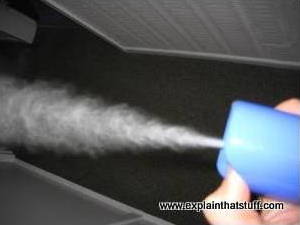
How would that work? Look what happens with an aerosol can, which contains a liquid stored under pressure. When you spray an aerosol onto your hand, you've probably noticed that it feels really cold.
That's partly because some of the liquid cools and vaporizes (turns to a gas) as it leaves the can. But it's also because some of the liquid hits your warm skin and vaporizes at that point: it turns into a gas by stealing heat from your body—and that makes your skin feel cooler. This tells us that allowing liquids to expand and turn into gases is a very effective way to remove heat from things. That's no big surprise: it's how sweating works—and why dogs stick their tongues out to cool down on hot days.
Photo: Liquids can turn to gases (and gases cool down) when you let them expand into more volume. That's why aerosol sprays feel so cold.
Although solids and liquids take up broadly the same amount of space, gases take up very much more room than either. The molecules in a solid or liquid are quite close together and attract one another with a great deal of force. When a liquid turns into a gas, or vaporizes, some of its more energetic molecules pull apart and break away. It takes a lot of energy to make this happen, which is known as the latent heat of vaporization, and that energy has to come from within the liquid itself or something nearby. In other words, changing a liquid into a gas is a way to remove the energy from something, while changing a gas back into a liquid is a way to release that energy again. This is essentially how refrigerators move heat from their cooling cabinet to the room outside. They turn a liquid into a gas inside the cooling cabinet (to pick up heat from the stored food), pump it outside the cabinet, and change it back into a liquid again (to release the heat on the outside).
Animation: The basic idea of what's sometimes called mechanical refrigeration. Inside a refrigerator (1), we change a liquid into a gas to pick up heat from inside the cooling cabinet (2), pump it outside the machine, and then change it back into a liquid to release its heat there (3).
The heating and cooling cycle
By compressing gases into liquids, we can release heat; by letting liquids expand into gases,
we can soak up heat. How can we use this handy bit of physics to shift
heat from the inside of a refrigerator to the outside? Suppose we made a pipe that was
partly inside a refrigerator and partly outside it, and sealed so it
was a continuous loop. And suppose we filled the pipe with a carefully
chosen chemical (one with a low boiling point) that easily changed back and forth
between liquid and gas, which is known as the coolant or refrigerant.
Inside the refrigerator, we could make the pipe suddenly get wider, so
the liquid coolant would expand into a gas and cool the chiller cabinet
as it flowed through it. Outside the refrigerator, we could have something like a bicycle pump to compress
the gas, release its heat, and turn it back into a liquid. If the chemical flowed round and round the
loop, expanding when it was inside the refrigerator and compressing
when it was outside, it would constantly pick up heat from the inside
and carry it to the outside like a heat conveyor belt. In this way, we
could constantly move heat from a cold place (inside the refrigerator)
to a hotter one (outside it), which is not something that the laws of physics allow to happen automatically
(left to its own devices, heat flows from hotter things to colder ones).
And, surprise surprise, this is almost exactly how a refrigerator
works. There are some extra details worth noting. Inside the
refrigerator, the pipe expands through a nozzle known as an
expansion valve (more technically, it's what's called a fixed orifice). As the liquid coolant passes through it, it
cools dramatically and turns partly into a gas. This bit of science is sometimes known as the
Joule-Thomson (or Joule-Kelvin) effect for the physicists who
discovered it, James Prescott Joule (1818–1889) and William Thomson
(Lord Kelvin, 1824–1907). You won't be surprised to discover that the
compressor outside the refrigerator is not really
a bicycle pump! It's actually an electrically powered pump. It's the
thing that makes a refrigerator hum every so often. The compressor is
attached to a grill-like device called a condenser
(a kind of thin radiator behind the refrigerator) that expels the
unwanted heat.
Photo: Humid air inside your fridge contains
water vapor. When the refrigerator cools, this water turns to ice. The
coldest part of your fridge is the icebox at the top. That's because
the expansion valve is placed right next to it.
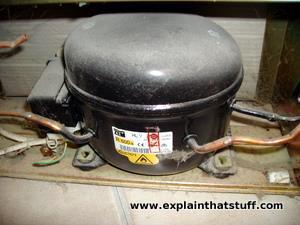
Photo: Here's the compressor from a typical refrigerator. Note the pipes carrying the coolant in one side and out the other. You can't see this unit unless you pull your appliance away
from the wall, because it's tucked away around the back and at the bottom. See more photos
of it in the box below.
How a refrigerator works
Artwork: The key parts of a refrigerator and the sequence of how they work.
Here's what's happening inside your refrigerator as we speak! The left-hand side of the picture shows
what's happening inside the chiller cabinet (where you keep your food).
The dotted line and pink area show the back wall and insulation
separating the inside from the outside.
The right-hand side of the picture shows what's going around the back of the fridge,
out of sight.
The coolant is a pressurized liquid as it enters the expansion valve (yellow). As it
passes through, the sudden drop in pressure makes it expand, cool, and
turn partly into a gas (just like a liquid aerosol turns into a cool gas when
you spray it out of a can onto your hand).
As the coolant flows around the chiller cabinet (usually around a
pipe buried in the back wall), it boils and turns completely into a gas,
and so absorbs and removes heat from the food inside.
The compressor squeezes the coolant, raising its temperature and
pressure. It's now a hot, high-pressure gas.
The coolant flows through thin radiator pipes on the back of the fridge,
giving out its heat and cooling back into a liquid as it does so.
The coolant flows back through the insulated cabinet to the expansion valve and the cycle
repeats itself. So heat is constantly picked up from inside the refrigerator
and put down again outside it.
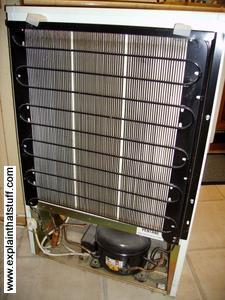
Photo: This is what a refrigerator looks like in reality when you take a peek around the back. You can see the large black compressor at the bottom (which is numbered 3 in the diagram above) and the thin pipe the coolant flows through at the back to disperse heat. It's a very good idea to pull the thing away from the wall every few months and vacuum all the dust away, so the cooling and heat dispersing process works more efficiently.
Photo: Here's a closeup. The coolant flows through the thicker, rounded, horizontal black pipe (which corresponds to the red lines, numbered 4 in our diagram above). The many thin wires that run between the pipes are simple radiator fins that help to carry the heat away from the pipes and dissipate it into the air.
Why does cooling take time?
Like everything else in our universe, refrigerators have to obey a fundamental law of physics called the
conservation of energy. The gist is that you can't create
energy out of nothing or make energy vanish into thin air: you can only ever convert energy into other forms.
This has some very important implications for fridge users.
First, it busts the myth that you can cool your kitchen by leaving the refrigerator door open. Not true!
As we've just seen, a refrigerator works by "sucking up" heat from the chiller cabinet with a cooling fluid,
then pumping the fluid outside the cabinet, where it releases its heat. So if you remove a certain quantity of heat from inside your fridge, in theory, exactly the same amount reappears as heat around the back (in practice, you get slightly more heat given off because the motor is not perfectly efficient and it's also giving off heat). Leave the door open and you're simply moving heat energy from one part of your kitchen to the other.
The law of conservation of energy also explains why it takes so long to cool or freeze food in a refrigerator or a freezer. Food contains a lot of water, which is made from very lightweight molecules (hydrogen and oxygen are two of the lightest atoms). Even a small amount of water-based liquid (or food) contains a huge number of molecules, each of which takes energy to heat up or cool down. That's why it takes a couple of minutes to boil even a cup or two of water: there are far more molecules to heat than if you were trying to boil something like a cup of molten iron or lead metal. The same applies to cooling: it takes energy and time to remove heat from watery liquids like fruit juice or food. That's why freezing or cooling food takes so long. It's not that your fridge or freezer is inefficient: it's simply that you need to add or remove large amounts of energy to make watery things change their temperature by more than a few degrees.
Let's try to put some rough figures to all this. The amount of energy it takes to change water's temperature is called its specific heat capacity, and it's 4200 joules per kilogram per degree celsius. It means you need to use 4200 joules of energy to heat or cool a kilogram of water by a single degree (or 8400 joules for two kilograms). So if you want to freeze a liter bottle of water (weighing 1kg) from a room temperature of 20°C to a freezer-like −20°C, you'll need 4200 × 1kg × 40°C, or 168,000 joules. If your refrigerator's freezing compartment can remove heat at a power of 100 watts (100 joules per second), that will take 1680 seconds or about half an hour.
You can see that lots of energy is needed to cool watery foods. And that, in turn, explains why refrigerators use
so much electricity. According to the US Energy Information Administration, fridges use about 7 percent of all domestic electricity (roughly the same as TVs and related appliances, and less than half as much as air conditioning, which uses a whopping 17 percent).
Chart: Home electricity consumption by end use: Refrigerators use 7 percent of domestic electricity—much less than air conditioners or heating systems. Main home refrigerators use about 77 percent of total refrigeration electricity, second fridges use another 18 percent, and further units account for the rest. Source: US Energy Information Administration, 2018.
Trashing the Fridge by Steven Kurutz. The New York Times, February 4, 2009. Can you really manage without a refrigerator? How some environmentalists have managed to live without one.
Refrigeration: A History by Carroll Gantz. McFarland & Company, 2015. A whistle-stop tour through the technological history and social impact of the fridge.
Chilled by Tom Jackson. Bloomsbury, 2015. A history of scientific cooling—and modern refrigerators.
Refrigeration & Air Conditioning Technology by William C. Whitman, William M. Johnson, and John Tomczyk. Cengage, 2004. A huge and very comprehensive study guide for professionals, covering both domestic and commercial appliances.
Patents
Artwork: Albert Einstein and Leo Szilard developed a revolutionary refrigerator in 1927,
for which they earned a patent in 1930. It used no electricity, but worked by circulating ammonia, water, and butane instead.
Artwork from US Patent US1,781,541: Refrigeration
courtesy of US Patent and Trademark Office.
Patents (formal, legal invention records) are a great way to go into much more detail about technical devices like this.
Here are a few older examples to fill in your knowledge. If you'd like to dig even deeper, the many patents filed by Kelvinator and Frigidaire in the 1920s and 1930s are a good place to start.
Patent Elevating Refrigerator by J.M. Blaisdell, July 21, 1874. A non-electric icebox with the somewhat unusual ability to raise itself up from your basement to the main floor of your home; it was made by Blaisdell and Burley of Sanbornton, New Hampshire, USA. I've not been able to find a record of it on the USPTO database, unfortunately, so the link will take you to a museum picture and record instead.
US Patent US1,781,541: Refrigeration by Albert Einstein and Leo Szilard. One of Einstein's lesser-known brilliant ideas was this clever refrigerator that uses no electricity.
Please do NOT copy our articles onto blogs and other websites
Articles from this website are registered at the US Copyright Office. Copying or otherwise using registered works without permission, removing this or other copyright notices, and/or infringing related rights could make you liable to severe civil or criminal penalties.