Are you a shower person or a bath person? Do you like to feel
pulsing jets of water blasting your dirty skin clean? Or do you
prefer to laze luxuriously in the tub until the water turns cold? If
you wash for less than five minutes and your shower has a modern,
low-flow head, you'll save over 50 gallons of water and a huge amount
of energy compared to taking a full bath. Saving hot water with a
shower helps to cut your energy bills and it's a simple thing you can
do to fight global warming.
Sounds good? Let's take a closer look at how showers work!
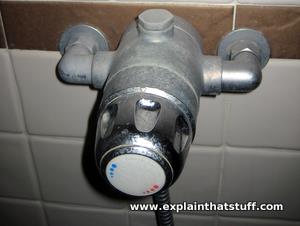
Photo: A simple Mira electric shower. There are two controls for adjusting the temperature.
The upper dial sets the temperature broadly as high, medium, or low. Once you've set the temperature roughly,
the lower dial lets you fine tune to get the water exactly as hot as you want it.
The simplest showers are called mixer showers and, as their name
suggests, they work by mixing hot and cold water from separate pipes
to make warm water whose temperature is somewhere in between. The
most basic form of mixer shower is a Y-shaped rubber pipe that you
fit over the hot and water faucets (taps) on a bath-tub. By adjusting the
faucets, you create a single stream of water at exactly the
temperature you want.
The trouble with mixer showers like this is that the temperature
is hard to control. If someone switches on a cold faucet or flushes a
toilet elsewhere in your home, the cold water supply is suddenly
reduced. That means there's proportionally more hot water coming
through your shower and, if the water's too hot, you could be
scalded. The opposite will happen if someone switches on a hot
faucet—you'll suddenly find the shower turning freezing cold!
Mixer showers that are plumbed into the wall overcome this problem
by using built-in thermostats. They constantly
adjust the temperature of the mixed water to ensure you're not boiled
like a lobster or frozen like a penguin by water that's alternately too hot or
too cold. Most mixer showers also have safety cut-outs that prevent
you from turning the water up to dangerously high levels, which is
good news if they're being used by frail elderly people or young children.
But there's still a basic problem with mixer showers: they typically run off hot water
from a tank. Once the tank is empty, there's no more hot water and you have to wait
for the tank to fill up before you can shower again.
Photo: 1) A typical, thermostatically controlled mixer shower. Hot water and cold water flow in through the
two pipes in the wall (top), mix in the valve unit in the center, and flow out through the curly
hose at the base, which connects to the shower head. This is a really simple shower: you just turn the knob to switch
the water on cold, then keep turning it clockwise to make the water as hot as you wish.
Photo: 2) Take it apart, however, and it's a bit more complex! The magic component is that little black cylinder in the middle, which is a wax thermostat. It contains a sealed capsule of wax that expands or contracts, opening and closing the hot water valve and so keeping the overall temperature of the mixed water constant.
Sponsored links
How does an electric shower work?
Electric showers overcome this problem by heating cold water with electricity.
They never run out of hot water, so they're a great solution if you have lots of people in your house
who like to shower one after another.
Electric showers work in much the same way as other electric
appliances that get hot, including electric toasters and hair dryers. They
send an electric current through a piece of metal called a heating element.
This has a moderate resistance, so it gets really hot when
electricity moves through it. Cold water flows past the element, picking up heat and heading out through
the nozzle where you're standing.
Artwork: The basic concept of an electric shower: cold water enters the pipe at the left,
flows past the coiled heating element (red) in the center, and leaves as hot water on the right.
You probably know that water and electricity are usually a very
dangerous combination, but electric showers are perfectly safe if they're properly fitted.
That's because a heating element is a completely sealed unit. The
electric current flows through the element, but not in such a way
that it can give you a shock. No electricity comes into contact with
the water that touches you.
Thermostatic control
You can adjust the temperature of an electric shower by turning a
dial, which is usually marked with a scale running from blue (for
cold) to red (for hot). In basic electric showers, this dial
simply adjusts the flow so more or less water streams past the heating element, making
the water that comes out of the shower head colder or hotter.
In better showers, pressure-balancing valves, a built-in water mixing tank (which helps
to avoid sudden changes in temperature when you turn the dial), and
various thermostats and flow sensors keep the temperature and water pressure as
safe and steady as possible. That's a tall order, because the water feeding into an electric shower is much more variable
in temperature and pressure than you might think. In wintertime, the incoming temperature might drop as low
as a few degrees Celsius, while in summertime it's very likely to be ten degrees hotter. It's a real challenge for
a shower to maintain a decent water flow rate and a constant water temperature all year round.
(That, incidentally, explains why, even if you never change the temperature control of your shower, the water that
comes out of the hose might feel hotter or colder than it was last time you showered.)
Photo: If you want to save money on your shower, make friends with the thermostat—and turn it down a degree or two.
Power showers
For an electric shower to work effectively, you need a cold water
supply with reasonably high water pressure to begin with, because the
shower heating unit will reduce the pressure of the water as it flows
through, and the relatively high level of the hose and shower head
will reduce it even more. If you don't have enough water pressure for an ordinary
electric shower, the solution is to fit a power shower. It takes in
and heats cold water just like an ordinary electric shower, but it
also uses an electric pump to increase the water pressure so it
leaves the nozzle with greater force and higher speed. If saving
water and energy is important, bear in mind that power showers use
3-5 times more than ordinary showers. That means a lengthy power
shower can easily cost you as much as a generous bath-tub full of hot
water!
How an electric shower works: in a nutshell
A typical electric shower is like a more sophisticated version of a mixer shower,
where hot water is heated instantaneously by a heating element but still mixed with
cold water to get the final water temperature you prefer. How does it work? Like this!
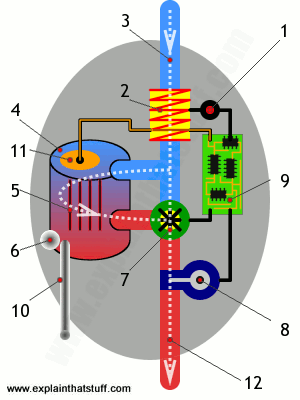
You press or turn the ON switch.
This operates a solenoid (electromagnetic switch) that opens a valve on the water inlet pipe.
With the valve open, pressurized cold water flows into the shower from your ordinary household supply.
Some of the water flows into a small plastic heater tank (about 0.25 liters in capacity). The tank acts as a
hot water reservoir, helping to ensure both a constant flow of hot water and a much more steady temperature.
It also helps to even out temporary "overshoots" and "undershoots" in temperature that occur when you suddenly turn the temperature dial up or down.
Powerful heating elements inside the tank (sometimes rated as high as
10.8kW—about five times the power of an electric kettle) instantly
heat the cold water. The water heats up much quicker than in a kettle because you have maybe
a half or a quarter as much in the tank and five times the power at your disposal.
In passing, let's just note that there's a handy little silt trap at the bottom of the tank to capture scale and debris, which can be emptied by removing a hidden cover.
Heated water from the tank and cold water from the supply meet up in a thermostatic mixer valve, similar
to the ones we looked at up above. The large temperature dial you turn controls this valve, making the
water hotter or colder as you require. The thermostat built into the valve tries to keep the temperature constant
once you've set it.
A pressure flow sensor on the output pipe checks for dangerously low pressure and triggers a circuit
to switch off the shower if necessary.
An electronic circuit board monitors this sensor and the various other sensors and controls. Different showers are more or less sophisticated. Some are entirely electronically controlled; some are entirely manual.
At the bottom of the water tank, a safety valve (sometimes called a pressure release device or PRD) can blow open if the water pressure gets too high. If that happens, water spills out of a small overflow pipe.
The water tank also contains a thermal cutout mechanism. If the water gets too hot, a temperature sensor in the tank triggers the circuit and solenoid to shut off the water supply (or sometimes just the heating element) so you don't get boiled like a lobster!
Hot water pumps out to the shower head, just the way you like it.
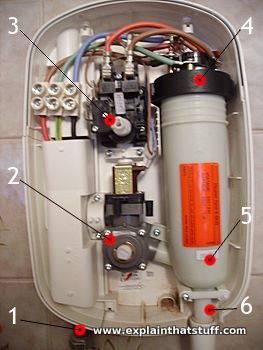
Here's the Mira shower from our top photo with the plastic cover removed, showing what some of these components look like in practice:
Cold water inlet pipe.
Main flow/temperature control. When the front cover is in place, the large blue-red (hot-cold) thermostat dial clicks into place on here.
On/off switch, solenoid, and main (low-medium-high) temperature control.
Heating elements. You can see the wires connected to them right at the top.
Water heating tank.
Outlet pipe connected to shower hose (not shown).
As you'd expect, the two halves of the plastic case are sealed by a rubber gasket; when they click together, no water can get in to the electrical parts inside.
How much energy does an electric shower use?
Like any other electrical appliance, showers carry power ratings that tell you how much energy they use
each second. Typically, you'll find a shower uses somewhere between 7.5kW (kilowatts) and 11kW; the higher
the number, the more energy you're using and the better the shower experience.
In a power shower, the electricity drives both the pump and the
heating element, so a higher number usually means a greater flow of water and a more invigorating shower.
There's a downside too: a higher number usually means a more sophisticated
shower unit (which is more expensive to begin with) and each of your showers will
use more energy and cost more money. The number of kilowatts represents the number of units of electricity
you'd use if you showered for a full hour—so an 11kW shower would use 11 units, for example.
Multiply this number by the unit cost of your electricity to figure out how much a one-hour shower
would cost, then divide down to find the cost of a shower lasting two, four, eight, or however many minutes
you prefer.
Chart: Power showers: Showers use more power (energy per second) than most other home
appliances. That doesn't mean they cost more to run, because some of these other appliances (such as clothes
dryers and radiators) run for much longer and use more energy overall. Remember that the energy you use
is equal to the appliance power multipled by the time over which you use it. The running cost of an appliance is based
on its total energy use, not its power.
If you think showers don't cost much, look at those power figures again: round about 10kW. That's about 3–5 times more than an electric kettle uses and probably twice the power consumption of your clothes dryer. Suppose you shower for 5–10 minutes at a time and there are four people in your household taking one shower a day, that means you'll be using
20–40 minutes of expensive, instant hot water a day, which will cost you several units of electricity
daily. That's much more expensive than it sounds. Obviously the more powerful your shower and the longer you use it, the more it costs.
Do showers save energy compared to baths?
Which costs more, a shower or a bath? Generally, showers use less
energy because they use less water, but it all depends on your shower
and your bath. If you have a modern electric shower with a low-flow
head and you use it for only three or four minutes, it'll be very
efficient and should save you money compared to taking a bath. If you
have a power shower and you stand under it for 15 minutes, don't
expect to save much—you may even find it costs you more! If you have
a shower over your bath-tub, the simple way to test whether you're
saving anything is to take a shower with the plug in place. Broadly speaking, if you
use less water, you're saving energy and money; the less hot water
you use, the more you save. (Of course, the calculation changes somewhat if your
shower is using hotter water than your bath—or vice-versa.)
Chart: Generally speaking, showers use less water and energy than baths, but long power showers will use more. Drawn using data from Showers vs. Baths: facts, figures and misconceptions by Waterwise,
November 24, 2011 [archived with the Wayback Machine].
If you have a separate bath-tub and shower cubicle, comparing
costs is more tricky. If you know your math, you could read your
electricity (or gas) meters before and after taking a bath and shower
and calculate the cost using the difference in the readings. Or you
could use an electrical energy monitor, though that won't help you if
either your bath or shower is powered by gas or oil!
Are eco-friendly shower heads worth buying?
Photo: Electric showers use heating elements that are almost 100 percent efficient so, broadly speaking, the
heat energy you get out is the same as the electrical energy you put in. What that means is that if you want to save on the energy you put in (to help the environment or save money), you must also save on the energy coming out either by reducing the temperature, water flow, or the time you spend in the shower.
One of the most basic (and useful) laws of physics, the conservation of energy,
tells us that we can't create or destroy energy: we can't pluck it out of thin air or make it vanish completely, only convert it from one form into another. If you want to reduce the amount of energy you use in
the shower (or the money you spend), the conservation of energy tells us that the only ways you can do so are:
Use less water (in other words, shower for less time).
Use the same amount of water but at a lower temperature.
Use a more efficient shower element that wastes less energy. However, most electrical heating elements are almost 100 percent efficient,
so this is unlikely to make much difference.
Use an electric shower element with a lower power rating (in watts). But if the element is consuming less power (less energy
per second), less energy must be entering the water each second as well—so a lower-powered shower is simply going to make
the water colder.
Photo: Want to save water, energy, and money in the shower? Forget that pricey, eco shower head; this is really all you need. It's a four-minute "egg-timer" on a suction cup. Many water companies give them away for free; check if yours does!
So what about eco-friendly, replacement shower heads that claim to save water and money? Again, the conservation of energy
tells us that any gains you make have to be lost somewhere else. If your shower is saving energy, it can do that
only by reducing the amount of water you're using or the temperature of the water. It can't give you exactly the same
quality of shower (equally as hot for just as long using exactly the same amount of water) if it's simultaneously saving energy; the laws of physics simply don't allow that! Eco shower heads typically work by reducing the amount of water flowing through them (and changing the air flow so you don't notice the difference). Since they tend to be quite expensive, they may not actually be saving you any money at all—and you can achieve exactly the same effect by either turning down the water at the faucet (mixer showers usually let you do that, but electric showers often don't), showering at a slightly lower temperature, or showering for less time.
How do pulsating shower heads work?
Photo: In a pulsating shower head, the pressure of the incoming water (1) powers a small turbine (2) that makes a wheel rotate (3). Holes in the wheel interrupt the incoming water flow periodically giving hammering pulses of outgoing water (4). This is a very simplified version of what's going on; for a much more detailed description and diagrams, see the patent documents listed below.
Power showers are great for tired bones, but pulsating showers can be even better if you want to massage
your aching muscles at the same time. How do they work? Although there are various different designs, most
rely on the pressure of the water jet to turn a miniature water turbine attached to
a rotating wheel inside the shower head. The wheel has one or more holes in it so it interrupts
the water flow intermittently, giving regular blasts of pressurized water
through the shower head nozzles instead of a constant stream. It's a little bit like a garden sprinkler, where a
cam driven by the pressure of the incoming water trips the outgoing flow on and off.
Is it worth installing an electric shower?: The Guardian, Mar 30, 2019. Guardian readers debate whether switching from a showered by a tank to an electric shower is a good idea.
Please do NOT copy our articles onto blogs and other websites
Articles from this website are registered at the US Copyright Office. Copying or otherwise using registered works without permission, removing this or other copyright notices, and/or infringing related rights could make you liable to severe civil or criminal penalties.