The worst thing that could ever happen
to you on a ship in the middle of the ocean would be for water
to flood in and make you sink. But if you're on-board a submarine, sinking is exactly what you
want! Unlike ships, which pitch and roll as they struggle across the
waves, submarines slip swiftly and silently through the calmer waters
beneath. They are lean, mean, military machines and they can stay
submerged for weeks or even months at a time. Let's take a closer look
at how they work!
Photo: The fast-attack-class nuclear-powered submarine USS Newport News (SSN-750) speeds across the sea. Photo by Aaron Chase courtesy of US Navy and Wikimedia Commons.
Oceans are most turbulent where wind meets water: on their surface. The waves that race across
the sea are a sign of energy, originally transmitted by the Sun and whipped up into winds,
racing from one side of the planet to the other. Ships battle and lurch across tough seas where no fish—worth its salt—would ever swim.
Sailing ships make good use of winds, harnessing the gusts of air to make a very effective form of propulsion.
Diesel-powered ships stay on the surface for a different reason: their engines need
a steady supply of oxygen to burn fuel. In theory, it should be much easier for ships to swim under the waves
where the water is calmer and puts up less resistance; in practice, that creates a different set of problems.
If you've ever gone snorkeling or scuba
diving, you'll know that life underwater is very different from
life on the surface. It's dark and difficult to see, there's no air to
breathe, and intense water pressure makes everything feel uncomfortable
and claustrophobic. Submarines are ingenious bits of engineering
designed to carry people safely through this very harsh environment.
Although they were originally invented as military machines, and most
large subs are still built for the world's navies, a few smaller subs
do work as scientific research vessels. Most of these are
submersibles
(generally small, unpowered, one- or two-person submarines tethered to
scientific research ships as they operate).
Photo: Submarine ahoy! When we see photos of submarines floating on the surface,
it's hard to imagine how big they really are: like icebergs, virtually all of a floating sub is underwater.
In this very unusual picture of a submarine in dry dock for maintenance, you can clearly see how big a submarine really is—and that it really is almost a perfect cylinder. Photo of USS City of Corpus Christi at Pearl Harbor Naval Shipyard by Dustan Longhini courtesy of US Navy and
Wikimedia Commons.
Parts of a submarine
Photo: Despite many technological advances, the
basic concept of the submarine has changed little in over a century,
since John Holland designed the USS Holland, the US Navy's first
submarine. Photo by courtesy of Naval Historical Center.
Sponsored links
These are some of the key parts of a typical submarine.
Pressure hull
The pressure of water pushing inward is the biggest problem for
anyone who wants to go deep beneath the ocean surface. Even with scuba
tanks, we can dive only so far because the immense pressure soon makes
it impossible to breath. At a depth of 600m (2000ft), the maximum
depth subs ever dive to, the water pressure is over 60 times greater than it
is at the surface!
How do subs survive where people can't? The hull of a standard ship
is the metal outside that keeps the water out. Most submarines have two
hulls, one inside the other, to help them survive. The outer hull is
waterproof, while the inner one (called the pressure hull) is much
stronger and resistant to immense water pressure. The strongest
submarines have hulls made from tough steel or titanium.
Planes
Just as sharks have fins on their bodies to help them swim and dive,
so submarines have fins called diving planes or hydroplanes.
They work a bit like the wings and control surfaces (swiveling flaps)
on an airplane, creating an upward
force called lift.
Buoyancy is the tendency of something to
sink, rise, or float at a certain depth. While it's underwater, a submarine is
negatively buoyant, which means it tends to sink, left to its own devices, if it's not moving.
But as the submarine's propellers push it forward, water rushes
over the planes, creating an upward force called lift that helps it remain at a certain depth,
creating a state of neutral buoyancy (floating).
The planes can be tilted to change the lift force,
so making the submarine climb or dive through the sea, as necessary. The planes provide most of the
submarine's control of its depth, most of the time. The amount of lift they
generate depends both on the angle to which they're tilted and on the submarine's speed (just as the lift that wings generate
depends on a plane's speed and "angle of attack").
Photo: The diving planes on either side of a submarine's tower generate lift as it moves forward, just like the wings on a plane. Two photos of the USS Alabama by
Ray Narimatsu and Mark A. Correa courtesy of US Navy and Wikimedia Commons
(original photos
here
and
here).
Ballast tanks
There are spaces in between the two hulls that can be filled with
either air or water. These are called the ballast
tanks and, with the diving planes, they give a sub control over its
buoyancy, particularly during the first part of a dive or a return to the surface
from the depths. When the ballast tanks are filled with air, the submarine rises to the surface
because it has positive buoyancy. With water inside the tanks, the sub has negative buoyancy so it sinks deeper into the ocean.
The tanks at the front (known as the front trim tanks) are usually filled with water or air first, so the
submarine's front (bow) falls or rises before its rear (stern).
The ballast tanks can also be used to help a submarine surface very quickly in an emergency.
Photo: A submarine blows the air from its ballast tanks as it prepares to dive. Photo by Michael Murphy courtesy of US Navy and
Wikimedia Commons.
Engine
Gasoline engines and
diesel engines used by
cars and trucks, and jet engines used by
planes, need a supply of oxygen from the air to make them work. Things
are different for submarines, which operate underwater
where there is no air. Most submarines except nuclear ones have
diesel-electric engines. The diesel engine operates normally when the
sub is near the surface but it doesn't drive the sub's propellers
directly. Instead, it powers an electricity generator that charges up
huge batteries. These drive an electric motor that, in turn, powers
the propellers. Once the diesel engine has fully charged the batteries,
the sub can switch off its engine and go underwater, where it relies
entirely on battery power.
Early military submarines used breathing tubes called snorkels to
feed air to their engines from the air above the sea, but that meant
they had to operate very near the surface where they were
vulnerable to attack from airplanes. Most large military submarines are
now nuclear-powered. Like nuclear power plants, they have small nuclear reactors and, since they need no air to operate, they can generate power to drive the
electric motors and propellers whether they are on the surface or deep
underwater.
Tower
Photo: The tower or sail can double up as an observation
platform when the sub is cruising on the surface. Note the various different communications
and navigation antenna. Photo by Jeffrey M. Richardson courtesy of
US Navy.
Submarines are cigar-shaped so they can slip smoothly through the
water, but in the very center there's a tall tower. In older submarines,
the tower was packed with navigation and other equipment
and was sometimes known as the conning tower
(because, historically, it contained a submarines controls).
It's also referred to simply as the tower or the sail,
because in a modern submarine the controls and navigation equipment
take up more room and tend to be located in the hull.
Navigation systems
Photo: Periscopes are useful if you're near the
surface searching for enemy ships but they're useless underwater. Photo
by Jeffery S. Viano courtesy of
US Navy.
Light doesn't travel well through water, so it gets darker and
darker the
deeper down you go. Most of the time, submarine
pilots can't even see where they're going! Submarines have
periscopes (seeing tubes that can be
pushed up through the tower), but they're useful only when subs are on
the surface or just beneath it. Submarines navigate using a whole range
of electronic equipment. There's GPS satellite
navigation, for starters, which
uses space satellites to tell the
submarine its position. There's also SONAR, a system similar to radar, which sends out pulses of sound into the
sea and listens for echoes reflecting off the seabed or other nearby
submarines. Another important navigation system onboard a submarine is
known as inertial guidance.
It's a way of using gyroscopes to keep track of how far the submarine
has traveled, and in which direction, without referring to any outside
information. Inertial guidance is accurate only for so long (10 days or
so) and occasionally needs to be corrected using GPS, radar, or other
data.
Photo: The sonar apparatus in a typical submarine.
Photo by Brandon Shelander courtesy of US Navy.
Life-support systems
A large military submarine has dozens of people onboard. How can
they eat, sleep, and breathe, buried deep beneath the sea, in freezing
cold water, for months at a time? A submarine is a completely sealed
environment. The nuclear engine provides warmth and generates electricity—and the electricity powers all
the life-support systems that submariners need. It makes oxygen for
people to breathe using electrolysis to chemically separate molecules of water (turning H2O
into H2 and O2) and it scrubs unwanted carbon
dioxide from the air. Subs can even make their own drinking water from
seawater using electricity to remove the salt. Trash is compacted into steel cans, which are ejected from an
airlock system (a watertight exit in the hull) and dumped on the seabed.
Who invented the submarine?
Early days
1620: Englishman Cornelis
Drebble (1572–1633) builds the first submarine by waterproofing a
wooden, egg-shaped boat with leather and coating the whole thing in
wax. Scientists are uncertain whether Drebble's boat ever set sail.
1776: During the US revolution, David
Bushnell (1742–1824) builds a hand-powered one-person submarine
called the Turtle to help attack British warships.
Artwork: Two views of David Bushnell's Turtle submarine.
Artworks from A History of Sea Power by William Oliver Stevens and Allan F. Westcott, George H. Doran Co., 1920, p.294, courtesy of Internet Archive.
1800: American steam engineer Robert
Fulton (1765–1815) designs a convertible ship with folding-down
sails that can turn itself into a submarine for traveling underwater.
Artwork: Robert Fulton's Nautilus submarine.
Artwork from A History of Sea Power by William Oliver Stevens and Allan F. Westcott, George H. Doran Co., 1920, p.295, courtesy of Internet Archive.
1863: American engineer Horace Lawson Hunley (1823–1863) develops
a hand-powered submarine that ultimately becomes known as the
CSS H.L. Hunley
(often just "Hunley" for short). It sinks once during testing in August 1863,
killing five crew, then sinks again in October 1863, killing Hunley himself and all his crew.
Later retrieved, it becomes the first submarine to sink a warship
(during the American Civil War)—a real milestone in submarine history.
1888: Spanish engineer Isaac Peral (1851–1895) builds the first
electric (battery-powered) submarine. Despite successful tests, it never enters
production, though Peral's ideas influence other engineers around the world.
1897: American inventor Simon Lake (1866–1945) launches the Argonaut, the first submarine to
operate in the open sea.
Practical subs
1900: The US Navy launches its first ever submarine, the USS
Holland, named for its Irish-American inventor John
Holland (1840–1914). Although
Holland had offered submarines to the Navy for years beforehand, it had
originally shown no interest.
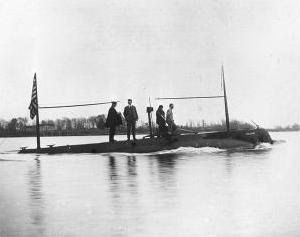
Photo: The USS Holland (Submarine Torpedo Boat # 1) underway, circa 1900. Photo by courtesy of Naval Historical Center.
1908: Russia's Pochtovy is an early
pioneer of Air Independent Propulsion (AIP)—operating a submarine without frequent trips to the surface—using a gasoline engine fed by compressed air.
From World Wars to the Cold War
1914–18: During World War I, the German navy operates a fleet of
highly effective military submarines called U-boats (short for
Unterseeboot, which means underwater ship). In the 1930s, the Germans
start using snorkel tubes (invented by a Dutch engineer) to supply
air to their U-boat's diesel-electric engines, giving them greater
range and effectiveness.
1930s: Germany engineer Hellmuth Walter
pioneers high-thrust hydrogen peroxide engines for use in submarines and missile rockets. It's
another step forward for Air Independent Propulsion.
1952: French underwater photographer
Dimitri Rebikoff launches the Poodle, the first tethered Remotely Operated Vehicle (ROV).
1955: The US Navy launches the USS Nautilus, the first nuclear-powered submarine.
1964: Alvin, a scientific research submersible operated by Woods Hole Oceanographic Institution, begins its long and distinguished history of underwater exploration.
Its major successes including discovering black smokers (hydrothermal vents—a bit like chimneys in the ocean floor)
and exploring the wreck of the Titanic.
1968: The Soviet Union (Russia and its former allies) launches
K-162, the first submarine with a titanium hull and the world's fastest.
1969: The Soviets launch the first of their sleek, fast, titanium-hulled Alfa-class nuclear submarines.
Modern times
1990s: Nuclear submarines made redundant by the end of the Cold War are used for
oceanographic and climate research in the Arctic in a project named
Science Ice Exchange (SCICEX).
1990s: British-born submarine designer Graham Hawkes promises to revolutionize sub design
with small, plane-like submersibles called Deep Flight that "fly" underwater.
1990s–: As in many other industries, China emerges as a major supplier of affordable but effective
diesel-electric military submarines, including refurbished versions of the old 1960s–1980s Ming class (Type 035) and the more recent Song class (Type 039).
2023: Titan, a tiny carbon-fiber submersible designed to carry tourists to the wreck of the Titanic,
implodes catastrophically around 3.5km (2.1 miles) underwater, killing all five crew members onboard.
Photo: What of the future? Over two thirds of our planet is water, so submarines will always have a place in the military. But when it comes to scientific exploration, small robotic submersibles, like this Super Scorpio remotely operated vehicle (ROV), are becoming increasingly important. Note the video cameras on the front and the large, silver, robotic grabber arms. Photos by Geoffrey Patrick courtesy of US Navy and Wikimedia Commons (original photos here and here).
The Submarine Book by Chuck Lawliss. Burfood Books, 2000. Another historic account of the development of submarines, from the Drebble to the nuclear sub.
For younger readers
Ships and Submarines by Chris Woodford. Facts on File, 2004. My own short (96-page) introduction covers the history of shipping in chronological order. For ages 9–12.
Submarines by Rebecca Stefoff. Marshall Cavendish, 2006. A shorter introduction aimed at ages 9–12 (but suitable for older readers too).
Russia Launches Quietest Submarine in the World by Zachary Keck. The National Interest, April 29, 2015. All about the new diesel-electric Krasnodar, a type of Kilo-class submarine so quiet it has earned the nickname "black hole."
How we can get submarines to travel at supersonic speed by Jordan Golson. Wired, 25 August 2014. Chinese researchers are developing subs that can travel faster than most jet places, using a technology called supercavitation.
The First Soviet Giants by Norman Polmar, Undersea Warface (The Official Magazine of the US Submarine Force), Fall 2001. An intriguing article about the development of giant Soviet cargo submarines after World War II. [Archived via the Wayback Machine.]
Unravelling a Cold War Mystery: CIA Library, 1993. A fascinating declassified article explaining how the CIA tried to figure out the latest advances in Soviet submarine design during the Cold War.
Please do NOT copy our articles onto blogs and other websites
Articles from this website are registered at the US Copyright Office. Copying or otherwise using registered works without permission, removing this or other copyright notices, and/or infringing related rights could make you liable to severe civil or criminal penalties.