Is it a boat or a plane? Maybe it's a flying
saucer? Back in 1959, when the world's first hovercraft, SR.N1,
floated out across the windy English Channel, people must have
wondered exactly what they were seeing. Like a boat, a hovercraft
moves across water, but like a plane, it also pushes through the air
with the help of propellers . The "big idea" is that a hovercraft
can glide just as easily over water, land, or, ice. That makes it a
perfect vehicle for getting round some of the world's most
inaccessible areas—places where ordinary boats can't beach and
planes can't land. How exactly does this unique and rather remarkable
craft actually work? Let's take a closer look!
Photo: A US Navy hovercraft (LCAC) photographed in 2008. Picture by Chad R. Erdmann courtesy of US Navy and
Wikimedia Commons.
Much of the deck is empty space, suitable for carrying huge amounts of drive-on, drive-off military cargo.
One part boat, one part airplane, and one part helicopter a hovercraft is a vehicle that traps a cushion of air
underneath itself and then floats along on top of it. The air cushion
holds it high above waves and land obstructions, making the craft
superbly amphibious (equally capable of traveling on land or water or
gliding smoothly from one to the other). That's why military
hovercraft, designed for swift beach landings, are often called LCACs
(Landing Craft Air Cushion).
Hovercraft come in all shapes and sizes, from
one-person fun machines and small beach rescue craft to giant
passenger ferries capable of carrying over 400 passengers and 50
cars. Where boats are slowed by hulls that drag deep in the water,
hovercraft ride fully clear, which means they use less fuel and can
reach blistering speeds of up to 145kph (90mph). From ice and water
to mud and sand, from floodplains and river deltas to mangrove swamps
and frozen glaciers, the great advantage of a hovercraft is that it
can glide with ease to places ordinary boats struggle to reach, and
land people safely even where there are no harbors or landing stages.
In practice, hovercraft have four broad applications: large commercial hovercraft are mostly used as
high-speed people and car ferries; slightly smaller military LCACs
are used as tried-and-tested beach landing craft; smaller niche craft
are used for things like oil and gas prospecting, inshore search and
rescue, and scientific surveys; and small, one-person recreational
craft are often raced round courses like flying go-karts!
Photo: An old coastguard hovercraft. Note the deep black skirt (on the front view, above) and the central fan (toward the back in the middle) on the plan photo below. Photos courtesy of NASA Ames Research Center and
Internet Archive (front view and top view).
How does a hovercraft work?
At first sight, you might think a hovercraft works
in much the same way as a helicopter: it throws air down underneath
itself and then simply rides along on top. But where a helicopter
balances its own weight (the force of gravity pulling it down) with a
massive down-draft of air (pushing it back up again), a hovercraft
works in a much more subtle way that allows it to use far less air,
far more efficiently, so getting by with a much smaller engine and
considerably less fuel.
The basic mechanism of a hovercraft is very simple: there's an engine
(diesel or gasoline)
that powers both a large central fan, pointing downward, and one or more other fans pointing backward.
The central fan creates the lift that holds the craft above the waves; the other fans
propel the craft backward, forward, or to the side. A rubber skirt (with or without fingers)
traps a cushion of air under the craft. Side-wall hovercraft have only partial skirts: with solid sides and a skirt
only at the front and back, they can be powered by quieter propellers or
water-jet engines, making them quieter.
Photo: A typical hovercraft has two or more fans. The main fan in the center blows air downward to push the craft upward, above the water. Two or more other fans at the back blow air backward to make the craft go forward. This is an example of action-and-reaction (Newton's third law of motion) at work.
How much can a hovercraft carry?
A fan of a given power will create a certain amount of pressure under the craft. Now since:
pressure = force / area
it follows that a bigger hovercraft (one with a bigger overall area) can carry more weight than a smaller hovercraft with a fan the same size. Moreover, as Christopher Cockerell, the inventor of the hovercraft, quickly discovered, bigger hovercraft are more efficient than smaller ones:
"In such vehicles, the lift or load carrying capacity is proportional to the plan area of the gas cushion or cushions. The energy required to contain the cushion or cushions is proportional to the peripheral dimension of the cushion or cushions. Thus for an increase in size of a vehicle, the lift increases proportionally to the area of the cushion or cushions whilst the energy requirements increase linearly with the periphery of the cushion or cushions. The efficiency of a vehicle therefore increases with the plan area of the cushion or cushions, and hence with the plan area of the vehicle."—Christopher Cockerell, US Patent 3,177,960, 1965.
Sponsored links
Types of hovercraft
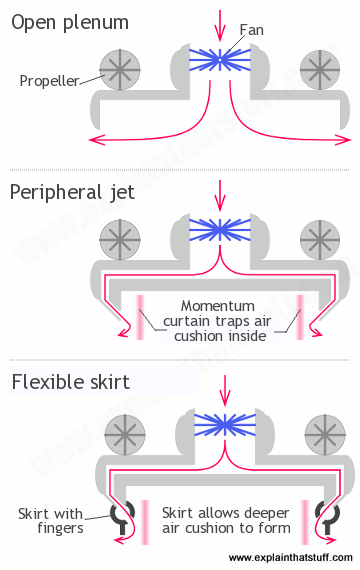
Now it's certainly possible to build a simple hovercraft with
a giant fan that blows air down into a container of some kind
(you'll find plenty on YouTube—a couple of them are
linked in the references at the bottom of this article); that
design is called an open plenum ("plenum" being another
word for the hollow region underneath the craft where the air
gathers). However, most hovercraft work in one of two other ways.
The original hovercraft design used a vertically mounted fan to blow air
between its outer shell and a slightly smaller inner container,
creating what's called a "momentum curtain": a ring of fast-moving, inward-pointing air that trapped a
bigger cushion of air inside it. This type of design is called a
peripheral jet and its big advantage over an open plenum is that the fan needs to move much less
air (or, to put it another way, it can create more lift with less
power). Unfortunately, it still only produces a relatively modest
hover height unless the fan is extremely powerful.
Later, engineers discovered it was more effective (and
efficient) to trap a much bigger air cushion with a rubber skirt that could
flex around waves and other obstructions, giving a greater hover height and
a better seal. Hovercraft with skirts could clear bigger
waves and land obstacles with no loss of stability or the all-important air cushion underneath
them, so the ride was generally quite smooth. Eventually, the flexible skirt evolved into a more
intricate design, with hundreds of independently moving "fingers" attached to the bottom
that could maintain the airflow even more effectively. A modern
hovercraft combines elements of the peripheral jet and flexible skirt
designs by directing many jets of air inward through the skirt.
Artwork: Hovercraft work in three main ways. Top: In an open-plenum design, the air effectively just pumps straight down under the craft. This requires a massive airflow and a very powerful engine. Middle: In Christopher Cockerell's peripheral jet design, a ring of fast-moving air, created by outer (peripheral) jets makes a "momentum curtain" that traps high pressure air inside it. The fan needs to move much less air to create the same lifting force, so it's a more efficient design than the open plenum. Right: Adding a skirt makes the air cushion higher, so the craft can safely clear bigger ocean waves and land obstacles. Skirts are either simple, flexible bags or more complex arrangements of individually moving segments called fingers.
Other important parts
What else do you need to make a hovercraft? A
downward-pointing fan can only blow air underneath, so hovercraft
typically have one or more propeller fans on top of the hull, pointing
backward to propel them forward. Usually, there's a rudder positioned
just behind each fan to swivel the air it produces and steer the
hovercraft in the appropriate direction. An alternative method of
steering is to divert some of the down-draft from the fan through
air nozzles that point horizontally—and the very first hovercraft
prototype, SR.N1, effectively worked this way. Although hovercraft
usually have separate fans (to create the cushion) and propellers (to
drive them along), the same engines typically drive both, using
gearboxes and transmissions to turn the engine's power through ninety
degrees. Bigger hovercraft like the US military LCACs typically use several
very hefty engines, such as powerful gas turbines. Then there's the hull itself. Most
large hovercraft are built from light, rustproof, and highly durable
aluminum, though hobby craft are often molded from tough
composite materials such as fiber glass. Finally, you need a cockpit
to keep your pilot safe and sound—and some cargo space (either
enclosed, for passengers and cars, or a large "open well" deck
for carrying military cargo).
Left: Close-up of a hovercraft skirt making a tight seal with the water beneath. Photo by Cody D. Lund.
Middle: Vertical rudders behind the fans steer the hovercraft by directing air to the side. Photo by Brian P. Biller.
Right: The fans are driven from engines in the side by giant axles. Photo by Christopher A Newsome.
All photos courtesy of US Navy.
Advantages and disadvantages
Hovercraft can launch and land anywhere, travel
over almost any kind of surface, race along at high speeds, and
efficiently carry large numbers of passengers and equipment or hefty
military cargos. They compare favorably with all kinds of rival
vehicles. Since they produce an air cushion more efficiently than a
helicopter, they're cheaper to operate, simpler, and easier to
maintain (safer too). Where boats waste energy dragging through water
and waves, a hovercraft riding smoothly on top creates little in the
way of either drag or wake, so it's generally more efficient
(and less disruptive to the marine environment than a
propeller-driven ship).
But if hovercraft are so wonderful, why aren't
they used everywhere? They're expensive initially and, though cheaper
than helicopters, considerably more costly to maintain than ships and
boats of similar cargo capacity (because they're essentially aircraft, not boats, and mechanically more complex).
Although hovercraft successfully carried tens of millions of people between
Britain and France for just over 30 years, they eventually stopped operating following the
opening of the Channel Tunnel and the arrival of low-cost
ferry ships and fast, wave-piercing catamarans.
Hovercraft are also fairly tricky to pilot: more like helicopters, in
this respect, than simple-to-operate boats. They're very noisy too, which
can be a problem both for passengers and people living near the ports
where they operate, and is certainly a drawback for "covert"
military operations.
Who invented the hovercraft?
The basic idea behind the hovercraft can be traced
back at least to the early 18th century: in 1716, Swedish philosopher
Emmanuel Swedenborg (1688–1772) conceived a kind of overturned rowing
boat in which each stroke of the oars pumped air under the hull,
floating it happily over the waves. Unfortunately, it soon became
obvious to Swedenborg that generating an air cushion by human muscle
power wasn't going to work, so the craft was never built. In the
1870s, British marine engineer Sir John Thornycroft (1843–1928)
figured out that a boat that could make an air cushion and carry it
underneath itself would be able to avoid the problem of dragging its
hull through the water. But his experiments to generate the cushion
simply by pumping air with bellows were unsuccessful: technology was
not on his side. [1]
Photo: Some of Sir John Thornycroft's experiments into reducing
the drag from model boats (red) by making them skim more lightly over the surface of the water.
From Experiments with Hydroplanes or Skimmers, Scientific American, Vol 100 Number 24, June 12, 1909, p.444.
It wasn't until the early 1950s that the theory of the hovercraft
moved into practice, thanks to the work of another British
engineer, Dr (and later "Sir") Christopher Cockerell (1910–1999).
Famously, he carried out an experiment with a coffee can and an empty
tin of cat food, putting one inside the other to create an ring of empty space
between them. Firing air from a blower down into this space from
above, he found he could generate what he called the momentum
curtain—a downward ring of high-pressure air that would effectively
trap a much bigger cushion of air under a hovercraft, producing more
lifting force for the same engine power. He measured the lift his
"craft" produced using a simple pair of kitchen scales.
Initially, Cockerell thought his idea would be of
huge benefit to the military and offered it to the British
government, who promptly classified it. Unfortunately for Cockerell,
the military weren't that interested, and the "top secret"
classification also prevented any further commercial development. In
the late 1950s, the frustrated inventor managed to get his idea
declassified again and, in 1959, formed the Hovercraft Development
Company. With £150,000 backing (equivalent to several million dollars or pounds today) from a British government agency called the National Research Development Corporation (NRDC), he
commissioned a full-scale prototype, which took eight months to
build. Constructed at Cowes on the Isle of Wight, England by a marine
company called Saunders Roe, the
SR.N1 (Saunders-Roe Navigation 1) was roughly the size of a small truck, but almost square (8.8m by
7.3m or 29ft by 24ft). Its most distinctive feature was a large, vertically mounted,
white fan (powered by a 450 horsepower engine) that produced both
the air cushion (by the peripheral jet principle) and steering (using
directional channels that diverted some of the fan's airflow). On
July 25 that year, Cockerell and pilot Peter Lamb took the SR.N1
across the English Channel (from England to France) in just over two
hours, marking the 50th anniversary of Louis Bleriot's pioneering
cross-channel airplane flight (but taking about 1.5 hours longer).
Artwork: This early sketch of a hovercraft by Christopher Cockerell shows all the essential components of a modern machine—except the skirt, which he added later. Following Cockerell's original numbering: 1 is the hovercraft itself; 2 is an opening at the front through which air enters; 3 is a double, four-bladed propeller; 4 is the engine; 5 is the drive shaft by which the engine powers the propeller; 6 is a chamber through which air flows; 7 is a tunnel into which air flows beneath the machine; 10 is the cockpit; 11 is the cargo bay; 12 are the bay doors; and 14 is the steering rudder at the back. Artwork from US Patent #3,363,716: Vehicles for travelling over land and/or water by Christopher Cockerell, filed on 12 December 1956 and granted on 16 January 1968. Courtesy of US Patent and Trademark Office.
Although Cockerell and his engineers continued to
tinker with the design of the SR.N1 and made small
improvements, the next big advance came with the development of the
flexible skirt, invented by British aircraft engineer Cecil Latimer-Needham (1900–1975).
Thanks to this innovation, the SR.N1 prototype was soon superseded by much bigger
and more practical craft. The
first commercial passenger hovercraft service began in 1962,
with a Vickers-Armstrong VA3 operating between Rhyl in North Wales and Merseyside, England
carrying 24 passengers at up to 110kph (70mph).
By 1968, technology had advanced to the point where Saunders Roe
could build two giant, cross-channel,
SR.N4 hovercraft ferries.
These huge machines successfully ferried tens of millions of people from England to France until
2000, when the service was closed for good. Although Britain pioneered the
hovercraft, the only passenger service now operating in the UK is a
relatively modest ferry shuttling passengers from Portsmouth on the
English mainland to the nearby Isle of Wight (fittingly, the island
where hovercraft first buzzed into life). Even so, hovercraft
continue to be widely used by military forces throughout the world,
and in all kinds of niche applications where they outperform boats
and helicopters.
Photo: The Princess Anne, one of the giant British SR.N4 hovercraft parked on a beach
in 1980. These craft were 56m (185ft) long and were powered by four gas-turbine engines,
one for each of the four propeller fans. Photo by Wikimedia user Murgatroyd49 published under a Creative Commons (CC BY-SA 4.0) Licence on
Wikimedia Commons.
Griffon Hoverwork: This site has some great technical data and specifications and offers an interesting insight into the range and diversity of modern hovercraft, from one-person military vessels to giant firefighting craft.
Hoverboard? Still in the Future by Conor Dougherty, The New York Times, 21 October 2014. What do hoverboards owe to the technology of hovercraft?
Mercier-Jones hovercraft by Conor Dougherty, Wordless Tech, 2 January 2013. Perhaps the most exciting hovercraft you've ever seen!
Hovercraft still afloat 50 years on by Brian Milligan, BBC News, 10 June 2009. A news report celebrating 50 years of the hovercraft, with video footage of early hovercraft experiments.
The Hovercraft: A History by Ashley Hollebone. The
History Press, 2012. The fascinating history of water-skimming hovercraft.
Discover the Hovercraft by Kevin Jackson.
Flexitech, 2004. This short, hands-on book about hovercraft technology includes experiments and activities you can try.
For younger readers
Hovercraft (Speed Machines) by Matt Scheff. ABDO, 2015. A 32-page introduction covering the history of hovercraft, how they work, and what they're used for. Suitable for ages 7–9.
Ships and submarines by Chris Woodford.
Facts on File, 2004. My own book about the history of ships, from ancient wooden craft to the very latest wave-piercing catamarans. Ages 10+.
If you're looking for more technical explanations, patents are always a good place to start. Here are four of Christopher Cokerell's pioneering designs:
↑ Most of Thornycroft's experiments seem to have been concerned with skimming "hydroplanes," somewhat like hydrofoils. There's a little bit
about his research in the article Experiments with Hydroplanes or Skimmers, Scientific American, Vol 100 Number 24, June 12, 1909, p.444–445. The first part discusses hydroplanes; on page 445, there's a brief mention of
how "Sir John Thornycroft also studied the passage of air under planing boats.
Please do NOT copy our articles onto blogs and other websites
Articles from this website are registered at the US Copyright Office. Copying or otherwise using registered works without permission, removing this or other copyright notices, and/or infringing related rights could make you liable to severe civil or criminal penalties.