Everyone knows real life is nothing like television—possibly
because TV screens are so much smaller than the things we see around us. You
couldn't show life-sized people, cars, sharks, trees, and skyscrapers
on a glass-fronted box 30cm (12 inches) high
even if you wanted to. But if you'd like your entertainment to feel more realistic, one option is
to swap your TV set for a projector that throws giant images of TV
pictures onto the wall. Watching TV then becomes more like
watching a movie—in the comfort and privacy of your own home.
Projection TV is also very useful in business meetings and college
lectures where a whole room full of people need to watch a picture at
the same time. You can use it to show live TV pictures, video and
DVD
recordings, or even the output from a computer
screen. Let's take a closer look at the different kinds of TV projector and how they work.
Photo: A typical LCD TV projector with its cover removed.
Photo by NASA Langley Research Center (NASA-LaRC) courtesy of Internet Archive.
There's nothing new about projecting images onto a screen. Back in
ancient times, Greek philosopher Plato (429–347 BCE) described a
famous idea called the "allegory of the cave" in which he likened
our everyday experiences to those of a group of cave-bound prisoners
watching distorted shadows of puppets flickering on a wall. Thanks to Plato, we can
say fairly confidently that people have understood the basic idea of
projecting simple images onto screens for thousands of years.
Shadow play like Plato described is something all children enjoy
and, simple though it is, it's the basis for all forms of projection
technology, no matter how sophisticated. Think for a moment how it
works. You have a light source, you put an
image in front of it, and a shadowy image of the object is thrown onto the wall in front of
you. If you move the object around, you create an animated image.
Sponsored links
Front projection and back projection
There are two basic kinds of projection. If
the light is behind you and the screen is in front of you, you make
an image through front projection.
You can also make projected images
a different way. You might have walked down the street at night and
seen shadows of people dancing around on their blinds as they walk
around inside brightly hit homes. In this case, the light source and
the object being projected are behind the screen (the blinds) and
you're looking from the opposite direction in what's known as back
projection.
Artwork: In front projection (left), the image is projected in front of you.
You see light reflected off the screen into your eyes. In back projection (right), the image is
projected through the screen from behind. The light you see is traveling directly through the screen.
"Cine" movie projectors, which were developed in 1895 by two French
brothers named Auguste and Louis Lumière (1862–1952 and
1864–1948), work by front projection. The projector is positioned
behind the audience and throws an image over their heads onto a
screen in front of them. Televisions, which became popular a few
decades later, work by back projection. You sit in front of the box
and watch a pattern of light that's being created by a very
sophisticated electronic mechanism
behind the screen.
Photo: The Lumière brothers pioneered the movie projector and
opened the world's first cinema in the 1890s.
What is projection TV?
Projection TVs are a cross between the two technologies:
they use television technology to build up a picture and
projector technology to throw that picture onto the screen. You've probably noticed how
televisions have evolved and developed in recent years: huge,
old-style cathode-ray tube (CRT) TV sets
have gradually given way to
flatter, squarer LCD (liquid-crystal display)
and plasma TVs that
work an entirely different way. Projection TVs have evolved in much
the same way.
Artwork: Projection meets TV—a TV projector throws a large TV picture onto your wall instead of squeezing a small one into a screen.
CRT projectors
The first TV projectors were a bit like super-powerful CRT
televisions. Although basic CRT TV projectors were available in the
1950s, they became really popular in the 1980s thanks to manufacturers such as Barco.
Instead of shining three colored electron guns onto a phosphor screen from behind (that
is, by using back projection), they use three hugely powerful light
guns to shine separate red, blue, and green images onto a screen
(through front projection). The images fuse together into a single,
large colored image. The trouble with projectors like this is that
they are huge and heavy (so they're not easily portable), they can
use lots of electricity (to power the three light guns), and the CRT
tubes inside them get very hot. But although they can be fiddly to
set up initially and adjust, they're neither unreliable nor obsolete, as
many people suppose: they give excellent picture quality (as good as or better than newer
technologies) and they're still compatible with new developments
like HDTV and Blu-ray DVD players.
Photo: An old-fashioned Barco 801 CRT projector from the early 1990s, with its distinctive blue, green, and red lenses shining out from the front.
LCD projectors
Just as CRT televisions have now largely being replaced by LCD sets, so CRT
projectors have gradually gone the same way—and for exactly the same
reason: LCD screens are smaller, lighter, cheaper, more reliable, and
use much less power than CRTs. In an LCD TV projector, a very bright light
shines through a small LCD screen into a lens, which throws a
hugely magnified image of the screen onto the wall.
Photo: An ASK Impression 960 LCD TV projector weighing
in at about 12.5kg. This one uses a powerful 575-watt metal halide lamp
to throw the image of an internal, 25cm (10-inch) LCD screen onto a screen up to 4 meters (13ft) away.
Photo by NASA Langley Research Center (NASA-LaRC) courtesy of Internet Archive.
The technology is sometimes called LCLV (liquid crystal light valve).
While CRT projectors were popular with businesses and colleges, lower-cost LCD
projectors are small, cheap, and portable enough for home use.
That doesn't necessarily mean they're superior, however. The image
quality is often poorer than that produced by CRT projectors and the
bright lamps used inside LCD projectors to throw the image still have
a limited life.
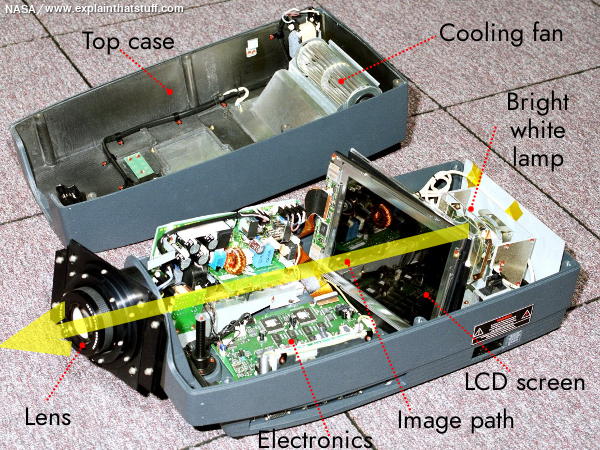
Photo: Inside an ASK Impression 960 LCD TV projector, modified by NASA.
Photo by courtesy of NASA Langley Research Center (NASA-LaRC) with annotations by Explainthatstuff
courtesy of Internet Archive.
DLP® projectors
Even LCD projectors are looking old-hat now. The latest TV projection technology, DLP® (digital light processing), uses an
entirely different method of making images using microscopic mirrors.
Have you ever used a mirror to send a light signal to a friend
some distance away? The basic idea is simple: you angle the mirror so
it catches light, then tilt it slightly so the light travels where
you want it to go. By tilting the mirror back and forth, you can send
precise light pulses of either long or short duration—and transmit
complex messages using something like Morse code. The latest
projection TV system, called DLP® (digital light
processing) technology, works in almost exactly the same way.
What is DLP® technology?
Developed in the mid-1980s by Texas Instruments scientist Dr Larry J. Hornbeck, DLP technology is based on an amazingly clever microchip called a
digital micromirror device (DMD). A DMD chip contains about two million tiny
mirrors
arranged in a square grid. Each mirror is less than one fifth the
diameter of a human hair, and it's mounted on a microscopic hinge so
it can tilt either one way or another. A bright lamp shines onto the
DMD mirror chip and an electronic circuit makes the mirrors tilt back
and forth. If a mirror tilts toward the lamp, it catches the light
and reflects it off toward the screen, creating a single bright dot
of light (equivalent to a pixel of light made by a normal TV); if a
mirror tilts away from the light source, it can't catch any light, so it
makes a dark pixel on the screen instead. Each mirror is separately
controlled by an electronic switch so, working together, the two
million mirrors can build up a high-resolution image from two
million light or dark dots.
Artwork: DLP® chips make pixels with tiny tilting mirrors.
In the original design by Larry Hornbeck, shown here, each pixel is a tiny cloverleaf-shaped plate of aluminum copper alloy (red) that can be electrically attracted by a second plate directly underneath (blue), so it tilts one way or the other on a central hinge (green).
Artwork from US Patent 4,710,732: Spatial light modulator and method by Larry Hornbeck, Texas Instruments, 1987, courtesy of US Patent and Trademark Office.
To make color images, DLP projectors need
an extra bit of technology: they have a spinning colored wheel
inserted into the light path, which can color the pixels red, blue,
or green. Combined with the tilting mirrors, the color wheel makes a
front-projected TV picture from millions of pixels of every possible
color. This is explained more fully in the box below.
How DLP® projection TV works
Old-style TV projectors based on CRT and LCD technology make and project images in traditional ways not all that different
from cine-movie projectors. But DLP projectors are entirely different...
The digital signal enters the projector from a TV receiver, computer, DVD player, or
other connected equipment.
The signal is decoded by an electronic circuit inside the projector.
A powerful lamp generates white light at the back of the projector.
The lamp shines through a rapidly rotating colored wheel, generating either red, blue, or green light at any particular instant.
The red, blue, or green light reflects off the grid of two million tilting mirrors
in a tiny DMD chip. The mirrors are rapidly swiveled back and forth by the electronic circuit, in exact synchronization with the position of the colored wheel, so they generate a precise pattern of red, blue, and green pixels to make up the TV picture.
A lens collects and focuses the light from the DMD chip and projects it onto the projection screen on the wall.
The screen displays a hugely magnified TV image.
Laser projectors
The latest TV projectors use lasers to produce bright, high-definition (4K), full color pictures at short range but gigantic size—2.5–5m (8–16ft) from a distance of about 1m (~3ft) or so is achievable. Some use a single laser to reproduce all colors; others are more like a modern-spin on CRT (Barco-style) projectors, with three tuned color lasers producing the red, blue, and green parts of each image instead of three powerful light guns. Different types of projectors use either
diode lasers (similar to the ones in laser printers and DVD players)
or large gas lasers (like the ones used in industrial machines). DMD mirrors are typically used to
"scan" the laser light around to make a picture.
Moving beyond the whiteboard: BBC News, 21 January 2010. How DLP projectors are helping school teachers to present their lessons in imaginative new ways.
Rear-Projection TV? Who, Us? by Eric A. Taub. The New York Times, April 9, 2009. Why are some manufacturers playing down their projection TVs?
Films without film arrive in Europe: by Marc Smith, BBC News, 3 February 2000. Explores the arrival of DLP digital projection at movie theaters (cinemas) in Europe.
Wall-size TV from Tiny LCDs by Mark Fleischmann, Popular Science, June 1991, page 94. A simple introduction to how liquid-crystal light valve (LCLV) projectors work.
Books
Polarization Engineering for LCD Projection by Michael D. Robinson, Gary Sharp, Jianmin Chen. Wiley, 2005. A detailed introduction to LCD projection, with some coverage of DLP.
US Patent 7,357,518,B2: Projector by Kazuyuki Iinuma, Seiko Epson, April 15, 2008. A more general description of a modern projector that doesn't specify the type of light source. There's quite a lot of detail about the optical system and user controls.
Please do NOT copy our articles onto blogs and other websites
Articles from this website are registered at the US Copyright Office. Copying or otherwise using registered works without permission, removing this or other copyright notices, and/or infringing related rights could make you liable to severe civil or criminal penalties.