A box that makes pictures from a soup of hot gas? Whatever next?
Cars that can fly? Men on Mars? It may sound like something straight
out of Flash Gordon, but plasma television
was far from science fiction. It was a brilliant example of how cutting-edge science
can be applied to everyday problems to make our lives better and more
fun—and the science is still interesting even if the technology is obsolete.
Let's take a closer look at how it worked!
Artwork: A television powered by plasma. You often can't tell from a quick look whether a flatscreen TV is LCD, plasma, or even OLED. It used to be the case that if you wanted a very large TV, you'd have to buy a plasma screen, but LCD and OLED screens are now available in very large sizes and much more efficient to boot.
In schools they teach us that all substances come in three basic
flavors or states of matter:
solid, liquid, and gas. But they're wrong! There's a fourth
flavor called plasma
(and a fifth one called a Bose-Einstein condensate too, that we won't get into here, but which
earned three scientists the 2001 Nobel Prize in Physics). What exactly is a plasma and how does it relate to solids, liquids, and gases?
Suppose you have a lump of freezing cold ice (a solid). Heat it up
a bit and you'll get a liquid (water). Heat it
up a bit more and, pretty soon, you'll have a gas (steam). The more heat you supply, the
more energy you inject. The more energetically the molecules (or atoms) have, the further apart they can push and the more they move about.
In a solid like water, the molecules are bound tightly together; in liquid water, the molecules
are free to move past one another (that's why water can pour and
flow); in steam (gaseous water), the molecules are completely free of
one another and have so much energy that
they spread out to fill all the space available.
Photo: The Sun mounts an impressive display of plasma in magnetically intense areas
of its surface known as active loops. The eruptions of plasma you can see here are gigantic—many
times the size of Earth! Photo courtesy of NASA/SDO.
But what happens if you don't stop there? What if you keep on
heating a gas? The molecules and atoms inside
it break apart, releasing some of their electrons so they move freely in and around
it. When atoms disintegrate like this, they form positively charged
particles called ions. The mixture of positively charged ions
and negatively charged electrons in a plasma turns it into a kind of hot
soup that will conduct electricity very easily. That's what we mean
by a plasma. It's a special type of gas in which some of the atoms
have become ions (an ionized gas, in other words).
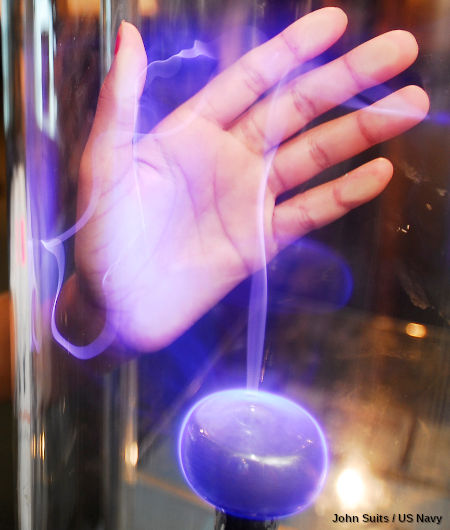
Photo: Playing with plasma. Plasmas are made when some of the electrons in a gas break free,
leaving behind a positively charged nucleus called an ion. The negatively charged electrons and positively charged ions make it possible for the gas to conduct electricity. This glass sphere contains plasma: a hot, ionized gas produced with an electric current. When you put your hands on the glass, they attract free electrons so the plasma seems to move toward you. Photo by John Suits courtesy of US Navy and
Wikimedia Commons.
How a plasma TV set makes its picture
If you've read our articles on energy-saving fluorescent lamps
(also known as CFLs) and neon lamps
(the lamps that make brightly
colored displays in our streets), you'll know how they make light by
buzzing electricity through a gas.
Imagine if you built a TV screen
out of millions of microscopically tiny CFLs or neon lamps, each of
which could be switched on or off very quickly, as necessary, by an
electronic circuit, to control all the
separate pixels (lit-up,
colored squares) on the screen. That's pretty much how a plasma TV
works and it's very different to other kinds of television
technology: in a conventional (cathode-ray) television,
the picture is built up by scanning an electron beam back and forth over a screen
treated with chemicals called phosphors; in an LCD TV (liquid-crystal
display television), polarizing crystals make light rays bend to
switch the pixels on and off.
The pixel cells in a plasma TV have things in common with both neon
lamps and CFLs. Like a neon lamp, each cell is filled with tiny
amounts of neon or xenon gas. Like a CFL, each cell is coated inside
with phosphor chemicals. In a CFL, the phosphor is the chalky white
coating on the inside of the glass tube and it works like a filter.
When electricity flows into the tube, gas atoms crash about inside it
and generate invisible ultraviolet light. The white phosphor
coating turns this invisible light into visible white light. In a plasma TV,
the cells are a bit like tiny CFLs only coated with phosphors that
are red, blue, or green. Their job is to take the invisible
ultraviolet light produced by the neon or xenon gas in the cell and
turn it into red, blue, or green light we can actually see.
Step by step
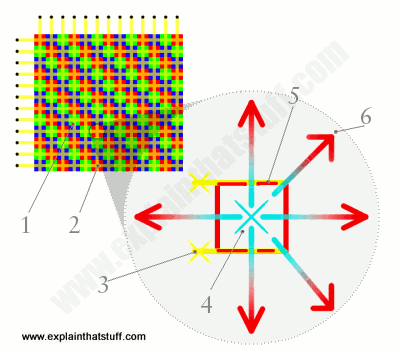
Much like the picture in an LCD screen, the picture made by a plasma TV is made from an array (grid) of red, green and blue pixels (microscopic dots or squares).
Each pixel can be switched on or off individually by a grid of horizontally and vertically mounted electrodes (shown as yellow lines).
Suppose we want to activate one of the red pixels (shown hugely magnified in the light gray pullout circle on the right).
The two electrodes leading to the pixel cell put a high voltage across it, causing it to ionize and emit ultraviolet light (shown here as a turquoise cross, though it would be invisible in the TV itself).
The ultraviolet light shines through the red phosphor coating on the inside of the pixel cell.
The phosphor coating converts the invisible ultraviolet into visible red light, making the pixel light up as a single red square.
Sponsored links
Who invented plasma screens?
The first practical plasma screen was developed in the 1960s by Donald Bitzer, Hiram Slottow, and
Robert Willson of the University of Illinois, as part of an educational computer system called
PLATO. This is one of Bitzer's own illustrations of his invention from his original patent, which was filed in 1966 and eventually granted in 1971. Like my illustration above, you can see that the screen consists of multiple, gas-filled display "minicells" (the orange blobs in the central blue section). In front and behind this are two sets of electrodes, one running horizontally and the other vertically. Each gas minicell ("blob") in the screen can be fired by energizing the appropriate pair of electrodes either side. Since each minicell can only be either on or off, this screen can display monochrome pictures but not color ones.
Plasma and LCD TVs look very similar but, as we've just seen, work
in totally different ways.
The main difference is that the cells that make up the pixels
in a plasma TV could switch on and off
thousands of times faster than the pixels in an LCD screen, so you
got clearer pictures with less blur, especially for moving images
during action movies or sports games. (The latest LCD screens switch
on and off more quickly than older ones, but it's generally true that plasma
screens were faster.) Plasma TVs were also typically brighter and
had higher contrast, which is important if you watch a lot of TV
in the daylight. You could view plasma screens from a wider angle
without seeing distortion of colors (like you get on an LCD computer
screen), so they were often better for larger audiences
(projection TV is another option for showing pictures to a roomful of people).
But there were drawbacks with plasma too. They were more power hungry
than LCDs, for one thing. Here's a very rough comparison of the four
main TV technologies to give you an idea. You can see that plasma
really stands out from the pack:
Plasma screens were also heavier and more fragile, so you had
to be very careful when you transported them. Plasma TVs also had
problems with "burn in" (where images that were
displayed for too long permanently damaged the screen) and they tended to "burn
out" (stop working through too much use) more quickly than LCDs, though
most people were likely to replace a TV for something newer before
this happened.
The market for plasma TVs peaked around 2010; they essentially became obsolete
in 2014 when first Panasonic and then Samsung (which, between them, made about three quarters of all plasma sets) abandoned the technology and better-funded, more-innovative rival technologies (LCDs and OLEDs (organic LEDs)) took over.
About the author
Chris Woodford is the author and editor of dozens of science and technology books for adults and children, including DK's worldwide bestselling Cool Stuff series and Atoms Under the Floorboards, which won the American Institute of Physics Science Writing award in 2016. You can hire him to write books, articles, scripts, corporate copy, and more via his website chriswoodford.com.
Kiss Your TV Goodbye by Paul O'Donovan. IEEE Spectrum, 25 Apr 2016. LCD, plasma... or none of the above? What does the future hold for TVs in the Internet age of super-thin OLED displays?
LED LCD vs. OLED vs. plasma by Geoffrey Morrison. CNET, November 18, 2013. Which TV technology will suit you best?
Choosing a big TV: Wired, 15 November 2011. Lists some of the things you need to consider when deciding between LCD, plasma, and other TV technologies.
Do flat-screen TVs eat more energy? by Sean Coughlan, BBC News, 7 December 2006. Plasma TVs can use up to three times more energy than old-style cathode-ray TVs or larger LCD TVs.
Patents
For deeper technical detail, try these:
US Patent 3,559,190: Gaseous display and memory apparatus by Donald Bitzer et al, University of Illinois, 26 January 1971 (filed in December 1966). The original gas plasma display produced for the PLATO educational computer system.
Please do NOT copy our articles onto blogs and other websites
Articles from this website are registered at the US Copyright Office. Copying or otherwise using registered works without permission, removing this or other copyright notices, and/or infringing related rights could make you liable to severe civil or criminal penalties.