Twenty thousand years ago, if you'd
needed to dig a hole in rough ground, chances are you would have found yourself swinging a sharpened
deer antler over your head. Modern pickaxes are based on pretty much
the same idea. The long wooden handle and heavy metal blade build up energy
as you swing, focusing it on a single, narrow point so each blow produces
maximum force and pressure. It's simple technology, but it's very effective.
Today, if you want to dig a hole in a hurry and there's a thick lump of
concrete or asphalt in your
way, you're most likely to use a jackhammer,
also known as a pneumatic (air-powered) drill, rock drill, or pavement breaker. A
strong and skilled road worker can swing a pickaxe 10 times a minute or
more, but a jackhammer can pound the ground 150 times faster—that's
1500 times a minute! Pretty amazing, but how exactly does it work?
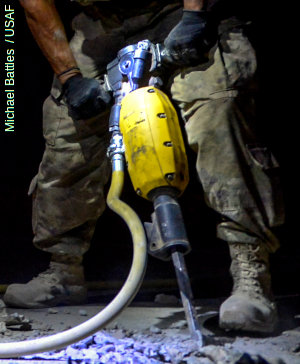
Photo: A typical pneumatic jackhammer drill being used
by the US military in an airfield repair project.
Picture by Staff Sgt. Michael Battles courtesy of US Air Force.
You've probably never handled a jackhammer, but you use exactly the
same technology every time you ride on a bicycle or travel by car. The
rubber tires that carry you smoothly down the road are inflated with
air, so the force of your weight pushing down is exactly balanced by
the pressure of the air pushing you upward. Tires are a simple example of
pneumatic technology, which means they use the
force of air pressure. (You may have heard
of a similar technology called hydraulics
that uses the force of liquid pressure.)
You can't see air, but it's a surprising thing. It's a mixture of
gases, mostly nitrogen and oxygen, with its molecules constantly
zooming back and forth like angry bees. When air is trapped in a
container, such as a bicycle tire,
molecules of gas are repeatedly
crashing into the rubber walls and bouncing back again. Each time one
of these collisions happens, the molecules give a tiny push to the
rubber. With millions of collisions happening all the time, the air
exerts quite a pressure (defined as the
force acting per unit of area) on the rubber—and that's what keeps the
tire inflated. (The hotter the air is, the faster the gas molecules
move, the more energetically they collide, and the more pressure they
exert. That's why tires inflate more on hot days and after a long car
journey.)
Photo: Jackhammers aren't just used for construction: since they offer the fastest
way of breaking through concrete and stone, they're often vital tools in emergency rescue work.
Here, a worker from the US Naval Air Station Sigonella Fire and Rescue Team is using a pneumatic jack hammer to
smash through concrete during a training exercise. Picture by Gary A. Prill courtesy of US Navy
and Wikimedia Commons.
You might have seen pneumatics in action elsewhere. Blowpipes are
another good example. When those bad guys from your comic books
blow poisoned darts at their enemies, they're using air pressure to
force a missile down a tube at high speed. In olden days, many
big department stores used pneumatic transport tubes to send money or messages rapidly from one floor to another—and some of them still do.
Steam engines use pneumatics too;
instead of air, they use high-temperature, high-pressure water vapor (steam) to push pistons back and forth and
turn wheels at high speed. Vacuum cleaners,
which use suction to remove
dirt from soft furnishings, use the same principle in reverse—sucking
air in rather than blowing it out.
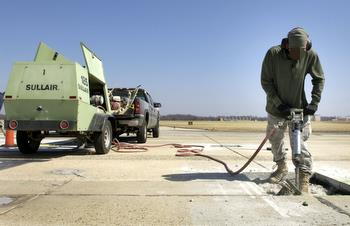
Photo: A construction worker using a pneumatic drill.
Note the red compressed air hose coming out of the left-hand side of the drill,
which is supplied by the large green portable air compressor (marked Sullair), hooked up to the
pickup truck on the left of the photo. Picture by Renae Kleckner courtesy of US Air Force.
Sponsored links
How does a jackhammer work?
Back to jackhammers. The first time you saw someone digging a hole
in the road with a tool like this, you probably thought the equipment
was electric or powered by a
diesel engine, right? In fact, the only
energy involved in making a jackhammer pound up and down is supplied
from an air hose. The hose, which has to be made of especially thick
plastic, carries high-pressure air (typically 10 times higher pressure
than the air around us) from a separate air-compressor unit powered by
a diesel engine.
The air compressor is a bit like a giant bicycle pump that never
stops blowing air. When the worker presses down on the handle, air
pumps from the compressor into the jackhammer through a
valve on one
side. Inside the hammer, there's a circuit of air tubes, a heavy
piledriver, and a drill bit at the bottom. First, the high-pressure air
flows one way round the circuit, forcing the piledriver down so it
pounds into the drill bit, smashing it into the ground. A valve inside
the tube network then flips over, causing the air to circulate in the
opposite direction. Now the piledriver moves back upward, so the drill
bit relaxes from the ground. A short time later, the valve flips over
again and the whole process repeats. The upshot is that the piledriver
smashes down on the drill bit over 25 times each second, so the drill
pounds up and down in the ground around 1500 times a minute.
Artwork: This little animation shows what happens inside a drill. Note how the blue valve at the top flips back and forth so the air changes direction. This makes the orange piledriver pound up and down, bashing the gray drill bit repeatedly into the ground. Note that this is a considerable simplification of what happens in a real drill, where the arrangement of valves, air passages, and so on is much more complex. You can get a sense of how much more complex real drills are from the illustration of Charles Brady King's original drill design, below.
Jackhammers, and the air compressors that power them, come in
all different shapes and sizes. The drill bits on the end are
interchangeable
too. There are wide chisels, narrow chisels, and tools called moil
points for fine work. A skilled drill operator can loosen chunks of
road in just 10-20 seconds, making light work of what our
ancestors—with their antler picks—would have found truly backbreaking work!
Who invented the jackhammer?
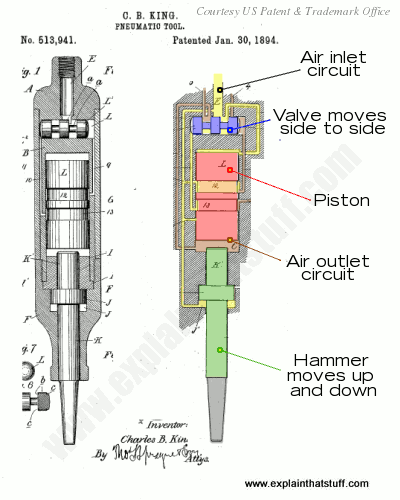
Artwork: Charles Brady King's jackhammer. Artwork courtesy of US Patent and Trademark Office.
Although there are hundreds of patents for jackhammers and pneumatic tools, the earliest appears to have been filed by Charles Brady King on May 19, 1892 and granted on January 30, 1894.
King's design is a more elaborate version of the one I've sketched out in my animation up above, but essentially works the same way with
a reciprocating (back-and-forth) valve making air move first one way and then another, moving a piston up and down, and bashing a drill bit repeatedly into the ground. I've colored the valve in blue and, in this design, it shifts from side to side, changing the way air flows between the inlet ports (colored yellow) and outlet ports (colored brown).
How does it work? When the valve is in the position shown here, air enters through the thick yellow hose at the top and follows the thinner paths shown in
yellow, pushing the piston (red) downward and smashing the hammer (green and gray) into the ground.
As the piston moves down, air flows back up through one of the pipes and pushes the blue valve over to the right, so the air now follows the brown paths and exits.
Here's a small selection of early jackhammer designs on record at the US Patent and Trademark Office, including King's. You can find many more examples if you search for "pneumatic drill" or "jackhammer" at the USPTO website (or on
Google Patents):
US Patent #651,487: Rock drilling engine by John Leyner 1900. Leyner perfected the rotating, "rifle bar" type of pneumatic drill in 1897 and introduced a number of other innovations in drilling shortly afterward.
US Patent #709,022: Rock-drilling engine by John Leyner, 1902, is a slightly later design that fires out jets of air and water to clear the cuttings from the drill hole.
US Patent #884,152: Pneumatic hammer by Martin Hardsocg, 1908. This variation shows how a pneumatic mechanism can power a rotary drill or boring machine.
Sponsored links
Electric jackhammers and other kinds
Not all jackhammers use compressed air, so it's a bit misleading to refer to them all, generically, as "pneumatic drills."
Some are driven by powerful electric motors, which rotate a crank or cam that converts the motor's spinning (rotary) motion into back-and-forth (reciprocating) motion, pumping a piston, forcing a small air cushion back and forth, so powering a second piston connected to a shaft that repeatedly hammers the drill or other tool. Electric jackhammers have the big advantage that you can operate them without a separate air compressor unit (you can use them wherever there's an electric power supply), though they sometimes struggle to cut through the thickest rock.
Photo: Look, no compressor! Electric jackhammers like this Bosch Brute run off any standard 115/120-volt electricity outlet or 2500-watt portable generator. Mechanically simpler, they're also much lighter; this one weighs just 29kg (63lb). Noise rated at 105dB, it's still horribly loud, but significantly quieter than many pneumatic drills.
Photo by James Fisher courtesy of US Air Force.
Other jackhammers are operated hydraulically so, instead of using compressed air, they're
powered by a continuous stream of hydraulic fluid (perhaps oil or water with additives). This flows through a hydraulic motor or turbine, powering a crankshaft and piston that hammers the drill bit. Hydraulic jackhammers are often used for underground mining where pneumatic tools are less suitable. Sometimes the hydraulic fluid that powers the drill is also used as a "cutting fluid" (for cooling and lubrication).
Photo: A hydraulic concrete breaker jackhammer attached to the end of a mini excavator. Jackhammers like this are capable of making up to 2600 blows per minute (bpm).
Because pneumatic jackhammers are incredibly noisy, engineers are constantly trying to develop quieter ways of achieving the same end. Perhaps surprisingly, much of the noise that a jackhammer makes comes not from the shattering pavement but from its own internal mechanism—the piledriver banging against the drill bit—so making a quieter machine means designing a hammer that works in a different way. In 2000, Brookhaven National Laboratory produced a helium-powered hammer called
RAPTOR that worked like a high-speed rifle, firing tiny steel nails into rock to break it apart.
NASA, meanwhile, has experimented with ultrasonic jack hammers that would
be lighter, quieter, and much more efficient. Ideas like those haven't caught on yet. Instead, electric jackhammers seem to be growing in popularity, largely because they're so much quieter than traditional pneumatic ones.
Artwork: One example of how a hydraulic jackhammer can work. Hydraulic fluid (turquoise, 24) flows in through a nozzle at top left, making a turbine (red, 25) rotate. This spins a transmission (dark green, 7), that powers a crank and connecting rod (dark blue, 12, 6). These move a sliding guide (yellow, 14a) back and forth, allowing a heavy mass (blue, 2a) to strike a rod (green, 15) attached to the tool bit. There's also an ingenious second part to this mechanism. The transmission simultaneously rotates the driveshaft (gray, 13), turning the drill chuck (gray, 16) and making the bit rotate. From US Patent 5,117,923: Hydraulic jackhammer by Wolfgang Wuhrer, Sulzer Brothers Limited, June 2, 1992, courtesy of US Patent and Trademark Office.
Sponsored links
Find out more
On this website
Pneumatics: A simple introduction to pneumatic technology.
Cranes: What's the science behind mighty lifting machines?
Drilling: Our general introduction to drilling technology covers everything from household DIY drills and oil wells to big-time air percussion rigs.
Hydraulics: The "liquid muscles" that power diggers and cranes work!
Simple machines: The science of forces—and how we can magnify them.
Books
Practical Pneumatics by Chris Stacey. Arnold, 1988 (reprinted in 2012 and available as an ebook). This doesn't specifically describe pneumatic drills; instead, it gives general background about pneumatic circuits, components, seals, and so on.
Hydraulics and Pneumatics: A Technician's and Engineer's Guide by Andrew Parr. Butterworth-Heinemann, 1998 (reprinted 2013 and available as an ebook). Another general guide covering the principles of pneumatic and hydraulic machines and the components from which they're built.
A Quiet Jackhammer: Discover,
November 1, 1997. An early article about RAPTOR.
Technical
Jackhammers: Popular Science, April 1961. This 50-year-old article gives a few more details about the internals of a jackhammer than I've been able to do here. Their version uses a rotating cylinder to open and close the valves and is based on a drill invented by John Leyner in 1897 (they omit to mention Charles Brady King's earlier design).
Safety
Powered Hand Tools - Pneumatic Tools - Basic Safety: Canadian Centre for Occupational Health & Safety, 2015. This useful factsheet explains safety precautions you need to take with jackhammers and power tools, from wearing eye and ear protection to avoiding the hazards of pressurized air.
Jackhammers and Silica Dust: The US National Institute for Occupational Safety and Health (NIOSH) explains how to reduce the respiratory risk from jackhammer dust using water spray attachments.
Patents
In addition to the conventional pneumatic patents listed in the box up above, these are also worth a look for their descriptions of alternative hammer-drilling mechanisms:
Please do NOT copy our articles onto blogs and other websites
Articles from this website are registered at the US Copyright Office. Copying or otherwise using registered works without permission, removing this or other copyright notices, and/or infringing related rights could make you liable to severe civil or criminal penalties.