Want to cook a dinner in five minutes or make an airplane safer to
fly in bad weather? You'll be needing some microwaves, then. Those are the invisible,
super-energetic, short-wavelength radio waves that travel at the
speed of light, doing the important stuff in microwave ovens and
radar-navigation equipment.
Making microwaves is easy if you have the right
equipment—a handy gadget called a magnetron. What is it and
how does it work? Let's take a
closer look!
Magnetrons are horribly complicated. No, really—they're horribly
complicated! To understand how they work, I find it helps to compare
them to two other things that work in similar ways: an old-style TV
set and a flute.
Photo: There's a magnetron tucked inside your microwave oven, usually just behind the control and instrument panel on the right. If you open the door, you can sometimes get a glimpse of the magnetron and its cooling fins through the perforated metal cage that separates it from the main cooking compartment.
A magnetron has quite a lot in common with a cathode-ray
(electron) tube, the sealed glass bulb that makes the picture in an
old-style television set. The tube is the heart of a TV: it makes the
picture you can see by firing beams of electrons at a screen covered
in chemicals called phosphors so they glow and give off dots
of light. You can read all about that in our main article on
television, but here (briefly) is what's happening. Inside the TV,
there's a negatively charged electrical terminal called a cathode
that's heated to a high temperature so electrons "boil" off it.
They accelerate down the glass tube, attracted by a positively
charged terminal or anode and reach such high speeds that they
race past and crash into the phosphor screen at the tube's end. But a
magnetron doesn't have the same purpose in life as a TV. Instead of making a
picture, it's designed to generate microwaves—and it does that a little bit
like a flute. A flute is an open pipe filled with air. Blow across
the top in just the right way and you make it vibrate at a specific
musical pitch (called its resonant frequency), generating a
sound you can hear that corresponds directly to the length of the
pipe.
Artwork: Right: One of the drawings of the high-energy magnetron developed in the 1940s by Percy Spencer, who went on to perfect the microwave oven while working at Raytheon. (I've colored it in to match my own artwork below.) You can see a bigger version of this drawing and read the full technical details via Google Patents. Artwork courtesy of US Patent and Trademark Office.
A magnetron's job is to generate fairly short radio waves.
If you could see them, you could easily measure them with a school ruler.
They're usually no shorter than about 1mm (0.04 in; the shortest
division on a metric ruler) and no longer than about 30cm (12in; the
length of a typical school ruler). The magnetron does its stuff by
resonating like a flute when you pump electrical energy into it. But, unlike a
flute, it produces electromagnetic waves instead of sound waves so
you can't hear the resonant energy its making.
(You can't see that energy either, because your eyes aren't sensitive to short-wavelength, microwave
radiation).
Photo: Typical microwaves range from the smallest (1mm) division on a school ruler up to the length of the ruler itself (30cm).
How does a magnetron make microwaves?
How does a magnetron resonate? It works a bit like a TV set:
There's a heated cathode (a solid metal rod) at the center of the magnetron. Here it's colored orange.
A ring-shaped anode surrounds the cathode (colored red).
If you switched on a simple magnetron like this, electrons would boil off from the
cathode and zip across to the anode in straight lines (shown by the black arrow) much like the
electron beam in a TV set. But there are two added extra bits in a
magnetron that change things completely.
First, the anode has holes or slots cut into it called cavities or resonant cavities.
Second, a powerful magnet is placed underneath the anode to generate
a magnetic field along the length of the tube (parallel to the
cathode and, in this diagram, going directly into the computer screen away from you).
Now when the electrons try to zip from cathode to anode,
they are traveling through an electric field (stretching between the
anode and cathode) and a magnetic field (produced by the magnet) at
the same time. So, like any electrically charged particles moving in a magnetic field,
they feel a force and follow a curved path (blue circle) instead of
a straight one, whizzing around the space between the anode and the
cathode.
As the electrons nip past the cavities, the cavities
resonate and emit microwave radiation. Think of the electrons passing
energy to the cavities, making then resonate like someone blowing
on the open end of a flute—only producing microwaves instead of sound waves.
The microwave radiation that the cavities produce is
collected up and channeled by a kind of funnel called a waveguide,
either into the cooking compartment of a microwave oven or beamed out
into the air by an antenna or satellite dish in radar equipment.
In reality, it's all a bit more complicated than that—of course. But think of
a TV set and a flute sort of merged together to produce microwaves instead of
flute sounds or TV pictures and you'll get the basic idea!
Sponsored links
A brief history of magnetrons
Photo: The CV64 cavity magnetron, developed in Birmingham in 1942, was small enough to fit inside an airplane. Devices like this made it possible for planes to use radar defenses for the first time. An exhibit at Think Tank (the science museum in Birmingham, England). Sorry about the slightly poor quality of the image: the exhibit is inside a glass case and hard to photograph.
1920s: American engineer Albert W. Hull invents the first magnetron while working for General Electric.
[1]
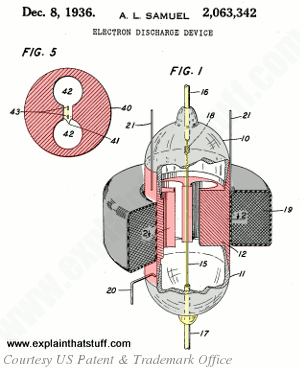
1934: Arthur L. Samuel of Bell Telephone Laboratories invents the cavity magnetron.
[2]
1936–7: Soviet scientists Nikolay Alekseyev and Dmitrii Malyarov build a four-segment cavity magnetron.
Although details of their work filters through to Germany, it remains unknown in Britain
and the United States.
[3]
1939: Two physicists, John Randall and Harry Boot, working at
the University of Birmingham, England independently develop a much more powerful
magnetron (E1189) that is compact enough to fit into ships, planes, and
submarines.
[4]
You can see a photo of it courtesy of the
UK's Imperial War Museum.
1940s: American engineer Percy Spencer accidentally discovers
that microwaves produced by a magnetron have enough power to heat
and cook food. He patents the microwave oven in the 1950s.
1943: The British E1189 cavity magnetron is deployed for the first time. [3]
1976: MIT researchers George Bekefi and Thaddeus Orzechowski develop the relativistic magnetron, which is roughly 10–100 times more powerful than the cavity magnetron. They achieve a power of 900MW, compared to the 10MW or so that cavity magnetrons were then capable of producing.
[5]
2009: University of Michigan researchers sponsored by the US Air Force
announce the development of a more compact, higher power magnetron that could improve the resolution of radar navigation.
About the author
Chris Woodford is the author and editor of dozens of science and technology books for adults and children, including DK's worldwide bestselling Cool Stuff series and Atoms Under the Floorboards, which won the American Institute of Physics Science Writing award in 2016. You can hire him to write books, articles, scripts, corporate copy, and more via his website chriswoodford.com.
A Brief History of the Microwave Oven by Evan Ackerman. IEEE Spectrum, September 30, 2016. How Raytheon's Percy Spencer pioneered a new way of cooking—with waves.
Personalities in Science: Albert W. Hull, Scientific American, Vol. 168, No. 5, May 1943, p. 195. A short biography of the magnetron pioneer—and why his work mattered so much in wartime.
Review of the relativistic magnetron by Dmitrii Andreev, Artem Kuskov, and Edl Schamiloglu. Matter and Radiation at Extremes 4, 067201 (2019). Includes a great review of general magnetron history and many useful citations.
Historical Notes on the Cavity Magnetron by H.A.H. Boot and J.T. Randall. Transactions of the Institute of Electrical and Electronics Engineers, Number 7, July 1976, p.724. How two British pioneers developed early military magnetrons.
Patents
Artwork: Illustrations of Arthur Samuel's original cavity magnetron from his
US Patent #2,063,342: Electron discharge device,
courtesy of US Patent and Trademark Office. As in the artworks above, the anode is colored red, the cathode yellow, and
the coil surrounding the glass discharge tube is dark gray.
If you want to read detailed technical descriptions of how magnetrons are designed and how they work, patents are an excellent place to start. They're not always that easy to understand, but the descriptions are extremely detailed and there are generally very clear labeled diagrams. Here are a few to start you off; you'll find lots more if you search at the USPTO (or Google Patents) using the keyword "magnetron":
US Patent #2,408,235: High-efficiency Magnetron by Percy L. Spencer, Raytheon Manufacturing Company, 24 September 1946. The full text of Percy Spencer's cavity magnetron patent, illustrated up above.
US Patent #7,906,912: Magnetron by Takeshi Ishii et al Panasonic Corporation, 15 March 2011. A very detailed description of the kind of magnetron you'll find in a modern microwave oven.
Please do NOT copy our articles onto blogs and other websites
Articles from this website are registered at the US Copyright Office. Copying or otherwise using registered works without permission, removing this or other copyright notices, and/or infringing related rights could make you liable to severe civil or criminal penalties.



.jpg)
.jpg)