Click click click! Thanks to an ingenious German physicist
named Hans Geiger, we've all heard the sound of
radioactivity. It's just as well we do have Geiger counters because
most radiation (radioactive particles and energy) is extremely
harmful to living things, completely invisible, and very difficult to
detect in other ways. What are Geiger counters? How do they work?
Let's take a closer look!
Artwork: The basic concept of a Geiger counter—a tube, attached to a meter, that can detect and measure particles of radiation.
There are several different types of radiation, caused by
different processes. Cosmic rays, for example, arrive on Earth
from outer space, but there's plenty of
naturally occurring radiation here
on Earth as well. Radiation is also made by artificial processes
that happen inside nuclear power plants and nuclear bombs.
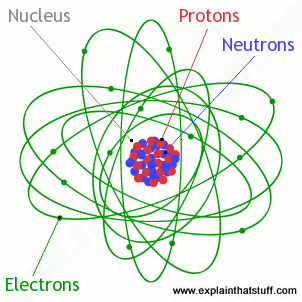
What causes radiation? Atoms of a particular chemical element
often exist in slightly different forms called isotopes.
The metal tin, for example, has ten stable isotopes: atoms that have the same number
of protons and electrons (50 of each) but different numbers of
neutrons. Stable isotopes are ones that are happy enough to stay as
they are indefinitely: they have nothing to gain by changing into a
different form. Not all isotopes are stable, however. Carbon has lots
of isotopes, the two best known being carbon-12 (ordinary, stable
carbon atoms with six protons, six neutrons, and six electrons) and
carbon-14 (with six protons, eight neutrons, and six electrons).
Having more (or fewer) neutrons than the ideal can make an atom so
unstable that it spontaneously changes into a different, more stable
atom or isotope by giving off some of its unwanted, subatomic
particles or energy. Thus, carbon-14 atoms spontaneously (albeit very slowly)
turn into nitrogen atoms. Atoms that are unstable in this way are
called radioactive isotopes and the particles they give off
are radiation. The kinds of radiation we're talking about are
alpha particles (two protons and two neutrons joined together, so
they're like the nuclei of helium atoms), beta particles (electrons
traveling at high speeds with high energy), and gamma rays (very
high energy electromagnetic rays—a bit like supercharged
light rays,
only invisible to our eyes and much more dangerous).
Artwork: Isotopes are atoms of an element that contain the same number of protons and electrons but different numbers of neutrons. An unstable (radioactive) isotope will naturally try to make itself more stable by getting rid of some of these particles and changing into a different atom.
Sponsored links
Ionizing radiation
Whether they come from Earth or space, radioactive particles and
rays have energy. Earth is surrounded by a blanket of gas (the
atmosphere) so, when radioactive particles race through it, they
collide with molecules of gases such as oxygen and nitrogen,
splitting them apart into electrons and positively charged ions.
This is called ionization. Now radiation may be impossible to see but detecting
ions and electrons is much easier. That's the job that a Geiger counter does
for us: it detects ionizing radiation by detecting the charged
particles that the radiation creates as it passes through gases in the
world around us.
Photo: A sailor with the US Navy uses a Geiger counter to check for radiation onboard a nuclear-powered vessel. Note the detector tube at the front and the handheld meter and loudspeaker in the separate box at the back. Photo by Tracy Lee courtesy of US Navy and
Wikimedia Commons.
What is a Geiger counter?
A Geiger counter is a metal cylinder filled with low-pressure gas
sealed in by a plastic or ceramic window at one end. Running down the
center of the tube there's a thin metal wire made of tungsten. The
wire is connected to a high, positive voltage so there's a strong electric
field between it and the outside tube.
When radiation enters the tube, it causes ionization, splitting gas molecules into ions and
electrons. The electrons, being negatively charged, are instantly
attracted by the high-voltage positive wire and as they zoom through
the tube collide with more gas molecules and produce further
ionization. The result is that lots of electrons suddenly arrive at
the wire, producing a pulse of electricity that can be measured on a
meter and (if the counter is connected to an amplifier and
loudspeaker) heard as a "click." The ions and electrons are
quickly absorbed among the billions of gas molecules in the tube so
the counter effectively resets itself in a fraction of a second,
ready to detect more radiation. Geiger counters can detect alpha,
beta, and gamma radiation.
Photo: Checking canned food for possible radioactive contamination back in 1963. This is a classic Geiger counter with the detector tube wired to a separate meter and a headset the operator
wears to listen to the clicks. Photo by Warren Dobson courtesy of
Centers for Disease Control (CDC).
Photo: Modern Geiger counters often have the two parts (detecting tube and associated electronics) packed into a single unit, with a digital display for easy reading. This is a Mirion ADM-300 with two built-in Geiger counters for detecting beta and gamma radiation and (inset) its LCD display. Both photos by Rhonda Smith courtesy of US Air Force and
DVIDS.
How a Geiger counter works
In summary then, here's what happens when a Geiger counter detects
some radiation:
Radiation (dark blue) is moving about randomly outside the detector tube.
Some of the radiation enters the window (gray) at the end of the tube.
When radiation (dark blue) collides with gas molecules in the tube (orange), it causes ionization:
some of the gas molecules are turned into positive ions (red) and electrons (yellow).
The positive ions are attracted to the outside of the tube (light blue).
The electrons are attracted to a metal wire (red) running down the inside of the tube maintained at a high positive voltage. As the electrons head for the wire, some of them collide with other gas molecules, splitting them into ions and more electrons. So we get a kind of chain reaction in which even a single particle of radiation can produce avalanches of electrons in rapid succession; this process is known as a Geiger discharge.
Many electrons travel down the wire making a burst of current in a circuit connected to it.
The electrons make a meter needle deflect and, if a loudspeaker is connected, you can hear a loud click every time particles are detected. The number of clicks you hear gives a rough indication of how much radiation is present (the meter gives you a much more accurate idea).
Before the counter can detect any more radiation, it needs to be restored to its original state through a process called quenching, which cancels out the effects of the Geiger discharge. Sometimes that's achieved by having a second gas (called a quenching gas, often a halogen) inside the tube. Or it can be done using an external circuit with a very large
resistance.
Artwork: A slightly different approach. This counter uses a standard Geiger tube (yellow,
left) with a central wire (blue) as above. But instead of detecting electrons directly, it looks for
photons of light and uses a photomultiplier tube (red, middle) to convert them into a measurable current.
The results are displayed on an "indicator" (blue, right), which is typically a counter of some sort. Artwork courtesy of US Patent and Trademark Office
from US Patent 2,485,586: Geiger counter by Ladislas Goldstein, International Standard Electric Corporation, granted October 25, 1949.
Who invented the Geiger counter?
Geiger counters are the most familiar of various ionizing
radiation detectors that work in broadly the same way. German
physicist Hans Geiger (1882–1945) developed the idea in 1912
while working with Ernest Rutherford, the New-Zealand-born physicist
who "split the atom" (proved experimentally that atoms consisted
of other, smaller particles). Back in Germany, sixteen years later,
Geiger greatly improved the instrument with the help of a colleague
named Walter Müller, which is why Geiger counters are often called
Geiger-Müller counters (or Geiger-Müller tubes).
Photo: Using a Geiger counter to check cans of buried nuclear waste for possible radiation leaks. Photo courtesy of
US Department of Energy (Flickr).
Can you make your own?
Odd though it might seem, there's a long tradition of amateur "radiation hunting."
In my 2015 book Atoms Under the Floorboards (p.106), I reprised the story of how amateur uranium prospectors used to sneak out with their Geiger counters, under
cover of darkness, to try to find lucrative uranium deposits (read more in
Finding Uranium in the Dark, Popular Science, July 1955, p.71).
In 2013, in the wake of the Fukushima nuclear disaster, citizen science groups equipped themselves with DIY counters called bGeigies to check the radiation.
You can build your own Geiger counter if you want to—and you'll find a few
in kit form in the hobbyist/maker space. The one pictured below is the battery-powered MightyOhm version from Jeff Keyzer. You can clearly see the Geiger tube at the bottom.
Radiation Detection and Measurement by Glenn F. Knoll. John Wiley, 2010. A guide for nuclear engineers that covers all kinds of radiation measurement, including Geiger counters, scintillation detectors, photomultipliers, and much more. Quite a complex book and not really one for beginners or general readers.
The Fly in the Cathedral by Brian Cathcart. New York: Farrar, Straus and Giroux, 2005. An account of how Cambridge scientists, led by Ernest Rutherford, fathomed out the mysteries of the atom in the early 20th century.
What's Lurking in Your Countertop?
by Kate Murphy. The New York Times, July 24, 2008. Is your new granite kitchen giving off dangerous levels of radiation? A Geiger counter will tell you.
Me and My Geiger Counter by Fred Bernstein. The New York Times, June 27, 2002. How the 9/11 terrorist attacks rekindled interest in home radiation detectors.
How to choose a Geiger counter by Griff Borgeson. Popular Science, January 1956. This old article from the Pop Sci archive speaks of another age when amateur uranium hunting was all the rage! It explains the basic principles of Geiger counters and compares simple counters, rate meters, and multitubes.
Patents
For deeper technical detail, try these:
US Patent 2,485,586: Geiger counter by Ladislas Goldstein, International Standard Electric Corporation, granted October 25, 1949. A small, lightweight Geiger counter that uses a photon (light particle) detector and photomultiplier tube.
US Patent 2,442,314: Geiger counter improvement by Allen F Reid, Atomic Energy Commission, granted May 25, 1948. This counter uses quenching with a halogen gas to detect rapid emission of particles more effectively. You'll find a detailed description of how quenching works here.
Please do NOT copy our articles onto blogs and other websites
Articles from this website are registered at the US Copyright Office. Copying or otherwise using registered works without permission, removing this or other copyright notices, and/or infringing related rights could make you liable to severe civil or criminal penalties.