Power to go—aren't batteries brilliant?
The trouble is, they store only a fixed amount
of electric charge before running flat, usually at the most
inconvenient of times. If you use rechargeable batteries, that's less
of a problem: click your batteries in the charger, plug in, and in a
few hours they're as good as new and ready to use again. A typical
rechargeable battery can be charged up hundreds of times, may last
you anything from three or four years to a decade or more, and will
probably save you hundreds of dollars in buying disposables (so it's
brilliant for the environment too). But exactly how well your batteries
perform depends on how you use them and how carefully you charge
them. That's why a decent battery charger
is as important as the batteries you put into it. What is a battery charger and how does
it work? Let's take a closer look!
Photo: Solar-powered battery chargers, like this one made by BEAM, are sure to become increasingly common as more of us switch to electric cars. The overhead canopy contains a 4.3kW, photovoltaic, sun-tracking solar panel
and feeds onboard batteries so it even works at night. It can charge up to six electric vehicles
at a time. Photo by Erin Rohn courtesy of US Marine Corps and DVIDS.
If you've read our main article on batteries,
you'll know all about these portable power
plants. An example of what scientists refer to as electrochemistry,
they use the power of chemistry to release stored electricity very
gradually.
What happens inside a typical battery—like the one in a flashlight?
When you click the power switch, you're
giving the green light to chemical reactions inside the battery.
As the current starts flowing, the cells (power-generating compartments)
inside the battery begin to transform themselves in startling but
entirely invisible ways. The chemicals from which their components
are made begin to rearrange themselves. Inside each cell, chemical
reactions take place involving the two electrical terminals (or
electrodes) and a chemical known as the electrolyte
that separate them. These chemical reactions cause electrons (the
tiny particles inside atoms that carry electricity) to pump around
the circuit the battery is connected to, providing power to the
flashlight. But the cells inside a battery contain only limited supplies of chemicals so
the reactions cannot continue indefinitely. Once the chemicals are
depleted, the reactions stop, the electrons cease flowing through the
outer circuit, the battery is effectively flat—and your lamp goes
out.
Photo: Ordinary batteries (like this everyday zinc-carbon battery)
are only designed to be used once—so don't attempt to recharge them. If you
don't like zinc carbon batteries, don't start trying to recharge them: buy rechargeable ones to begin with.
That's the bad news. The good news is that if you're using a rechargeable battery, you can
make the chemical reactions run in reverse using a battery charger.
Charging up a battery is the exact opposite of discharging it: where
discharging gives out energy, charging takes energy in and stores it
by resetting the battery chemicals to how they were originally. In
theory, you can charge and discharge a rechargeable battery any
number of times; in practice, even rechargeable batteries degrade
over time and there eventually comes a point where they're no longer
willing to store charge. At that point, you have to recycle them or
throw them away.
Sponsored links
How battery chargers work
All battery chargers have one thing in common: they work by feeding a
DC electric current through batteries for a period of
time in the hope that the cells inside will
hold on to some of the energy passing through them. That's roughly
where the similarity between chargers begins and ends!
Charging methods
There are, broadly speaking, two different ways to charge a battery: quickly or slowly.
Fast charging essentially means using a higher charging current for a shorter time,
whereas slow charging uses a lower current for longer.
That doesn't mean the charging process is just a simple matter of passing a steady
current through the battery until it's charged.
There are several common methods of charging (plus a few more we won't go into here).
[1]
Photo: Battery chargers look simple, but they're surprisingly complex inside.
Different types of rechargeable batteries need charging in different ways, for different times,
sometimes using several different methods in turn, which make up what's called the charging
algorithm. A charger like this is constantly sensing what the batteries inside it are doing
and adjusting the charging process accordingly.
Pulse charging involves sending intermittent pulses of high current through the battery,
with rest periods in between to allow the battery chemicals to absorb the charge.
In crude terms, the pulses are a little bit like the thumping charges to the chest you see an emergency responder giving to someone who's suffered a cardiac arrest, except that they continue until
the battery's voltage climbs toward its rated, peak value and the battery is fully charged.
(Pulse charging can also be useful for reviving older, degraded batteries, such as lead-acid or nickel-cadmium, in which crystals have grown and impeded the batteries'
ability to keep on working; the pulses of electricity break the crystals down so the
battery works normally again.)
In taper-current charging, the charger starts off using a high, constant current,
which progressively lowers to a trickle as the battery fills with charge and reaches
its peak voltage. Inexpensive chargers often work this way.
[8]
Two alternative ways of charging are constant current (CC) and
constant voltage (CV). As their names suggest,
constant current applies a steady current (usually the battery's peak current),
while constant voltage applies a steady voltage (usually the battery's peak voltage),
and the two are often used together, one after another, in constant
current constant voltage (CCCV) chargers.
Typically, they start off applying a constant current until the battery voltage
passes a certain threshold; then they apply a constant voltage until the
current passes another threshold.
Another variation is two-step constant-current charging that begins with a fast high-current
charge and switches to a slower, lower-current charge part way through the process.
[9]
Photo: This "fast-charge" battery charger is designed to
charge four cylindrical nickel-cadmium (nicad) batteries in five hours or
one square-shaped RX22 battery in 16 hours. I think it's an example of a constant-current
or maybe taper-current charger, though I've not tested it to find out.
It's easy to use, and just as easy to misuse: there's nothing to tell you when charging is complete.
With a battery charger like this, charging batteries is complete guesswork.
The final method is called trickle charging, and is similar to constant current charging but uses a much smaller current (perhaps 5–10 percent) for much longer. Some appliances (like cordless phones and electric toothbrushes) are designed to sit on trickle chargers indefinitely.
However you charge, it's worth remembering that, in a very crude sense, batteries are a bit like suitcases: the more you pack in, the harder it is to pack in any more—and the longer it takes.
That's easy to understand if you remember that charging a battery essentially involves reversing the chemical reactions that take place when it discharges and supplies useful current.
In a laptop battery, for example, charging and discharging involve shunting lithium ions (atoms missing electrons) back and forth, from one electrode (where there are many of them) to another electrode (where there are few).
Since the ions all carry a positive charge, it's easier to move them to the "empty" electrode at the start. As
they start to build up there, it gets harder to pack more of them in, making the later stages of charging harder work than the earlier ones.
Graph: Batteries get harder to charge in the later stages. It can take as long to charge the last 25 percent of a battery (red area) as the first 75 percent (orange area).
[2]
It's worth remembering this if you have limited time to charge a battery and worry that it'll take too long: you might be able to charge it halfway in much less time than you think. If the battery in this
example takes an hour to charge, you can see that it would reach 50 percent charge (dotted lines)
in just 6.5 minutes.
Charging algorithms
Different charging methods are suited to different types of batteries. Simple pulse charging works well
for nickel cadmium and nickel metal-hydride batteries, which are also widely charged by the constant
current (CC) method, but pulse charging is quite crude and unsuitable for lithium-ion batteries, which are generally charged by CCCV instead.
Better chargers work more intelligently, combining different types of charging in sequence according to how the battery performs as it's being charged.
So, for example, a battery may be slowly pre-charged (by trickle charging) for a short time to test how well it's accepting charge, then fast-charged fully by CC and CV, which may be alternated multiple times.
[3]
The combination of charging methods used by a particular charger is known as its charging algorithm.
Graph: A simple charging algorithm might involve three stages: brief trickle charging to test the battery followed by periods of fast constant-current and constant-voltage charging.
[7]
Charging time
The ideal charging time varies for all sorts of reasons
(how much charge the battery held to begin with, how hot it is,
how old it is, whether one cell is performing better than others, and so on).
How does a charger know when to stop?
Different methods are used for different types of batteries, and for slow charge or fast charge.
The best chargers work intelligently, using microchip-based electronic circuits to sense how much charge is stored in the batteries, figuring out from such things as changes in the battery voltage
(technically called delta V or ΔV) and cell temperature (delta T or ΔT) when the charging is likely to be "done," and then switching off the current or changing to a
low trickle charge at the appropriate time.
There's usually a primary method of figuring out that the charge is complete
(such as measuring the voltage) and one or more backup methods
(temperature changes or a preset timer).
[4]
NiCd chargers, for example, often use a primary method called −ΔV (also written negative delta V or NDV, which refers to the slight voltage drop that a NiCd battery shows just after it's fully charged),
with a backup timer or temperature-change detector.
NiMH chargers are more likely to rely on temperature changes as their primary method with a backup
timer cut-off circuit. In theory, it's impossible to overcharge or undercharge with an intelligent charger.
Photo: The Innovations Battery Manager, popular in the 1990s, was sold as an intelligent battery charger capable of recharging even ordinary zinc-carbon and alkaline batteries. Right: A digital display showed the voltage of each battery as it charged (in this case, 1.39 volts). After charging, a little bar graph appeared showing how good a condition the battery was in (how many more times you could charge it). Many thousands of these chargers were sold, but there were
differing opinions on how well they worked.
If you're charging batteries, you probably think fast charge is automatically better—you
want to use your laptop or phone as soon as you can. But it comes with major drawbacks.
The chemicals in batteries take time to absorb charge and faster charging can shorten
the life of a battery (a big problem for things like expensive electric car batteries), or
risk safety problems such as overheating and fires.
[5]
Multiple batteries
Most chargers are designed to charge two, three, or four batteries at the same time,
which adds a few extra complications.
If you simply connect them in series and try to charge them, how do you know which
batteries are in a good condition and charging well and which ones are poorer and
accepting less charge? One battery is almost certain to reach full charge before the others,
so it's almost inevitable that some will be overcharged (and potentially damaged) while
others remain undercharged. Decent battery chargers get around this with circuits that monitor each battery individually, switching off or reducing its charging current to a trickle,
independently, when it's fully charged.
[6]
AC and DC
Batteries are direct current (DC) devices: current flows in one way (during charging)
and out the other (during discharging).
But most of us live in homes with alternating current (AC) supplies, so plug-in battery chargers
have to convert AC electricity to DC before they can charge the batteries you
want to put into them. Exactly how they do this affects the quality of the DC charging current and how cleanly and effectively they charge. Typically, AC-powered chargers use some combination of step-down transformers (to convert
high voltages, typically 110–240 volts, to lower ones more like 1.5–20 volts); rectifiers (diode-type circuits) and thyristors (silicon controlled rectifiers), to convert AC to DC; and integrated circuits to filter and smooth their output.
Sponsored links
Charging different kinds of rechargeable batteries
To complicate matters, different types of rechargeable batteries respond best to different
types of charging, so a charger suitable for one type of battery may
not work well with another.
Nickel-based batteries
Photos: An electric toothbrush typically contains either nicad or NiMH batteries and slowly or trickle charges on a stand, which is actually an induction charger.
Nickel cadmium
(also called "nicad" or NiCd), the oldest and perhaps still best
known types of everyday rechargeable batteries, respond best either to fairly
rapid charging (providing it doesn't make them hot) or slow trickle
charging.
[10]
Nickel metal hydride (NiMH) batteries use newer technology and look exactly
the same as nicads, but they're generally more expensive because they can store
more charge (shown on the battery packaging as a higher rating
in mAH or milliampere-hours). NiMH batteries can be fast charged (on
high current for several hours, at the risk of overheating), slow
charged (for about 12–16 hours using a lower current), or briefly trickle
charged (with a much lower current than nicad), but they should
really be charged only with an NiMH charger: a rapid nicad charger
may overcharge NiMH batteries.
Expert opinions seem to differ on whether nickel batteries experience what's widely known as the memory effect. This is the well-reported phenomenon where failure to discharge a nickel-based battery before charging (when you're "topping up" a partly discharged battery with a
quick recharge) reputedly causes permanent chemical changes that reduce how
much charge the battery will accept in future. Some people swear the
memory effort is real; others are equally insistent that it's a myth.
The real explanation for an apparent memory effect is
voltage depression, where a battery that hasn't been fully discharged before charging temporarily
"thinks" it has a lower voltage and charge-storing capacity than it should have.
Battery experts insist you can cure this problem by charging and discharging
a battery fully a few times more.
It's generally agreed that nickel-based batteries need to be "primed"
(charged fully before they're used for the first time), so be sure to
follow exactly what the manufacturers say when you take your new
batteries out of the packet.
How long should you charge rechargeable batteries?
There are two simple reasons why there are so many different sizes and types of batteries:
a bigger battery has more chemicals inside it so it can store more energy
and release it for longer; bigger batteries also tend to have more cells inside them so they can produce a higher voltage
and current to power bigger things (brighter flashlight bulbs or higher-powered motors).
By the same token, bigger rechargeable batteries need charging for longer.
The more energy you expect to get out of a rechargeable battery
(the longer you expect it to last), the longer you'll need to charge it
(or the higher the charging current you'll need to use). A basic law
of physics called the conservation of energy tells us
you can't get more energy out of a battery than you put into it.
Most people tend to put things on to charge "overnight" without paying too much attention to exactly
what that means—but your batteries will work better and last longer if you charge them for the
right number of hours. How long is that? It can be very confusing, especially if you use batteries that didn't come supplied with your charger.
Never fear! All you have to do is read what it says on your batteries and you should find (often in tiny writing) the recommended charging current and charge times. If you have a basic charger, simply check its current rating and adjust the charge time accordingly. Bear in mind what we've said elsewhere about matching your charger to your batteries, however.
Photo: Battery science is not rocket science—charging rechargeables is easy if you follow the instructions, generally written on the batteries or the package they came in.
For example, these three ordinary, 1.2-volt nickel-based rechargeables have quite different recommendations:
At the top, the white and green nicad battery recommends a slow charge of 60mA (milliamps) for 14–16 hours or a fast charge of 390mA (over six times higher current) for just two hours (2h). The total charge going into the battery is equal to the current multiplied by the time, so multiply the numbers and you'll get a value of about 800–900 mAh. The battery itself claims its capacity is 0.65Ah (650mAH), but don't forget that the charging process is not 100 percent efficient: the battery won't absorb all the electrical energy passing through it. So the amount of charge you're supplying and the amount the battery will absorb are in the same ball park.
In the middle, the silver NiMH battery recommends a charge of 200mA (milliamps) for 7 hours, which gives us a charge of about 1400mAh. Again, the battery itself claims its capacity is lower than this (1000mAH).
At the bottom, the green and orange NiMH battery recommends a charge of 63mA (milliamps) for 18 hours, which gives just over 1000mAh. The battery is rated slightly lower (970mAH).
Lithium-ion batteries
Lithium-ion rechargeable batteries are usually built into gadgets such as
cellphones,
MP3 players,
digital cameras, and laptops. Typically they
come with their own chargers, which automatically sense when charging
is complete and cut off the power supply at the right time.
Lithium-ion batteries can become dangerously unstable when the
battery voltage is either too high or too low, so they're designed
never to operate under those conditions. If the voltage gets
too low (if the battery discharges too much during use), the
appliance should cut out automatically; if the voltage gets too high
(during charging), the charger will cut out instead. Although
lithium-ion batteries don't show a memory effect, they do degrade as
they get older. A typical symptom of aging is gradual discharge for a
period of time (maybe an hour or so) followed by a sudden, dramatic,
and completely unexpected cut-out of the appliance after that.
Read more about how lithium ion batteries work.
Photo: An idiot-proof Canon charger for lithium-ion camera batteries. When the battery needs charging, the camera warns you well in advance. Simply remove the battery (very easy on a digital camera), put it the separate charger unit, and the indicator light shows red, turning green when the battery is fully charged. The whole process is automatic and safe: the camera stops you using the battery before its voltage gets too low; the charger stops you charging it before the voltage gets too high.
Lead-acid batteries
The biggest, heaviest, and oldest rechargeable batteries take their name from their
(dilute) sulfuric-acid electrolyte and lead-based electrodes. They're most
familiar to us as car batteries (the initial energy supplies that
get a car engine turning over before the gas starts burning),
though slightly different types of lead-acid batteries are also used in things like golf
buggies and electric wheelchairs.
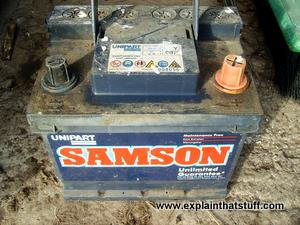
Photo: Lead-acid car batteries were originally developed in the 19th century, long before nickel- and lithium-based rechargeable technologies came along.
Lead-acid batteries are popular because they're simple, cheap, reliable, and use well-proven technology
that dates back to the middle of the 19th century. Generally they last for several years, though that depends entirely on how well
they are maintained—in other words, charged and discharged. They do take quite a long time to charge (typically up to 16 hours—several times longer than they take to fully discharge), and that can lead to a tendency both to undercharge
(if you don't have time to charge them properly before you next use them) or overcharge (if you put them on charge and forget all about them). Undercharging, charging with the wrong voltage, or leaving batteries unused causes a problem known as sulfation (the formation of hard lead sulfate crystals), while overcharging causes corrosion (permanent degradation of the positive lead plate through oxidation, analogous to rusting in iron and steel). Both will affect the performance and life of a lead-acid battery. Overcharging also tends to degrade the electrolyte, decomposing water (by electrolysis) into hydrogen and oxygen, which are given off as gases and therefore lost to the battery. That makes the acid stronger and more likely to attack the plates, which will reduce the battery's performance. It also means there's less electrolyte available to interact with the plates, also reducing the performance. From time to time, batteries like this have to be topped up with distilled water (not ordinary water) to keep the acid at the optimum strength and at a high enough level to cover the plates.
Matching the batteries to the charger
Different battery chargers are designed to work in different ways at different speeds,
largely to suit different types of batteries. The first rule of
battery charging is that a charger designed for one kind of battery
may not be suitable for charging another: you can't charge a
cellphone with a car battery charger, but neither should you charge
NiMH batteries with a nicad charger. Many modern rechargeable
appliances and gadgets—such things as laptops, MP3 players, and
cellphones—come with their own, special charger when you buy them, so you
don't have to worry about matching the charger to the battery. But if
you buy a packet of generic, rechargeable batteries in a store, it's
important that you buy batteries that suit the charger you have or
replace your charger accordingly. Note the voltage and current that
the batteries require (it will be marked on the battery package or on
the batteries themselves), be sure to choose a charger with the right
voltage and current to go with them, and charge for the correct
amount of time. If you want to buy yourself some rechargeable
batteries but you're not really sure how to go about matching batteries and
charger, go for a combined set—where you buy batteries and charger
in the same package.
Photo: Matching the battery to the charger. As the world shifts to more environmentally friendly battery-powered electric cars, we'll need a lot more
properly equipped, conveniently sited charging stations. This one uses photovoltaic solar cells (in the canopy) to charge the vehicles parked below. Photo by Dennis Schroeder courtesy of NREL.
How long do rechargeable batteries last?
Not surprisingly, it depends on how you treat them, store them, and use them.
Small rechargeables (like NiCd, NiMH, and lithium ion) typically last hundreds of "cycles"
(you can charge and discharge them that many times), which can mean anything from several years
of decent life in a laptop to a decade of use in a portable radio. Treated well,
lead-acid car batteries are usually good for thousands of cycles and can easily last
5–10 years in a car that's driven each day. But if you leave rechargeable batteries
in a product you barely ever use, never charge or discharge them, overcharge them,
let them overheat, or store them in poor conditions, don't expect them to last long.
How do you know when it's time to replace batteries? In something like a laptop, you might
notice a lithium-ion battery discharges normally for a time, then suddenly loses all its remaining
charge very quickly. If you're using rechargeable NiCd or NIMH batteries in things like flashlights,
you'll see very gradually reducing capacity and the need to recharge much more often.
Top tips for better battery life
How can you get the best from your batteries? Here are some top tips I've found
by reading through a variety of battery-expert websites:
Rechargeable batteries work best when used regularly. Don't leave them sitting
around in your shed, fully charged or fully discharged for months.
Battery experts suggest it's a good idea to "condition" or "recondition"
your batteries. This means you regularly let them discharge
substantially before recharging if you can (though you don't need to completely drain them).
Match your charger to your batteries. For example, use an NiMH charger for NiMH batteries
and be sure the charger uses appropriate voltage and current.
Don't overcharge your batteries. You will damage them.
Don't let your batteries get too hot or too cold, either during charging, storage,
or use (it damages them). They will warm up during charging, but if they get really hot, something's wrong.
Don't skimp on buying a decent, intelligent charger. Your batteries will last much
longer if the charger treats them right!
Wherever possible, follow the instructions that come with your appliance. For example, the
instructions that come with the Roomba® robot vacuum cleaner tell you to leave it
"docked" (sitting on its charger), trickle charging, all the time it's not being used. If you don't do this,
you'll find your Roomba loses its charge very quickly (even if you don't use it) and you may well shorten the battery life.
If you use something like a laptop, permanently plugged in, get into the habit of
letting it run from the battery, perhaps once a week or so, until it discharges almost completely,
to help keep the battery in good condition. You'll find this helps to extend the
life of your battery.
Battery University: Isidor Buchmann's wonderfully detailed website covers everything you could possibly want to know about virtually every type of battery you can think of.
The Electropaedia: Barrie Lawson has a similarly detailed site with an alternative explanation of batteries, energy storage, and related physics.
Understanding Batteries by Ronald Dell and David Rand. Royal Society of Chemistry, 2001. A very comprehensive guide covering the history of batteries, the various types, how to choose a battery for a certain application, and the electrochemistry of charging and discharging.
Powerful Chemical Cocktail, With a Drawback by Matthew Waldjan. The New York Times, January 17, 2013. Fire risk is an ever-increasing concern as lithium-ion batteries become more commonplace.
↑An Overview of the Fundamentals of Battery Chargers by Bora Tar and Ayman Fayed, 2016 IEEE 59th International Midwest Symposium on Circuits and Systems (MWSCAS), 16–19 October 2016, Abu Dhabi, UAE, 2016, pp. 1–4, doi: 10.1109/MWSCAS.2016.7870048.
↑ See "V. Multi-cell battery chargers" in An Overview of the Fundamentals of Battery Chargers by Bora Tar and Ayman Fayed, 2016 IEEE 59th International Midwest Symposium on Circuits and Systems (MWSCAS), 16–19 October 2016, Abu Dhabi, UAE, 2016, p.4, doi: 10.1109/MWSCAS.2016.7870048.
↑ Taper-current charging is briefly described in Understanding Batteries by Ronald Dell and David Rand. Royal Society of Chemistry, 2001, p.38.
↑ Variations on constant-current and constant-voltage charging are described in Understanding Batteries by Ronald Dell and David Rand. Royal Society of Chemistry, 2001, pp.36–38.
↑ Lead-acid batteries were the first rechargeables, invented in 1859 by Gaston Planté, but I'm thinking here of the kind of compact, everyday rechargeables we use around the home. Nicads were invented c.1898 by Swedish
electrical engineer Waldemar Jungner,
who earned a number of patents for battery innovations, including
Electrode for reversible galvanic batteries, filed in September 1904 and granted in April 1908.
Please do NOT copy our articles onto blogs and other websites
Articles from this website are registered at the US Copyright Office. Copying or otherwise using registered works without permission, removing this or other copyright notices, and/or infringing related rights could make you liable to severe civil or criminal penalties.