Have you ever done one of those spot-the-difference newspaper puzzles where
you have to find the missing details using two very similar cartoons?
The quick way to solve them is to cut out the two images, place one
on top of the other, and shine a light through the paper. It might
sound like cheating but it's actually science: you're using the light
pattern from one image to show up differences in the other.
Scientists use a very similar process called interferometry to
measure small things with incredibly high accuracy by comparing
light or radio beams. Let's take a closer look at how it works!
Photo: A laser interferometer. The laser beam is split into two parts. One part travels straight to a detector while the other undergoes a change of some sort. By comparing the two beams again at the end, you can measure the extent of the change very precisely. Photo courtesy of NASA Glenn Research Center (NASA-GRC) and Internet Archive.
To understand interferometry, you need to understand interference.
In everyday life, interference simply means getting in the way or
meddling, but in physics it has a much more specific meaning.
Interference is what happens when two waves carrying energy meet up
and overlap. The energy they carry gets mixed up together so, instead
of two waves, you get a third wave whose shape and size depends on
the patterns of the original two waves. When waves combine like this,
the process is called superposition.
If you've ever sat making waves in a bath-tub, you'll have seen
interference and superposition in action. If you push your hand back
and forth, you can send waves of energy out from the center of the
water to the walls of the tub. When the waves get to the walls, they
bounce back off the hard surface more or less unchanged in size but
with their velocity reversed. Each wave reflects off the tub just as if
you'd kicked a rubber ball at the wall. Once the waves come back to
where your hand is, you can make them much bigger by moving
your hand in step with them. In effect, you create new waves that add
themselves to the original ones and increase the size of their peaks
(amplitude). When waves add together to make bigger waves, scientists call it
constructive interference.
If you move your hands a different way, you can create waves that are
out of step with your original waves. When these new waves add to the
originals, they subtract energy from them and make them smaller. This
is what scientists call destructive interference.
Artwork: The two types of interference.
Constructive interference means combining two or more waves to get a third wave that's bigger.
The new wave has the same wavelength and frequency but more amplitude (higher peaks).
Destructive interference means waves subtracting and canceling out.
The peaks in one wave are canceled by the troughs in the other.
Sponsored links
It's just a phase
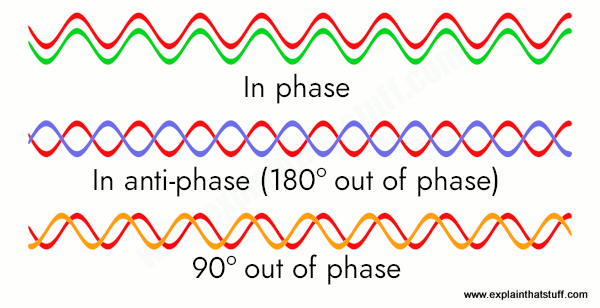
The extent to which one wave is in step with another is known as its
phase. If two identical waves are "in phase," it means their
peaks align so, if we add them together, we get a new wave that's
twice as big but otherwise exactly the same as the original waves.
Similarly, if two waves are completely out of phase (in what we call antiphase),
the peaks of one exactly coincide with the troughs of the other so
adding the waves together gives you nothing at all. In between these
two extremes are all sorts of other possibilities where one wave is
partly in phase with the other. Adding two waves like this
creates a third wave that has an unusual, rising and falling pattern of peaks and
troughs. Shine a wave like this onto a screen and you get a
characteristic pattern of light and dark areas called interference
fringes. This pattern is what you study and measure with an interferometer.
Artwork: 1) If two waves vibrate exactly in step, we say they're in phase. 2) If they vibrate so the peaks of one wave match the troughs of the other, we say they're 180 degrees out of phase or in antiphase. 3) If one vibrates so its peaks and troughs coincide with the mid-points of the other, we say they're 90 degrees out of phase.
How do interferometers work?
An interferometer is a really precise scientific instrument designed to
measure things with extraordinary accuracy. The basic idea of
interferometry involves taking a beam of light
(or another type of electromagnetic radiation) and splitting it into two equal halves
using what's called a beam-splitter (also called a half-transparent
mirror or half-mirror). This is simply a piece of glass whose surface is very thinly coated with silver. If you shine light at it, half the light passes straight through and half of it reflects back—so the beam-splitter is like a cross between an ordinary piece of glass and
a mirror. One of the beams (known as the reference beam) shines onto a mirror and from there to a screen, camera,
or other detector. The other beam shines at or through something you want to measure, onto a second mirror, back through the beam splitter, and onto the same screen. This second beam travels an extra distance
(or in some other slightly different way) to the first beam, so it gets slightly out of step (out of phase).
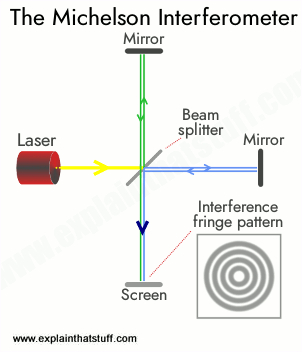
Artwork: How a basic (Michelson) interferometer works. If we take the green
beam to be the reference beam, we'd subject the blue beam to some sort of change we wanted to measure.
The interferometer combines the two beams and the interference fringes that appear on the screen
are a visual representation of the difference between them.
When the two light beams meet up at the screen, they overlap and interfere, and the phase difference between them creates a pattern of light and dark areas (in other words, a set
of interference fringes). The light areas are places where the two
beams have added together (constructively) and become brighter; the
dark areas are places where the beams have subtracted from one
another (destructively). The exact pattern of interference depends on
the different way or the extra distance that one of the beams has
traveled. By inspecting and measuring the fringes, you can calculate
this with great accuracy—and that gives you an exact measurement of
whatever it is you're trying to find.
Instead of the interference fringes falling on a simple screen, often they're directed into
a camera to produce a permanent image called an interferogram. In another arrangement,
the interferogram is made by a detector
(like the CCD image sensor used in older digital cameras) that converts the pattern of fluctuating optical interference fringes into
an electrical signal that can be very easily analyzed with a computer.
What are the different types of interferometers?
Interferometers became popular toward the end of the 19th century and there are several
different kinds, each based roughly on the principle we've outlined
above and named for the scientist who perfected it. Six
common types are the Michelson, Fabry-Perot, Fizeau,
Mach-Zehnder, Sagnac, and Twyman-Green interferometers.
The Michelson interferometer (named for Albert Michelson,
1853–1931) is probably best known for the part it played in the
famous Michelson-Morley experiment in 1881. That was when Michelson and his
colleague Edward Morley (1838–1923) disproved the existence of a mysterious invisible fluid called "the ether" that physicists had believed filled empty space. The Michelson-Morley experiment was an important stepping-stone toward Albert Einstein's theory of relativity.
The Rayleigh interferometer (invented in 1896 by Lord Rayleigh, 1842–1919),
is mainly used for measuring the refractive indexes of gases,
which explains why it's also sometimes known as the Rayleigh interference refractometer.
It works by splitting a light beam in two, passing each half beam through a separate tube (one of them containing
the gas being studied), and then combining them again to produce interference.
Artwork: How a Rayleigh interferometer works. The light source is split between two tubes, one containing a gas being studied and the other containing a control. The interference pattern shows up the difference between the two.
The Fabry-Perot interferometer (invented in 1897 by Charles
Fabry, 1867–1945, and Alfred Perot, 1863–1925), also known as an
etalon, evolved from the Michelson interferometer, but looks very different.
Light bounces back and forth between two half-silvered glass plates, with
some transmission and some reflection each time. Each ray of transmitted light
is slightly more out of phase than the previous one because of the extra distance
it's traveled. The rays are brought to a focus by a lens to make clearer and
sharper fringes that are easier to see and measure.
Artwork: How a Fabry-Perot interferometer works.
Here's an example of what a real Fabry-Perot looks like:
The Fizeau interferometer (named for French physicist Hippolyte
Fizeau, 1819–1896) is another variation and is generally easier to use than a Fabry-Perot. It's widely used for making optical and engineering measurements.
Artwork: A Fizeau interferometer can be used to compare the surfaces of two transparent objects, such as microscope slides, placed back to back. Laser light passes through a single beam splitter, bounces back off the two surfaces (a test surface and a control or reference surface for comparison), interferes, reflects off the beam splitter, and arrives at a detector where the interference fringes can be measured.
The Mach-Zehnder interferometer (invented by German Ludwig Mach and Swissman Ludwig Zehnder) uses two beam splitters instead of one and produces two output beams, which can be analyzed separately. It's widely used in fluid dynamics and aerodynamics—the fields for which it was originally developed.
Artwork: A Mach-Zehnder interferometer has two mirrors, two beam splitters (half mirrors), and two detectors. Mirrors and beam splitters affect the phase of incoming waves in different ways, so the upper detector is normally dark (due to destructive interference) and the lower detector is light (due to constructive intererence). Adding a test to one beam and a control to the other changes the interference in the detectors in a way that can be compared and measured.
The Sagnac interferometer (named for Georges Sagnac, a French physicist) splits light into two beams that travel in opposite directions around a closed loop or ring (hence its alternative name, the ring interferometer). It's widely used in navigational equipment, such as
ring-laser gyroscopes (optical versions of gyroscopes that use laser beams instead of spinning wheels).
Artwork: In a ring-laser gyroscope, an incoming laser beam (yellow) is split into two at the bottom. One beam (blue) goes clockwise around the ring while the other (orange) goes counterclockwise, before they meet up again and "interfere" at the top. If the gyroscope is still, the two beams travel equal distances and interfere constructively. If it's turning to the left or the right, one beam must travel further than the other and the beams will interfere destructively. The interference pattern therefore gives a sense of how the gyroscope is moving. By combining three of these rings, mounted at right angles, you can make an inertial guidance system, which measures your movement in three dimensions. It's a way of navigating without using external signals such as compass measurements or satellite signals.
The Twyman-Green interferometer (developed by Frank Twyman and Arthur Green in 1916) is a modified
Michelson mainly used for testing optical devices.
Most modern interferometers use laser light because it's more regular and
precise than ordinary light and produces coherent beams (in
which all the light waves travel in phase). The pioneers of interferometry didn't have access to lasers (which weren't developed until the mid-20th century) so they had to use beams of light passed through slits and lenses instead. This is known as collimated light.
Artwork: Fiber-optic interferometry. Most interferometers pass their beams through the open air, but local temperature and pressure variations can sometimes be a source of error. If that matters,
one option is to use a fiber-optic interferometer like this. A laser (red, 12) shoots its beam through lenses (gray, 16a/b) into a pair of fiber-optic cables. One of them (blue, 18) becomes the reference beam, bouncing its light straight onto a screen (orange, 22). The other (green, 20) allows its beam to reflect off something that's being measured (such as a vibrating surface) into a third cable (green, 30). The reference and reflected beams meet up and interfere on the screen in the usual way. Artwork from
US Patent 4,380,394: Fiber optic interferometer by David Stowe, Gould Inc., April 19, 1983, courtesy of US Patent and Trademark Office.
Sponsored links
How accurate are interferometers?
A state-of-the-art interferometer can measure distances to within 1 nanometer (one billionth of a meter,
which is about the width of 10 hydrogen atoms), but like any other kind
of measurement, it's subject to errors. The biggest source of error is likely to come from changes in the
wavelength of the laser light, which depends on the refractive index of the material through which it's
traveling. The temperature, pressure, humidity, and concentration of different gases in the air all
change its refractive index, altering the wavelength of the laser light passing through it and potentially
introducing measurement errors. Fortunately, good interferometers can compensate for this. Some have
separate lasers that measure the air's refractive index, while others measure air
temperature, pressure, and humidity and calculate the effect on the refractive index indirectly; either way,
measurements can be corrected and the overall error is reduced to perhaps one or two parts per million.
What are interferometers used for?
Photo: Interferometry in action: These 3D topographical maps of Long Valley, California were made from the Space Shuttle using a technique called radar interferometry, in which beams of microwaves are reflected off Earth's contours and then recombined. Photo courtesy of NASA Jet Propulsion Laboratory (NASA-JPL).
Interferometers are widely used in all kinds of scientific and engineering applications for making precise measurements. By scanning interferometers over objects, you can also make very detailed maps of surfaces.
By "precise" and "detailed", I really do mean precise and detailed. The interference fringes that an optical (light-based) interferometer produces are made by light waves traveling fractionally out of step. Since the wavelength
of visible light is in the hundreds of nanometers, interferometers can theoretically measure lengths a couple of hundred times smaller than a human hair. In practice, everyday laboratory constraints sometimes make that kind of precision hard to achieve. Albert Michelson, for example, found his ether-detecting apparatus was affected by traffic movements about a third of a kilometer away!
Astronomers also use interferometers to combine signals from telescopes so they
work in the same way as larger and much more powerful instruments
that can penetrate deeper into space. Some of these interferometers
work with light waves; others use radio waves (similar to light waves
but with much longer wavelengths and lower frequencies).
Photo: The Keck interferometer. Astronomers have linked the two 10-m (33-ft) optical telescopes in these domes on Mauna Kea, Hawaii to make what is effectively a single, much more powerful telescope. Photo courtesy of NASA Jet Propulsion Laboratory (NASA-JPL).
Interferometry is also helping us to figure out the secrets of gravity. In 2017, three US physicists (Rainer Weiss, Barry Barish, and Kip Thorne) shared the Nobel Prize in Physics for the discovery of gravitational waves ("ripples in spacetime"), originally predicted by Albert Einstein over a century ago.
Their experiment is called LIGO (Laser Interferometer Gravitational-Wave Observatory) and uses two very large laser interferometers with arms 4km (2.5 miles) long, located in two different places 3000km (1800 miles) apart, at opposite ends of the United States (Hanford, Washington and Livingston, Louisiana).
Where else will you find interferometers? Two relatively new applications are biological sensing devices (using what are called plasmonic interferometers) and quantum computers.
PDF: Optical Interferometry Motivation and History by Peter Lawson, NASA JPL. These slides come from a 2006 talk by a NASA expert on interferometry. They explain the theory and practice of interferometry and how it's used in astronomy and space science. [Archived via the Wayback Machine]
The Michelson Interferometer: This great page from the Department of Physics, Middlebury College, VT, clearly describes several good interferometer experiments for college-level students: measuring the wavelength of laser light, comparing the wavelength of different light sources, and measuring the refractive index of air. It also describes the measuring procedure step by step. [Archived via the Wayback Machine]
Basics of Interferometry by P. Hariharan. Academic Press, 2007. Begins with a primer about interferometers before going on to cover different techniques and applications.
Building Quantum Computers With Photons by Ian Savage, IEEE Spectrum, 5 September 2018. Interferometers are the power behind a new optical approach to quantum computing.
Faster Than the Speed of Light?
by Danny Hakim, The New York Times, July 22, 2013. How NASA engineers are using interferometry to test the feasibility of a "warp drive."
Two become one: Giant telescopes linked: BBC News, 15 March 2001. A brief news report on how the Keck telescopes were combined to make the Keck interferometer.
Six telescopes act as one: BBC News, 19 March 2002. Reports of another astronomical interferometry experiment.
For much deeper technical detail, here are a few representative interferometer patents (and there are many more on the US Patent and Trademark Office database, via Google Patents):
US Patent 4,278,351: Interferometer by James B. Breckinridge, et al, NASA, July 14, 1981. A high-resolution interferometer designed to avoid misalignment effects.
Please do NOT copy our articles onto blogs and other websites
Articles from this website are registered at the US Copyright Office. Copying or otherwise using registered works without permission, removing this or other copyright notices, and/or infringing related rights could make you liable to severe civil or criminal penalties.