Light is an amazing source of energy—the power behind virtually everything
that happens on Earth. Light from the Sun brightens the dark depths of space, makes plants leap to life, and (indirectly) powers our bodies. But did you know it can help to clean things as well? In air purifiers that
work using a method called photocatalysis, light energy kick-starts a
process that zaps all kinds of nasty air pollutants and turns them
into harmless substances instead. For people who suffer from asthma
and allergies, light-powered air purifiers like these are another
weapon in the fight for cleaner air and better health. Now photocatalysis
might sound horribly complicated, but it works in a relatively simple way. Let's
take a closer look!
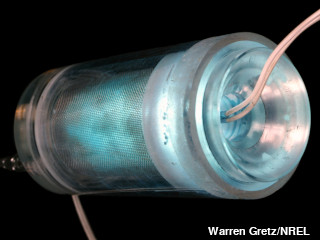
Photo: Designed by US DOE/NREL (National Renewable Energy Laboratory), this photocatalyser unit uses ultraviolet light to help purify the air inside cars, turning harmful volatile compounds (from such things as petroleum and exhaust fumes), bacteria, and viruses into less harmful substances instead. Domestic air purifiers that use photocatalysers in a similar way are made by companies
such as Daikin and Zander. Photo by Warren Gretz courtesy of US DOE/NREL (photo id#26315).
You've probably heard of catalysts already—in things like
catalytic converters (the exhaust-cleaning systems fitted to cars)
and zeolites (rock-like crystals used in all kinds of products and
industrial processes). Catalysts are hugely important in
industry; there are many types, they work in many
different ways, and they're used in the manufacture of almost every
chemical product you can think of.
Simply speaking, a catalyst is a substance that makes a chemical
reaction more likely to happen by reducing the energy needed to kick
start it ("activation energy," as it's known). A catalyst can speed up a chemical reaction
or make it happen at a lower temperature. Once the reaction has finished, the catalyst isn't used up, though it may
be physically changed in some way.
Artwork: A catalyst makes it easier for a chemical reaction to happen. Here's an example of how it can work. 1. Three chemicals (red, green, blue) come together with a catalyst (gray). 2) The catalyst provides a working surface that helps the chemicals join together. 3) At the end of the reaction, the catalyst is chemically the same as it was at the start.
What about photocatalysts? When you see "photo" attached to a
word (as in photocopier, photograph, photomultiplier,
photoelectric...), you can be pretty sure light is involved:
phōtos is the Greek word for "light." Photocatalysis means light is involved in
making a catalyst do its job. In other words, light provides the
energy that allows the catalyst to work.
How does a PCO photocatalytic air purifier work?
In a nutshell, ultraviolet light shines onto a catalyst, which converts water in the air into a form that turns
molecules of pollution into more harmless substances. Here's how...
Artwork: The basic concept of photocatalysis: UV light and a catalyst, supported on an aluminum or ceramic honeycomb framework ("substrate"), turn dirty air into cleaner air.
In photocatalytic air purifiers, the catalyst that cleans the air is typically titanium
dioxide (sometimes called titania) and it's energized by ultraviolet
(UV) light. UV is the short-wavelength light just beyond the
blue/violet part of the electromagnetic spectrum that our eyes can detect. The bad
thing about it is that it gives you sunburn. The good thing is that it has much more energy than ordinary, visible light—and exactly the right amount of energy to get titanium dioxide excited.
Titanium dioxide is a semiconductor (a bit like materials such as
silicon, used in integrated circuits).
You don't actually need much titanium dioxide: just a thin
film covering the surface of a backing material called a substrate,
which is usually made from a ceramic or a piece of metal (such as
aluminum).
Here's how the titanium dioxide catalyst in an air purifier breaks apart molecules of air pollution:
When UV light (the big yellow arrow shown here) shines on the titanium dioxide, electrons (the tiny, negatively charged particles inside atoms) are released at its surface. It's the electrons that do the useful work
for us.
The electrons interact with water
molecules (H2O) in the air, breaking them up into
hydroxyl radicals
(OH·), which are highly reactive, short-lived, uncharged forms of
hydroxide ions (OH−).
These small, agile hydroxyl radicals then attack bigger organic
(carbon-based) pollutant molecules, breaking apart their chemical
bonds and turning them into harmless substances such as carbon
dioxide and water. This is an example of oxidation—and that's why
air purifiers that work this way are sometimes also described as PCO (photocatalytic oxidation) air cleaners.
Here, then, is the big advantage that photocatalytic air purifiers have
over other air-cleaning technologies, such as filters: instead
of simply trapping pollutants (which still have to be disposed of somehow),
they completely transform the harmful chemicals and effectively destroy them.
Drawbacks
“Imagine if, in an effort to clean the air more efficiently, you were involuntarily introducing chemicals more dangerous than the ones you were trying to scrub.”
The disadvantage of this process is that photocatalytic purifiers can also produce tiny
amounts of ozone (O3), a chemical variant of the oxygen in the air
that is, in itself, a toxic air pollutant. [1]
Purifier makers claim the amounts of ozone produced are well within the guideline limit (0.05 parts per million) suggested by the US FDA but, even so, this is something to bear in mind. Although hydroxyl radicals occur naturally in the atmosphere, they can themselves pose dangers. If your indoor air contains volatile organic compounds (VOCs—the easily evaporating chemicals used in things like paints and hairsprays), instead of removing them completely, a photocatalytic air purifier may chemically convert them into other unpleasant pollutants, including formaldehyde and acetaldehyde. [2]
All told, there is some debate and uncertainty over whether the pollutants produced by photocatalytic air purifiers could pose a greater risk to human health than the ones they are designed to remove. [3]
Another thing worth noting is that all the interesting stuff happens on the surface of the titanium dioxide catalyst. That's why air purifiers need fans to suck polluted air in at one end and blow clean out out of the other. It's also why air purifiers take some time (typically up to 30 minutes) to clean a large room properly.
A third issue is that the catalysts used in photocatalytic purifiers have a limited lifetime, which significantly reduces
their cost-effectiveness. In time, better catalysts with longer lifetimes should solve this problem.
Sponsored links
Photocatalysis in practice
Photocatalysis only tackles certain, chemical forms of air pollution and doesn't solve the problem of
particulates (soot and dirt). That's why photocatalytic air purifiers combine UV-activated,
titanium-based catalysers with other cleaning and filtering technologies to form a
comprehensive system that can tackle a whole range of dirt and
pollutants.
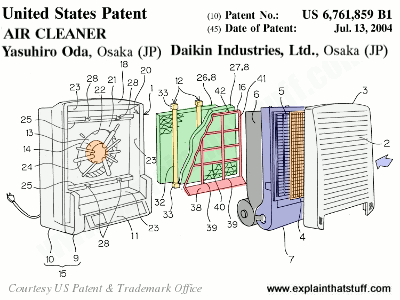
A typical purifier draws incoming air past a series of
different cleaning stages, each of which tackles a different kind of
airborne pollutant:
A relatively coarse prefilter captures large particles of household
dust, hair, and pet hair. This filter is made of polypropylene
netting coated with catechin (a bitter-tasting natural substance, found in green tea,
that works as an antibacterial agent and deodorant).
A fine HEPA filter removes airborne viruses, bacteria, spores,
and mold.
A plasma ionizer gives a positive electrical charge to any
remaining dust and pollen particles so they stick to a negatively
charged metal grid (or something like a roll of disposable filter paper) further along the machine. (This is much like the
system used in an electrostatic smoke precipitator that scrubs soot from smokestacks.)
A photocatalyst made from titanium apatite (similar to but more effective than titanium dioxide) chemically destroys
remaining organic pollutants such as exhaust fumes, volatile organic compounds, and so on.
Artwork: An exploded view of a typical Daikin air purifier, which reads from right to left. Air enters on the right (blue arrow) through the front grille (gray, 2). It passes through a coarse prefilter (orange, 4), an ionizer that charges dirty particles (blue 5), and a roll filter (gray, 6). Then it enters the photocatalytic cleaning section in the middle, where there are two honeycomb-shaped photocatalytic surfaces (green) energized by UV lamps (yellow, 12). The back of the machine contains the fan and motor (orange, 13 and 14). Artwork from US Patent: 6,761,859: Air cleaner by Yasuhiro Oda, Daikin Industries, Ltd, courtesy of US Patent and Trademark Office (with colors added for clarity).
Indoor Air Quality (IAQ): A comprehensive, trustworthy, independent introduction to improving air quality from the US EPA Office of Air and Radiation.
Guide to Air Cleaners in the Home: A short, handy factsheet from the US EPA. This one includes some discussion of photocatalytic air cleaners. [Archived via the Wayback Machine.]
Daikin Industries: Air Purifier MC707: Mechanism: Daikin's simple explanation of its photocatalytic MC707 air purifier includes a clear diagram showing the different stages of air cleaning and filtration. [Via the Wayback Machine; the original link has been deleted.]
Books
Photocatalysis: Fundamental Processes and Applications by Mehrorang Ghaed (ed). Academic Press, 2021. This opens with a review of basic electronic processes and photodegradation, before considering applications such as wastewater treatment, environmental remediation, and uses of zeolites. Air pollution is covered mostly in Chapter 7.
Photocatalysis: Fundamentals and Perspectives by
Jenny Schneider (ed.), Royal Society of Chemistry, 2016. A comprehensive, up-to-date overview. A companion volume deals with applications.
Photocatalysis: Science and Technology by Masao Kaneko and Ichiro Okura. Springer, 2002. Reviews the basic science of photocatalysis before considering environmental applications in cleaning and energy conversion.
Photocatalysis: Fundamentals and Applications by Nick Serpone, Ezio Pelizzetti (eds). Wiley, 1989/2011. A more detailed treatment of the surface science of catalysis in 18 chapters by leading researchers.
How to Select an Air Cleaner by Jay Romano. The New York Times, February 11, 2007. This article suggests that performance, room coverage, and noise are the three most important criteria on which to compare cleaners.
US Patent: 6,761,859: Air cleaner by Yasuhiro Oda, Daikin Industries, Ltd. Issued July 13, 2004. A very clear description of what you'll find inside a typical household air purifier that combines photocatalysis with traditional air filters.
US Patent: 6,884,399: Modular photocatalytic air purifier by Bradley Reisfeld et al, Carrier Corporation. Issued April 26, 2005. Describes a titanium-dioxide photocatalytic air cleaner broadly similar to the one I've sketched out above.
US Patent: 7,300,634: Photocatalytic process by Zvi Yaniv et al, Nano-Proprietary, Inc. Issued April 27, 2007. This patent goes into a bit more detail about the mechanism of photocatalysis involving titanium dioxide and ultraviolet light.
References
↑ "Catalytic
oxidation.... Can generate harmful byproduct such as formaldehyde, and acetaldehyde, and ozone."
Quoted in Table 1, page 18 of US EPA: Residential Air Cleaners: A Technical Summary,
3rd Edition, EPA 402-F-09-002, July 2018 [Archived via the Wayback Machine].
Please do NOT copy our articles onto blogs and other websites
Articles from this website are registered at the US Copyright Office. Copying or otherwise using registered works without permission, removing this or other copyright notices, and/or infringing related rights could make you liable to severe civil or criminal penalties.
Woodford, Chris. (2010/2022) Photocatalytic air purifiers. Retrieved from https://www.explainthatstuff.com/how-photocatalytic-air-purifiers-work.html. [Accessed (Insert date here)]