Until engines were invented, the only way to power a
small boat was with oars or sails. Calm and elegant it might have
been, but it took ages to get anywhere quickly—and you had to rely
on there being wind or muscle power available. Outboard motors have
changed all that. Invented in the early years of the 20th century,
outboards brought the same freedom to small boats that gasoline engines
brought to cars. Let's take a closer look at these handy machines and
find out how they work!
Photo: Outboard motors are perfect for powering a RIB (rigid-hull inflatable boat) like this.
Unlike a car engine, which is often at the front, outboards are always at the back (just below the flag on this picture). That's because they need to create
a backward-pushing draft of water to push a boat forward (an example of Newton's third law of motion).
Photo by Maci Sternod courtesy of US Navy and DVIDS.
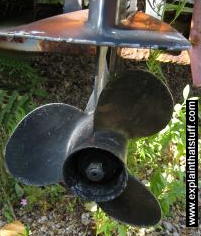
Photo: A typical outboard motor on the back of a scuba diver's RIB (rigid inflatable boat). The propeller at the bottom of the motor "screws" through the water to push you along (that's
why propellers are sometimes called screws).
If you've read our article on car engines, you'll know that they
produce motion by burning gasoline with oxygen in metal cylinders.
The cylinders have sliding pistons that push a crank around and the
crank drives a shaft that (eventually) powers the wheels. Much the
same happens in an outboard motor. The main difference is that there are usually fewer cylinders, operating in either a two-stage or
four-stage cycle. Instead of driving a gearbox, the motor powers a
propeller. To steer a boat with an outboard motor, you simply tilt
the whole motor casing so the propeller pushes the water away from it at an angle.
(Some outboards you can tilt by hand; others are steered by turning
a steering wheel that tilts the motor using hydraulic cables.)
You can go faster by opening up the throttle so the outboard burns
more fuel and turns over more quickly.
How does an outboard motor work?
In theory
Open up an outboard and this—hugely simplified—is what you'll find inside:
Fuel burns in the cylinder (or cylinders) to make power. There's a fuel tank (not shown) inside the case of
the motor at the top, big enough to hold perhaps 23 liters (6 gallons) of gas. The heavier your boat, the faster you drive it, the choppier the water, the more heavily loaded, or the lower in the water it sits, the more fuel you'll burn.
Powered by the burning and expanding fuel gases, a piston moves back and forth in the cylinder. This is just like the
piston in a car-engine cylinder and often works through the same four-step process (four-stroke cycle), although
some outboards do use a simpler two-stroke cycle.
The piston rod turns the crankshaft, converting the back-and-forth (reciprocating) motion of
the piston into round-and-round (rotary) motion.
The crankshaft turns the main driveshaft running down the long spine of the motor.
A small gearbox at the bottom of the driveshaft converts vertical spinning motion into horizontal spinning motion.
The propeller powered by horizontally spinning gears powers the boat through the water.
In practice
The very simplified illustration up above is designed to show you the basic operating principle of an outboard motor;
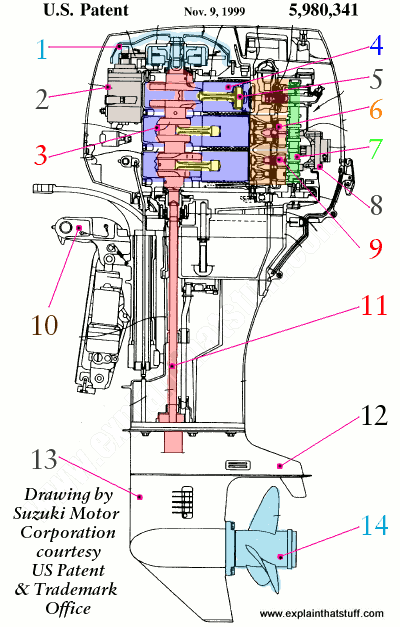
real motors are somewhat more complex than this! Here's a very clear cutaway illustration prepared by Suzuki Motor Corporation for
a patent application they were granted in 1999 for a new design (US Patent #5,980,341: Outboard Motor, courtesy of US Patent and Trademark Office). I've colored it and greatly simplified the numbering so you can make sense of it more easily; if you want to know all the details, check out the patent, where you'll find more drawings of the same engine. Here a few of the parts that are worth noting:
Flywheel (blue): A heavy wheel that builds up momentum as the engine accelerates, helping to maintain a smooth and steady engine speed.
Starter motor (grey): Normally you'd start an outboard motor electrically, just as you'd start a car. If that's not possible, you can attach a pull cord to the flywheel and tug it vigorously to "crank" the motor into life. There's a special notch in the flywheel where you attach the cord. (Find out more about flywheels.)
Crankshaft (red): Collects power from the engine pistons, which fire slightly out of step to keep the motor running at a steady speed
Cylinders (blue): This motor has three cylinders arranged horizontally. A medium-sized, three-cylinder outboard like this produces something like 40–50 horsepower. It's a fairly hefty machine, weighing in at 86kg (190lb)—almost the exact average weight of an American adult male!
Pistons (yellow): Move back and forth in the cylinders, driven by the energy released from burning fuel, and transferring that energy to the crankshaft.
Carburetors (orange): Three separate carburetors combine fuel with air to make an explosive mixture—there's one for each cylinder.
Camshaft (green): Opens and closes cylinder valves that let fuel in and exhaust gas out.
Fuel pump: Sends fuel to the carburetors.
Sparking plugs (red): ignite the fuel in the cylinders.
Mounting bracket: Where the motor attaches to the back of the boat and swivels up and down.
Driveshaft: Carries power from the crankshaft down to the gears. Think of it as a kind of "spinning spine," running straight down through the center of the motor linking the cylinders at the top to the gears and propeller at the bottom.
Anti-ventilation/cavitation plate: Cavitation is what happens when a spinning propeller churns up air or engine exhaust gas in the water. Bubbles form and burst, which, over time, wear away the propeller's surface. The anti-cavitation plate is designed to reduce that problem, but cavitation can still be caused by floating debris disrupting the smooth flow of water around the propeller blades.
Gear unit: The gears (not shown) and clutch (sometimes centrifugal in design, like the one in a chainsaw) are inside here.
Propeller.
Looking from above...
Here's the same motor pictured from above and using the same colors to show the same parts. Now visible are the cams (green) opening and closing the cylinder valves (dark blue), the electrical equipment box (purple), and the fuel injection system (orange). In the middle, you can see a cylinder (light blue), piston/crank (yellow), and crankshaft (red). Artwork prepared by Suzuki Motor Corporation courtesy of US Patent and Trademark Office.
Illustration: Gustave Trouvé's experimental electric outboard motor. Notice the batteries on the right, the motor on the left, and the long strings of wire between them. Artwork courtesy of Wikimedia Commons
It wasn't the most practical invention at a time when batteries were huge and heavy. You can see how low the boat is sitting in the water, which might be a bit of artistic flair—or a reflection of how perilious this pioneering voyage really was! And what about "mixing" electricity and water with all those wires strung around you? Gasoline-powered outboards followed about 20 years later, developed by Ole Evinrude of Milwaukee.
He patented what he called a "marine propulsion mechanism," with a very obvious resemblance to the modern outboard, in 1911,
and developed numerous other innovations, including a method of water cooling outboards in 1928.
Artwork: Ole Evinrude's original motor looks much like a modern one. From top to bottom, the key parts are the flywheel (blue), fuel tank (orange), cylinder (red) and piston (green), drive shaft (yellow), and propeller (purple). Artwork from US Patent 1001260A: Marine propulsion mechanism by Ole Evinrude courtesy of US Patent and Trademark Office.
Other pioneers included Swedish brothers Carl and Oscar Hult, who studied and improved on Evinrude's designs
(and gained Swiss patent CH63928A: Propulsion device for small boats in 1912).
Artwork: "Summer vacations that never end" was the promise with which Ole Evinrude advertised his outboards in LIFE magazine in 1914. According to the copy, an Evinrude outboard was the perfect way to convert your basic rowboat into an eight-mile-an-hour motorboat that anyone could use: it didn't need a rudder, so you could steer "without the exertion of strength." Artwork courtesy of US Library of Congress
About the author
Chris Woodford is the author and editor of dozens of science and technology books for adults and children, including DK's worldwide bestselling Cool Stuff series and Atoms Under the Floorboards, which won the American Institute of Physics Science Writing award in 2016. You can hire him to write books, articles, scripts, corporate copy, and more via his website chriswoodford.com.
How a kicker (outboard motor) works by George Waltz, Popular Mechanics, June 1951. Another nice set of cutaway drawings and photos showing the internal parts of a typical outboard.
Please do NOT copy our articles onto blogs and other websites
Articles from this website are registered at the US Copyright Office. Copying or otherwise using registered works without permission, removing this or other copyright notices, and/or infringing related rights could make you liable to severe civil or criminal penalties.