In 1800, something like 90 percent of the entire US population was
employed working the land; fast-forward 200 years and you'll find
only 2 percent of people are now working this way. What caused that
amazing change in society? One important factor was the development
of huge, automated machines such as combine harvesters that made each
agricultural worker vastly more productive. Let's take a closer look
at how they work!
Photo: A typical combine harvester, or "combine," made by Case IH; other makes include John Deere, Gleaner, New Holland and Claas. Photo courtesy of Carol M. Highsmith's America Project in the Carol M. Highsmith Archive, Library of Congress Prints and Photographs Division.
The crops we grow in our fields, such as wheat, barley, and rye,
are only partly edible. We can use the seeds at the top of each plant (known
as the grain) to make products like bread and cereal, but the
dry coatings of the seeds (the chaff) are inedible and have to be discarded,
along with their stalks.
Before modern-day machines were developed, agricultural workers had to
harvest crops by carrying out a series of laborious operations one
after another. First they had to cut down the plants with a long-handled cutting
tool such as a scythe. Next, they had to separate the edible grain
from the inedible chaff by beating the cut stalks—an operation known as threshing. Finally,
they had to clean any remaining debris away from the seeds to make them
suitable for use in a mill. All this took a lot of time and a lot
of people.
Thankfully, modern combine harvesters do the whole
job automatically: you simply drive them through a field of
crops and they cut, thresh, and clean the grains all by themselves using
rotating blades, wheels, sieves, and elevators. The grain collects in a tank
inside the combine harvester (which is periodically emptied into carts
pulled by tractors that drive alongside), while the chaff
and the stalks spurt from a big exit pipe at the back and fall back down onto the field.
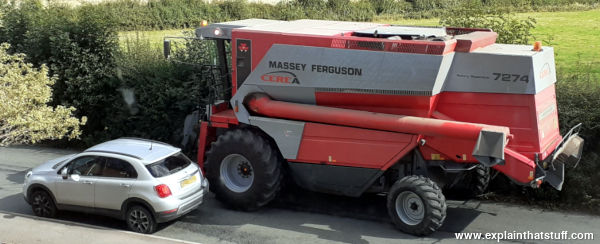
Photo: Combine harvesters are gigantic machines not really built for small roads.
This Massey Ferguson Cerea 7274 weighs 13,800kg (13.8 tonnes or roughly 13.5 tons), stands 4m (13ft) high, and is 10.2m (33.4ft) long. It's main tank can hold 9500 liters (2156 dry gallons) of grain.
Sponsored links
Inside a combine harvester
There's an awful lot going on inside a combine harvester—gears,
blades, augers (screws that move cut crops), conveyors, belts,
levers, and wheels—so
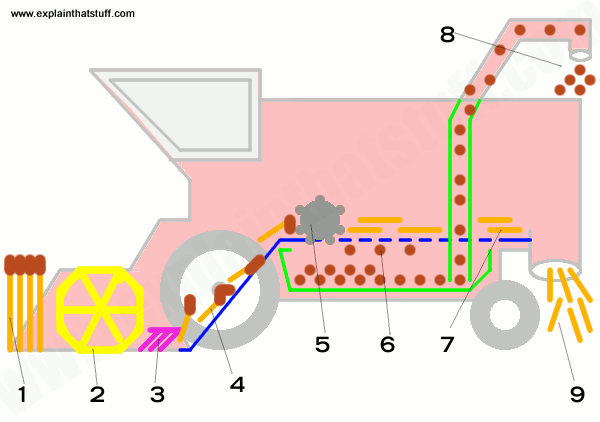
I've vastly simplified everything to make it easier to follow. Roughly speaking, here's how a combine harvester works:
Cereal crops are gathered in by the header at the front, which has a pair of sharp pincers called crop dividers at either end. Generally speaking, the wider the header, the faster and more efficiently a harvester can cut a field. Different headers are used for cutting different crops; the header is often hydraulically powered and can be raised, lowered, and angled in different ways from the cab. The header can be removed and towed behind the harvester lengthwise so it can fit down narrow lanes.
Photo: Left: The enormously wide header at the front of a combine makes it impossible to drive down a narrow country lane, so how do you move it from field to field? Right: Fortunately, the header can be removed and towed on a special trailer, sideways behind a tractor. It's a simple job that takes just a few minutes.
A slowly rotating wheel called the reel (or pickup reel) pushes the crops down toward the cutter. The reel has horizontal bars called bats and vertical teeth or tines to grip the plant stalks.
The cutter bar runs the entire length of the header underneath the reel. Its teeth (sometimes called mowing fingers) open and close repeatedly to cut off the crops at their base, a bit like a giant
electric hedge cutter sweeping along at ground level.
Photo: Left: The wide, sweeping header on a John Deere combine harvester.
Right: A closeup view. Photo by Carol M. Highsmith courtesy of Gates Frontiers Fund Colorado Collection within the Carol M. Highsmith Archive, Library of Congress, Prints and Photographs Division.
Behind the cutter bar, the cut crops are fed toward the center by spinning augers (screws) and travel up a conveyor to the processing mechanism inside the main part of the combine.
A threshing drum beats the cut crops to break and shake the grains away from their stalks.
The grains fall through sieves into a collecting tank below.
The unwanted material (chaff and stalks) passes along conveyors called straw walkers toward the back of the machine. More grain falls through into the tank.
When the grain tank is full, a tractor with a trailer on the back pulls alongside the combine. The grain is carried up from the tank by an elevator and shoots out of a side pipe (sometimes called the unloader) into the trailer.
The unwanted stalks and chaff tumble from the back of the machine. Some combines have a rotating spreader mechanism that throws the straw over a wide area. Sometimes the straw is baled up by a baling machine and used for animal bedding.
Photo: Unloading the grain tank of a combine harvester into a trailer pulled by a tractor driven alongside. The combine's header (cutting blade) has been raised right up so the driver can circle
around the parked trailer and fill it up evenly. Look closely at the header and you'll see both the reel (black)
and the cutter bar (green) underneath it.
You'll be relieved to hear that I'm not going to go through all of them (you can look at the patent itself if you really want that much detail), but I have colored a few of the parts we've already looked at so you can see where they fit into a real machine. From left to right, look out for:
40: Reel (not shown, but I've indicated its position with a purple circle). It's held in place by reel arms, 48.
50: Cutter bar (blue, bottom).
80: Threshing drum (red).
30/90: Conveyors and auger screws (yellow) that move stuff through the machine.
42: Hydraulic rams (gray, bottom) that lift the header up and down.
28: Sieves (purple) that clean the grain.
100: Straw walkers (blue)
18: Grain tank (orange). This sits like a saddle over the central, straw-walker mechanism, with a shallow middle part and two deeper sections that extend either side.
36: Unloading pipe (dark green), based on an auger mechanism.
19: Engine (red) sits behind the driver. The power shaft (blue, 102) drives all the machinery inside.
14: Front drive wheels (light gray) are fixed (do not steer). The rear wheels (15) swivel for steering the combine.
Have combine harvesters always looked like this?
Not exactly! Here's a horse-drawn harvester from 1902. You can just make out the reel on the right, but the really fascinating thing is the huge number of horses—typically about 30—that this machine needed to pull it along!
Photo: A 30-odd horse-powered combined harvester, cutting, threshing and sacking machine, pictured in Walla Walla, Washington, c.1902. Photo by Underwood & Underwood courtesy of
US Library of
Congress.
Here's a slightly more modern-looking Caterpillar wheat harvester from 1900, apparently being pulled by a steam engine:
Artwork: A steam-powered Caterpillar wheat harvester. Photo courtesy of
US Library of
Congress.
Here's a drawing of a Gleaner harvester from the 1930s, which looks similar to the machines photographed above. I've colored and simplified into four basic parts:
At the front of the machine, on the right, we have the reel (red) that draws the crops in.
Next we have the cutter unit (orange), including the scythe (blue) that chops the crops.
Once the crops are cut, they're smashed apart in the thresher (yellow).
All that remains is to split the wheat from the unwanted stalks and chaff in the separator unit (green).
Artwork: A Gleaner harvester designed by Perren J. Hanson and patented on June 21, 1932. You can read more detail about how it works in US Patent #1,863,691: Combine harvester (via Google Patents). Artwork courtesy of US Patent and Trademark Office.
Different types of combine harvesters
Although combine harvesters all look the same to most people, there are a few different
variations: different kinds of crops need different cutting and handling. Most combines have interchangeable headers so they can harvest all kinds of crops. This John Deere is fitted with a corn header, a special type of header with large, sturdy prongs for harvesting corn cobs:
Photo: Harvesting corn. Left: Looking from the front; Right: looking down from the cab toward the incoming corn crops. Photos by Warren Gretz courtesy of US Department of Energy/National Renewable Energy Laboratory (DOE/NREL).
Cotton also needs rather different handling. Here's a John Deere cotton harvester, which is like a cross
between a combine harvester (at the front) and a hay bailer (at the back). Instead of spewing out grain
and chaff, this machine squeezes and bundles the cotton into giant round bales (called "modules") and wraps them in protective plastic. When a bale is ready, the machine's hydraulic back lifts up to dump it onto the field behind.
Photo: Harvesting cotton. Left: Looking from the front; Right: A rear view shows the hydraulic opening back that ejects the cotton bales. Photos by Carol M. Highsmith in the Carol M. Highsmith Archive, Library of Congress, Prints and Photographs Division. The original photos
are here
and here.
Huge headers need huge wheels to hold them high—but not always. Some combines are fitted with half-tracks at the front (like miniature tanks). Although these are mechanically more complex, and more
expensive, they have quite a few advantages. They do away with the need for huge front wheels, so a combine
with tracks can be driven down much more narrow roads. They also make driving with a wide header much more stable, and have better grip on hills and difficult terrain. The tracks are surprisingly speedy. The Claas 770
Lexion harvester shown below has a top speed of 40 km/h (25 mph), making it the world's fastest machine.
Photo: A Claas 770 Lexion with half-tracks at the front. Photo courtesy of Carol M. Highsmith's America Project in the Carol M. Highsmith Archive,
Library of Congress,
Prints and Photographs Division.
Sponsored links
Find out more
Photo: A typical John Deere combine. You can see how wide the header (front cutting mechanism) is compared to the main body of the machine. The biggest combines have headers about 12m (40 ft) wide!
The Combine Harvester by Jonathan Whitlam, Amberley Publishing, 2018. A comprehensive, 96-page history, from early tractor-pulled harvesters to the latest giant machines.
Combine Harvesters: Theory, Modeling, and Design
by Petre Miu. CRC, 2016. If you think combine harvesters are simple, take a look at this fascinating introduction to the surprisingly complex science, technology, and mathematics lurking inside.
Massey Tractors by C.H.Wendel and Andrew Morland. Motorbooks, 1992. Covers the history of Massey-Harris and Massey-Ferguson tractors, combines, and agricultural implements.
Combines & Harvesters by Hans Halberstadt. Motorbooks, 1994. Another photographic guide to combines old and new.
A Claas combine harvester in action: A short (2 minute video) of a Claas harvester with some interesting details if you watch closely. Notice how the driver lifts the header to turn the machine at the end of the row. See how the chaff is sprayed out evenly from side to side behind the machine?
Case IH 9120 And Magnum 310 With Hawe Grain Cart: This slightly longer (6 minute video) shows a Case harvester in action. Notice the huge header again. At about 2:50, a tractor drives alongside and the harvester unloads, while continuing to harvest more crops.
How to operate a combine: A driver's eye view of combining, including a very surprising number of controls and instruments!
Patents
If you're looking for a really detailed description of how a combine works, patents are a good place to begin. Here are a couple you might find useful:
US Patent #1,863,691: Combine harvester by Perren J. Hanson, Gleaner Combine Harvester Corporation, patented June 21, 1932. A Gleaner combine typical of those used in the period between the two world wars.
Please do NOT copy our articles onto blogs and other websites
Articles from this website are registered at the US Copyright Office. Copying or otherwise using registered works without permission, removing this or other copyright notices, and/or infringing related rights could make you liable to severe civil or criminal penalties.